Author Archives: susanjcrockford

Gulf of Boothia, unheralded Arctic utopia, has the highest density of polar bears worldwide

The issue of polar bear population density (# of bears per 1000 km2) came up a few posts ago, during my discussion of the new Davis Strait population study by Lily Peacock and colleagues (here). Since the various polar bear subpopulations across the Arctic are so different in size, calculating the density of bears in the various regions generates an interesting metric of how well the regional populations are doing relative to each other.

Almost 20 years ago, Taylor and Lee (1995) did just that: they determined the density of polar bears in the various Canadian subpopulations, as of the 1990s. Surprisingly, the ‘leader’ among those, by a wide margin, was one of the smallest in geographic area: the Gulf of Boothia. Located in the central Canadian Arctic (see Figs. 1 and 2 below), in the 1990s, tiny Gulf of Boothia supported a density of 10.4 polar bears per 1000 km2, the highest density of all regions examined.
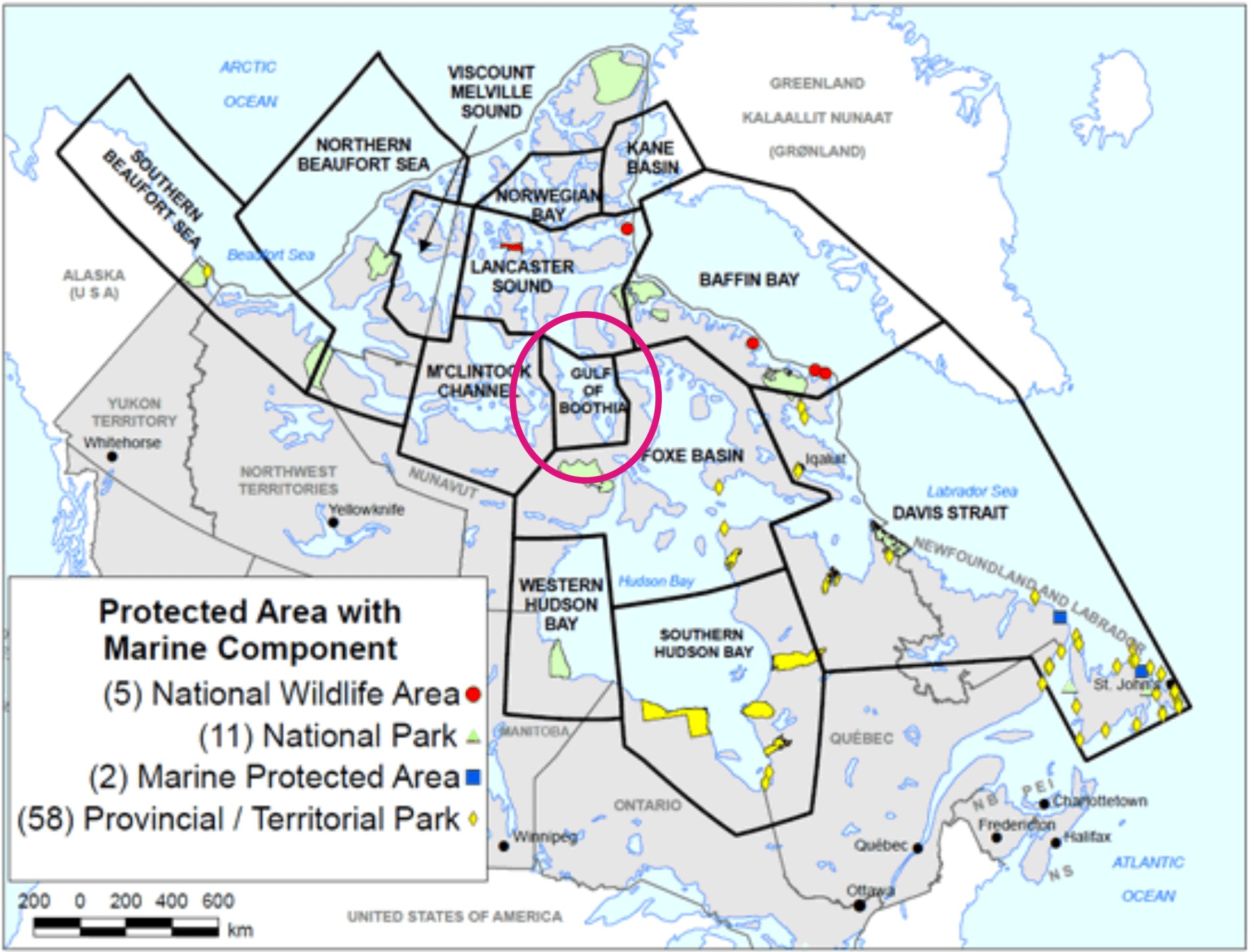
 Figure 1. The Gulf of Boothia (circled) is right in the middle of the Canadian Arctic. In terms of geographic area, it is one of the smallest of all 19 subpopulations worldwide: at only 170,000 km2, only the Norwegian Bay and Kane Basin subpopulation regions, also in Canada (just to the north of Gulf of Boothia), are smaller at 150,000 and 155,000 km2 respectively (Vongraven and Peacock 2011). The Gulf of Boothia supports the highest density of polar bears known.Modified from map of polar bear protected areas provided by Environment Canada.


Figure 1. The Gulf of Boothia (circled) is right in the middle of the Canadian Arctic. In terms of geographic area, it is one of the smallest of all 19 subpopulations worldwide: at only 170,000 km2, only the Norwegian Bay and Kane Basin subpopulation regions, also in Canada (just to the north of Gulf of Boothia), are smaller at 150,000 and 155,000 km2 respectively (Vongraven and Peacock 2011). The Gulf of Boothia supports the highest density of polar bears known. Modified from the map of polar bear protected areas provided by Environment Canada.

But this density value for Gulf of Boothia was based on the 1986 population estimate of 900 bears – what is the most current figure?

For that, we need an updated population assessment. That was done in 2000 and it generated an estimate of 1,592 ± 361 bears (Taylor et al. 2009).

Taylor et al. (2009:791) said this about their assessment:

Our results suggest population size had increased steadily under a harvest regimen of approximately 40 bears/yrand added, “Barber and Iacozza (2004) found no trends in Gulf of Boothia sea ice conditions or ringed seal habitat suitability indices in the interval 1980-2000.

In other words, despite there being no trend in either sea ice conditions or habitat for seals – and a yearly harvest of 40 bears – polar bear numbers in the Gulf of Boothia increased significantly (by almost 700 bears) during the twenty years between 1980 and 2000. Even if the 1986 estimate of approximately 900 bears was somewhat less accurate than the more recent one, the fact that tiny Gulf of Boothia can support 1,592 bears is surely a remarkable feat.

Using this new population estimate and the same area of ‘available habitat’ used by Taylor and Lee in 1995, I calculated the most recent density at a spectacular 18.3 bears per 1000 km2! [note this is exactly what Peacock et al (2013) did to get their density value of 5.1 bears/1000 km2, discussed here.] But I didn’t update just Gulf of Boothia, I did them all.

The updated density values for Gulf of Boothia and several other Canadian subpopulations are listed in Table 1 below. Note that aside from Davis Strait, as far as I know these density figures have not been published elsewhere: you’re seeing them here for the first time.
Continue reading

NSIDC says the sea ice minimum in 1964 was not different from 1979, 1981, or 2001

I just came across the National Snow and Ice Data Center (NSIDC) “monthly highlights” article for April 2013 (Glimpses of sea ice past), which turned out to be a rather more interesting story than it appeared at first glance.

The article chronicles the details of how NSIDC technicians pieced together photos taken by the Nimbus 1 satellite between August 28 and September 23, 1964 – of both the Arctic and the Antarctic – to create an estimate of sea ice extent at September 1964 for both regions. For the Arctic, this was the yearly minimum; for the Antarctic, the yearly maximum.

NSIDC scientist Walt Meier was part of this effort and he and colleagues Gallaher and Campbell recently published their findings in the journal The Cryosphere (Meier et al. 2013). For the Arctic estimate, they had to add in data from Alaskan and Russian sea ice charts because the 1964 satellite data was not complete. This means the ice extent figure they came up with is not a true ‘satellite only’ figure but a composite one.

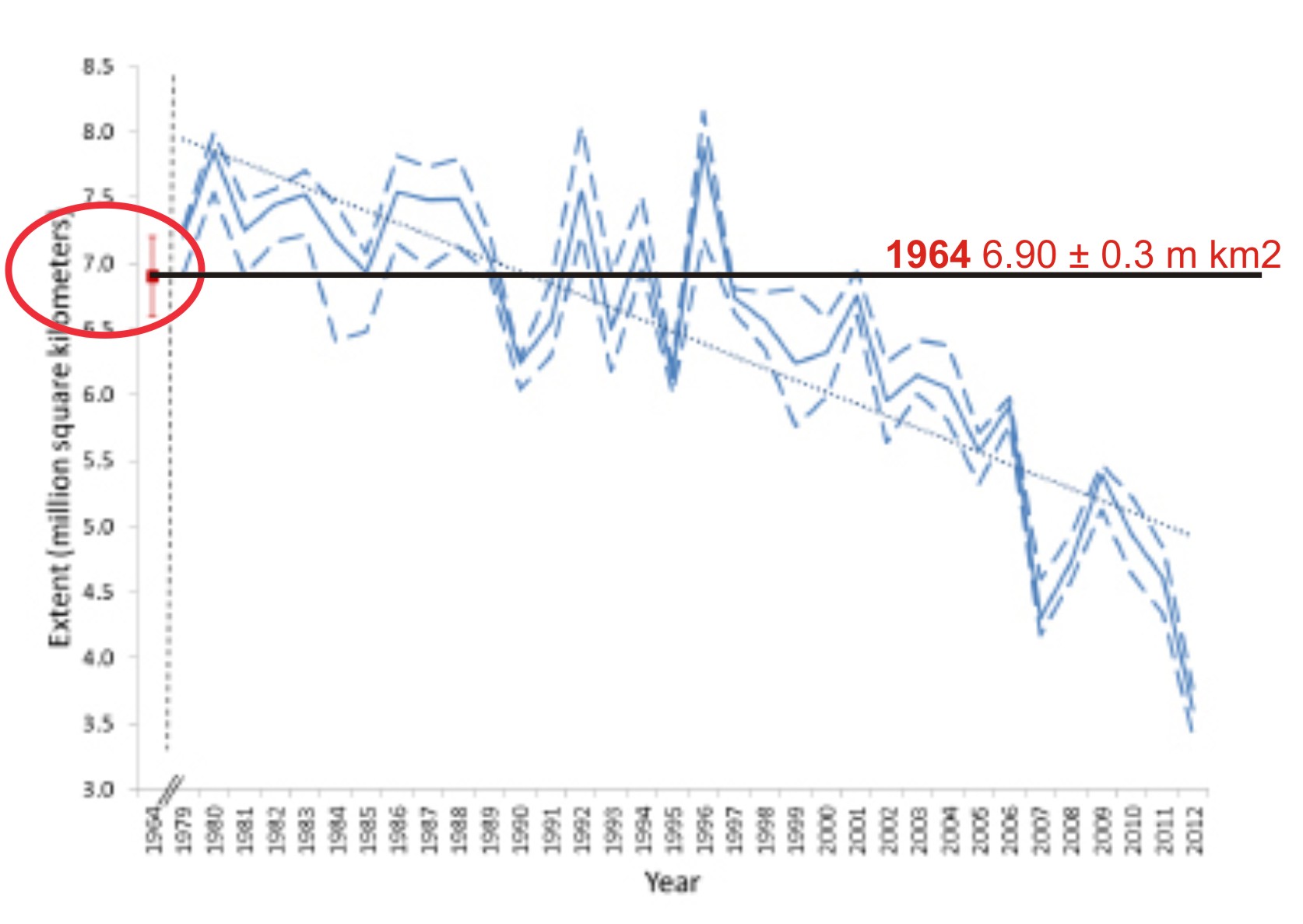
One of the things they did in their analysis was to place the 1964 value on a graph of the more recent 1979-2012 data, which really helps put it into perspective (see Fig. 1 below).

Figure 1. This is Fig. 7 from the Meier et al. 2013 paper, to which I’ve added labels. Meier et al. call this a “time series of Arctic September sea ice extent.” The estimate for 1964 is the red dot on the far left (with its error bars), which I’ve circled (I also added the red label for 1964 and the black line). Note the Y-axis on the left goes to 3.0 million km2, not zero. The solid blue line is the monthly average for September from passive microwave data (1979-2012), and the blue dashed lines are a “three-day average of the high and low range of daily extents during the month.” The 1964 estimate of 6.90 ± 0.3 million km2 is just about identical to 1979, 1981, and 2001 and well within the average for 1979-2000. However, it’s significantly lower than the previous estimate of 8.28 million km2 for 1964 made by the UK Hadley Centre in 2003 (Meier et al. 2013:704).

Figure 1. This is Fig. 7 from the Meier et al. 2013 paper, to which I’ve added labels. Meier et al. call this a “time series of Arctic September sea ice extent.” The estimate for 1964 is the red dot on the far left (with its error bars), which I’ve circled (I also added the red label for 1964 and the black line). Note the Y-axis on the left goes to 3.0 million km2, not zero. The solid blue line is the monthly average for September from passive microwave data (1979-2012), and the blue dashed lines are a “three-day average of the high and low range of daily extents during the month.” The 1964 estimate of 6.90 ± 0.3 million km2 is just about identical to 1979, 1981, and 2001 and well within the average for 1979-2000. However, Meier and colleagues note it is significantly lower than the previous estimate of 8.28 million km2 for 1964, made by the UK Hadley Centre in 2003.

Continue reading

Davis Strait polar bears again: body condition declined while population increased

This is a short follow-up to my last post on Davis Strait polar bears.

Today I’ll highlight a paper published last year (Rode et al. 2012) that had three of the same co-authors as the Peacock et al. (2012) paper I discussed on Monday – Lily Peacock, Mitch Taylor, and Ian Stirling contributed to both papers. Rode et al. (2012) deals with the issue of body condition (relative degree of fatness) in polar bears vs. changing levels of sea ice over time, and if you’ll pardon the pun, adds even more weight to the conclusion that declines in summer sea ice do not necessarily spell the disaster for polar bears we have been told is inevitable.

A polar bear near Thule, NW Greenland. Note the decidedly chubby back end on this bear, who looks well prepared for winter. Photo by Robin Davies. [details at my Quote Archive, Featured Quote #6]

A polar bear in the summer of 2012 near Thule, NW Greenland (part of the Baffin Bay subpopulation). Note the decidedly chubby back end on this bear, who looks well prepared for winter. Photo by Robin Davies.
[details at my Quote Archive, Featured Quote #6]

Continue reading

Signs that Davis Strait polar bears are at carrying capacity

Exciting news about polar bears in eastern Canada: the peer-reviewed paper on the Davis Strait subpopulation study has finally been published (Peacock et al. 2013). It concludes that despite sea ice having declined since the 1970s, polar bear numbers in Davis Strait have not only increased to a greater density (bears per 1,000 km2) than other seasonal-ice subpopulations (like Western Hudson Bay), but it may now have reached its ‘carrying capacity.’

This is great news. But where is the shouting from the roof-tops? This peer-reviewed paper (with its juicy details of method and analysis results), considered by some to be the only legitimate format for communicating science, was published February 19, 2013. No press release was issued that I could find and consequently, there was no news coverage. Funny, that.

There was a bit of shouting back in 2007 when the study ended and the preliminary population count was released – polar bear biologist Mitch Taylor is quoted in the Telegraph (March 9 2007) as saying:

“There aren’t just a few more bears. There are a hell of a lot more bears.”

There was also a CBC news item in January 2007 and a Nunatsiaq|Online report in October 2009 when the official government report was completed. But these were all based on preliminary information and focused on the population increase only.

This new paper (Peacock et al. 2013) reveals that the story in Davis Strait is about more than simple population growth. Small wonder no one is drawing attention to it. Continue reading

Polar Bear Specialist Group adds WWF and PBI activists as full voting members

In a previous post I noted:

In 2009, for the first time, the polar bear biologists that make up the IUCN’s Polar Bear Specialist Group (PBSG) invited four professional advocates – not one or two, but four – to their exclusive, once-every-four-years meeting of top polar bear biologists (called “delegates”) from the world’s Arctic nations (Canada, Russia, USA, Greenland/Denmark and Norway) – two from World Wildlife Fund (WWF) and two from Polar Bears International (PBI).

In that post, I mentioned that there was an “exclusive members-only meeting” scheduled for October 24-27, 2013.

Well, I just came across a notice on the PBSG website that tells us what went on at that meeting.

The Polar Specialist Group (PBSG) voted unanimously to embrace World Wildlife Fund activist Geoff York and Polar Bears International activist Steve Amstrup as delegates with full voting rights until 2016. This is a first: never before have employees of activist organizations been made full member-delegates of this formerly exclusive organization.

With this move, the PBSG are telling the world that they are an advocate association first and a scientific organization second.

Continue reading

Buffet time for polar bears – spring/early summer is for eating baby seals

Spring is the busiest and most important season for polar bears: it is the most important feeding period and it is also when mating occurs. The fat that polar bears put on during the spring and early summer is critical for their survival over the rest of the year and for females, determines whether they can successfully produce cubs the following year.

Mothers and new cubs emerge from their winter dens in late March to early April and those who have chosen to den on land soon head towards the sea ice. For a fabulous photo of a polar bear female and her two young cubs, just out of their winter den, feeding on a bearded seal pup, pop over here. All other bears, including females with older cubs, will already be on the ice, feeding on the first newborn ice seals of the season and any other seals they can catch.

It’s buffet time for polar bears but the most dangerous time for cute baby seals. Continue reading

Not much has changed in polar bear country since the sea ice maximum

I’ve been busy with work-related activities lately and will be for several more weeks. Until then…

Sea ice changes since March 15 [Update added May 10, see below]

Lots of ice everywhere – even in Hudson Bay. A bit less ice in the Barents Sea (north of Norway) than there was two months ago at the sea ice maximum March 15 (see Fig. 1 below compared to the extent at May 5 in Fig. 2: both from NSIDC). But there is still quite a bit around Svalbard – that group of islands between NE Greenland and NW Norway (see Fig. 3 below a MASIE image, where this situation is more apparent).

Polar bears are eating and mating at this time of year (early May being the tail-end of the season in most areas) – and right now, they have a huge, circumpolar ice platform for those activities.

Continue reading

Cannibalism update and insight on the timing of media hype

In my last post, I went over some of the spin and misrepresentation of fact contained in the claim by leading polar bear biologists Steven Amstrup, Ian Stirling and Andrew Derocher (Amstrup et al. 2006; Stirling and Derocher 2012) that cannibalism is on the increase because of the effects of global warming on Arctic sea ice.

I’ve had an opportunity to follow up on three points that puzzled me. Three relate to the Amstrup et al. paper that described three cases of cannibalism in the southeastern Beaufort Sea in 2004 and one to the incidents in western Hudson Bay in 2009. In the process, I found at least three more misrepresentations of fact and gained some insight on why these incidents of cannibalism were hyped so enthusiastically when they were. Continue reading

Cannibalism in polar bears: spin and misrepresentation of fact galore

In my next to last post, I discussed some of the anecdotal reports of den collapses included in the peer-reviewed summary of facts presented by biologists Ian Stirling and Andrew Derocher (2012) that supposedly support the premise that global warming is already having an impact on polar bear populations (discussed previously here, here, and here), prophesied to be even greater in the future. While they admit that such reports are not based on scientific studies, they nevertheless include them in their published list of global warming impacts, and not surprisingly, that is how others have interpreted them.

The same is true for their treatment of the phenomenon of cannibalism in polar bears. In that same paper, Stirling and Derocher (2012:2701) have a section called “Anecdotal observations consistent with predictions of the effects of climate warming.” This section begins with a discussion of cannibalism:

“There have been several well-publicized observations that are consistent with predictions of the effects of climate warming on polar bears, but cannot be statistically linked. For example, intraspecific aggression and cannibalism were predicted to increase in polar bears with climate warming (Derocher et al. 2004, Table 1). Observations of infanticide and cannibalism by thin adult males on land during the open water period have been documented (e.g., Lunn & Stenhouse, 1985; Derocher & Wiig, 1999; Amstrup et al., 2006; Stone & Derocher 2007). Such events have been known to occur for many years and, although their significance is unclear, there is some evidence suggesting the frequency of occurrence is increasing in areas where bears fast on land for extended periods. ” [my bold]

And this is the evidence for the supposed increase in occurrence:

“For example, in late summer and autumn 2010 [sic], there were eight observations of cannibalism on the western coast of Hudson Bay compared to one or two in the previous 5 years (I. Stirling, unpublished data).” [my bold; 2010 should be 2009 – more on this later.]

Were these observations of cannibalism made by polar bear researchers or someone else? Were there as many observers in the area in each of the five years prior to the year they occurred, as there were when these incidents were observed? We don’t know, because it’s unpublished data.

Stirling and Derocher have again included critical information in their list of facts that has not been published. I guess I’ll have to add “evidence for cannibalism” to my previous list of “Critical evidence on polar bears in W. Hudson Bay is unpublished” (see also “Stirling and Derocher’s sea ice trick) [there is more information available, but it’s not from peer-reviewed sources – more on this below]

In this post, I take a look at some of the evidence that is published, some of the media interviews and reports that followed, and the information that came from a press release issued by an advocate group. I’ve made a table summarizing the details of all recent papers and reported incidents, and some of them are described in more detail. In a footnote, I have a brief summary of why polar bears kill and eat each other.

These details reveal some rather shocking evidence of scientists misrepresenting evidence – in their peer-reviewed papers and in interviews with the media – and bathing their global warming prophesies in the blood-lust of cannibalism. It’s past time to shine a big bright light on the cannibal issue, so pardon the length of this post.

[See followup post April 19 here]

Continue reading

The two faces of polar bear biologists – Zac Unger interviews Amstrup and Stirling

Former firefighter Zac Unger has been in the news quite a lot over the last few months, promoting his new book, “Never Look a Polar Bear in the Eye” (see Zac’s website here, where you’ll find a list of some of the articles he’s written; the Canadian Geographic one is very good (“The truth about polar bears”) and was the one that originally caught my attention in early December 2012. One article that I’ve read is missing from that list, “Are Polar Bears Really Disappearing?” (Wall Street Journal, Feb. 8, 2013). There is a book review in the Winnipeg Free Press here (Feb. 2, 2013) and on climate scientist Judith Curry’s blog (Dec. 21, 2012), and an interview with Globe and Mail columnist Margaret Wente here from Feb. 23, 2013).

I’ve mentioned bits from some of these articles previously: Featured Quote #32 (Feb. 23, 2013) and in my Dec. 16, 2012 post, ‘Species-threatening’ population declines vs. polar bear declines.

In my last post, I promised a follow-up discussion on cannibalism in polar bears, as it has been promoted by polar bear biologists. I recalled a discussion of this by Unger, which I think makes a nice lead-in for my own essay, which I should have up in a few days.

Here is the money quote from Unger (with a link to the NBC interview with Amstrup and Stirling he is talking about). A lengthy excerpt from the article is below, for the context – it’s well worth a read:

[In 2008, after watching polar bear biologist Dr. Steve Amstrup give an interview on NBC News explaining “the evidence behind the decision to list the polar bear as threatened. Evidence like cannibalism.”] “Wait a second. Hadn’t Amstrup just finished telling me that the cannibalism thing was getting too much play by a bloodthirsty media?” Zac Unger, PS Magazine, Dec. 17, 2012 [2:40 min. NBC News video here]

Continue reading