Category Archives: Life History

Sea ice is critical habitat for polar bears from late fall through late spring only

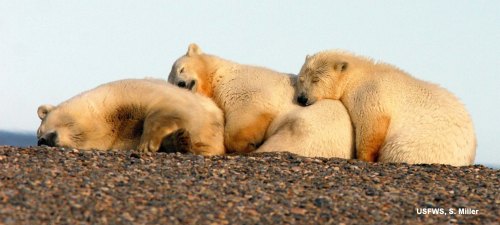
Sea ice is said to be “an essential habitat for polar bears” but that’s an overly simplistic advocacy meme as ridiculous as the “no sea ice, no polar bears” message with which the public is constantly bombarded. Polar bears require sea ice from late fall to late spring only: from early summer to mid-fall, sea ice is optional. Historical evidence of polar bears that spent 5 months on land during the summer of 1874 proves an extended stay ashore is a natural response of polar bears to natural summer ice retreat, not a consequence of recent human-caused global warming. Sea ice is a seasonal requirement for polar bears: it’s not necessary year round.
polarbears-arcticnatlwildliferefuge-suzannemiller-usfws_labeled_sm

[This PBI newsletter from 2011 repeats this meme and Andrew Derocher’s recent tweet conveys a similar message (“Sea ice loss = habitat loss for polar bears”)]

As long as sea ice is available from late fall through late spring (December to early June) and accompanied by abundant seal prey (sometimes it isn’t, see Derocher and Stirling 1995; Stirling 2002; Stirling et al. 1981, 1982, 1984), polar bears can survive a complete or nearly complete fast from June to late November (and pregnant females from June to early April the following year). That’s the beauty of their Arctic adaptation: fat deposited in early spring allows polar bears to survive an extraordinary fast whether they spend the time on land or sea ice.

Young and very old bears, as well as sick and injured ones, are the exception: these bears often come ashore in poor condition and end up dying of starvation — as a much-publicized bear on Baffin Island who likely had a form of cancer did last summer (Crockford 2018). Competition with bigger, stronger bears means these bears can’t keep what they are able to kill and they are most often the bears who cause problems. Starvation is the leading natural cause of death for polar bears because if they cannot put on the fat they need in spring, they will not survive the low food months of summer and winter, whether they are on land or out on the sea ice (Amstrup 2003). Continue reading
Spring feeding for polar bears is over – sea ice levels are now largely irrelevant

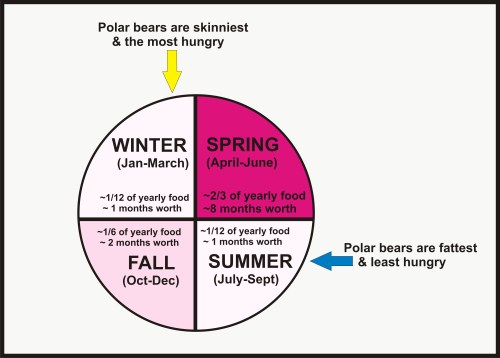
Polar bears in virtually all regions will now have finished their intensive spring feeding, which means sea ice levels are no longer an issue. A few additional seals won’t make much difference to a bear’s condition at this point, except perhaps for young bears that haven’t had a chance to feed as heavily as necessary over the spring due to inexperience or competition.

Polar bear feeding by season simple_Nov 29 2015

The only seals available on the ice for polar bears to hunt in early July through October are predator-savvy adults and subadults. But since the condition of the sea ice makes escape so much easier for the seals to escape, most bears that continue to hunt are unsuccessful – and that’s been true since the 1970s. So much for the public hand-wringing over the loss of summer sea ice on behalf of polar bear survival!

Polar bears in most areas of the Arctic are at their fattest by late June. They are well prepared to go without food for a few months if necessary – a summer fast is normal for polar bears, even for those that spend their time on the sea ice.

Putting on hundreds of pounds of fat in the spring to last through periods of food scarcity later in the year (at the height of summer and over the winter) is the evolutionary adaptation that has allowed polar bears to live successfully in the Arctic.
Continue reading

Hudson Bay sea ice update: more ice in the east than usual but less in the west

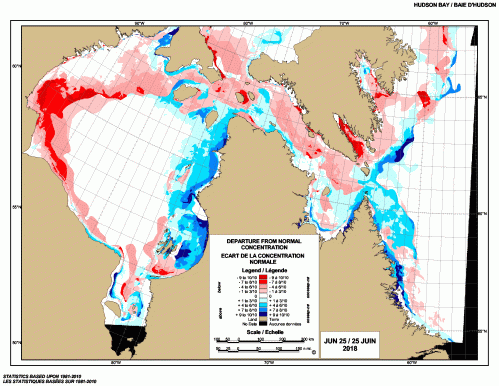
There’s almost more blue in the Canadian Ice Service “departure from normal” charts for this week than red, which means more sea ice than usual, especially in the eastern half of the bay and northern Labrador. Eventually, the melting ice will force polar bears ashore where they will fast for 4-5 months, living off the fat they’ve put on over the spring feeding season.

Hudson Bay weekly departure from normal 2018 June 25

Continue reading

Hansen’s 1988 climate change testimony was the answer to Stirling’s polar bear problem

Last week’s media coverage made me realize that James Hansen’s testimony to a US Senate committee in 1988 provided well-timed answer to a vexatious problem facing polar bear biologist Ian Stirling. Thirty years ago, Stirling was struggling to understand why polar bear productivity in Western Hudson Bay had dropped.  He was ripe for the suggestion from Hansen (and his follow-up paper) that human-caused global warming could be the explanation. An interview with Stirling and colleague Andrew Derocher published in 2016 helps connect the dots.DA-IS-measuring_Ian Stirling

Many bears were in poor condition in the fall of 1983 (Calvert et al. 1986:19, 24; Ramsay and Stirling 1988). In general, the 1980s saw weights of bears decline and cub mortality increase, with a marked increase in the loss of whole litters over what had been documented in the 1960s and 1970s (Derocher and Stirling 1992, 1995).

Until Hansen and climate change came along,  density-dependent effects (such as the number of bears out-pacing food supply) were seen as the most likely explanation. But sea ice decline blamed on human-caused global warming was suddenly a new possibility that Stirling soon embraced (Stirling and Derocher 1993). By the late 1990s, sea ice coverage on Hudson Bay had indeed declined but the correlation with polar bear productivity produced a weak trend that was not statistically significant (Stirling et al. 1999).

The 1999 Stirling paper did not provide scientific evidence to explain the 1980s decline in productivity as much as it presented a novel scapegoat to blame when a more plausible explanation could not be made.

Bottom line: Global warming could not have been the proximate cause of the productivity changes in WH polar bears documented during the 1980s but Stirling spent the next two and a half decades vigorously pushing climate change as the cause of all polar bear ills. Continue reading

Lingering late season sea ice brings polar bear visitor to northern Newfoundland

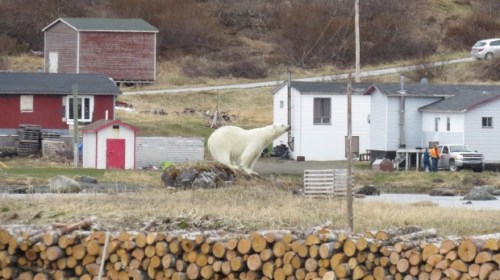
Polar bear season for St. Lunaire-Griquet Newfoundland ran from 6 March to 10 June this year — three long months when polar bears came to visit the community during the season when bears are usually occupied with feeding on young seals and mating.

Newfoundland polar bear 10 June 2018_Iceberg Festival Committee_Thresa Burden photo

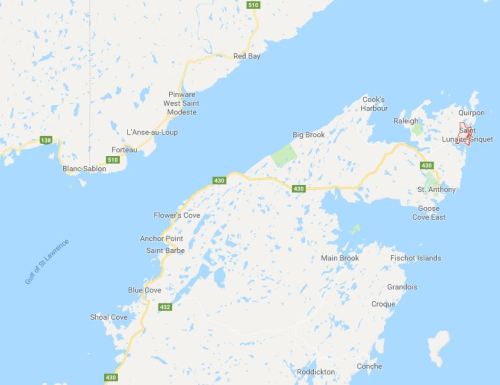
Below is a map of the region: St. Lunaire-Griquet is at the tip of the Northern Peninsula of Newfoundland, just north of St. Anthony (where some of the action in my polar bear attack thriller, EATEN, takes place):

Saint Lunaire Griquet Newfoundland location_Google maps

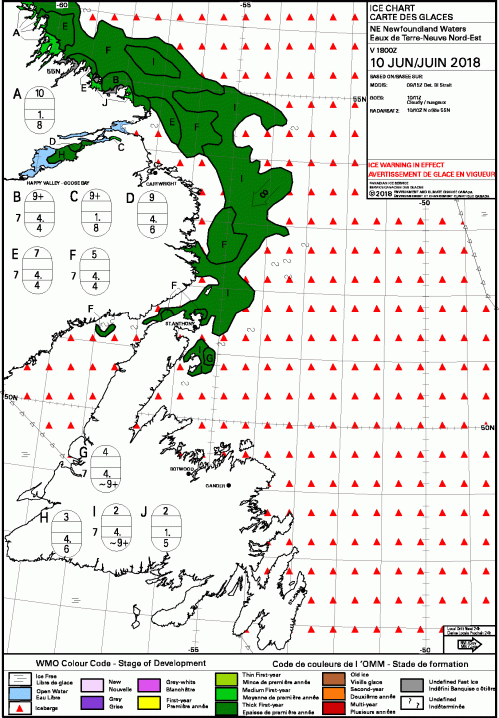
As of yesterday (June 10), when the last sighting of a fat and healthy polar bear took place, there was still quite a mass of thick first year ice (>1.2 m thick) off the northern peninsula of Newfoundland, amongst a field of icebergs:

Hudson Bay North daily stage of development 2018 June 10 ice warning

The first sighting in the area this year was back in early March, which I blogged about here. Fortunately, the Davis Strait bears that occupy the East Coast pack ice are usually well feed at this time of year and seldom pose a serious threat to humans: the fact that visitors ashore are often easily pursuaded to leave (or do so on their own) suggests they are more curious than hungry.

Continue reading

Critical evidence on W Hudson Bay polar bears still not published after 25 years

Polar bear researchers have been doing capture/recapture studies in Western Hudson Bay for decades yet most of the data claimed to be critical for assessing effects of human-caused global warming on this species have not been published. I raised this point in one of my early blog posts (27 Sept 2012) but the situation has not changed in 6 years. Here’s an update.

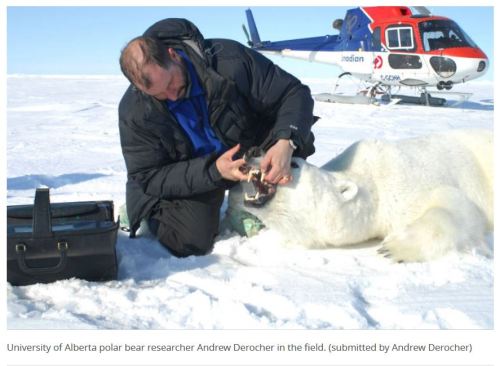
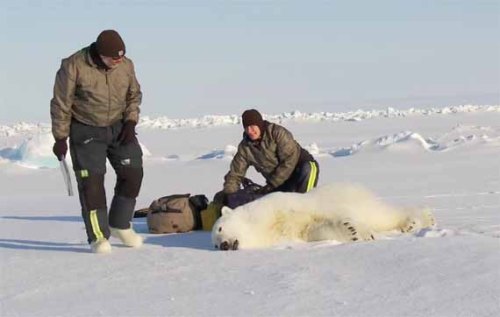
Derocher in the field in WH_CBC story 2016

From CBC story 14 Sept 2016.

Years ago now, in an oft-cited paper, Stirling and Derocher (2012) claimed to summarize the evidence that climate warming was negatively impacting polar bear health and survival. Several life history parameters were considered crucial, particularly body condition.

Despite almost a dozen papers (and perhaps more) on various aspects of WH polar bear health and life history studies based on capture/recapture data published since 2004  (e.g. Castro de la Guardia 2017; Lunn et al. 2016; Pilfold et al. 2017), none have reported the body condition data that supposedly support the claim that sea ice loss is having a severe impact — and the same is true for litter size, proportion of independent yearlings, and cub survival.1

continue reading

Does thick first year ice on Hudson Bay mean a late date ashore for WH polar bears in 2018?

Following up on my previous post, it appears sea ice conditions on Hudson Bay this year might be headed for a late breakup due to the dominance of thick first year ice. That would mean a relatively longer on-ice season for polar bears in Western and Southern Hudson Bay.

James Bay female and cub_Ontaro Govt

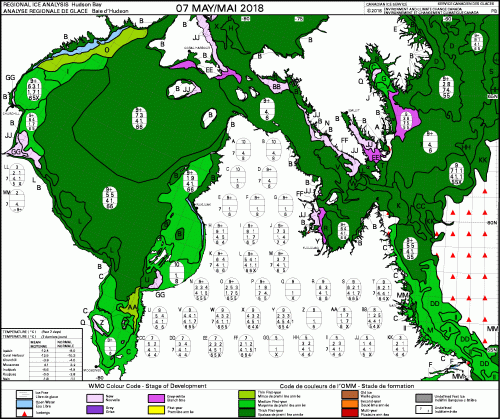
As of the 1st week in May 2018, most of Hudson Bay, Foxe Basin and Hudson Strait were covered with thick 1st year ice (dark green, >1.2 m thick):

Hudson Bay weekly stage of development 2018 May 7

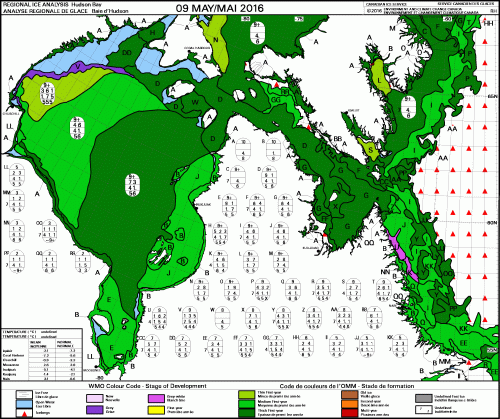
Compare that to the 1st week of May 2016, which had much less thick first year ice than 2018 and more medium first year ice (70-120cm, bright green):

Hudson Bay ice stage of development weekly at 9 May 2016

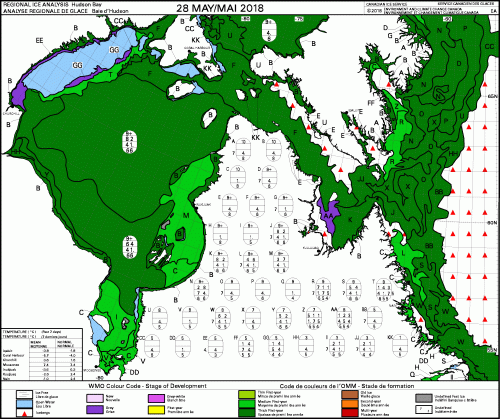
To update the situation, at the end of May this year (week of 28 May), thick first year ice covered even more of the bay with a large patch of open water in the NW corner:

Hudson Bay weekly stage of development 2018 May 28

Thick first year ice does not melt as quickly as medium or thin first year ice (lime green) under most conditions, so the amount of thick first year ice present in May strongly affects the rate of breakup of the ice over the summer (temperature and wind also contribute). Here are some charts of ice melt sequences from the past (2016 and a couple others) that give a hint at what might be in store for Hudson Bay polar bears this year.

Continue reading

Tracking polar bears in the Beaufort Sea resumes after a one year hiatus

Fourteen bears tagged by the US Geological Survey (USGS) on or near the central Southern Beaufort Sea coast in April 2018 (near Kaktovik) will be tracked online over the coming months.

The break in published USGS tagging data from March 2017 to April 2018 was the first since the project began in December 2009 but no explanation for the hiatus has been provided. It is therefore unclear whether no tagging occurred in spring 2017 or data was simply not published online. The last bears followed were tagged in March 2016.

Tranquilized_pb570_S Beaufort March 2014_USGS

In contrast to previous years, this spring all fourteen of the bears have glue-on ear transmitters, which means they are either adult males or juvenile bears rather than females (which are fitted with satellite collars):

“In collaboration with the U.S. Fish and Wildlife Service we are also experimenting with glue-on and ear tag satellite transmitters, which can be deployed on adult male bears and younger, still-growing bears.”

Continue reading

Polar bear habitat update mid-May: little change since 1989 despite CO2 increase

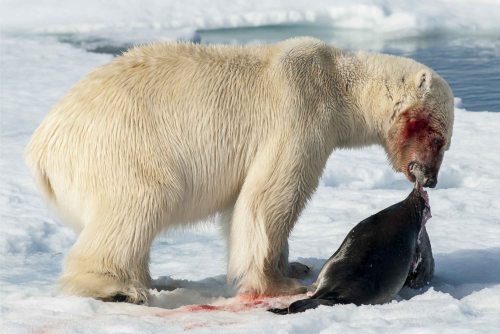
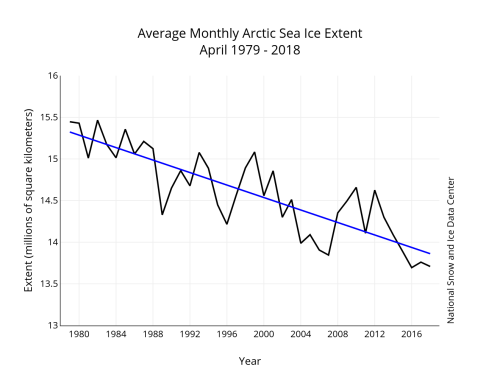
Sea ice habitat for polar bears has not become progressively worse each year during their season of critical feeding and mating, as some scaremongers often imply. It’s true that absolute extent of Arctic ice is lower this spring than it was in 1979. However, according to NSIDC Masie figures, polar bear habitat at mid-May registers about 12 million km2, just as it did in 2006 (although it is distributed a little differently); other data show spring extent has changed little since a major decline occurred in 1989, despite ever-rising CO2 levels.

Polar bear feeding_Shutterstock_sm

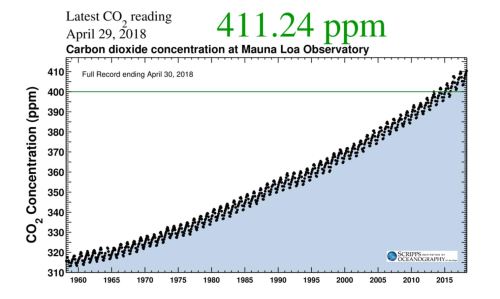
In other words, there has been virtually no change in sea ice cover over the last 12 years, despite the fact that atmospheric CO2 has now surpassed 410 parts per million, a considerable and steady increase over levels in 2006 which were about 380 ppm (see below, from the Scripps Oceanographic Laboratory, included in the Washington Post story 3 May 2018):

Scripps CO2 curve at 29 April 2018

Not only that, but if rising CO2 levels were responsible for the decline of sea ice and implied effects on polar bears since 1979 (when CO2 levels were around 340 ppm), why has spring ice extent been so variable since 1989 (when the first big decline occurred) but so little changed overall since then? See the NSIDC graph below for April:

Sea ice 2018 April average_NSIDC graph

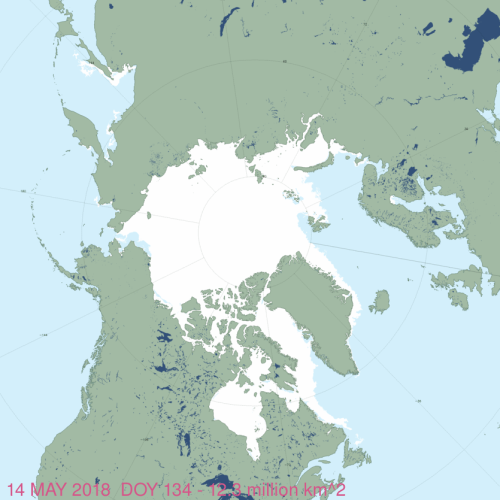
This year on day 134 (14 May), global ice cover registered 12.3 mkm2:

masie_all_zoom_4km 2018 May 14

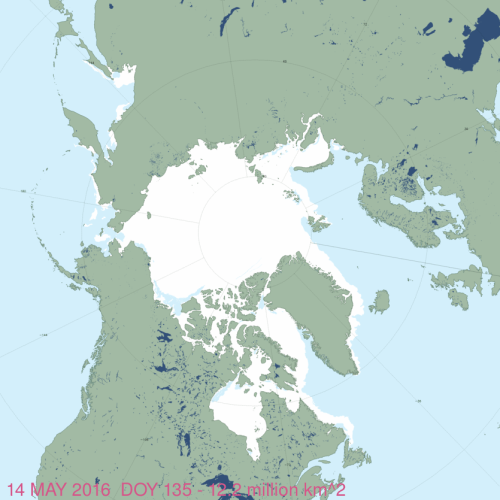
In 2016 on the same day, the overall extent was much the same but there was more ice in the Chukchi and Bering Seas and less in the eastern Beaufort:

masie_all_zoom_4km 2016 May 14

More close-up charts of different regions below for 2018 vs. 2016, showing more detail.

Continue reading

Polynya refresher: open water in spring is due to winds & currents, not ice melt

Arctic sea ice begins to open up in spring at predictable locations due to currents and prevailing winds and this was as true in the 1970s as it is today. Polynyas and widening shore leads that most often get mistaken for early sea ice melt are those in the Beaufort and Chukchi Seas and in Hudson Bay.

Beaufort Sea male polar bear USGS_2005 Amstrup photo

But contrary to concerns expressed about possible negative implications of these early patches of open water, these areas have always been critical congregation areas for Arctic seals and are therefore important feeding areas for polar bears.

Seal habitat frozen open lead_Beaufort 2008_Miller

Seals hauled out beside a lightly frozen over lead in Beaufort Sea ice, 2008. USFWS.

Continue reading