Category Archives: Sea ice habitat

Polar bear habitat update early spring 2018

Spring in the Arctic is April-June (Pilfold et al. 2015). As late April is the peak of this critical spring feeding period for most polar bear populations, this is when sea ice conditions are also critical. This year, as has been true since 1979, that sea ice coverage is abundant across the Arctic for seals that are giving birth and mating at this time as well as for polar bears busy feeding on young seals and mating.

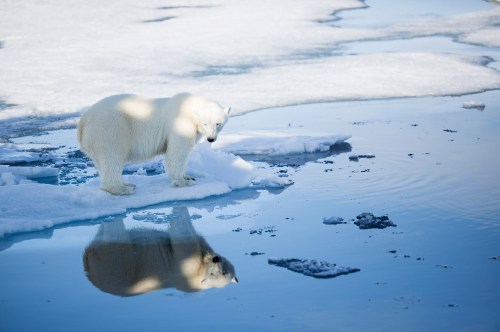
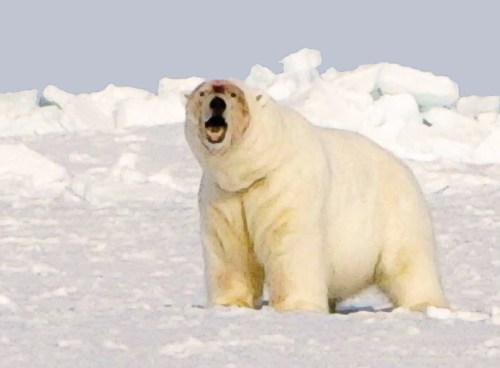
Polar_Bear_male on sea ice_Alaska Katovik Regehr photo_April 29, 2005_sm labeled

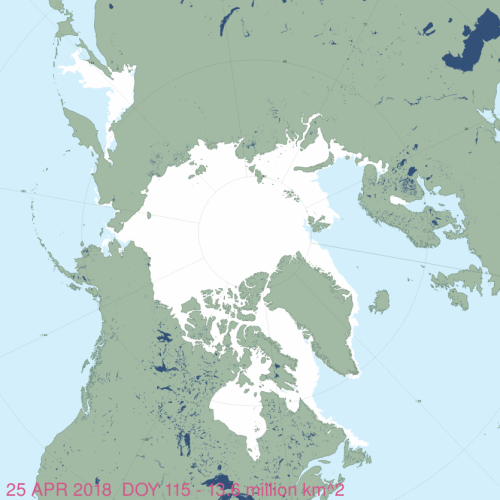
Below is a chart of sea ice at 25 April 2018, showing sea ice in all PBSG polar bear subpopulation regions:

masie_all_zoom_4km 2018 April 25

Some Arctic subregions below, in detail. Continue reading

Less Svalbard polar bear habitat during the early Holocene than now

Svalbard in the western Barents Sea has recently had less sea ice extent than it had in the 1980s, especially in the west and north, but this is not unprecedented.

Svalbard polar bear_Aars August 2015-NP058930_press release

New evidence from clams and mussels with temperature-sensitive habitat requirements confirm that warmer temperatures and less sea ice than today existed during the early Holocene period about 10.2–9.2 thousand years ago and between 8.2 and 6.0 thousand years ago (based on radio carbon dates) around Svalbard. Barents Sea polar bears almost certainly survived those previous low-ice periods, as they are doing today, by staying close to the Franz Josef Land Archipelago in the eastern half of the region where sea ice is more persistent.

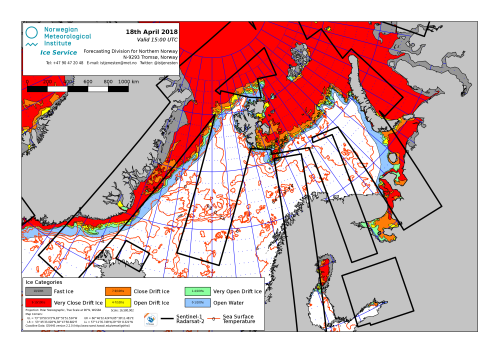
As this sea ice chart for 18 April 2018 shows, ice this month has been virtually absent from the west and north coasts of the Svalbard Archipelago, while Franz Josef Land to the east is surrounded by highly concentrated pack and land-fast ice.

Barents Sea ice 2018 April 18 NIS

From a new paper by Jan Mangerud and John Svendsen (2018) [my bold]:

Svalbard, located between 74° and 81°N, is the warmest place on Earth at this latitude (Drange et al., 2013). This is because of the North Atlantic Current and large-scale atmospheric circulation which transport warm water and air masses from lower latitudes northwards across the Atlantic and along the coast of Norway to Svalbard (Figure 1). Yet, during the Holocene Thermal Maximum, the climate of Svalbard was considerably warmer than at present.

The transition from Younger Dryas cold to Holocene Thermal Maximum warm conditions took place very rapidly, according to records from nearby Greenland (Taylor et al. 1997), warming in “steps” of about five years each over a period of about 40 years. This was at least as fast, if not faster than, recent Arctic warming between the 1980s and 2015. And since polar bears of the Barents Sea and adjacent Arctic areas appear to have survived this change to Holocence Thermal Maximum conditions, it challenges the notion that recent warming has been (or will be) too fast to allow polar bears to survive without huge changes in their present distribution (Amstrup et al. 2007).
Continue reading

Steve Amstrup is lying to the media about my critique of his 2007 model

Until now, my scientific paper post at PeerJ Preprints for review, about the failure of Steve Amstrup’s 2007 USGS polar bear survival model (Crockford 2017), has been formally ignored by Amstrup and his colleagues. But now Amstrup and his colleagues have taken to lying to the media about my analysis because he can’t refute it in a scholarly manner.

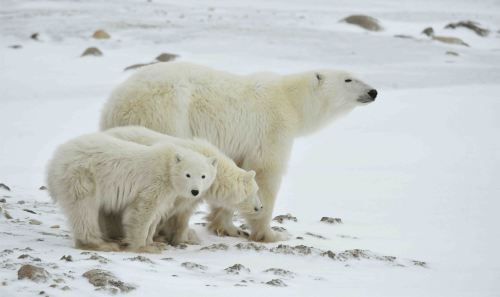
Mother with cubs Russia_shutterstock_71694292_web size

Amstrup was quoted by Erica Goode in her New York Times article on the Harvey et al. (2018) BioScience attack paper published Tuesday (10 April 2018: “Climate Change Denialists Say Polar Bears Are Fine. Scientists Are Pushing Back”):

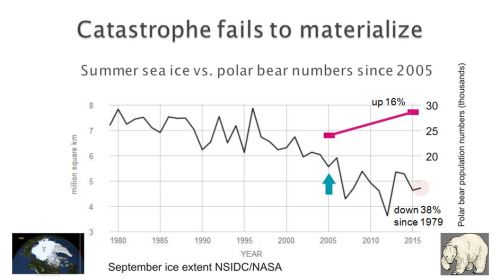
“Dr. Amstrup, however, said that according to the National Snow and Ice Data Center, the average September sea ice extent for the years 2007 to 2017 was 4.5 million square kilometers, “nowhere near the low levels projected it would be by the middle of the century.”

“To say that we already should have seen those declines now when we’re not early [sic] to the middle of the century yet is absurd,” he said.” [my bold]

And over at the online outlet Mashable (11 April 2018: “Climate scientists fight false polar bear narrative pushed by bloggers”), reporter Mark Kaufman quoted Jeff Harvey, lead author of the BioScience paper on the issue, although Harvey is hardly an authority:

“(Harvey noted Crockford misunderstood and then mischaracterized this prediction).”

Amstrup also presented a lame critique of the portion of my Financial Post 27 February 2018 op-ed that dealt with his 2007 predictions, published 2 March 2018 by Climate Feedback (self-proclaimed “fact checkers”), that is easily refuted because it’s a blatant lie. He’s saying 2015 sea ice models are relevant to his 2007 predictions that used 2005/2006 sea ice models.

Continue reading

An embarrassment to science: BioScience editor formally rejects retraction request

After four long months of waiting, late last week I finally received an official  response from the editor of BioScience regarding my retraction request for the Harvey et al. paper (Internet Blogs, Polar Bears, and Climate-Change Denial by Proxy), which I sent 5 December 2017.
Crockford 2017_Slide 12 screencap

From the sounds of it, the wait took so long because the paper went through a tedious process of parsing words just so among the 14 co-authors (akin to that used by the IPCC in constructing the Summary for Policy Makers), to convey the authors meaning and retain as much of the original insult as possible. In reality, we know the decision was made barely two weeks after I sent the request (16 December 2017) because that day, BioScience editor Scott Collins told a reporter he had no intention of retracting the paper.

In the end, the authors were compelled to make two small word changes. The editor insists that:

“…prior to publication, the article was peer reviewed by highly reputable scholars with expertise on the topic as per our standard procedures.”

So he says.

But all we can do is judge by the results the reviewers approved: a paper with two prominent spelling errors (“principle” component analysis; “Refereces” cited) as well as several serious errors in the supplemental material that were brought to the editors attention (which does not even break the surface of the statistical errors described in detail by others or the additional errors found after my retraction request was filed, including a case of plagiarism of my blog content by a so-called “science” blog used in the paper).

Harvey et al. hardly needed much analysis for savvy folks to judge its quality: on the day of release, climate scientist Judith Curry’s scathing remark on twitter said it all:

“This is absolutely the stupidest paper I have ever seen published.”

Among the co-authors of the paper are polar bear specialists Steven Amstrup and Ian Stirling, as well as Stephen Lewandosky and Michael Mann (who now writes for children, competing with my popular polar bear science book for kids):

The online version available today (26 March) did not contain the changes described by the editor in his 23 March 2018 email nor were the spelling errors fixed (pdf here). Errors in the supplementary data file remain (here), although these were identified months ago.

The entire fiasco, start to finish, is an embarrassment to science but apparently, the editor does not care. As I’ve said before, this paper says more about the editor of the journal, the journal’s publishers, and the authors of the paper than it does about me or any of the bloggers discussed within it.

If published as is by the journal, it will go down in history as a low point for science and BioScience will have the dubious honor of being complicit in its production, as will all 14 co-authors. I encourage you to read the paper and see for yourself.

The same morning I received the response from the BioScience editor (text below), Dr. Richard Tol received a rejection notice for the critique of the Harvey et al. paper he and co-author Anand Rajan submitted 25 January 2018 (“LIPSTICK ON A BEAR: A COMMENT ON INTERNET BLOGS, POLAR BEARS, AND CLIMATE-CHANGE DENIAL BY PROXY”), with two reasons given:

“First. author guidelines state that letters are limited to 500 words and must be considered to be constructive. Secondly, and more importantly, your letter has already been published verbatum on line and therefore does not merit re-publication in BioScience.” [my bold]

Odd timing and a bit ironic, isn’t it? Preprint server publication is damned as ‘prior publication’ even though it is dismissed out of hand by vocal champions of scientific virtue because it hasn’t been through a journal-orchestrated review process (as opposed to simply being reviewed by peers).

Such a “dismissal” has occurred with my paper that shows how and why Amsturp and colleagues 2007 polar bear predictions failed so miserably (Crockford 2017), now downloaded more than 2300 times (see a shorter summary in Crockford and Geist 2018, and here). This is the paper Amstrup and Stirling don’t want the public to read.

I’ll let readers decide for themselves if they agree with Collins on whether the changes agreed to by all parties to this sham of a paper come anywhere close to addressing the insult to science and dedicated scientists everywhere.

Continue reading

At the winter maximum, still about the same polar bear habitat this year as 2006

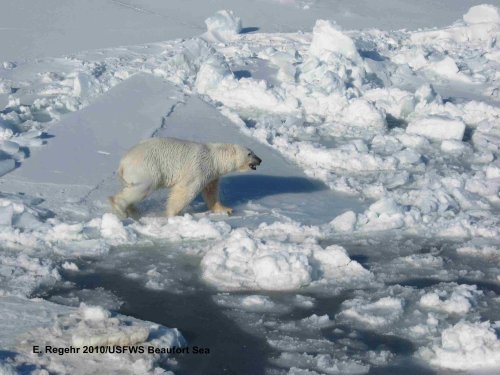
There is no evidence that slightly less winter sea ice than the average since 1979 has had any negative impact on polar bear health or survival: the difference is simply not biologically meaningful to Arctic animals.

PB_male on ice_Regehr USFWS_March 2010_labeled

Polar bear on winter sea ice around the yearly maximum in the Beaufort Sea, 2010 (March 21).

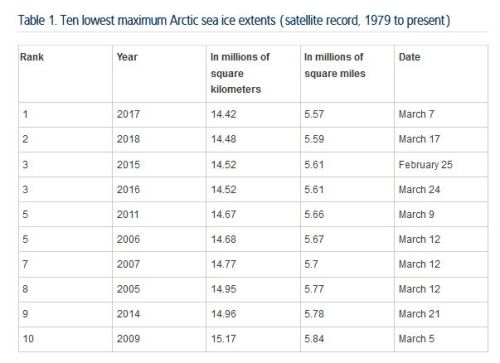
NASA’s 23 March 2018 announcement regarding the Arctic sea ice maximum this year:

“Sea ice in the Arctic grew to its annual maximum extent last week, and joined 2015, 2016 and 2017 as the four lowest maximum extents on record, according to scientists at the NASA-supported National Snow and Ice Data Center (NSIDC) and NASA.”

Except, what they don’t tell you is that 2006 had almost the same extent as 2018 and 2006 wasn’t far behind according to the official, averaged data presented at NSIDC’s Arctic Sea Ice News & Analysis:

Arctic sea ice Maximum 10 lowest extents_NSIDC 23 March 2018

Current conditions at the winter maximum (at 17 March 2018, from NSIDC Masie, extent measured at 14.7 mkm2, using software able to discern more ice than used for the figures in Table 1), shown below: Continue reading

Amstrup & colleages can’t refute my critique of their 2007 polar bear survival model, Part 2

Polar bear specialists Andrew Derocher and Steven Amstrup recently spent inordinate energy trying to refute the opinion piece I’d written for the Financial Post in celebration of International Polar Bear Day last month, ignoring my fully referenced State of the Polar Bear Report for 2017 that was released the same day (Crockford 2018) and the scientific manuscript I’d posted last year at PeerJ Preprints (Crockford 2017).

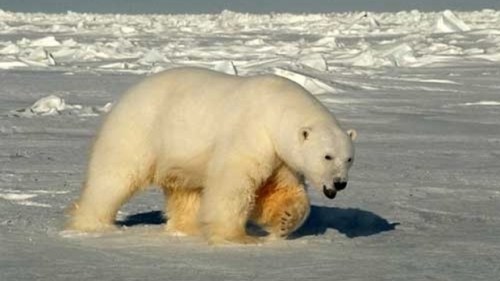
polar_bear_USFWS_fat Chukchi Sea bear

Their responses use misdirection and strawman arguments to make points. Such an approach would not work with the scientific community in a public review of my paper at PeerJ, but it’s perfect spin for the self-proclaimed “fact-checking” organization called Climate Feedback. The result is a wildly ineffective rebuttal of my scientific conclusion that Amstrup’s 2007 polar bear survival model has failed miserably.

This is Part 2 of my expose, see Part 1 here.
Continue reading
Amstrup & colleages can’t refute my critique of their 2007 polar bear survival model, Part 1

It’s been more than a year since I first published my scientific manuscript at PeerJ Preprints (a legitimate scientific forum) on the failure of Amstrup’s 2007 USGS polar bear survival model (Crockford 2017), a year waiting in vain for the polar bear community to comment. They either couldn’t be bothered or knew they couldn’t refute it – I haven’t known for sure which. But I do now.

Beaufort Sea male polar bear USGS_2005 Amstrup photo

Polar bear specialists didn’t comment because they couldn’t refute it in the scholarly manner required by PeerJ: all they could do is tear it down with derision, misdirection and strawman arguments.

I know this because the damage control team for the polar-bears-are-all-going-to-die-unless-we-stop-using-fossil-fuels message wasn’t activated over my fully-referenced State of the Polar Bear Report for 2017 (Crockford 2018) released on International Polar Bear Day last month, but for a widely-read opinion piece I’d written for the Financial Post published the same day (based on the Report) that generated three follow-up radio interviews.

By choosing to respond to my op-ed rather than the Report or my 2017 paper, biologists Andrew Derocher and Steven Amstrup, on behalf of their polar bear specialist colleagues1, display a perverse desire to control the public narrative rather than ensure sound science prevails. Their scientifically weak “analysis” of my op-ed (2 March 2018), published by Climate Feedback (self-proclaimed “fact checkers”), attempts damage control for their message and makes attacks on my integrity. However, a scientific refutation of the premise of my 2017 paper, or The State of the Polar Bear Report 2017, it is not (Crockford 2017, 2018).

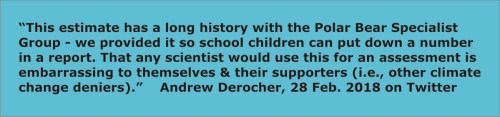
Derocher further embarrasses himself by repeating the ridiculous claim that global polar bear population estimates were never meant for scientific use, then reiterates the message with added emphasis on twitter:

Derocher tweet 2018 Feb 28 quote

Just as the badly written Harvey et al. (2017) Bioscience paper said more about the naked desperation of the authors than it did about me or my fellow bloggers, this attempt by the polar bear community’s loudest bulldogs to discredit me and my work reveals their frustration at being unable to refute my scientifically supported conclusion that Amstrup’s 2007 polar bear survival model has failed miserably (Crockford 2017).

Part 1 of my detailed, fully referenced responses to their “analysis” of my op-ed are below.  Part 2 to follow [here]. Continue reading

More Davis Strait polar bears onshore in the last two days

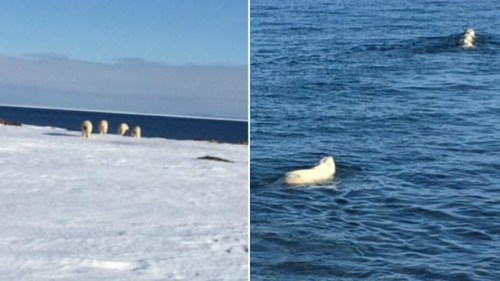
Four bears were photographed outside of Red Bay, Southern Labrador on Thursday 8 March and a bear was spotted ashore in NE Newfoundland overnight on Wednesday.

Red Bay Labrador polar-bears 8 March 2018_Vicki Hancock photo_CBC 9 March 2018

Continue reading

Winter polar bear sea ice habitat by early March 2018 varied little from 2006 or 2017

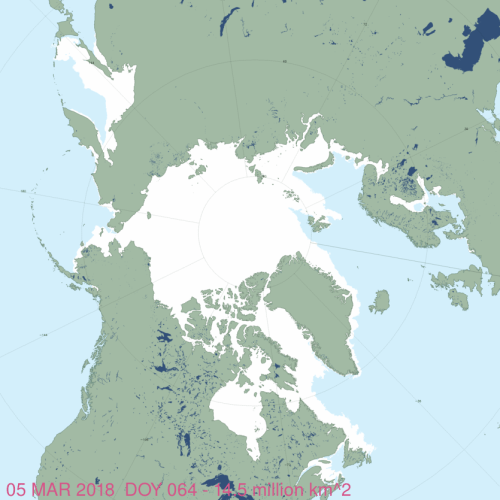
Here’s a polar bear habitat update for early March: some folks are wringing their hands over the relatively extent of ice this season but ice maps show that as far as polar bear habitat is concerned, conditions are not materially different this year from what they were in 2006 or 2017. There is still plenty of late winter sea ice for polar bears needing a platform from which to hunt Arctic seals, which in some areas will have already begun giving birth to their fat furry pups (harp seals first, other species later).

The MASIE map for 5 March 2018 (Day 64) shows ice extent at 14.5 mkm2:

masie_all_zoom_4km 2018 March 5

Continue reading

Polar bear sighted onshore in northern Newfoundland at St. Lunaire-Griquet

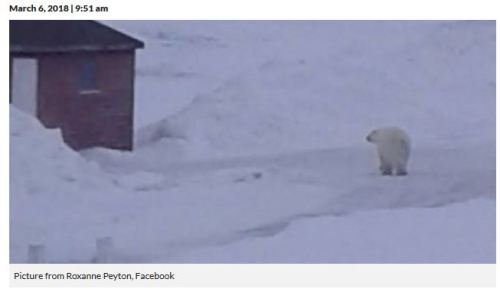
The first report I’ve seen this season of a polar bear onshore has come in and ironically, it comes from northern Newfoundland, the setting of my polar bear attack thriller, EATEN. Only time will tell if this year will be as active as 2017’s record-breaker for polar bears ashore in Newfoundland.

Saint Lunaire Griquet Newfoundland polar bear_VOCM news_6 March 2018

Update: 6 March 2018. A couple of hours after posting this, CBC News Newfoundland published a story on this incident, providing a bit more detail and video footage of the bear wandering around local houses.

Continue reading