Category Archives: Sea ice habitat

My Financial Post op-ed: Polar bears keep thriving even as global warming alarmists keep pretending they’re dying

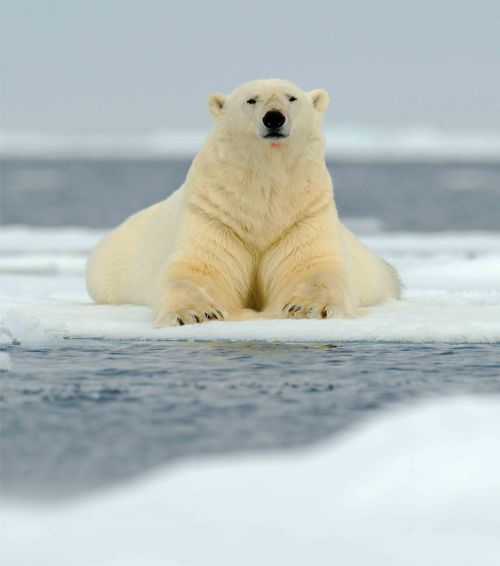
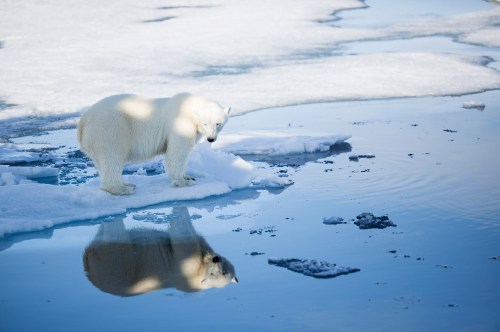
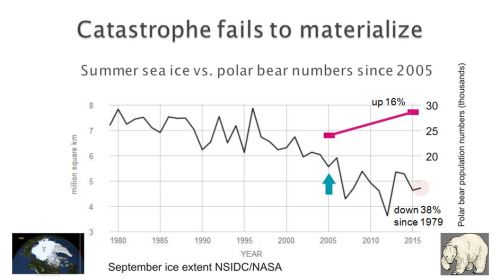
One powerful polar bear fact is slowly rising above the message of looming catastrophe repeated endlessly by the media: More than 15,000 polar bears have not disappeared since 2005. Although the extent of the summer sea ice after 2006 dropped abruptly to levels not expected until 2050, the predicted 67-per-cent decline in polar bear numbers simply didn’t happen. Rather, global polar bear numbers have been stable or slightly improved.

lying-bear-shutterstock_244419640_cropped_web-size.jpg

The polar bear’s resilience should have meant the end of its use as a cherished icon of global warming doom, but it didn’t. The alarmism is not going away without a struggle. Continue reading

Archive of 2007 USGS reports supporting 2008 ESA listing for the polar bear

The administrative reports used in 2007 to support the decision to list polar bears as ‘threatened’ under the US Endangered Species Act (ESA) in 2008 disappeared from the US Geological Survey website several years ago. I have archived them here in pdf format to make them easy to find for anyone wishing to access the accuracy of the models, data, and assumptions made in 2007.

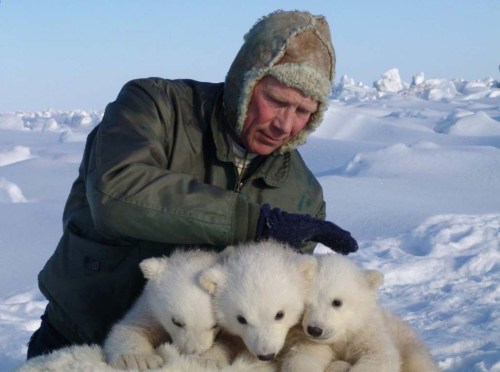
Amstrup w triplet_Prudhoe Bay 2005_USGS_sm

Steven Amstrup in 2005, then lead USGS polar bear biologist, with triplet cubs, Prudhoe Bay, AK.

This is a housekeeping post meant for future reference. I’ve included citations for the relevant sea ice projection papers used in the models presented in the 2007 documents and a few other related reports from the same time period. Continue reading

Histrionics over Arctic temperatures & sea ice extent: implications for polar bears

Panic over Arctic temperatures got smeared across news networks last week, so I think a bit of perspective is in order, including an assessment of what this means for polar bears and their prey (because some of the hysteria is being amplified from that corner).

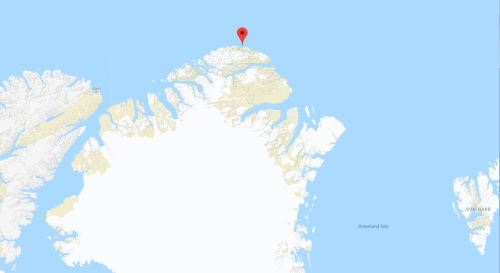
The region causing all the kerfuffle is at the northernmost tip of Greenland (see map below), where there is a weather station at Cape Morris Jesup. Next-nearest stations are at Alert, Canada (to the west) and Longyearbyen, Svalbard (Norway, to the east).

Cape Morris Jesup location Greenland_Google map

Arctic temps spike over 30 degrees in the midst of winter (The Weathern Network, Friday, February 23, 2018) included the tweet below, showing a fracture of sea ice north of Greenland so transient that it does not show up on daily sea ice maps:

“Along with those spikes in temperature, Lars Kaleschke’s tweet, above, also shows the large rift in the sea ice that opened up just north of Cape Morris Jesup, at the same time. Kaleschke is a professor of sea ice remote sensing at the Center for Earth System Research and Sustainability, at the University of Hamburg, in Germany.

Summary: Temperature and sea ice “abberations” in northern Greenland are transient phenomena that have clearly happened before (e.g. 2011) without major consequences except perhaps through impacts on eastern Arctic and subArctic weather conditions (including the UK).

Lack of sea ice north of Svalbard in the Barents Sea occuried last year and in 2012 in Februrary. But by mid-to-late March, when seal are beginning to give birth on the ice and polar bears are busy hunting them, ice had again covered the region. This year is likely to be the same. However, we won’t know until the end of March or ealry April if a recovery will or won’t happen, so any alarm-ringing about impacts on Arctic fauna surival have no foundation in fact until then.

East Greenland Scorsby Sound March 2011 on Kap Tobin_Rune Dietz_press photo

Scorsby Sound, East Greenland bear in March 2011. Rune Dietz, press photo.

In the Bering Sea, ice extent is well below average for this time of year but studies show the one consistent feature of Bering Sea ice is its variability. Low ice levels have distressing impacts for St. Lawrence island seal and whale hunters. However, there is certainly enough ice in the Bering Sea/Chukchi Sea region for polar bears and Arctic seals to do what they do this time of year (which is try to survive until early April, at which time seals start giving birth to their pups and polar bears start to eat them, with gusto). And the ice season isn’t over: maximum extent of ice in the Bering sea doesn’t usually come until late April or May, and the dramatic decline of mid-February already shows signs of reversing.

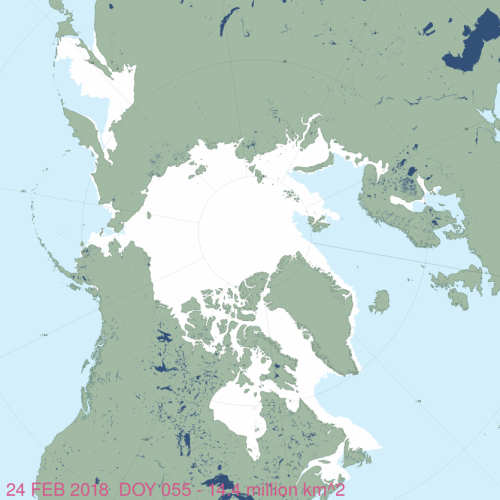
Details below this ice map for 24 February 2018, courtesy NSIDC Masie:

masie_all_zoom_4km 2018 Feb 24

PS. I’m off within hours to Toronto for the launch of my State of the Polar Bear Report in honour of International Polar Bear Day, 27 February. Watch for reports in the news and for my op-ed 27 February at the Financial Post.

Continue reading

Russia confirms Chukchi Sea polar bears not at risk from climate change or poaching

A statement yesterday from Yegor Vereshchagin, wildlife conservation manager from Chukotka, Russia  (Polar Bears Adjust to Climate Change, 20 February 2018) confirms that Chukchi Sea polar bears are currently doing extremely well.

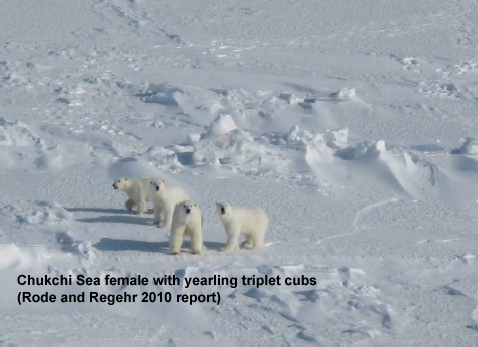
Rode and Regehr 2010_Chukchi_report2010_Fig1_triplets_labelled

Contrary to previous reports and predictions (e.g. Amstrup 2011; Amstrup et al. 2007, 2008; Durner et al. 2009), there appears to be no threats due to recent declines in summer sea ice (Rode and Regehr 2010; Rode et al. 2013, 2014, 2018) or from poaching.
Continue reading

State of the Polar Bear Report 2017 to be released Feb 2017 at press lunch Toronto

My “State of the Polar Bear Report 2017” will be unveiled at a Global Warming Policy Foundation press conference and luncheon in Toronto on Tuesday, 27 February, in celebration of International Polar Bear Day. There will be a video presentation as well.

State of Polar Bear Report cover_12 Feb 2018 image

The report summarizes clear, reliable and concise information on the current state of polar bears relative to historical records. It highlights up-to-date data and research findings in a balanced and factual format that avoids hype and exaggeration, all in one place. It is intended for a wide audience, including scientists, teachers, students, decision-makers and the general public interested in polar bears and Arctic ecology.

The launch will be held on Tuesday 27 February at 11:00am at the Toronto Public Library, Founders’ Room, 789 Yonge St, Toronto, ON M4W 2G8.

Programme

* Welcome (Dr Benny Peiser, Director of the GWPF)
* Introduction: Prof Chris Essex (Chairman of the GWPF’s Academic Advisory Council)
* Short video screening
* Presentation: Dr Susan Crockford (author of the report)

For further information and to schedule interviews, please contact Harry Wilkinson (harry.wilkinson@thegwpf.org)

A copy of the report will be posted on Polar Bear Science Tuesday.

New Scientist prints a more reasoned polar bear article but myths persist

New Scientist has an article coming out next week takes a fairly reasoned approach to the polar bear conservation issue. It acknowledges that polar bear numbers have not declined in recent years even though summer sea ice dropped dramatically but goes on to perpetuate a number of myths that might not have happened if the author had done his homework or quizzed his other experts as thoroughly as he did me.

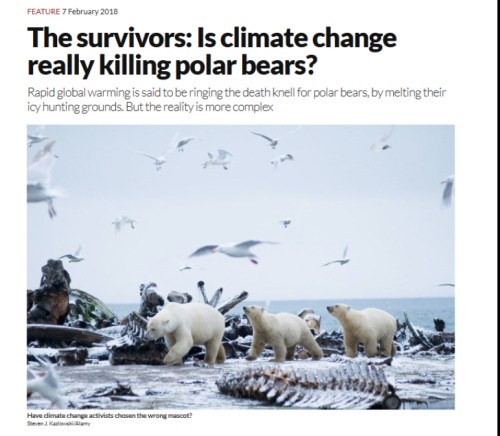
New Scientist headline_10 Feb 2018 issue 3164 photo

The survivors: is climate change really killing polar bears? Rapid global warming is said to be ringing the death knell for polar bears, by melthing their icy hunting grounds. But the reality is more complex. Fred Pearce, New Scientist 10 February 2018. Online now.

Continue reading

Polar bear specialists double-down on message of future starving bears

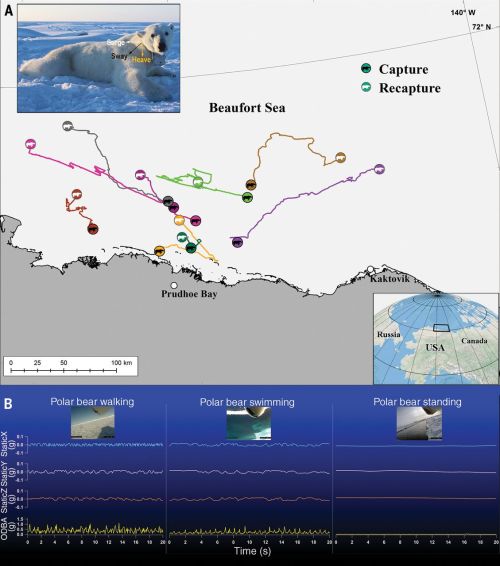
The really significant content of a new paper being heavily-hyped by the media1 is what wasn’t said rather than what the authors discovered about metabolic rates and weight maintenance of a small sample of nine Southern Beaufort Sea bears in 2014 to 2016 (Pagano et al. 2018; Whiteman 2018).

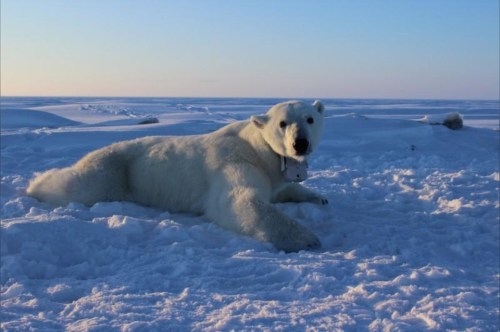
Pagano et al. 2018 photo released to press 2

This paper does not document starving or dying bears but merely found some (5/9) that lost weight when they should have been gaining, given that early April is the start of the ringed seal pupping season (Smith 1987) and the intensive spring feeding period for polar bears (Stirling et al. 1981).

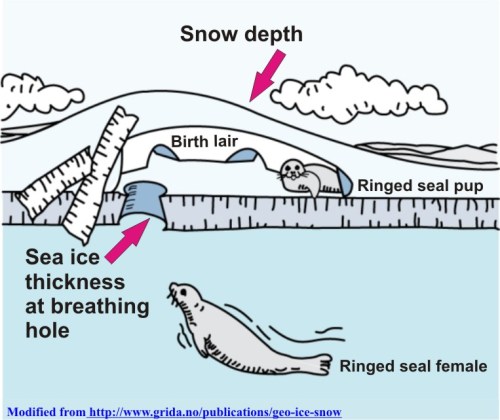
The question is, why were Southern Beaufort Sea polar bears off Prudhoe Bay (see map of the study area below), still hunting and capturing only adult and subadult ringed seals from sea ice leads when newborn ringed seal pups and their mothers should have been plentiful and relatively easily available in their birth lairs on the sea ice (see below)?

Ringed seal lair_snow and ice thickness_PolarBearScience_sm

“Using video collar data, we documented bears’ hunting behavior and foraging success. Bears used sit-and-wait tactics to hunt seals 90% of the time, and stalking comprised the remaining 10% of hunts (movies S1 to S4) (19). Bears that successfully killed and ate adult or subadult ringed seals either gained or maintained body mass, whereas bears that only scavenged or showed no evidence of eating lost mass.”

There was no discussion in the paper of ringed seal birth lairs, or sea ice conditions at the time of the study, but several mentions about what might happen in the future to sea ice and potential consequences for polar bears. The press release did the same.

However, as you’ll see by the sea ice thickness maps below, there may be good reason for the lack of ringed seal lairs, and a general lack of seals except at the nearshore lead that forms because of tidal action: the ice just a bit further offshore ice looks too thick for a good crop of ringed seals in all three years of the study. This is reminiscent of conditions that occurred with devastating results in the mid-1970s and mid-2000s (Burns et al. 1975; Cherry et al. 2009; Harwood et al. 2012, 2015; Pilfold et al. 2012; Stirling 2002, Stirling et al. 1987). Those events affected primarily bears in the eastern half of the Southern Beaufort and were almost certainly responsible for the recorded decline in SB bear numbers in the 2001-2010 survey (Bromaghin et al. 2015; Crockford 2017; Crockford and Geist 2018).

It seems very odd to me that Pagano and colleagues suggested no reasons for the unexpectedly poor showing of polar bear hunting success during their study except a bit of hand-waving about higher-than-we-thought metabolic rates in the bears. For years, I’ve worried that the inevitable next episodes of thick Southern Beaufort spring ice would cause problems for polar bears and seals but we wouldn’t know it because whatever effects were documented would be blamed on reduced summer ice: I suspect that time may have come.

Pagano et al. 2018 polar bear fat and energy fig 1

Figure 1 from Pagano et al. 2018 cropped to show only the study area off Alaska.

Continue reading

Early Holocene polar bear skeleton from Norway vs. other ancient remains

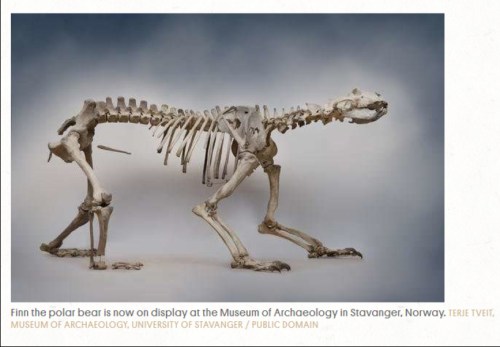
A press release issued yesterday (23 January 2018) by the University of Stavanger tells the story of decades of work on the most complete ancient polar bear skeleton in the world, found in 1976 in southern Norway, that culminated in an articulated museum display. This specimen was described in my research paper, Annotated Map of Ancient Polar Bear Remains of the World (Crockford 2012), which shows how many very early Holocene remains have been found outside current polar bear range.

Finn the ice age polar bear skeleton_U Stavanger_photo 2

Continue reading

Franz Josef Land is a sea ice refugium for most pregnant Barents Sea polar bears

Consensus polar bear expert Andrew Derocher has been busy over the last few weeks, expounding a story of doom regarding Svalbard area polar bears (e.g. here and here), ridiculing the suggestion that Franz Josef Land is viable alternate habitat for Barents Sea bears, especially pregnant females looking for a place to den and give birth. But the facts say otherwise.

Svalbard polar bear_Aars August 2015-NP058930_press release

Below are the long answers, with references and ice maps, to the questions Derocher asked in his 21 December 2017 tweet (above), a refreshing change from the ‘take my word for it, I’m the official expert’ answer one gets from him, along with derogatory slurs directed at those who don’t share his pessimism.

UPDATED 1 February 2019. Two references added.

Continue reading

Failed Amstrup polar bear predictions have climate change community in a panic

Polar bear experts who falsely predicted that roughly 16,400 polar bears would be dead by now1 (given sea ice conditions since 2007) have realized their failure has not only kicked their own credibility to the curb, it has taken with it the reputations of their climate change colleagues. This has left many folks unhappy about the toppling of this important global warming icon but ironically, consensus polar bear experts and climate scientists (and their supporters) were the ones who set up the polar bear as a proxy for AGW in the first place.
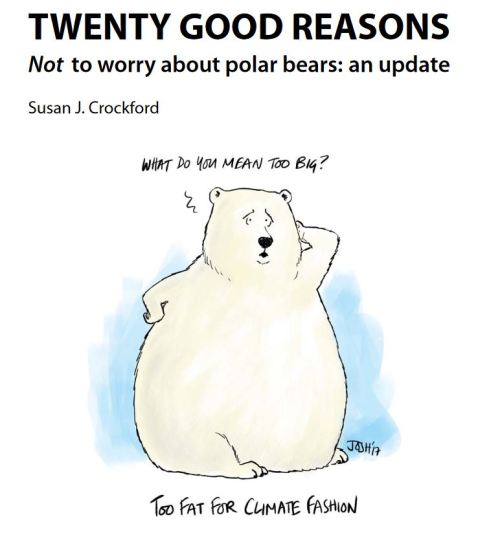
Cover image_Twenty Reasons_polarbearscience

I published my professional criticisms on the failed predictions of the polar bear conservation community in a professional online scientific preprint journal, which has now been downloaded almost 2,000 times (Crockford 2017; Crockford and Geist 2017).
Crockford 2017_Slide 12 screencap

My paper demonstrates that the polar bear/seaice decline hypothesis, particularly the one developed by Steven Amstrup, is a failure. I’m not the only one who thinks so, as emails obtained from the US Fish and Wildlife Service show. The argument the paper lays out and the facts it presents have not been challenged by any one of the consensus polar bear experts who object to it so strenuously. Instead, they have chosen to misrepresent my work, and publicly belittle my credentials and scientific integrity in the published literature (Harvey et al. 2017) and online.

Harvey and colleagues suggest in their paper that I and others use polar bears as a proxy for AGW as part of a deliberate plan to undermine the public’s confidence in global warming.

Harvey et al. state:

“…the main strategy of denier blogs is therefore to focus on topics that are showy and in which it is therefore easy to generate public interest. These topics are used as “proxies” for AGW in general; in other words, they represent keystone dominoes that are  strategically placed in front of many hundreds of others, each representing a separate line of evidence for AGW. By appearing to knock over the keystone domino, audiences targeted by the communication may assume all other dominoes are toppled in a form of “dismissal by association.” [my bold]

I do not recall ever stating or implying that if polar bear predictions of doom were wrong, then general climate change models must also be wrong. But if any other bloggers have done so, they can hardly be blamed.

A bit of reflection shows it was the climate science community itself — in collaboration with Arctic researchers and the media — who by the year 2000 (below left) set the polar bear up as an icon for catastrophic global warming. They made the polar bear a proxy for AGW.

Al Gore used the polar bears on an ice flow image (above right) to seal global warming icon status for the polar bear in his 2007 movie, An Inconvenient Truth (see National Post March 2007 article here).

As Harvey et al. co-author Michael Mann said only a few years ago (24 March 2014):

“We are now the polar bear.”

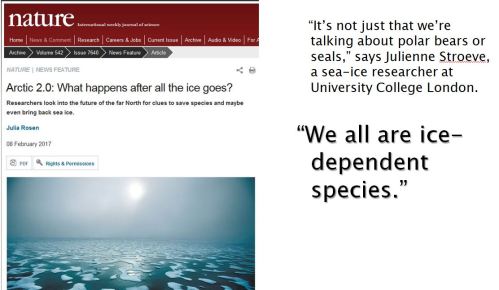
A clear association was made between polar bear survival and AGW, time and time again, as recently as last February (2017):
Stroeve 2017 we are all ice dependent species

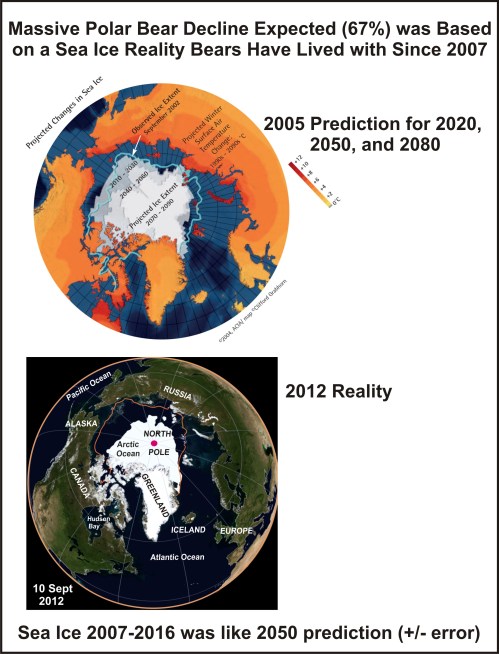
So, when the polar bears failed to die by the thousands as polar bear models predicted, after years of lower summer ice than any sea ice models predicted (see graphic below), some people may have logically stated or implied that perhaps general climate models are similarly flawed.

In essence, Mann’s “we are now the polar bear” statement came back to bite him and his colleagues in the ass, Amstrup and Ian Stirling included.  Predictably, they would like to blame someone else for their failure and embarrassment, so they wrote a sloppy tantrum paper that pretends my polar bear/sea ice decline document doesn’t exist.

I guess we all should have seen it coming.

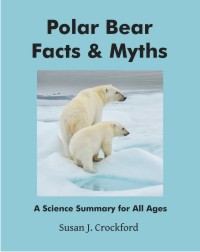
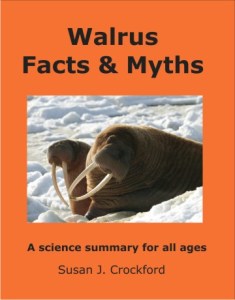
UPDATE 8 January 2018: Forgot to add that Mann’s upcoming children’s book depends on the polar bear being an appealing icon for global warming: he uses the bears as a hook to grab the interest and sympathy of naive youngsters so that he can sell them his scary modeled prophesy of the future. In contrast, my children’s book Polar Bear Facts & Myths deals with the current status and science of polar bears, sea ice and Arctic ecology and draws no parallels between global warming predictions and polar bear survival.

Mann_tantrum that saved the world Dec 2017 cropped

Fig 3 Sea ice prediction vs reality 2012

Predicted sea ice changes (based on 2004 data) at 2020, 2050, and 2080 that were used in 2007 to predict a 67% decline in global polar bear numbers vs. an example of the sea ice extent reality experienced since 2007 (shown is 2012). See Crockford 2017 for details.

Footnote (added 30 March 2018):

Just to clarify, this represents the predicted decline of 67% of the population (i.e. 24,500 bears) estimated to exist in 2005 by the US Geological Survey.

References

Crockford, S.J. and Geist, V. 2018. Conservation Fiasco. Range Magazine, Winter 2017/2018, pg. 26-27. Pdf here.

Crockford, S.J. 2017. Testing the hypothesis that routine sea ice coverage of 3-5 mkm2 results in a greater than 30% decline in population size of polar bears (Ursus maritimus). PeerJ Preprints 2 March 2017. Doi: 10.7287/peerj.preprints.2737v3 Open access. https://doi.org/10.7287/peerj.preprints.2737v3

Harvey, J.A., van den Berg, D., Ellers, J., Kampen, R., Crowther, T.W., Roessingh, P., Verheggen, B., Nuijten, R. J. M., Post, E., Lewandowsky, S., Stirling, I., Balgopal, M., Amstrup, S.C., and Mann, M.E. 2017. Internet blogs, polar bears, and climate-change denial by proxy. Bioscience. DOI: 10.1093/biosci/bix133