Tag Archives: Arctic

Polar bear habitat update – Arctic sea ice today covers same area as it did on June 30

Arctic refreeze is well underway. Less than half way through the Arctic autumn (Oct-Dec), polar bear habitat on 11 November 2015 covered the same total area as it did on the last day of Arctic spring (April-June); it’s just distributed differently.

polar_bear_usfws_no date_sm

Yesterday, courtesy NSIDC Masie

masie_all_zoom_4km_2015 Nov 11

Here is what 30 June 2015 ice extent looked like, with the same amount of ice coverage:

masie_all_zoom_v01_2015181_4km

For the week of 12 November, Hudson Bay sea ice development is well underway, with more ice in the north than there has been in many years; Davis Strait ice is the highest this week since 1999 and Baffin Bay ice coverage is above average. Foxe Basin and the Beaufort Sea are both approaching maximum coverage, which means bears there will be back out on the ice hunting. Chukchi Sea ice has finally surrounded Wrangel Island but the Svalbard Archipelago in the Barents Sea is still ice-free. More ice maps and charts below.
Continue reading

Tracking polar bears in the Beaufort Sea – all three bears on the ice during October 2015

All three of the females with radio collars installed by USGS last spring (see footnote below) spent October out on the sea ice – which suggests the Kaktovik female with the tight collar that made the news last week was either wearing a failed collar, USGS removed her icon from the map, or she was not wearing a USGS collar.

polar-bear-radio-collar_CBC Oct 28 2015

It is possible that the poor bear was the one represented by the purple icon from last month (see map below), the only USGS collared bear that was on shore during September and still sending signals. The bear in the above photo was photographed in Kaktovik, easy walking distance for a bear, near the end of October.  The purple icon on shore in the September USGS map is no longer present this month.

As far as I know, there has been no follow-up information on the fate of this bear: we still don’t know whether the collar has yet been successfully removed.
Continue reading

Beaufort Sea polar bear habitat highest since 2008 at this date

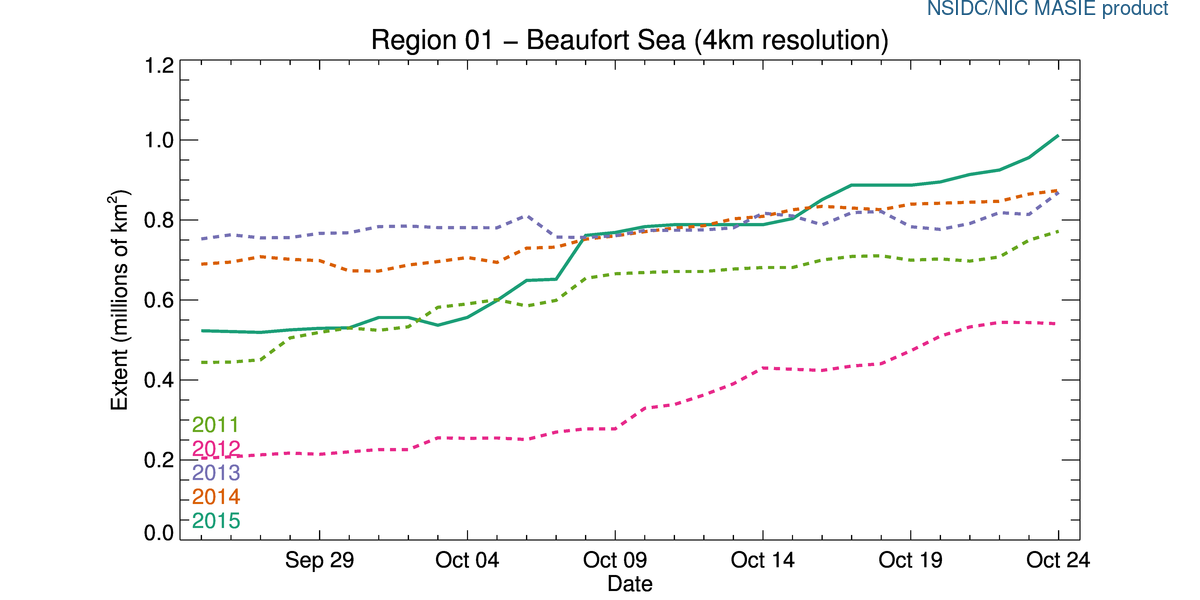
Good news for Southern Beaufort polar bears! Sea ice converging on the north shore of Alaska earlier than any year since 2011 at least, according to NSIDCs regional ice plots (below).

r01_Beaufort_Sea_ts_4km

But wait, their Masie ice maps show it’s actually the earliest since 2008 (although the ice movement onshore was also earlier than 2006 and 2007, see below). And it’s still a full week before the end of October, the first month of Arctic fall (October-December). Lot’s of seal hunting habitat.

This emphasizes the fact that the primary problem faced by Southern Beaufort sea polar bears is not scarce summer ice but by thick sea ice conditions in the spring. Bears photographed near Kaktovik this year were in excellent condition (see here and here, taken by Kelsey Eliasson, Polar Bear Alley). If folks have been seeing starving bears, they haven’t said anything that I’ve been able to find.

Ice maps below.
Continue reading

September minimum 2015 looks like the earliest end of Arctic melt season since 2007

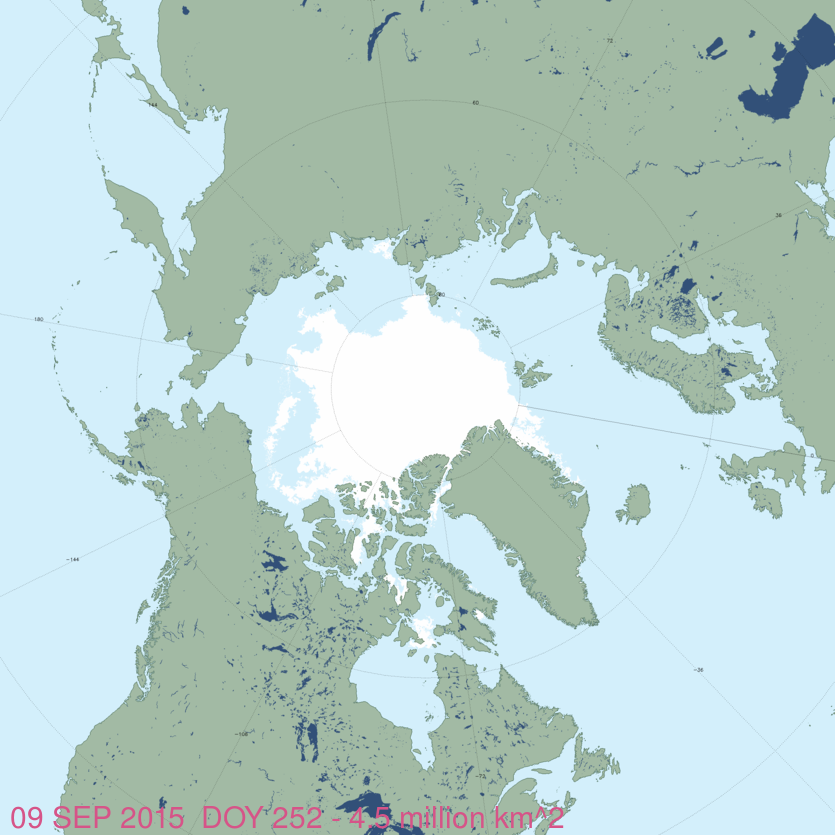
Polar bear habitat in the Arctic Basin this year appears to have reached its apex days earlier than average. As of 12 September, freeze-up of Arctic sea ice had begun. Unless something dramatic happens over the next few days, this will make 2015 the earliest September minimum since at least 2007, using NSIDC data.1

masie_all_zoom_v01_2015252_4km

The two lowest September ice extents (2007 and 2012) were also both later than average; this year’s minimum is the fourth lowest (see chart below).

Of course, all this fuss about how low the September minimum gets is irrelevant to polar bears: they are either on land or in the Arctic Basin, and virtually all are living off stored fat no matter where they are (see Arctic Basin bear here). What matters is when the refrozen ice reaches pregnant females that have preferred denning spots onshore (like in Svalbard) or for bears onshore waiting to return to the ice to hunt (like Davis Strait, and Western and Southern Hudson Bay bears). We won’t know that until October (for Svalbard) or November (for E. Canada).

Again, no sea ice death spiral or polar bears in peril because of it.

UPDATE 15 September 2015, 11:00 am PDT: Just published at the NSIDC website, 2015 minimum has been (tentatively) called at 4.41 mkm2, confirming my figure taken from their interactive graph (see below). However, despite the fact that their own data show that sea ice extent stayed at that value for three days, NSIDC has chosen the last day of that 3-day period rather than the first to represent the 2015 minimum. Go figure. That makes 2015 tied with 2011 for the earliest date for their official records, which seems more than a little self-serving and means I’m not changing the title of my post. NSIDC have also modified slightly some of the official extent figures for past minimums (added below) but it doesn’t really change anything.
Continue reading

Polar bears are not hungriest in summer when scientists are busy in the Arctic

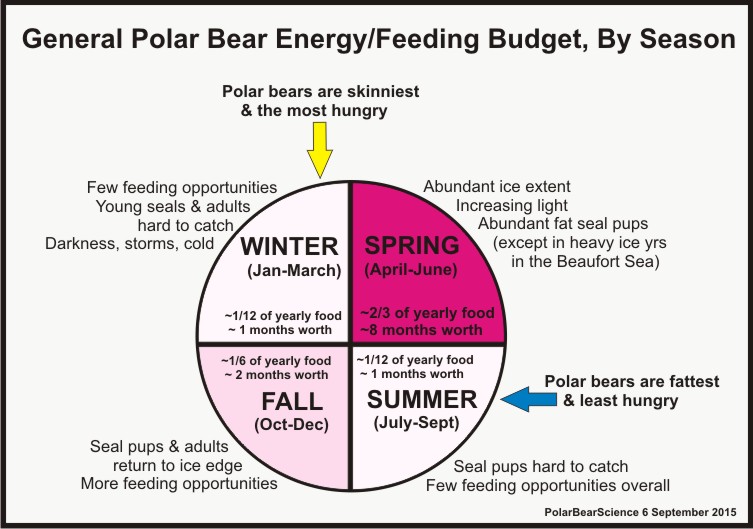
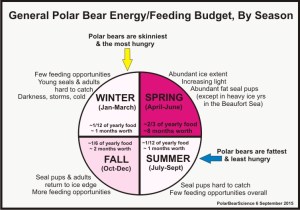
Polar bears are leanest – and therefore, hungriest – at the end of March, not in the summer, as chemist Crispin Halsall stated in a recent article about working in the Arctic.
Polar bear feeding budget_PolarBearScience_6Sept2015

Recent September 1st stories by CNN and the BBC, based on a press release by WWF Russia on 27 August 2015, that five bears in the southern Kara Sea were hanging around a weather station and frightening workers there, apparently prompted chemist Crispen Halsall to make a nonsensical statement about polar bears being at their “hungriest” in summer (first here, reproduced here and picked up yesterday (September 5) by The Guardian here).

“In the path of the polar bears: what it’s like to be an Arctic scientist” (4 September 2015; Crispin Halsall, Reader in Environmental Chemistry at Lancaster University) had this to say:

“The case of Russian scientists trapped in their remote Arctic base by a group of inquisitive yet hungry polar bears does not come as a surprise. By late summer, Arctic sea ice is at a minimum and polar bears are effectively landlocked in coastal areas eagerly awaiting the return of ice during the autumn freeze and the chance to hunt seals again.

The Arctic summer is also the time of year when scientific activities are at their maximum, with bases operating at capacity and fieldwork operations at full flow, particularly in tundra and coastal regions. Polar bears are hungriest when scientists are busiest – “encounters” are inevitable. [my bold]

Polar bears are leanest – and therefore, the hungriest – at the end of winter (when it is more likely to kill with the intent to consume human prey) as stated clearly by Stirling and Øritsland (1995:2603):

Polar bears reach their lightest weights for the year in late March, just prior to the birth of the next cohort of ringed seal pups, which also suggests that it is the success of their hunting in spring and early summer that gives them the body reserves they need to survive through the rest of the year.” [my bold]

A polar bear that has not fed properly in spring – because it was young and inexperienced, too old or too young to defend its kills from bigger, stronger bears, or simply sick or injured – it might be unusually hungry in summer but it’s not the norm.  Polar bears eat nothing or very little over the summer (whether on land or on the ice) because they live off their stored fat – the physiological condition known as ‘fasting.’

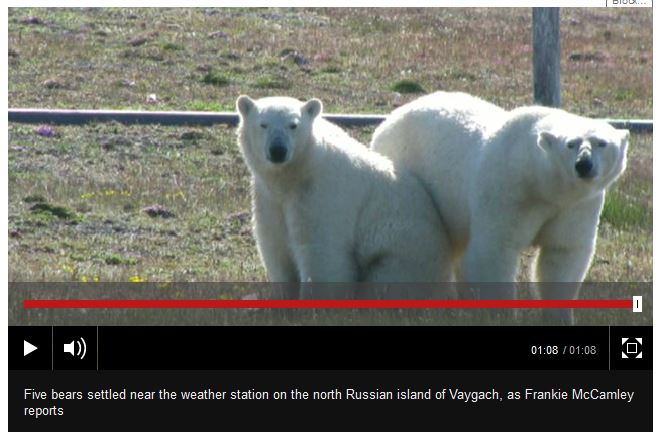
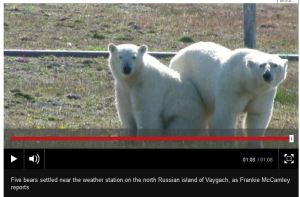
The photos and video in the September 1, 2015 BBC story of the Russian bears shows this: the bears are fat, not skinny (“Video caption: Five bears settled near the weather station on the north Russian island of Vaygach, as Frankie McCamley reports”):
Beseiged by bears Russia BBC video Sept 1 2015

Polar bears might approach humans working in the Arctic during the summer because they are curious and/or bored, and they might attack and even eat humans because they have a drive to eat whenever the opportunity arises. But it’s not because they are “hungriest” in the summer.

References
Stirling, I. and Øritsland, N. A. 1995. Relationships between estimates of ringed seal (Phoca hispida) and polar bear (Ursus maritimus) populations in the Canadian Arctic. Canadian Journal of Fisheries and Aquatic Sciences 52: 2594 – 2612. http://www.nrcresearchpress.com/doi/abs/10.1139/f95-849#.VNep0y5v_gU

Summer polar bear habitat then & now – little impact from 2007 record-breaking sea ice low

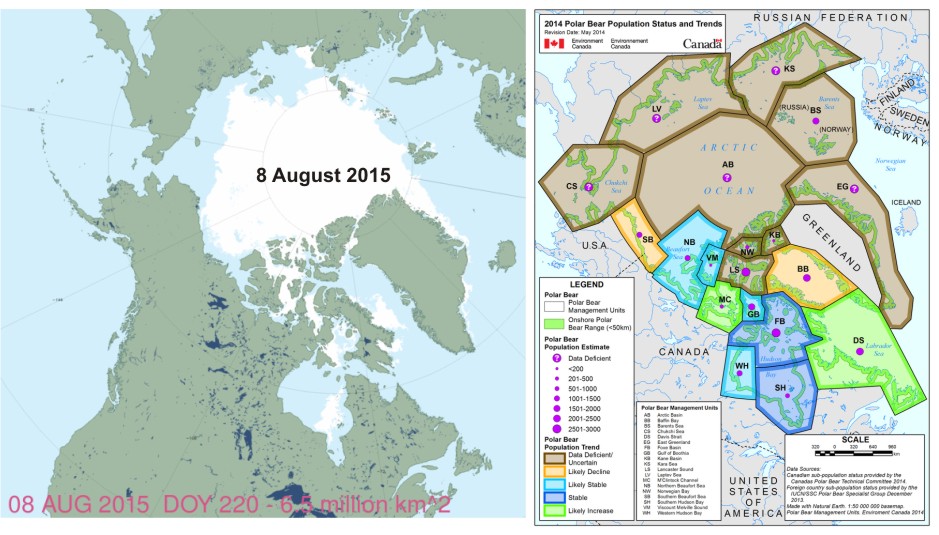
Sea ice looks low for this time of year but how does it compare to 2007, when summer ice habitat for polar bears hit a record-breaking low?  What can the impact of 2007 ice levels on polar bears tell us about what to expect this year?

Sea ice at 2015 Aug 8 vs pb status map_Aug 9 2015 sm

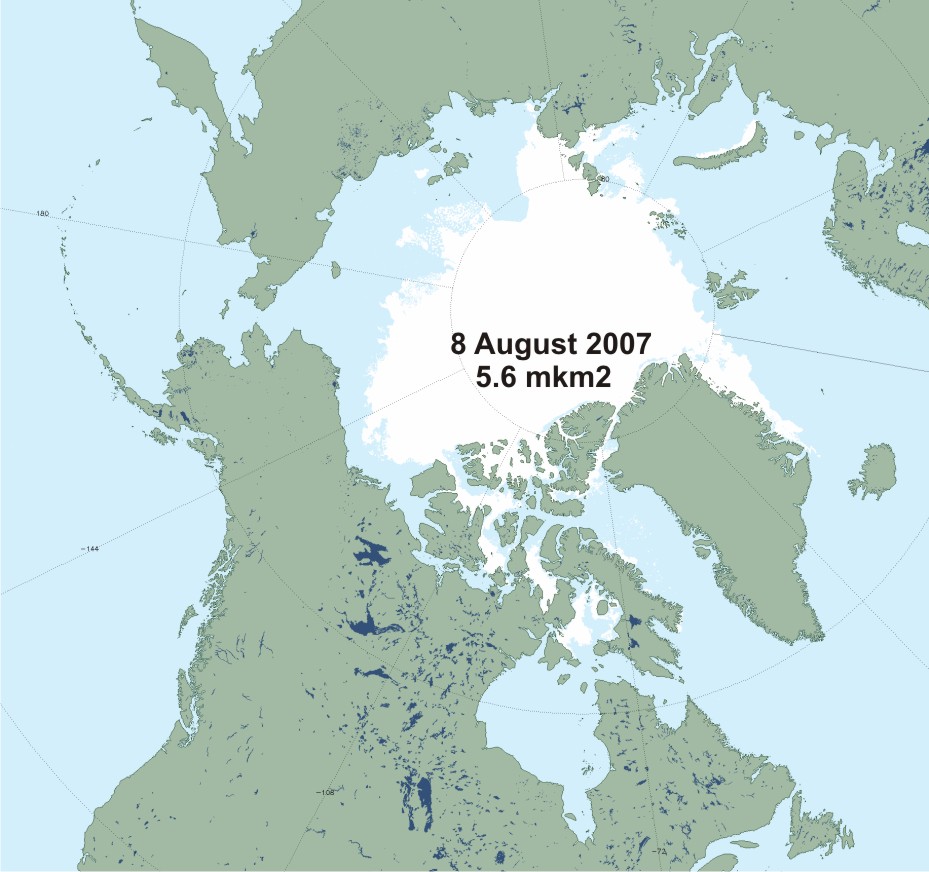
By this date in 2007 (8 August, Day 220, NSIDC Masie map below), there was almost 1 million km2 less ice than there is this year (map above). However, look which polar bear subpopulations not only survived, but thrived, through the 2007 low ice summer: Chukchi Sea, Southern Beaufort, Barents Sea, Davis Strait, Foxe Basin, Western Hudson Bay, and Southern Hudson Bay. That’s all of the subpopulations for which we have recent data.

There is more than a month left in the melt season, of course. However, while 2012 finished with a lower minimum ice extent due to a massive mid-August storm that broke up a lot of ice (Simmonds and Rudeva 2012), by the end of the first week of August (i.e, the 8th), there was more  ice in 2012 than in 2007 and a bit less than this year (2012, 6.3 mkm2; 2007, 5.6 mkm2; 2015, 6.5 mkm2).

This means if less summer ice for a longer period of time impacts polar bear health and survival, conditions in 2007 should have had a noticeable impact on polar bears around the world. They didn’t. That suggests even if this September sea ice minimum is as low as 2007, it won’t have any negative impact on polar bear health or survival. The most profoundly negative documented impacts have come from thick sea ice in spring or  suboptimal spring snow levels (Crockford 2015) and the evidence shows that variation in the extent of summer ice is simply irrelevant to polar bears.

Sea ice at 2007 Aug 8_polarbearscience
Continue reading

Hudson Bay breakup later than average, longer hunting season for polar bears

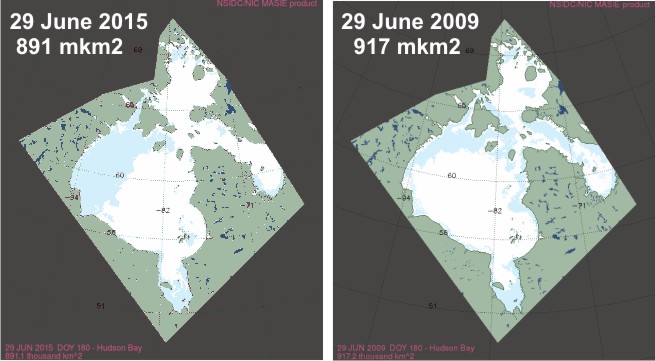
Due to the atypical pattern of sea ice melt on Hudson Bay this year, 2015 will definitely be a later than average breakup year – perhaps not as late as 1992 but maybe almost as late as 2009. Easing into the first days of Arctic summer, there is still a lot of polar bear habitat left on Hudson Bay, especially in the east.

Hudson Bay breakup 2015 vs 2009 at 29 June_MASIE

Although official breakup in 2009 was only a little later than usual (9 July), bears came ashore about the same time (after mid-August) as they did in 1992, when breakup was very late (30 July). With the pattern this year being so unusual (and the melt so slow over the last few weeks), who knows how late it could be before the last bears leave the ice in 2015?

There is definitely more sea ice this year on the bay than there was last year, when breakup was about average for the last 24 years.

UPDATE 2 July 2015: CIS weekly ice coverage graphs added to the end of this post. Hudson Bay ice highest since 2009 and Davis Strait highest since 1994! Have a look.
Continue reading

USGS promotes another flawed polar bear model: GHG emissions still “primary threat”

It’s still based on the same flawed ecological premise as all previous models – it assumes that sea ice was a naturally stable habitat until human-caused global warming came along. It also uses slight-of-hand maneuvers to correlate declining summer sea ice and declining polar bear population numbers.

PolarBearCV1_USGS_2009

Just because they keep repeating the same hype doesn’t make it true.
Continue reading

Polar bear habitat update: many bears on the ice in Hudson Bay, lots of sea ice globally

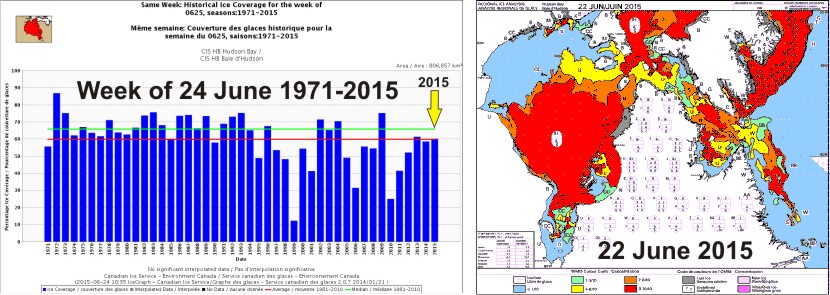
Polar bear habitat over Hudson Bay was average this week (at 60% coverage), despite the odd pattern of breakup – but the end of spring in the Arctic is only 5 days away and there is still plenty of polar bear habitat in all regions.

Hudson Bay breakup 2015 June 22 and 24_sm

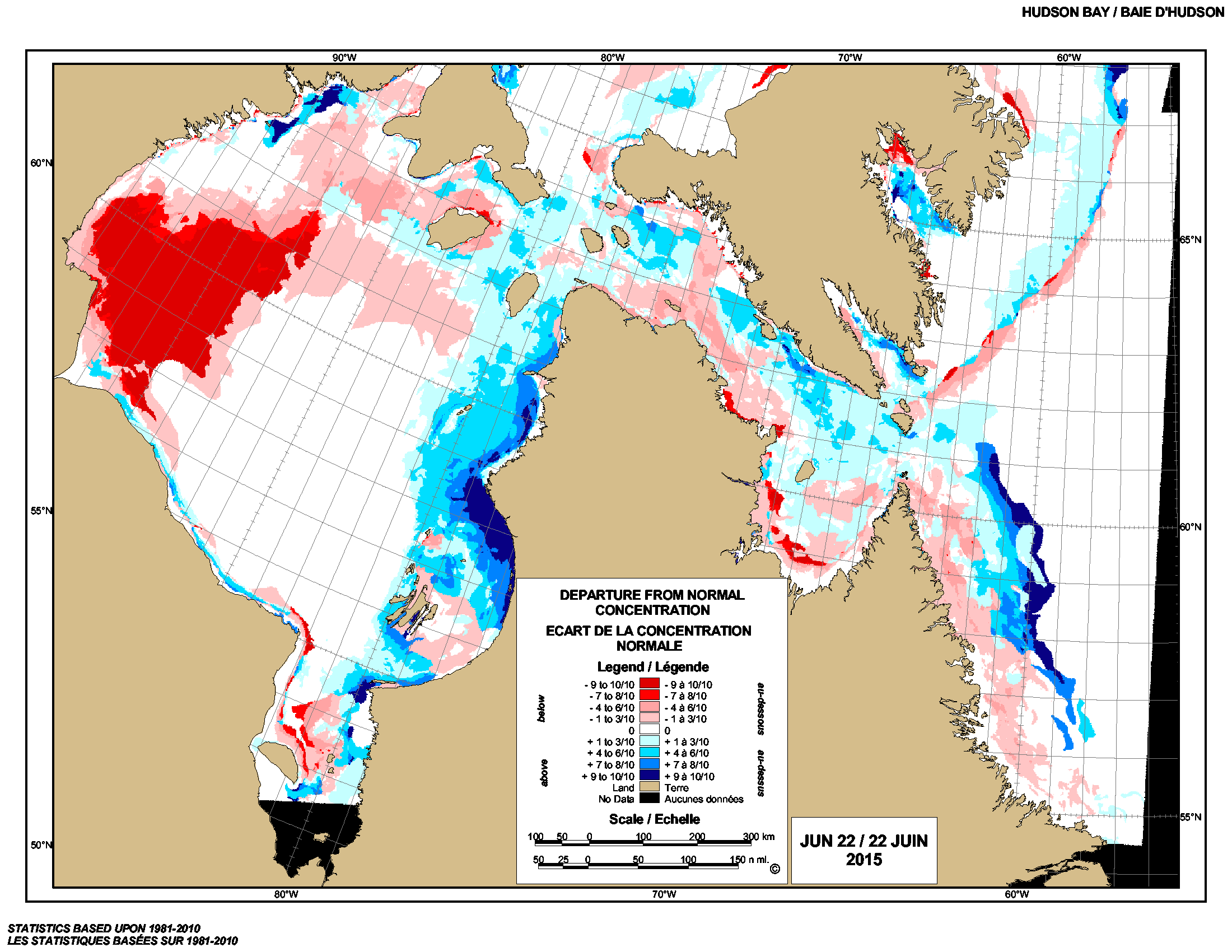
According to the Canadian Ice Service (CIS), there is still more ice in the eastern portion of the bay than usual and much less in the northwest (Fig. 1 below). There is far more ice than average ice in Hudson Strait, the approach to southern Davis Strait.

Figure 1. Hudson Bay sea ice, difference from average at 22 June 2015. Blue is less than average, red is more than average. CIS.

Figure 1. Hudson Bay sea ice, difference from average at 22 June 2015. Blue is less than average, red is more than average. CIS. Click to enlarge.

Continue reading

Many polar bears cubs seen in Svalbard this year, says Norwegian biologist

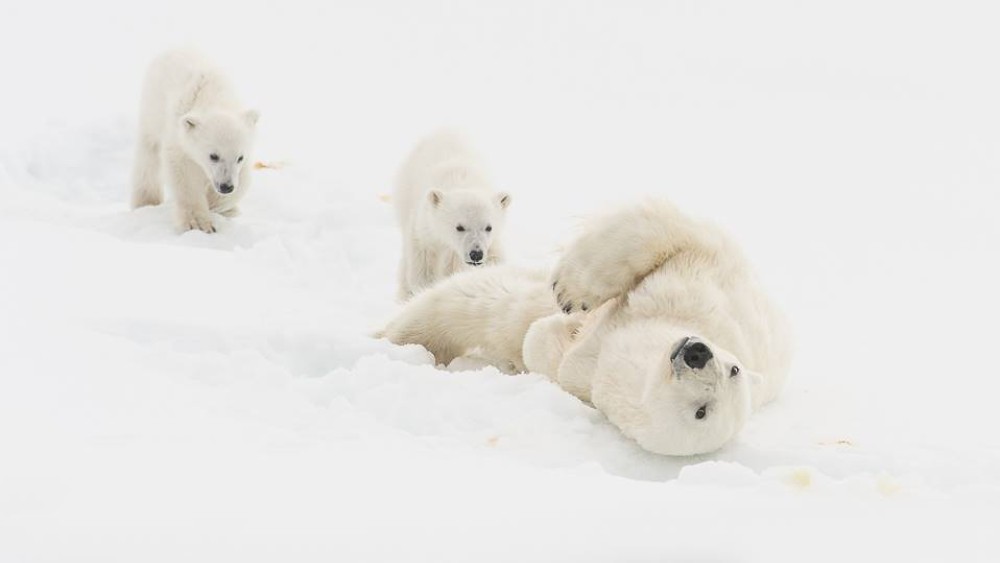
Good news from Norway: polar bears around Svalbard are in excellent condition this spring and many females with new cubs have been spotted. This is a marked turn around from conditions just last year.

 Roy Mangersnes / Wildphoto


Roy Mangersnes / Wildphoto

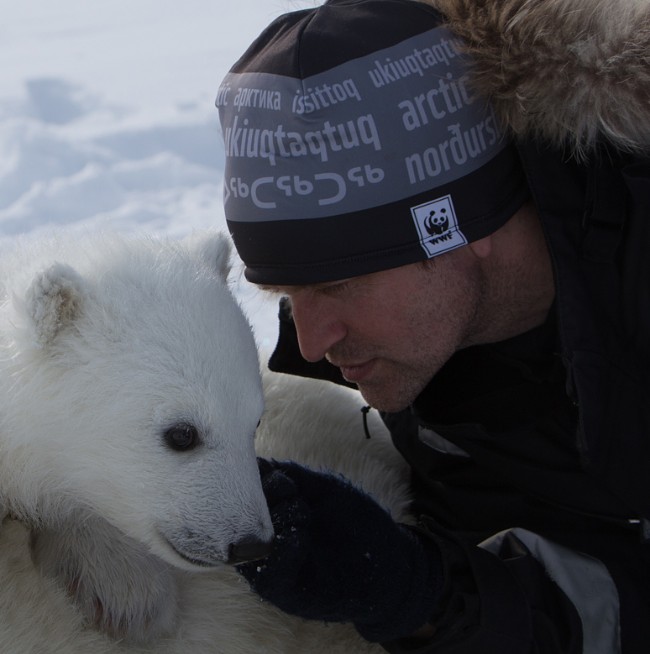
According to a Norwegian news outlet yesterday, Jon Aars (Fig. 1, below), from the Norwegian Polar Institute, confirms that this has been an excellent year for polar bear cubs around Svalbard because there has been abundant sea ice near denning areas on the east coast.

Figure 1. Biologist Jon Aars with a Svalbard cub.

Figure 1. Biologist Jon Aars with a Svalbard cub.

Continue reading