Tag Archives: Barents Sea

Polar bear habitat update early spring 2018

Spring in the Arctic is April-June (Pilfold et al. 2015). As late April is the peak of this critical spring feeding period for most polar bear populations, this is when sea ice conditions are also critical. This year, as has been true since 1979, that sea ice coverage is abundant across the Arctic for seals that are giving birth and mating at this time as well as for polar bears busy feeding on young seals and mating.

Polar_Bear_male on sea ice_Alaska Katovik Regehr photo_April 29, 2005_sm labeled

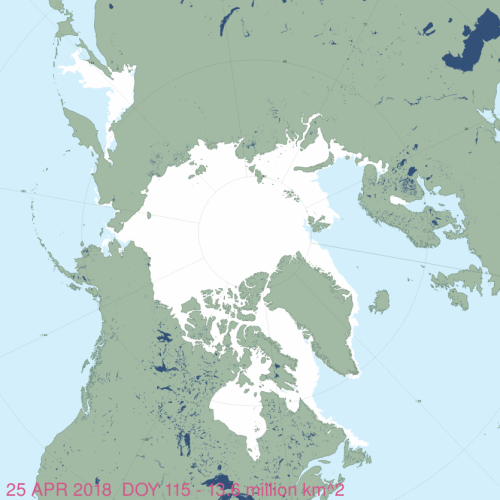
Below is a chart of sea ice at 25 April 2018, showing sea ice in all PBSG polar bear subpopulation regions:

masie_all_zoom_4km 2018 April 25

Some Arctic subregions below, in detail. Continue reading

Less Svalbard polar bear habitat during the early Holocene than now

Svalbard in the western Barents Sea has recently had less sea ice extent than it had in the 1980s, especially in the west and north, but this is not unprecedented.

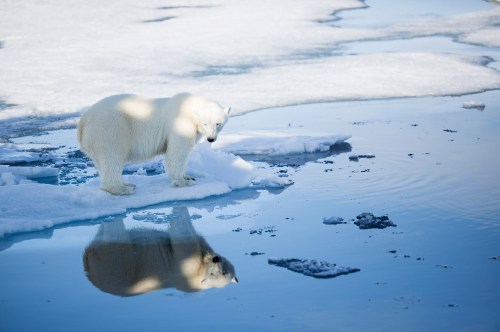
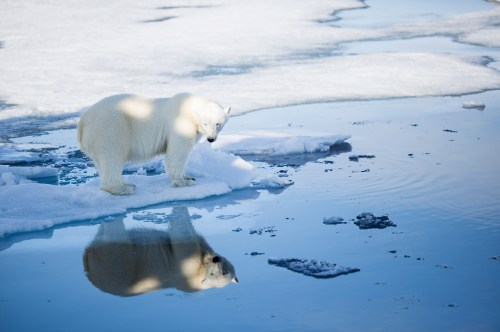
Svalbard polar bear_Aars August 2015-NP058930_press release

New evidence from clams and mussels with temperature-sensitive habitat requirements confirm that warmer temperatures and less sea ice than today existed during the early Holocene period about 10.2–9.2 thousand years ago and between 8.2 and 6.0 thousand years ago (based on radio carbon dates) around Svalbard. Barents Sea polar bears almost certainly survived those previous low-ice periods, as they are doing today, by staying close to the Franz Josef Land Archipelago in the eastern half of the region where sea ice is more persistent.

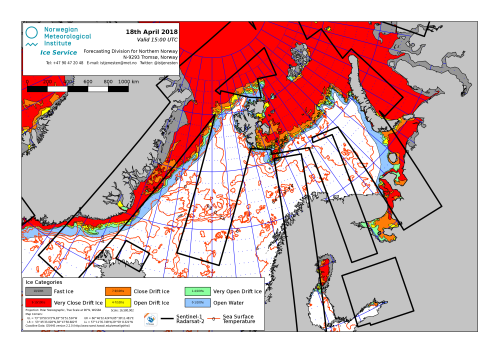
As this sea ice chart for 18 April 2018 shows, ice this month has been virtually absent from the west and north coasts of the Svalbard Archipelago, while Franz Josef Land to the east is surrounded by highly concentrated pack and land-fast ice.

Barents Sea ice 2018 April 18 NIS

From a new paper by Jan Mangerud and John Svendsen (2018) [my bold]:

Svalbard, located between 74° and 81°N, is the warmest place on Earth at this latitude (Drange et al., 2013). This is because of the North Atlantic Current and large-scale atmospheric circulation which transport warm water and air masses from lower latitudes northwards across the Atlantic and along the coast of Norway to Svalbard (Figure 1). Yet, during the Holocene Thermal Maximum, the climate of Svalbard was considerably warmer than at present.

The transition from Younger Dryas cold to Holocene Thermal Maximum warm conditions took place very rapidly, according to records from nearby Greenland (Taylor et al. 1997), warming in “steps” of about five years each over a period of about 40 years. This was at least as fast, if not faster than, recent Arctic warming between the 1980s and 2015. And since polar bears of the Barents Sea and adjacent Arctic areas appear to have survived this change to Holocence Thermal Maximum conditions, it challenges the notion that recent warming has been (or will be) too fast to allow polar bears to survive without huge changes in their present distribution (Amstrup et al. 2007).
Continue reading

Franz Josef Land is a sea ice refugium for most pregnant Barents Sea polar bears

Consensus polar bear expert Andrew Derocher has been busy over the last few weeks, expounding a story of doom regarding Svalbard area polar bears (e.g. here and here), ridiculing the suggestion that Franz Josef Land is viable alternate habitat for Barents Sea bears, especially pregnant females looking for a place to den and give birth. But the facts say otherwise.

Svalbard polar bear_Aars August 2015-NP058930_press release

Below are the long answers, with references and ice maps, to the questions Derocher asked in his 21 December 2017 tweet (above), a refreshing change from the ‘take my word for it, I’m the official expert’ answer one gets from him, along with derogatory slurs directed at those who don’t share his pessimism.

UPDATED 1 February 2019. Two references added.

Continue reading

Svalbard polar bear habitat higher than average – here’s what that looks like

Polar bear habitat around Svalbard in the Barents Sea is currently slightly above average for 23 June 2017: this short post records what that amount of ice looks like according to the Norwegian Ice Service (NIS).

Svalbard ice extent 2017 June 23_NIS from archive

Compare to 2015 at the same date, the year that the last polar bear count was conducted for the Svalbard region, when many cubs were seen and the bears were reported in excellent condition:

Svalbard ice extent 2015 June 23_NIS from archive

Continue reading

IUCN PBSG insists the 2015 Barents Sea polar bear count was not an increase

Similar to the spin on the 2013 Baffin Bay/Kane Basin polar bear population survey, the IUCN Polar Bear Specialist Group now insists the latest count of the Barents Sea subpopulation is not evidence of an increase in numbers since 2004, as the leader of the study announced in 2015.

Svalbard polar bear_Aars August 2015-NP058930_press release

This is Part 2 of the big surprises in the latest version of the polar bear status table published by the IUCN Polar Bear Specialist Group (PBSG) on 30 March 2017. See last post here regarding the PBSG population size estimates that no longer concur with the 2015 Red List assessment, including the global total — even though PBSG members wrote the report (Wiig et al. 2015, and its Supplement).

Here I want to focus on the results of subpopulation surveys that were made public after the 2015 Red List assessment was published, particularly the Barents Sea estimate.

While the 2013 Baffin Bay and Kane Basin estimates (SWG 2016) have been added to the new PBSG table, any suggestion that these might indicate population increases are strong discounted. Similarly, contrary to initial reports by the principal investigators of the survey, the PBSG insist that the Barents Sea population has not actually increased since 2004, which you may or many not find convincing.

Continue reading

Polar bear habitat message for the year end: 2016 Arctic ice extent same as 2010

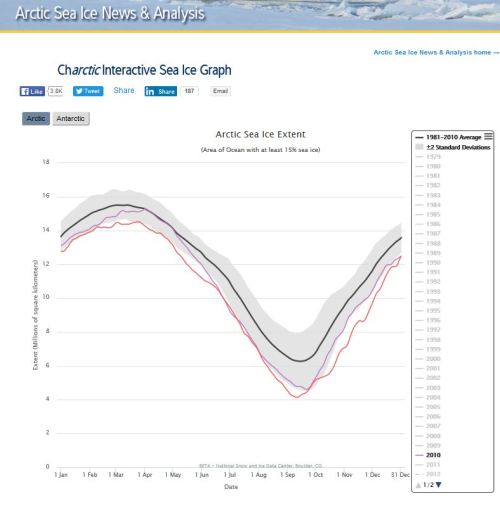
According to NSIDC daily sea ice interactive graph,  there was ever so slightly more ice on 31 Dec 2016 than on that date in 2010. However, the corresponding ice maps show just how differently that ice was distributed.

sea-ice-at-31-dec-2016_vs-2010_nsidc-interactive

Recall that in 2010, there was no huge die-off of polar bears attributed to reduced amounts of sea ice in the fall (or to reduced ice in summer, for that matter) because there was no catastrophic die-off at all.

Continue reading

Fall Arctic ice growth often differs regionally: 2016 compared to other years

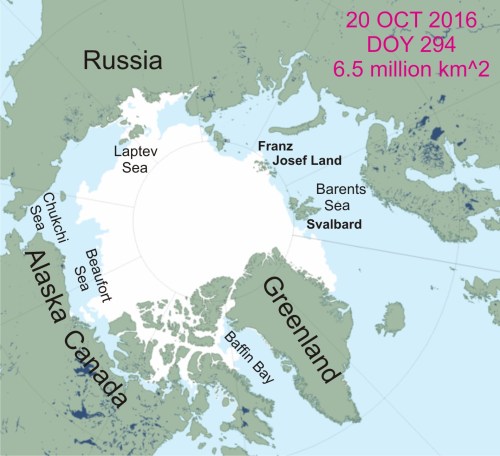
Arctic sea ice is spreading out quickly from its central basin summer refuge – according to this NSIDC Masie ice chart, it has already grown more than 2 mkm2 beyond the annual minimum reached in early September. Ice is already pushing south into the eastern Beaufort and the archipelago of Franz Josef Land in the Barents Sea.

masie-sea-ice-2016-oct-20-cropped-and-marked_polarbearscience

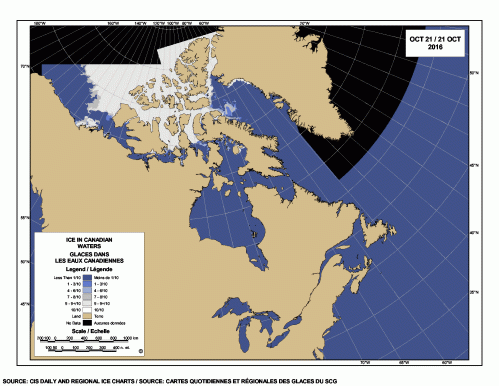
Over the next couple of weeks, shorefast ice will start forming along the coasts of North America and Eurasia (see the first bits off Alaska in the 21 October CIS map below), which will eventually meet the expanding Arctic Basin pack to fill the Basin and Canadian Arctic Archipelago with ice – as it has done for eons.

sea-ice-extent-canada-2016-oct-21_cis

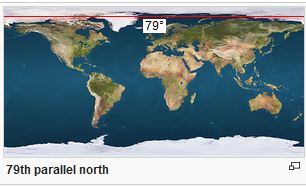
The evidence from the last decade or so suggests that by the end of October, most of the Arctic north of the 79th parallel (see map below) will be filled with ice – although the Chukchi Sea (north of the Bering Strait) may not fill until sometime in November:

79-th-parallel-north_wikipedia

Polar bears usually resume hunting as soon as sea ice conditions permit in the fall, since it’s their last chance to top up their fat reserves before the dark and cold of winter when hunting may become next to impossible.

I’ve copied ice charts from the Masie archives for some previous years at 31 October below.

Continue reading

Polar bear habitat this fall shaping up fast – more like 2010 than 2007

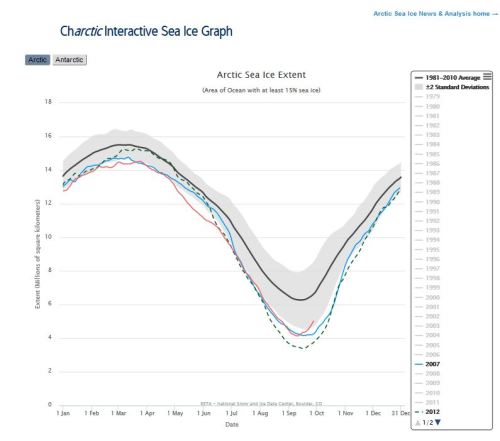
Arctic sea ice tied 2007 for extent at the September minimum less than 3 weeks ago but with the refreeze proceeding much faster than 2007, seals will soon be returning to the ice edge and polar bears will be back to feeding like they did in 2010.

sea-ice-at-28-sept_2016_vs-2007_2012_5-point-0_nsidc-interactive

Sea ice extent less than 5.0 mkm2 lasted less than 6 weeks (23 August – 28 September), according to NSIDC.

Continue reading

Recent studies show Sept ice of 3-5 mkm2 did not kill polar bears off as predicted

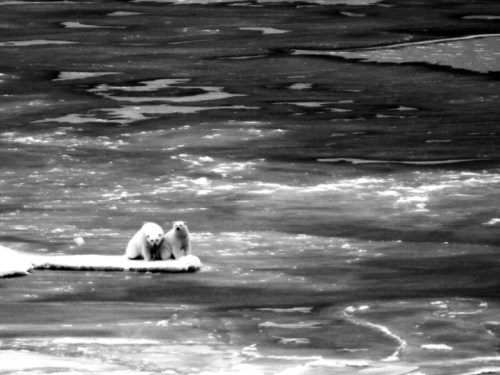
The annual Arctic sea ice minimum for 2016 is imminent and the hand-wringing about polar bear survival has already begun. While this year is shaping up to be another very low sea ice minimum in the Arctic – not as low as 2012 but lower than as low as 2007 (previously the 2nd lowest since 1979) – contrary to predictions, several recent studies show that such low sea ice coverage in summer has had no (or very limited) negative effects on polar bear health and survival. In fact, for polar bears in some areas low summer sea ice has been quite beneficial (although these are not the populations that polar bear specialists predicted would do better).
polar_thin_ice Jessica Robertson_USGS

Since low summer extents of recent magnitude (3.0 – 5.0 mkm2) are clearly not any sort of threat to polar bears, it seems improbable that even an ice-free (≤ 1.0 mkm2) summer (e.g. Wang and Overland 2015) would be devastating to the species [don’t forget Cronin and Cronin 2016: they’ve survived such conditions before] – as long as conditions in spring allow for the necessary concentrated feeding on young seals.
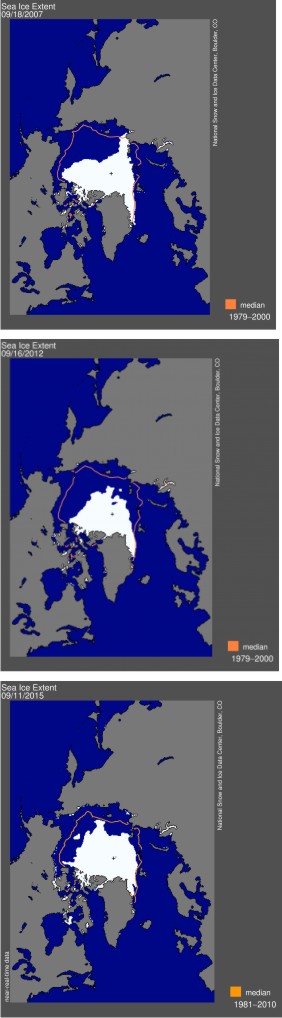
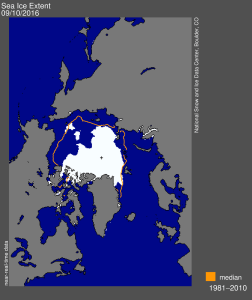
sea-ice-mins_2007_2012_2015_polarbearscienceAbove: Top, minimum at 2012 (16 Sept, 3.41 mkm2, lowest since 1979); Center, 2007 (18 Sept, 4.17 mkm2); Bottom, 2015 (9 Sept, 4.50 mkm2), from NSIDC. Below: sea ice at 10 Sept 2016, 4.137 mkm2 – minimum not yet called).
sea-ice-extent-2016-sept-10_nsidc

Recall that in 2006, the IUCN Polar Bear Specialist Group based their conservation status of ‘vulnerable’ (likely to become threatened within the next 45 years due to reduced habitat) on the predictions of sea ice specialists (see 2008 update here).

Sea ice experts in 2005 predicted such low summer sea ice extents as polar bears have endured since 2007 (3.0 – 5.0 mkm2) would not happen until 2040-2070, at which time PBSG biologists said that >30% of the world’s bears would be gone.

Evidence to the contrary comes from polar bear specialists working in the Chukchi, Beaufort, and Barents Seas – and in Southern Hudson Bay – since 2007. Overall, the latest IUCN Red Book assessment (2015) put the global population size at 22,000-31,000 (or about 26,500).

All of this means that those polar bear experts were wrong: polar bears are more resilient to low summer sea ice conditions than they assumed.

UPDATE 2 January 2017: I’ve added some quotes from the original USGS reports that explicitly state their dire predictions for 2050 that differ from the predictions made by the IUCN Polar Bear Specialist Group.
Continue reading

Five years of polar bear habitat at June 20 around the Arctic

Five years worth of sea ice maps for the same date is hard to come by in this country, since the Canadian Ice Service does not archive their daily sea ice maps. However, due to some forethought, I have at hand ice maps going back to 2012 for the longest day of the year for Canada and archives for other regions provide similar perspective at the solstice.

Polar_Bear_male on sea ice_Regehr photo_March 21 2010_lg

Few photos of polar bears in June likely exist – too early for most bears to come ashore and the ice too unstable for humans to be offshore [photo above is dated March].

Compare the five maps for Canada and eastern Alaska below. Notice the differences for Hudson Bay: it may seem ironic, but 2012 (which had the lowest September minimum since 1979 due to an August storm) had the most typical Hudson Bay breakup/melt pattern compared to previous years. [Keep in mind this recent post about how much ice can remain even when almost none is visible on the ice maps]

In many regions, polar bear hunting efforts are seldom successful after early June because young-of-the-year seal pups have taken to the water to feed, which means the only prey still on the ice are predator-savvy adults and subadults that have an easy time escaping in the rapidly breaking up ice fields. Bears that come ashore in June likely are not missing much – a little less ice than usual at this time of year is not going to make much difference.

Overall, despite doom and gloom predictions we heard in March 2016 (“wintertime extent hits another record low”), sea ice extent (courtesy NSIDC) at 20 June 2016 was the same at this date as it was in 2010 and 2012 at this time of year – which essentially marks the end of the primary feeding period for polar bears (except for those that live in the Canadian Arctic Archipelago, where seals give birth a bit later in the spring).

Sea ice at 20 June_2016 vs 2012 and 2010_NSIDC interactive

And did polar bears die in droves due to conditions in 2010 or 2012, in any subpopulation around the Arctic affected by low sea ice levels? No, they did not. In fact, the subpopulation that had the most recent survey done (Svalbard portion of the Barents Sea – 2015) was not only found to be thriving but numbers had increased markedly (42%) over 2004 levels. Now that’s resilience!

Continue reading