Tag Archives: facts

Four years of PolarBearScience and polar bear habitat for ‘Christmas in July’

The traditional gift for a 4th anniversary is flowers, so to celebrate 4 years of blogging at PolarBearScience, I’m highlighting a CBC article from last year that featured the work of photographer Dennis Fast, who captured some fantastic images of polar bears cavorting in a field of fireweed near Churchill (see screencap below from the 2015 CBC feature, more at the DailyMail for 21 August 2015). Great photography – it deserves another look.
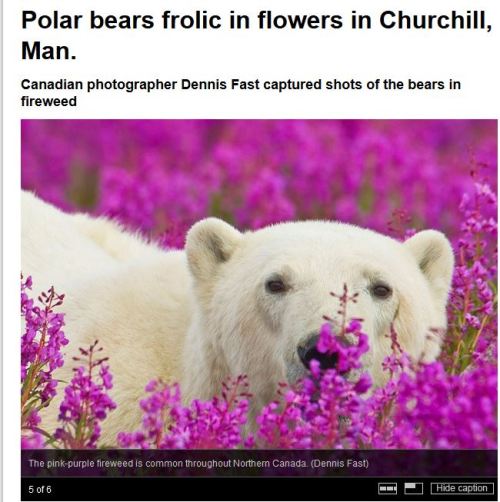
Churchill pbs in wildflowers_CBC feature_August 2015

Hard to imagine that four years have passed! Cheers to Hilary Ostrov (who blogs at The view from here) for getting me over my initial frustrations with WordPress – without which I’d never have made it this far – and for her much-appreciated typo alerts [Hilary is still dealing with on-going health issues but we talk on the phone from time to time.]

And thanks of course to my readers, who’ve made it all worthwhile. I truly appreciate all your tips and feedback. The word is getting out, via tweets and retweets, reblogging, personal blog and Facebook discussions, as well as links back to particular posts in the comments of news articles and other internet content, and straight up media mentions. The sum of it all has brought us to this point: 495 posts, over 764,000 views, and more than 411,000 visitors. Not too shabby for a single issue science blog, eh?

I thought of adding a Tip Jar button for next year, but decided against it – instead, if you’d like to support my efforts here, you can buy my polar bear attack novel (give it as a gift if you’re not keen on this type of fiction). I’d be just as grateful. See the sidebar for the link.

But back to business – below find sea ice maps of polar bear habitat at 25 July (‘Christmas in July’), this year as well as some previous years.
Continue reading
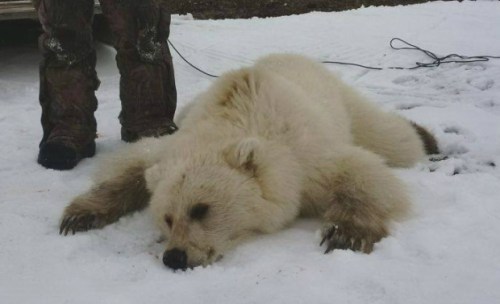
BREAKING: DNA results prove so-called polar bear hybrid was a blonde grizzly

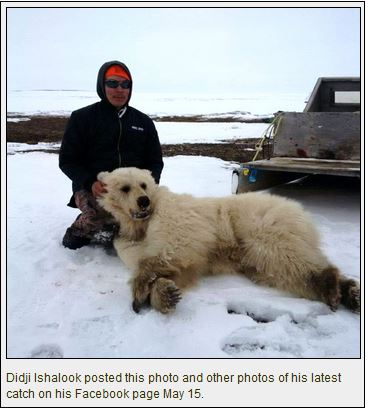
All the hubris last month about polar bear x grizzly hybrids, based on an unusual-looking bear killed near Arviat, has turned out to be wishful thinking by those who’d like to blame everything to do with polar bears on climate change. An awful lot of “experts” now have egg on their faces. That “hybrid” was just a blonde grizzly, as I warned it might.

grizzly-polar-bear-hybrid_Arviat 2016 Didji Ishalook

According to one report, Nunavut wildlife manager Mathieu Dumond said:

“Some otherwise pretty renown bear biologists jumped on the hybrid bear story without even knowing what they were talking about,” Dumond said.

“I think it was something blown out of proportion, with the wrong information to start.”

Gee, ya think? CBC ran a story too. But the CBC don’t really admit (see below) that they were the first out of the gate on this story and started the media madness. It was the CBC that relied on the opinion of a black bear expert from Minnesota (who likely only saw a picture) – but since he was willing to say it was a hybrid and that its presence was a sign of climate change, they went with it.  See “Grolar or pizzly? Experts say rare grizzly-polar bear hybrid shot in Nunavut: Expert says interbreeding may be happening more frequently due to climate change” (CBC 18 May 2016).

For background, see these recent posts on this putative hybrid and the issues on hybridization it spawned:
Another alleged grizzly-polar bear hybrid shot but it’s not a sign of climate change

Polar bear hybrid update: samples sent for DNA testing to rule out blonde grizzly

Five facts that challenge polar bear hybridization nonsense

Most polar bear hybrids said to exist have not been confirmed by DNA testing

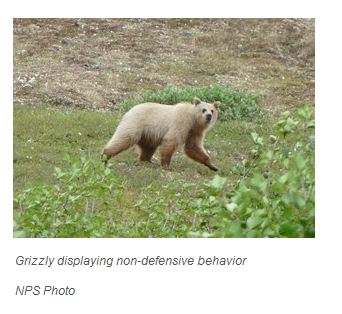
Blonde grizzlies, like the one pictured below (which I posted the day the story broke), are actually a proven sign of natural variation within species – a critical lesson in biology that should be the take-home message here. [ADDED: 2007 Alaska Fish & Wildlife Service Newsletter article on colour variation in black and brown/grizzly bears. h/t Wayne D]

“Paging Professor Derocher”: PBSG biologist and University of Alberta professor Andrew Derocher gave so many interviews to the media on this issue I lost count – he fed the media frenzy almost single-handedly. Well, except for granddaddy of polar bear experts Ian Stirling, who said (via the Toronto Star)[update: Toronto Star published correction]:

“I think it’s 99 per cent sure that it’s going to turn out to be a hybrid,” said Ian Stirling, an emeritus research scientist with Environment Canada and adjunct professor at the University of Alberta.”


Grizzly light_NPS photo

Quotes from today’s story below.
Continue reading

Five years of polar bear habitat at June 20 around the Arctic

Five years worth of sea ice maps for the same date is hard to come by in this country, since the Canadian Ice Service does not archive their daily sea ice maps. However, due to some forethought, I have at hand ice maps going back to 2012 for the longest day of the year for Canada and archives for other regions provide similar perspective at the solstice.

Polar_Bear_male on sea ice_Regehr photo_March 21 2010_lg

Few photos of polar bears in June likely exist – too early for most bears to come ashore and the ice too unstable for humans to be offshore [photo above is dated March].

Compare the five maps for Canada and eastern Alaska below. Notice the differences for Hudson Bay: it may seem ironic, but 2012 (which had the lowest September minimum since 1979 due to an August storm) had the most typical Hudson Bay breakup/melt pattern compared to previous years. [Keep in mind this recent post about how much ice can remain even when almost none is visible on the ice maps]

In many regions, polar bear hunting efforts are seldom successful after early June because young-of-the-year seal pups have taken to the water to feed, which means the only prey still on the ice are predator-savvy adults and subadults that have an easy time escaping in the rapidly breaking up ice fields. Bears that come ashore in June likely are not missing much – a little less ice than usual at this time of year is not going to make much difference.

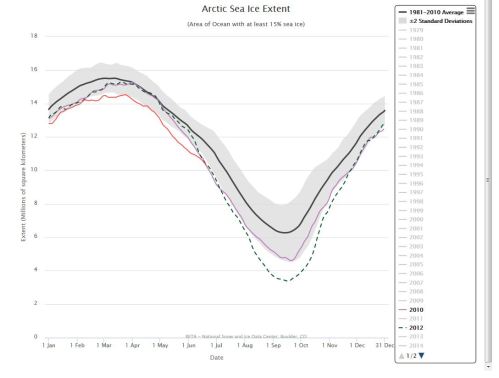
Overall, despite doom and gloom predictions we heard in March 2016 (“wintertime extent hits another record low”), sea ice extent (courtesy NSIDC) at 20 June 2016 was the same at this date as it was in 2010 and 2012 at this time of year – which essentially marks the end of the primary feeding period for polar bears (except for those that live in the Canadian Arctic Archipelago, where seals give birth a bit later in the spring).

Sea ice at 20 June_2016 vs 2012 and 2010_NSIDC interactive

And did polar bears die in droves due to conditions in 2010 or 2012, in any subpopulation around the Arctic affected by low sea ice levels? No, they did not. In fact, the subpopulation that had the most recent survey done (Svalbard portion of the Barents Sea – 2015) was not only found to be thriving but numbers had increased markedly (42%) over 2004 levels. Now that’s resilience!

Continue reading

PBSG failure to acknowledge 2015 IUCN polar bear update drives the public here

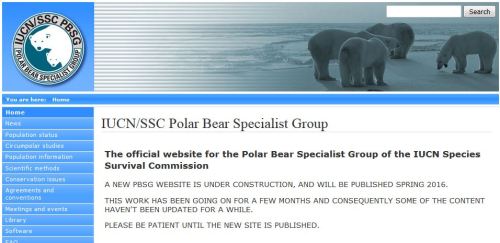
It is now past the 15 June 2016 mark and the IUCN Polar Bear Specialist Group (PBSG) has still not acknowledged the 2015 IUCN Red List update on the status of polar bears. See the screencap below, taken this morning.

PBSG at 16 June 2016

This notice has been up since 14 January 2016 and no reference or link to the November 2015 IUCN Red List update has been posted, even though PBSG members authored the report (pdf here)!

What they may not realize is that their silence just drives people who search the internet looking for up-to-date population and conservation status info on polar bears to this site. My posts on population size and conservation status have been the most popular posts since November.

It’s that kind of attention that has made this site so popular: PolarBearScience will reach 750,000 views within the next couple of weeks (see “Blog Stats” lower right) – that’s right, 3/4 million views in less than four years. More than 400,000 readers have come here since the end of July 2012 to find out what’s really going on in the world of polar bears. Continue reading

Some inconvenient polar bear facts supported by scientific literature

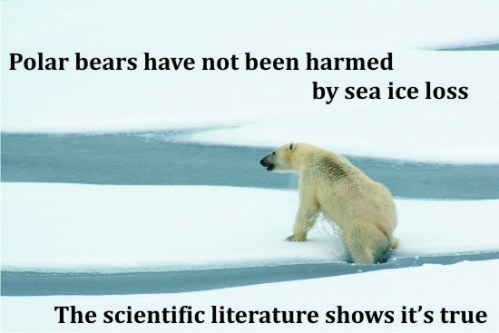
The evidence that polar bears have not been harmed by recent declines in sea ice is contained in the scientific literature, no matter what some researchers say when they talk to the media.

USGS w_polarbearscience_caption 2016

Here’s a few of those facts (not all, by any means), with the references to back them up:
Continue reading

Polar bear hybrid update: samples sent for DNA testing to rule out blonde grizzly

That putative polar bear hybrid shot in Arviat last week has been sent for DNA testing.

hybrid-bear_didji-ishalook-15 May2016_facebook

Just out from NunatsiaqOnline (24 May 2016): Nunavut biologist sends possible “grolar” bear DNA for analysis: Unusual bear killed in Arviat could just be a blonde grizzly bear

Additional details confirm the animal shot was a female, which could account for the fact it was described as “small”. The Nunavut biologist who sent in the sample for testing warned it could also be a blonde grizzly, as I pointed out last week.

UPDATE 24 May 2016: Comments added below from a Toronto Star news report below on the hybrid identity of this animal.

UPDATE 28 May 2016: See this 27 May 2016 follow-up post (Most polar bear hybrids said to exist have not been confirmed by DNA testing) for details on unconfirmed sightings or reports of hybrids.
Continue reading

Silence of the IUCN Polar Bear Specialist Group on the 2015 IUCN Red List assessment

It’s been six months and still the IUCN Polar Bear Specialist Group has not updated its website with a link to the 2015 IUCN Red List assessment for polar bears, which was made public with some fanfare in November 2015. They are not the only group still ignoring the Red List decision but their silence is the most damning – the IUCN is the parent body of their organization.

On May 7th, I wrote to the IUCN Red List folks (redlist@iucn.org) about this situation (excerpt below) but as yet have received no reply.

PBSG website banner May 10 2016

Continue reading

Beaufort Sea fractured ice due to strong Beaufort Gyre action – not early melt

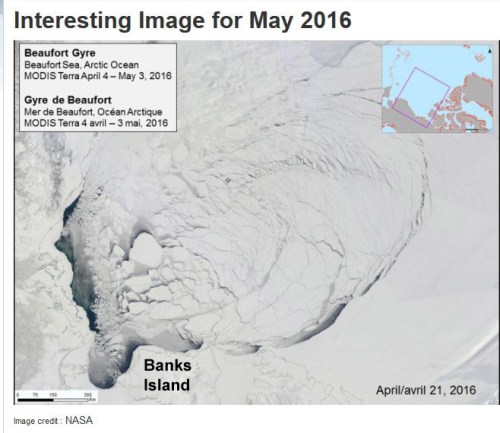
The Canadian Ice Service has a cool NASA animated video showing the Beaufort Gyre in action – you can actually see the solid mass of ice crack and swirl west and north under the pressure of the massive corkscrew current – see original here (tips on getting yourself oriented in the video below the screencap) and view below, for Apri 4- May 3, 2016:

Beaufort Gyre video screencap_21 April 2016_labelled

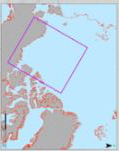
Note that the video is oriented with Banks Island on the bottom and the shore of Alaska along the left-hand side, as if the locator map provided was rotated as below:

Beaufort Gyre video screencap_locator map_rotated

The big ‘bite” of ice being torn out to the south of Banks Island is the Amundsen Gulf.

The caption for the NASA video says this (my bold):

“MODIS Terra imagery taken between April 4 and May 3, 2016 of the Beaufort Sea. The animation highlights the gradual ice breakup due to the Beaufort gyre.

So, early breakup here is due to Beaufort Gyre action – not early seasonal melt.
Continue reading

Tracking polar bears in the Beaufort Sea in April 2016 and early polynya formation

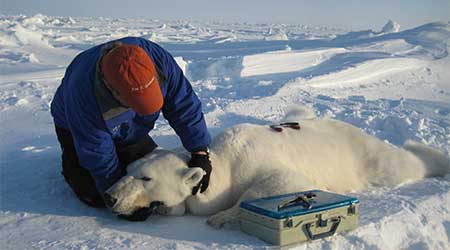
putting_collar_on_polar_bear_slider_USGS

Here’s the update on the polar bears fitted with satellite collars or ear tags in the Beaufort by USGS biologists over the last two years. Five new bears were added last month, which means there are now thirteen bears being tracked. Ice conditions are somewhat different than they have been in the past but concluding that such a situation means trouble is premature, I think (see here). Continue reading

Longest-swimming polar bear lost less weight than if she had stayed onshore

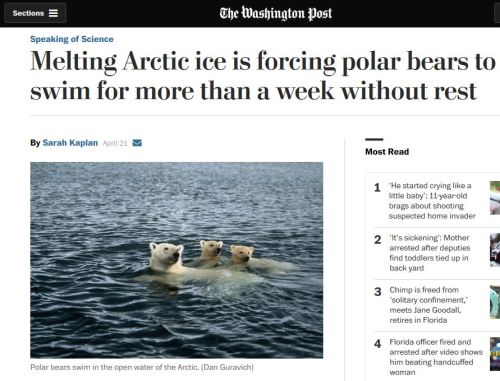
Recent media hype over swimming polar bears in the Southern Beaufort has been quite spectacular (still going strong today at the Washington Post here) but a close look at relevant data shows the message is bogus. Researchers admit (in their methods section) they couldn’t tell if bears said to have swum “non-stop” actually hauled out for half a day or more to rest on small ice flows invisible to satellites and astonishingly, the bear getting all the media attention – who swam the longest of any bear – lost less weight than a bear would have done simply sitting on shore for the same length of time.

Washington Post_swimming polar bears_snapshot 21 April 2016

Continue reading