Tag Archives: Hudson Bay

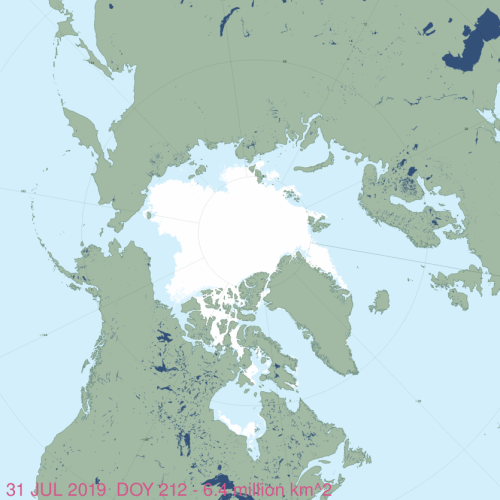
Sea ice adjacent to all major polar bear onshore summer refugia at 31 July 2019

For all the hand-wringing over sea ice extent this year and its supposed similarity to 2012, what is truly remarkable is that at the end of July ice remains adjacent to every single major terrestrial summer refugia known to be important for polar bears. Those refugia sites include (from west to east, starting in the Chukchi Sea): Wrangel Island, western Chukotka, Severnaya Zemlya, Franz Josef Land, East Greenland, virtually all the islands of the Canadian Arctic Archipelago (including Southampton Island in Foxe Basin and the southwest and eastern coasts of Baffin Island), and Western Hudson Bay.

masie_all_zoom_4km 2019 July 31

Few bears spend the entire summer onshore along the Alaska coast: most still spend the summer on the sea ice and move with it as it contracts toward the Arctic Basin, as do many bears in the Barents, Kara, East Siberian, and Chukchi Seas. Until a few weeks ago, however, there was enough ice present that Beaufort Sea bears could go ashore if they wanted to do so. Continue reading

RCMP on manhunt spot a fat polar bear far from the coast of Western Hudson Bay

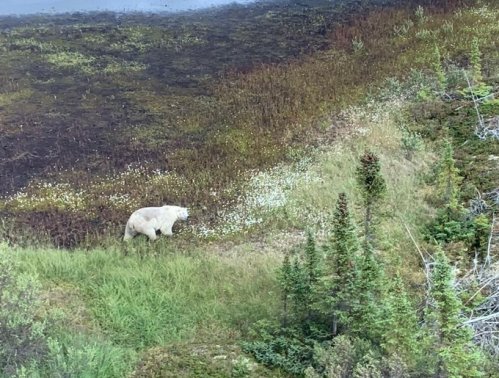
In the course of a manhunt for two murder suspects wanted in British Columbia, Royal Canadian Mounted Police posted a photo of a fat polar bear they spotted about 200 km north of Gillam, Manitoba.

Fat pb spotted by RCMP outside Gillam during manhunt 27 July 2019

This fat bear – as would any others that might be spotted in the area – is a pregnant female from the Western Hudson Bay subpopulation intent on finding a secure place to dig a den in the permafrost where she can stay cool over the summer and give birth this winter.

However, true to form, The Guardian (28 July 2019) ludicrously suggests those on the hunt for the murder suspects are now at risk of a polar bear attack:

The threat of a polar bear attack has become a reality for the huge Canadian police and military contingent searching for the teenage duo suspected of shooting dead Australian tourist Lucas Fowler, his US girlfriend and a university botanist.

Continue reading

First Churchill problem polar bear report of the season: its only incident caught on film

We are constantly told things are getting worse for polar bears, especially those in Western Hudson Bay, because the ice-free season there was predicted to decline earlier than other regions. It hasn’t turned out that way but that does not stop the public rhetoric of doom or NGOs pleading for funds.

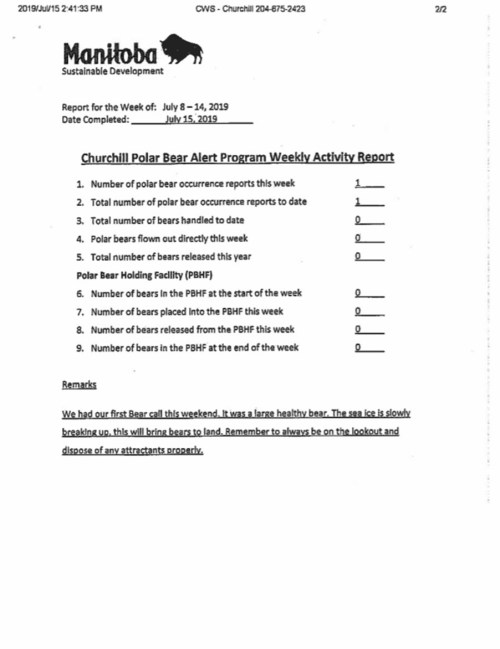
Last week, the Town of Churchill made public its first problem polar bear report of the year but oddly, it has only one entry.  This is the first time I’ve seen such a sparse first report:  since 2015, the first few incidents of the season have been subsumed into a first week report (issued no earlier than the first week of July) that announces the arrival of many bears on land.

Churchill problem bears_week 1_2019 July 8-14

Is this report of an isolated incident an attempt by Polar Bear Alert officials to make sure the first report of the season was not issued weeks later than usual? Or was it posted in isolation because the official response to the incident was caught on video and shared on social media (see below)?

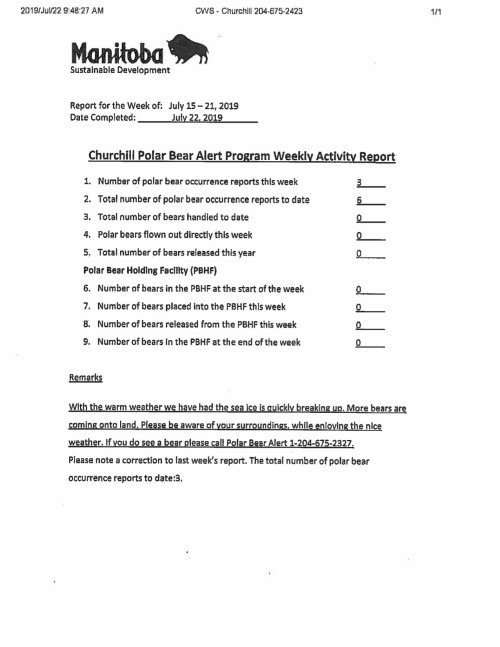
UPDATE 22 July 2019: Published early this afternoon by the Town of Churchill, the problem polar bear report for the 2nd week of the season claims an error in last week’s report that they only just noticed when preparing this week’s report (but a full 24 hours after this blog post was published – but that’s probably a coincidence). Below is the report for week 2 (15-21 July 2019), showing that three incidents occurred last week.

Churchill problem bears_week 2_2019 July 15-21

Continue reading

Now 20 years with no trend in ice breakup dates for Western Hudson Bay polar bears

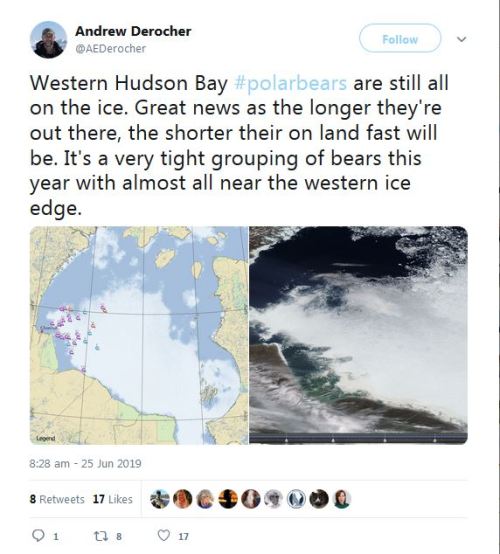
Straight from the horse’s mouth: all polar bear females tagged by researchers around Churchill in Western Hudson Bay last year were still on the ice as of 25 June. With plenty of ice still remaining over the bay, spring breakup will be no earlier this year than it has been since 1999. Contrary to predictions of ever-declining ice cover, the lack of a trend in sea ice breakup dates for Western Hudson Bay is now twenty years long (a hiatus, if you will) and yet these bears are repeatedly claimed to have been seriously harmed in recent years by a loss of sea ice.

Derocher 2019 WHB collared females 25 June all bears still on the ice

In fact, WH bears have faced relatively few ‘early’ years of sea ice breakup and breakup has never come before the 15th of June. The earliest recent spring breakup date did not come in 2012 – when sea ice hit a summer record low – but in 1999, when Hudson Bay sea ice suddenly began to melt by late June rather than mid-July (Cherry et al. 2013; Castro de la Guardia et al. 2017; Lunn et al. 2016). And this year, as has been the case since 1999, breakup looks to be about two weeks later (give or take a week or so, at around 1 July), than was the case in the 1980s and early 1990s.

In other words, there has been no escalation of breakup dates since 1999: there has been no declining trend in breakup dates for Western Hudson Bay polar bears for 20 years (and no trend in fall freeze-up dates either).

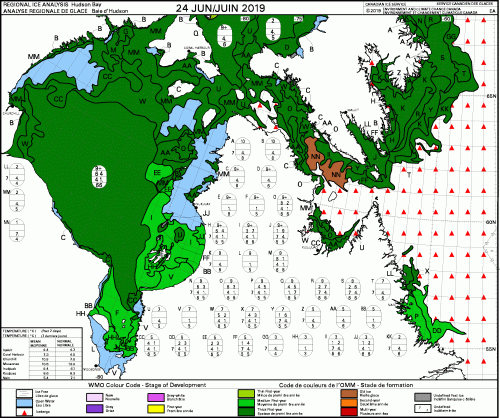
UPDATE 26 June 2019: Here is the latest sea ice chart for the week of 24 June 2019 from the Canadian Ice Service (all that dark green is thick first year ice >1 m thick):

Hudson Bay weekly stage of development 2019 June 24
Continue reading

Polar bear habitat update at mid-June: more than enough for survival

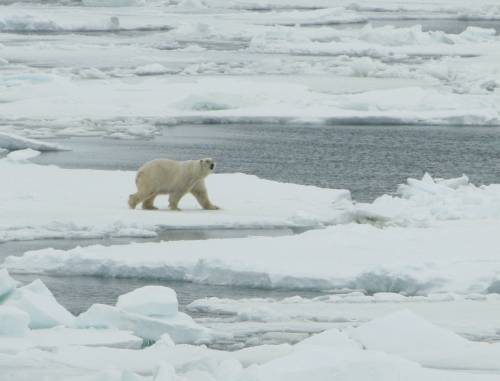
Here we are at the middle of June, when most polar bears are pretty much done with hunting seals for the season. And despite hand-wringing from some quarters, sea ice extent is down only marginally from average at this time of year and certainly not enough to impact polar bear survival.

Polar_bear Bering Sea 2007 USFWS lg

Given the large expanse of open water in the Southern Beaufort so early in the season, one resident pessimist insists those polar bears are “challenged” by the lack of ice. If he is right, there should be reports of dozens upon dozens of skinny and dying bears along the coast of Alaska this summer. If not, he will pretend he never suggested any such thing.

So far, despite the early loss of ice in some regions, there have been no reports of polar bears ashore unusually early. Hudson Bay still has lots of thick first year ice, so despite the overall reduced Arctic ice coverage, none of the three Hudson Bay polar bear populations are facing the earlier-than-usual sea ice breakup this year as we keep being promised will show up. In fact, there hasn’t been a significantly early breakup in Western Hudson Bay since 2010 (see previous posts here and here).

Continue reading

Polar bear habitat update: open water primarily due to winds pushing pack ice

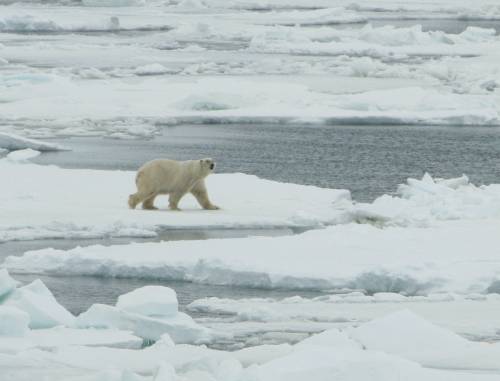
Here is a look at what polar bear habitat looks like this year at the end of May compared to previous years. It helps put any predictions of impending doom into perspective.

Polar_bear Bering Sea 2007 USFWS lg

This is the time year when declining sea ice gets some people all worked up. However, declining ice is normal at this time of year and there is always variation in where the most open water appears first. At this time of year, there isn’t much ice ‘melt’ going on. Rather, what we are seeing is the opening up of shore leads and polynyas by winds.

Continue reading

Derocher admits Western Hudson Bay polar bear population may not be declining

Earlier this year, I challenged a journalist to ask to see the data used by Andrew Derocher and his colleagues to support their repeated claims that Western Hudson Bay polar bears are having trouble surviving. It almost happened.
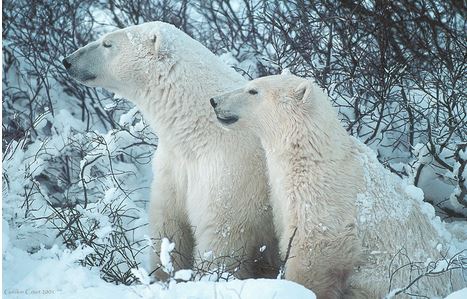
Polar bears_Gordon Court_Committee on the status of endangered wildlife in Canada Dec 2018

David Rose, writing for The Mail on Sunday, has produced an excellent feature on the conflict between Nunavut Inuit and biologists about polar bear management, got Andrew Derocher to tell the truth about current polar bear health and survival.

Or, to be more precise, to waffle a bit on his standard message of doom:

“Even Prof Derocher, who is convinced the bears’ long-term future is bleak, accepts that ‘the wheels are not coming off yet’, while ‘some bear populations are doing fine’. In West Hudson Bay, there has been ‘a recent period of stability’, he says, and though ‘we were seeing starving bears, starving cubs on land, that seems to have slowed down’. Then again, the computer models ‘are not great on the 5 – 10 year time-frame’, and it was possible that although the Arviat bears might look healthy now, they may be about to ‘fall off a cliff’.” [my bold]

This concession by Derocher suggests that Western Hudson Bay bears indeed are thriving, because he’s the guy who holds all the data. But he couldn’t help adding that disaster might be just around the corner.

But did he actually produce the data that show what’s been happening with cub survival or the body condition of females since 2004? Apparently not — but his admission that conditions are not as bleak as he continually portrays them suggests he is covering for data that says the same: polar bears in Western Hudson Bay are doing just fine and Inuit are right to be worried.

This may be as good as it gets unless the people of Nunavut can force Derocher to show his data.

Read the whole story here: “Why all you’ve been told about these polar bears could be WRONG: Animals driven to the edge of their natural habitat by shrinking ice have become one of the defining images of climate change, but Inuits who know the predators have a very different story.” (The Mail on Sunday, David Rose, 30 December 2018).

Continue reading

CBC hypes “bleak” Churchill polar bear fate with unsupported claims & falsehoods

Over the weekend in Canada, the CBC ran a polar bear news feature that is now available online (“Polar bears in peril: the bleak future of Churchill bears,” The National, CBC, 3 December 2018). It gave polar bear biologist Nick Lunn of Environment Canada free rein to spread unsubstantiated claims and outright falsehoods about the status of Western Hudson Bay polar bears and sea ice. Apparently, he and the CBC learned nothing from National Geographic‘s fiasco over their starving’ polar bear video last year: they still think the public will be swayed to “act” on human-caused global warming if a persuasive expert tells them that polar bears are on their way to extinction. I expect many were convinced otherwise, since the facts are available for all to see.

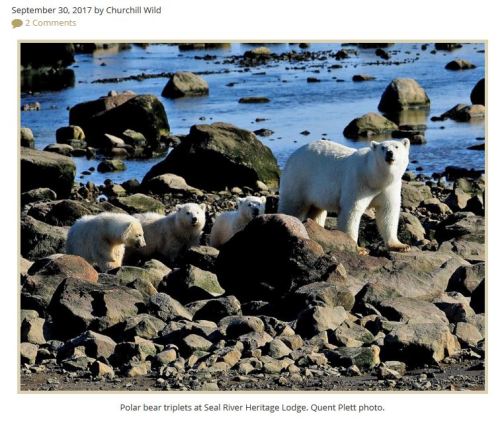
No triplet litters born since 1996? Nonsense, as the photo below (from 2017) shows.

Triplet litter at Seal River Lodge 2017 Quent Plett photo

The CBC video is described this way:

“They are a majestic icon of Canada’s North, but polar bears have also come to symbolize climate change. And scientists say the future for one particular population of polar bears in northern Manitoba is dire.

Continue reading

Hudson Bay polar bear habitat is highest in more than two decades for this time of year

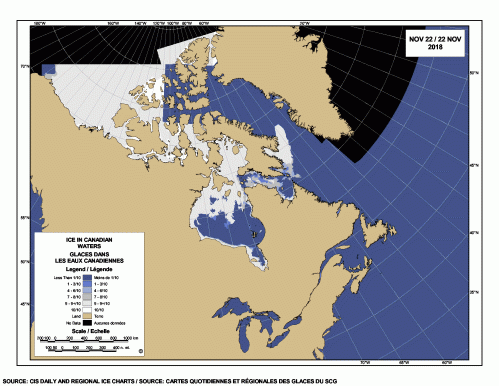
More ice in Hudson Bay and adjacent regions than we’ve seen at this time of year for more than two decades: not since 1993 has there been as much polar bear habitat in the 2nd-last week of November.

Sea ice Canada 2018 Nov 22

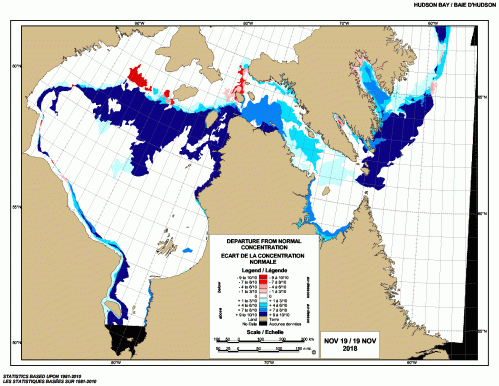
The anomaly chart for this week is almost all blue:

Hudson Bay weekly departure from normal 2018 Nov 19

Other years back to 1994 had much less ice for the 2nd-last week in November, as the charts below show. Colour charts are only available from 2004.

Continue reading

Nunavut government has a draft plan to deal with unsafe numbers of polar bears

In the news today: “Nunavut Draft Plan Says There Are Actually Too Many Polar Bears In Territory” (CTV News via The Canadian Press, Bob Weber, 12 November 2018).

Polar Bear seaweed_Lorraine Brandson Churchill_taken Nov 2012

Polar bear eating seaweed near Churchill, Manitoba (November 2012). Lorraine Brandson photo.

From the Canadian Press story:

“There are too many polar bears in parts of Nunavut and climate change hasn’t yet affected any of them, says a draft management plan from the territorial government that contradicts much of conventional scientific thinking.

The proposed plan — which is to go to public hearings in Iqaluit on Tuesday — says that growing bear numbers are increasingly jeopardizing public safety and it’s time Inuit knowledge drove management policy.

“Inuit believe there are now so many bears that public safety has become a major concern,” says the document, the result of four years of study and public consultation.”

I’ve noted previously that there were two fatal polar bear attacks in Hudson Bay this summer. Both of them happened outside local communities and both happened early during the ice-free period (when bears would have been onshore for only a few weeks). Neither incident can be reasonably blamed on lack of sea ice, an extended ice-free period, or lack of management of problem polar bears within or near communities. The bears involved in the August attack were described as being in good condition.

Update 13 November 2018: See The Guardian‘s take on this story, by a different writer. Despite potential to talk to other polar bear specialists about this issue, only Derocher is quoted. Is no one else talking? “Polar bear numbers in Canadian Arctic pose threat to Inuit, controversial report says” (The Guardian, 13 November 2018).

Update 14 November 2018: See a new CBC story on Inuit perspectives on this issue. “Nunavut community says Inuit lives need to be protected over polar bear population” (CBC News, 14 November 2018).

Continue reading