In case you missed it back on 27 Februrary 2019. See the original here (with photos).**
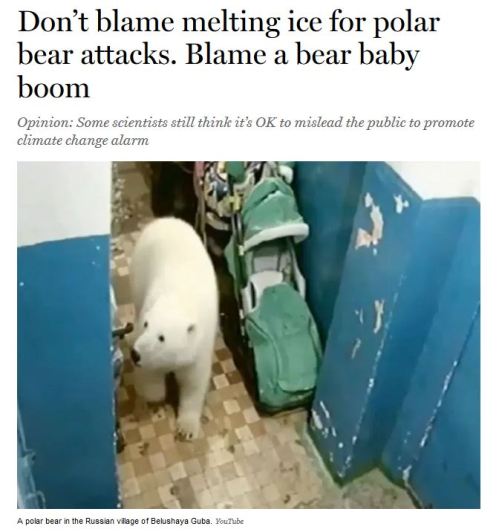

In case you missed it back on 27 Februrary 2019. See the original here (with photos).**
Comments Off on My International Polar Bear Op-Ed at the Financial Post on 27 February 2019
Posted in Advocacy, Conservation Status, Polar bear attacks, Population, Summary
Tagged attacks, Churchill, essay, fatal, Novaya Zemlya, Nunavut, opinion, polar bear, problem, sea ice
Abundant ice in Svalbard, East Greenland and the Labrador Sea is excellent news for the spring feeding season ahead because this is when bears truly need the presence of ice for hunting and mating. As far as I can tell, sea ice has not reached Bear Island, Norway at this time of year since 2010 but this year ice moved down to the island on 3 March and has been there ever since. This may mean we’ll be getting reports of polar bear sightings from the meteorological station there, so stay tuned.
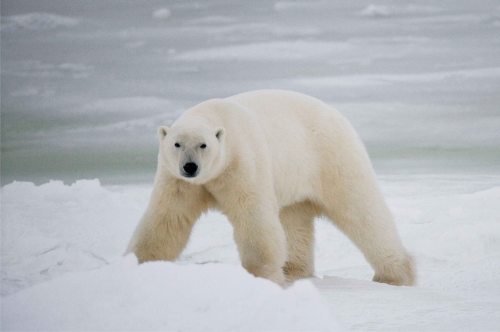
Sea ice extent as of 11 March 2019, from NSIDC Masie:
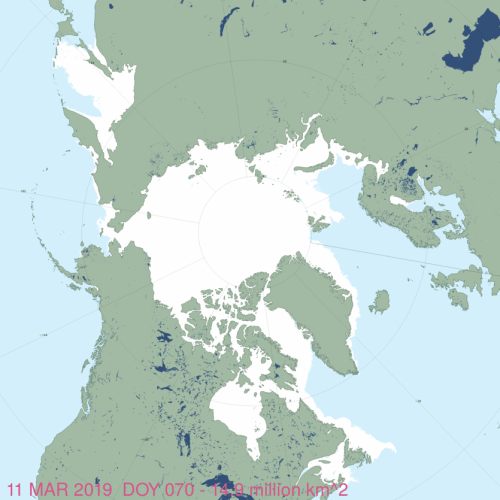
Much of the ice that was blown out of the Bering Sea early in the month has returned and ice in the Gulf of St. Lawrence on the East Coast of Canada is the highest its been in years, threatening to impede ferry traffic between Nova Scotia and Newfoundland, as it did in 2015 and again in 2017. The fishing season off Newfoundland might also be delayed by the heavy ice, as it was in 2017.
Comments Off on Polar bear habitat update: abundant sea ice across the Arctic, even in the Barents Sea
Posted in Polar bear attacks, Sea ice habitat
Tagged Barents Sea, Bear Island, Bering Sea, facts, Gulf of St. Lawrence, heavy ice, Labrador, Newfoundland, polar bear, science, sea ice, Svalbard
From CBC News late yesterday (28 February 2019) comes the news that a polar bear seen skulking around the homes of a small coastal town in Labrador this week has had residents on edge and authorities on high alert. If tragedy struck, the St. Lewis road was blocked by snow and the only way in or out was by helicopter. Message: polar bears are highly dangerous and a bear prowling a community is a very real threat to safety.
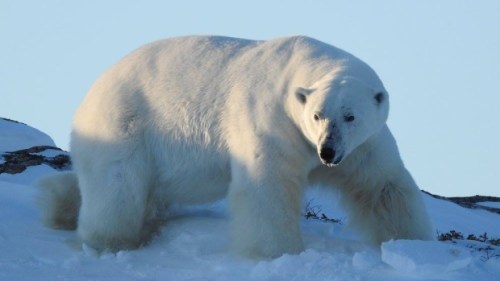
This bear visited Black Tickle in Labrador a few years ago. Edwin Clark photo.
According to a CTV News follow-up, while the road to St. Lewis was cut off because of a recent snowstorm for most of the week, wildlife officers were able to get in today (Friday 1 March). Sighting about 100km north in Charlottetown earlier in the week are believed to be the same bear.
The last sighting of the animal was Thursday morning (28 Feb), so the bear may now have left of its own accord. No one seems to have captured a photo.
However, the fear felt by residents of St. Lewis (population 200) in this story is palpable, especially after the terrifying visuals from the well-publicized invasion by more than 50 polar bears at Belushaya Guba on Novaya Zemlya last month.
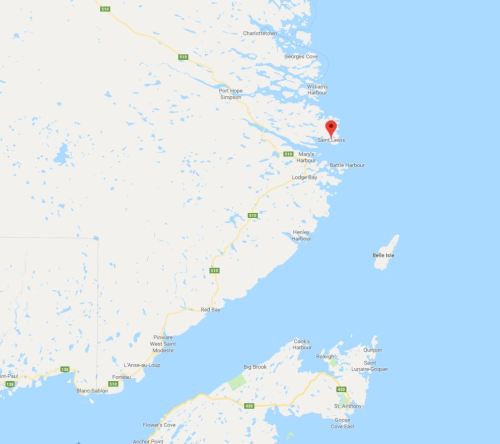
St. Lewis is located at the red marker; Charlottetown is the third town to the north. Both are just north of the Strait of Belle Isle that separates Labrador from the island of Newfoundland.
Comments Off on Polar bear prowling small Labrador town cut off by storm had authorities on high alert
Posted in Polar bear attacks, Sea ice habitat
Tagged attack, dangerous, invasion, Labrador, polar bear, safety, sea ice, sighting, St. Lewis, threat, winter
Inuit paying the price of rising bear populations
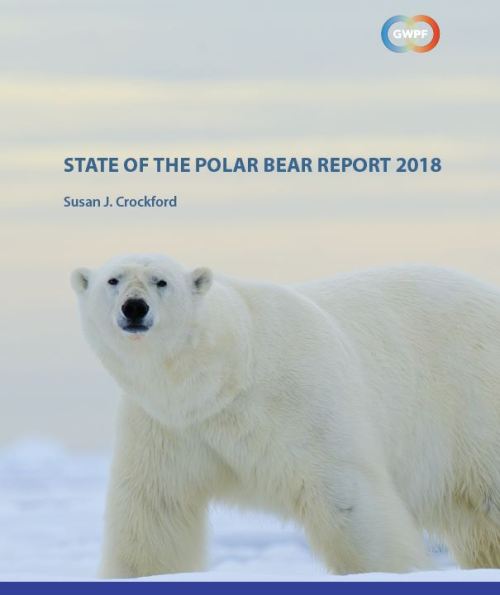
The State of the Polar Bear Report for 2018, published today by the Global Warming Policy Foundation, confirms that polar bears are continuing to thrive, despite recent reductions in sea ice levels. This finding contradicts claims by environmentalists and some scientists that falls in sea ice would wipe out bear populations.
The report’s author, zoologist Dr Susan Crockford, says that there is now very little evidence to support the idea that the polar bear is threatened with extinction by climate change.
“We now know that polar bears are very resourceful creatures. They have made it through warm periods in the past and they seem to be taking the current warming in their stride too”.
In fact, it is the human residents of the Arctic who seem to have most to worry about. With more and more bears on the landscape at all times of year, there have been worrying reports of people being threatened, mauled and even killed, particularly from Nunavut, in the Canadian north.
As Dr Crockford explains,
“The people of Nunavut are not seeing starving, desperate bears – quite the opposite. Yet polar bear specialists are saying these bears are causing problems because they don’t have enough sea ice to feed properly. The facts on the ground make their claims look silly, including the abundance of fat bears. Residents are pushing their government for a management policy that makes protection of human life the priority.”
UPDATE: Read my opinion piece in Canada’s Financial Post here.
· Data published since 2017 show that global polar bear numbers have continued to increase slightly since 2005, despite the fact that summer sea ice in 2018 was again at a low level not expected until mid-century: the predicted 67% decline in polar bear numbers did not occur.
· Despite marked declines in summer sea ice, Chukchi Sea polar bears continue to thrive: reports from the first population-size estimate for the region, performed in 2016, show bears in the region are abundant (almost 3000 individuals), healthy and reproducing well.
· National Geographic received such a profound backlash from its widely viewed ‘this is what climate change looks like ’ starving polar bear video, released in late 2017, that in 2018 it made a formal public apology for spreading misinformation.
· In Canada, where perhaps two-thirds of the world’s polar bears live, the Committee on the Status of Endangered Wildlife (COSEWIC) decided in 2018 to continue to list the polar bear as a species of ‘Special concern’ rather than upgrade to ‘Threatened.’
· Polar bear attacks made headlines in 2018: two fatal attacks in Nunavut, Canada and a narrowly averted death-by-mauling in northern Svalbard caught the world by surprise.
Citation: Crockford, S.J. 2019. State of the Polar Bear Report 2018. Global Warming Policy Foundation Report 32, London.
Comments Off on State of the Polar Bear Report 2018: Polar bears continue to thrive
Posted in Conservation Status, Life History, Polar bear attacks, Population, Sea ice habitat, Summary
Tagged attacks, International Polar Bear Day, Inuit, key findings, Nunavut, polar bear, press release, sea ice, State of the Polar Bear
Times have changed: where once many scientists worried that polar bears could not survive an Arctic with 40% less ice, now the concern is that people of the Arctic might not be able to keep themselves safe from growing numbers of increasingly fearless bears.
International Polar Bear Day is tomorrow, 27 February. It’s a good time to reconsider polar bear conservation in light of current realities. Polar bears are not threatened with extinction by loss of sea ice habitat but continue to thrive in spite of it (Crockford 2017).

Fat bear in August 2017 outside Arviat, Nunavut. Gordy Kidlapik photo.
Tomorrow, the 2018 State of the Polar Bear Report will be released. But for now, see some of the failed claims below.
Comments Off on International Polar Bear Day: a time to admit the species is not threatened with extinction due to reduced sea ice habitat
Posted in Advocacy, Conservation Status, Polar bear attacks, Population
Tagged attacks, breakup, fat bears, freeze-up, polar bear, population, problem bears, sea ice, threatened, western hudson bay
According to a report by CBC News earlier this week (18 February 2019), there was a defence kill of a potentially dangerous polar bear and her cub in Foxe Basin, Nunavut on January 4th that we are just hearing about now. Yet another bear on shore in winter, when there is plenty of sea ice, looking for food in an Arctic community and threatening the lives of its residents while a polar bear specialist blames such incidents on lack of ice.
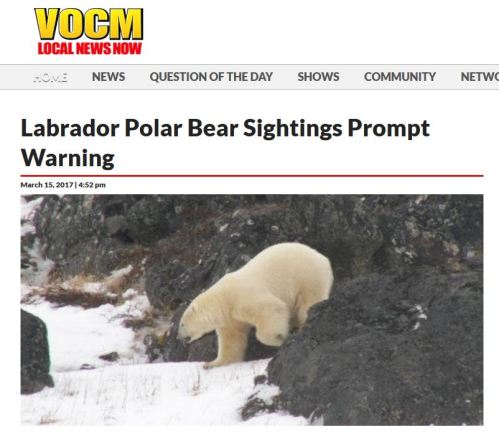
Polar bear on shore in Labrador, early March 2017, VOCM report
Comments Off on Bear on shore in January that threatened residents of Foxe Basin community was shot
Posted in Advocacy, Polar bear attacks, Sea ice habitat
Tagged attack, defence, defense, Foxe Basin, polar bear, risk, sea ice, threat, too many bears, winter
The state of emergency in Belushya Guba on Novaya Zemlya is over, according to a report yesterday from the Russian news agency TASS (18 February 2019), as no bears had been spotted over the previous 24 hours.
Comments Off on Polar bears driven out of Novaya Zemlya town onto the ice by persistent harassment
Posted in Advocacy, Polar bear attacks, Sea ice habitat
Tagged attack, Barents Sea, climate change, invasion, Kara Sea, Novaya Zemlya, polar bear, Russia, sea ice, seige, state of emergency
What a bunch of sensationalist claptrap about the polar bears on Novaya Zemlya but I guess it sells papers and raises donations (WWF and PBI, I mean you).1
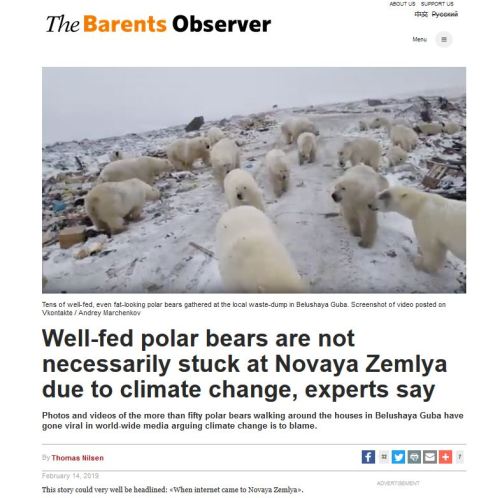
Seriously, if the bears were coming for us, people in Belushaya Guba would have died already, probably EATEN. These particular bears know there is stored food and refuse available that does not come packaged in human form and they know from experience that humans won’t hurt them. As I pointed out in my last post, these bears have known this since early December, when they chose to stay on land over the winter and ignored the sea ice when it arrived.
Lack of sea ice is not the problem here. These are habituated garbage bears that are no longer safe to have around: the responsible option is to shoot them. It’s harsh, I know, but the population will recover from the loss.
If you suddenly cut off their passive food supply (fence or close the dump, deal more carefully with individual refuse and stored food), all of these bears in the photos and videos being flashed across the Internet will become desperate and truly dangerous. Remember, just last summer an emaciated, desperate bear almost killed a cruise ship guard: he had a loaded gun and was actively looking for bears, yet the bear managed to ambush him. He’d have died if he’d been alone.
Of course the refuse and stored food problem needs to be dealt with, in Belushaya Guba and elsewhere across the Arctic, but these particular bears cannot be saved. Cleaning up these issues takes time, coordination, and money. Ask Churchill, Manitoba, who for years wrestled with these issues before a workable solution was agreed upon. And while few Arctic communities can afford to do it the Churchill way, virtually all must contend with the very real threat of polar bears both inside and outside their communities. Ask the Inuit of Arviat and Naujaat, who each lost a young man last summer to a predatory attack by a polar bear that happened well outside their respective villages and where lack of sea ice was not an issue.
Blaming this on climate change is the Paul Nicklen starving polar bear video all over again. You remember the one, the video that National Geographic got so much push-back about that they had to make a public apology for spreading misinformation?
Do climate change promoters really need another fiasco featuring polar bears?
Comments Off on Polar bears walking the streets on Novaya Zemlya are habituated garbage bears, not victims of climate change
Posted in Advocacy, Polar bear attacks, Sea ice habitat
Tagged attacks, Churchill, climate change, fatalities, garbage, global warming, habituated, Novaya Zemlya, patrol, polar bear, problem bears, sea ice, stored food
Since early December, a group of 52 polar bears have terrorized the Russian village of Belushaya Guba on southern Novaya Zemlya. The aggressiveness of some of the bears, their boldness in entering local buildings and fearlessness in the face of the usual deterrents has caused the local government to call a state of emergency to help the town residents. Global warming is blamed for the problem but as is so often the case, that claim does not stand up to scrutiny.
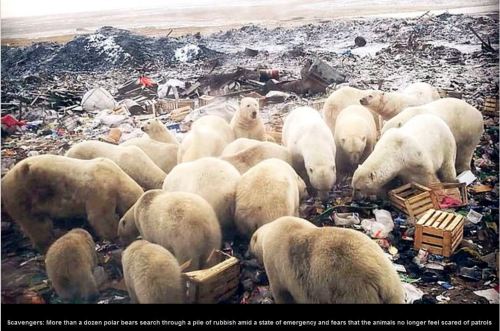
Large group of polar bears at the Belushya Guba town dump on Novaya Zemlya, Russia. From the 11 Feb. 2019 story at The Daily Mail.
Belushaya Guba is located on the southwest coast of Novaya Zemlya in the eastern Barents Sea. It is a town of mostly military personnel and their families:
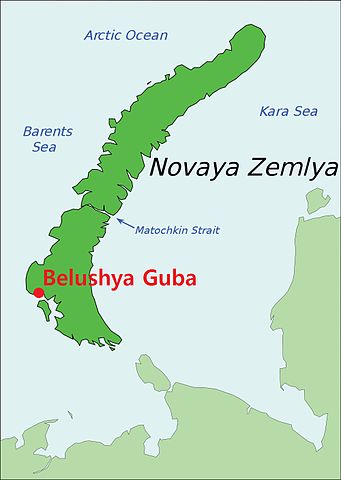
The predictable claims that this situation is due to global warming are confounded by the fact that the region has not had abundant sea ice by December in more than 30 years, yet this is the first time the town has had such a problem with polar bears. Polar bears in winter can be very dangerous, as they are often lean and desperately hungry. [except these ones are not, see update below]
UPDATE 11 February 2019: The international media have gone mad for this story and some photos are now available. Best series of photos and video is at The Daily Mail, UK (11 Feb 2019: State of emergency is declared after more than 50 polar bears invade Russian town and ‘chase terrified residents’). No new information is available on the story itself but plenty of hyperbole has been added. The photos show how fat and healthy these so-called ‘desperate’ bears are, which makes the claims that global warming is to blame for the crisis even more ludicrous (see the ice charts below). So far, the most over-the-top take on this goes to the Washington Post (11 Feb 2019: A ‘mass invasion’ of polar bears is terrorizing an island town. Climate change is to blame): they went to the most trouble to make the link to climate change and bring up the vilified ‘starving polar bear’ video that National Geographic was forced to apologize for last August and the debunked 2007 prediction that 2/3 of the world’s bears would be gone by 2050 (Crockford 2017). The Guardian‘s effort is weak by comparison, as is CNN‘s. The news outlet (not a blog) Daily Caller has some quotes from this page. Competition amongst bears for scarce natural resources in winter makes dump sites and stored food available around Arctic communities all the more attractive. When polar bear numbers are high, as they are now, this competition can get fierce. It’s no wonder the bears don’t want to leave.
Comments Off on Polar bears have been terrorizing a Russian town on the Barents Sea since December
Posted in Advocacy, Polar bear attacks, Sea ice habitat
Tagged attacks, Barents Sea, climate change, crisis, emergency, fearless, global warming, invasion, Novaya Zemlya, polar bear, problem bears, sea ice, terror, William Barents
On 10 April 2019, I am giving a polar bear lecture for Friends of Science in Calgary (“Polar Bears: Too Hot to Handle”) alongside astrophysicist Willie Soon (“The Sun Also Warms”) at their annual climate science event. Early bird ticket discounts are available now until February 28 only (but full price tickets can be purchased until April 2).

If you can, do join us. A buffet dinner is included in the ticket price.
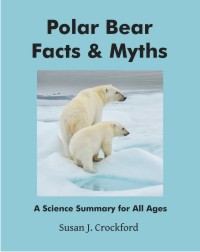
The launch event for my new book, The Polar Bear Catastrophe that Never Happened will take place earlier in the day (noon-ish) and you are welcome to attend that as well. The book will be available for purchase at the evening lecture event and I will be more than happy to autograph your copies. Copies of my novel (EATEN) and my polar bear science book for kids (Polar Bear Facts & Myths) will also be available for purchase and signing. Details below.
Continue reading
Comments Off on Polar bear lecture in Calgary coming up in April – book Friends of Science event now
Posted in Uncategorized
Tagged book launch, Calgary, catastrophe, Friends of Science, lecture, polar bear, science, signing





 polarbearscience
You must be logged in to post a comment.