Tag Archives: polar bear

Earth to Newsweek: polar bear populations have not been on the decline since 2008

A recent Newsweek story about the US Navy having no “rules of engagement” to deal with polar bear encounters leads with alarmist misinformation.
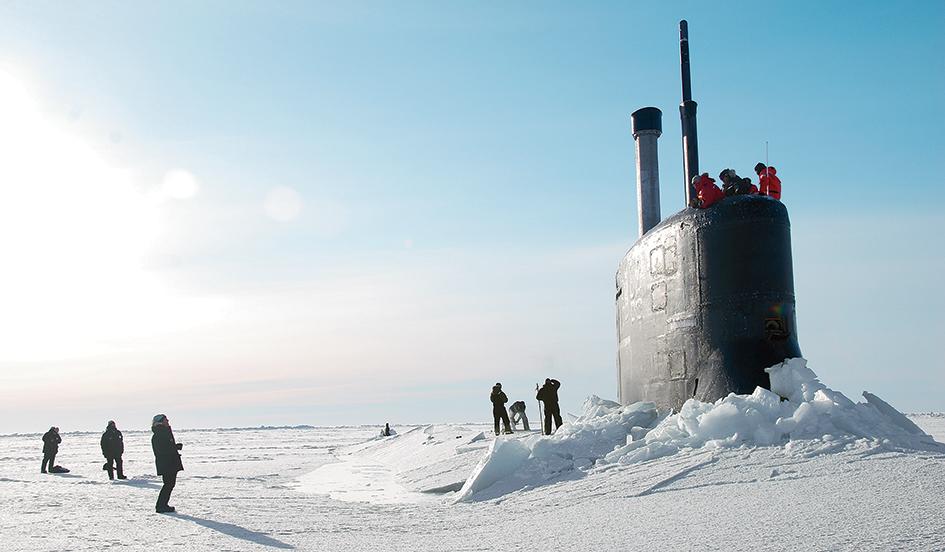
Photo credit Cmdr. Christy Hagen/U.S. Navy

Photo credit Cmdr. Christy Hagen/U.S. Navy

Author Max Strasser (April 30, 2013), in his recent article in Newsweek (As the World Warms, Navy Strategists Plan for an Arctic Rush”) [h/t D. V]

Approximately 25,000 polar bears live in and around the Arctic Circle. Climate change has put the majestic ursines, a longtime favorite of children’s books and Christmas cards, in peril. In 2008, the United States listed them as a “threatened species” under the Endangered Species Act, and populations have been on the decline since then.”

Sigh. Not so Max, totally not so.

Global polar bear numbers have been stable for the last 30 years, as the graphs below show. The proposed ‘threat’ to polar bears is a future decline in sea ice predicted by computer models. The future, Max, is not now.

Polar bear populations are currently doing very well (see my post on the most recent status update report here). On top of that, note that the bears are well distributed throughout available Arctic habitat — one of the accepted hallmarks of a healthy species.

Figure 1. Upper graph uses totals reported in PBSG status tables, with min/max; Lower graph uses the same figures, but adds back in the so-called "inaccurate" estimates dropped 2005-2013. The 1960 figure * is a ballpark estimate. See previous post here.

Figure 1. Upper graph uses totals reported in PBSG status tables, with min/max; Lower graph uses the same figures, but adds back in the so-called “inaccurate” estimates dropped 2005-2013. The 1960 figure * is a ballpark estimate.
See previous post here.

OK, with that error corrected, back to the point of the Newsweek story…
Continue reading

My interview with CNS News: “Alaskan Polar Bears Threatened…By Too Much Spring Ice”

Not bad, as these things go, but the reporter made one error that needs correcting – so I’m doing it here to set the record straight, just in case it does not get taken care of in the original story.

CNS News reporter Barbara Hollingsworth had seen my post last week, “Current ice conditions don’t bode well for Beaufort Sea polar bears” and wanted to talk to me about it. It was a little rushed, but I agreed.

This is how it turned out, with the error corrected and an updated ice thickness map.
Continue reading

New polar bear exhibit at Winnipeg zoo will help make it “self-sustaining”

Here’s a development I’m sure you’ll find surprising: the July opening of the new polar bear exhibit at the Assiniboine Zoo in Winnipeg, Manitoba, expected to draw huge crowds this summer, will coincide with a substantial hike in entrance fees.

Kaska and Aurora, courtesy Assiniboine Park Zoo.

Kaska and Aurora, courtesy Assiniboine Park Zoo, Winnipeg.
Aurora is the cub orphaned in Churchill last year when her mother was shot.

Starting July 3, the fee for adults will increase from $10.24 to $18.50, not including GST. Said a CBC News report earlier today:

“Officials said the admission prices are being adjusted to “reflect the industry standard across zoos in North America” and bring the Winnipeg zoo closer to being a self-sustaining facility.

“Our job was to build a world-class and increasingly self-sustaining facility that allowed the [Assiniboine] Park and Zoo to be dramatically less dependent on tax dollars,” Redmond said.”

So, that’s why having polar bears in zoos are a good thing. Didn’t I say that last year? See the whole story here, more comments below.

Continue reading

Current ice conditions don’t bode well for Beaufort Sea polar bears

Thick spring ice along the shore of the Eastern and Southern Beaufort is bad news for polar bears, especially females emerging from their dens with new cubs. Are those conditions developing now?

Beaufort Sea pressure ridges_Spring 1949 wikipedia sm

Every 10 years or so, since at least the 1960s, nearshore ice gets too thick for ringed seals to maintain their breathing holes and many breeding seals depart the area. This leaves a lot of polar bears without the baby seals they need to consume to get them through the rest of the year (that’s if they don’t (or can’t) leave themselves).

I’ve discussed various aspects of this phenomenon before, with references – see the list at the end of this post.

Sadly, we are on schedule for such conditions to recur – could be this year, could be next. The last time of heavy spring ice was 2004 and previous heavy ice conditions occurred the springs of 1964, 1974 (the worst), 1984, 1992 and 2004. The 2004-2006 event was reportedly almost as bad as the 1974-1976 event.

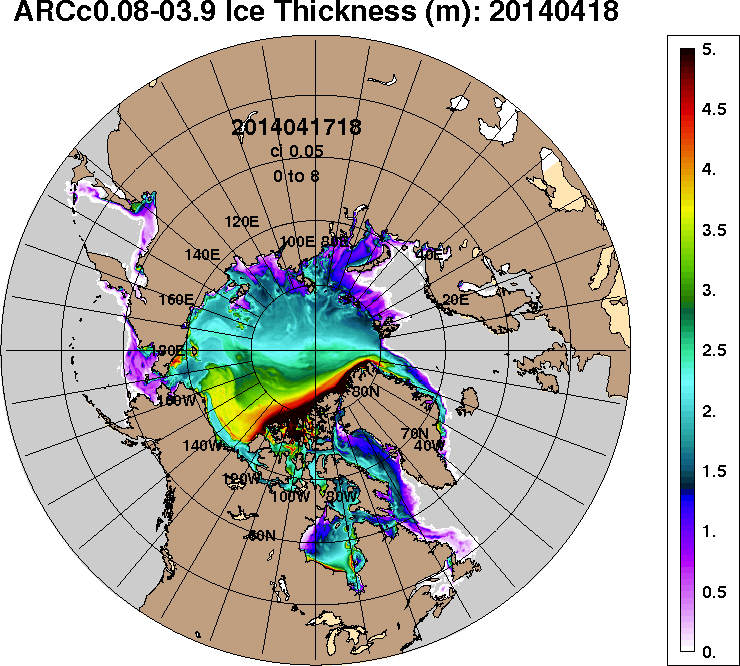
So, prompted by reports of the heaviest sea ice conditions on the East Coast “in decades” and news that ice on the Great Lakes is, for mid-April, the worst it’s been since records began, I took a close look at ice thickness charts for the Arctic. I’m not suggesting these conditions are necessarily related to Beaufort ice, just that they got me thinking.

Here’s a screencap of the US Navy ice thickness animation chart for yesterday [from WUWT Sea Ice Page]

Figure 1. Arctic Sea Ice Thickness (NRL), for April 18, 2014. Look at thick ice (yellow, 3.5-4.0 meters thick) spreading along the north coast of Alaska. See the 30 day animation here.

Figure 1. Arctic Sea Ice Thickness (NRL), for April 18, 2014. Look at thick ice (yellow, 3.5-4.0 meters thick) spreading along the north coast of Alaska. See the 30 day animation here.

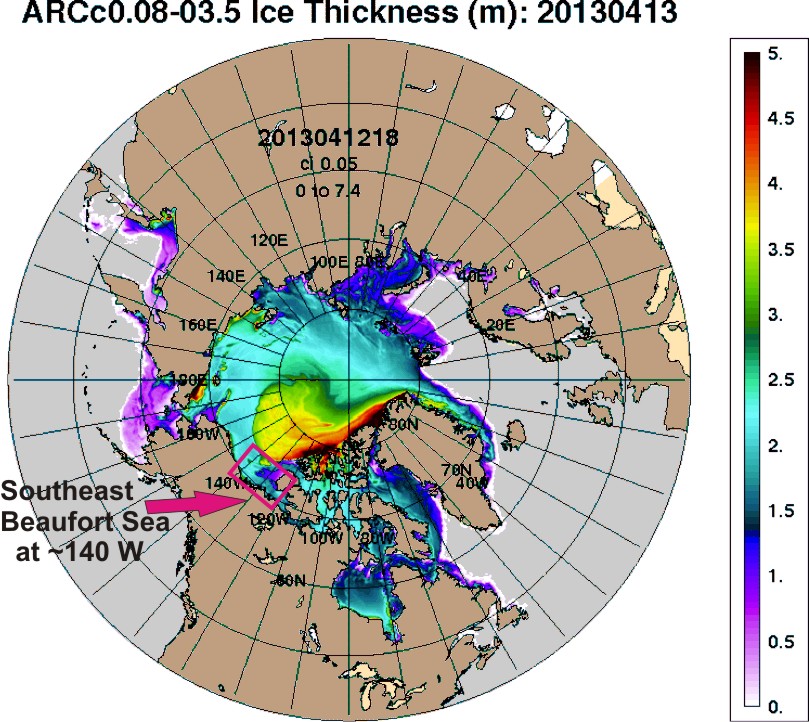
Below is a similar image from about the same time last year, with the Southeast Beaufort Sea marked.

Figure 2. Arctic Sea Ice Thickness (NRL), for April 13, 2013. Southeastern Beaufort marked.

Figure 2. Arctic Sea Ice Thickness (NRL), for April 13, 2013. Southeastern Beaufort marked.

I don’t think this bodes well for Beaufort bears but we’ll have to wait and see if there are any reports of starving bears bit later this spring and summer. Sea ice charts aren’t a guarantee that this heavy spring ice phenomenon is developing in the Beaufort, but they could be a warning.

Below are archived ice age charts from the US National Snow and Ice Data Center (NSIDC) for some previous years when Beaufort bears had trouble, especially 2004-2006, with which I compare this year’s conditions. [h/t Steve Goddard for alerting me to this resource]

Continue reading

Polar bears move around as sea ice habitat changes – this is what resilience looks like

Oddly, it seems some people expect polar bears to sit around and suffer (or die) when local conditions deteriorate, rather than move elsewhere.

PolarBear_2008_USGS

While there are perhaps a few places where moving is not really an option over the short term, over the long term (more than one season) polar bears are free to shift to another locale if ice conditions change (either too much ice or too little).

An announcement by the WWF last week (10 April) caught my eye, as it talked about bears moving from one area to another because of changing ice conditions — as if this was surprising, extraordinary and newsworthy. That said, at least they weren’t suggesting the bears are all going to die because of declining ice, which is a huge improvement.

See what you think of this part of the press release (below), in the context of what we know about the movement of bears between regions:

Continue reading

Amstrup grasps at straws to defend his polar-bears-are-doomed computer model

Polar bear activist Steven Amstrup made an astonishing statement in an interview earlier this week — he insisted that the current rate of warming in the Arctic is greater than anything polar bears have lived through before. He also said that optimistic comments on the future of polar bears made by geneticist Matt Cronin a few weeks ago were “incautious” and “misleading.”

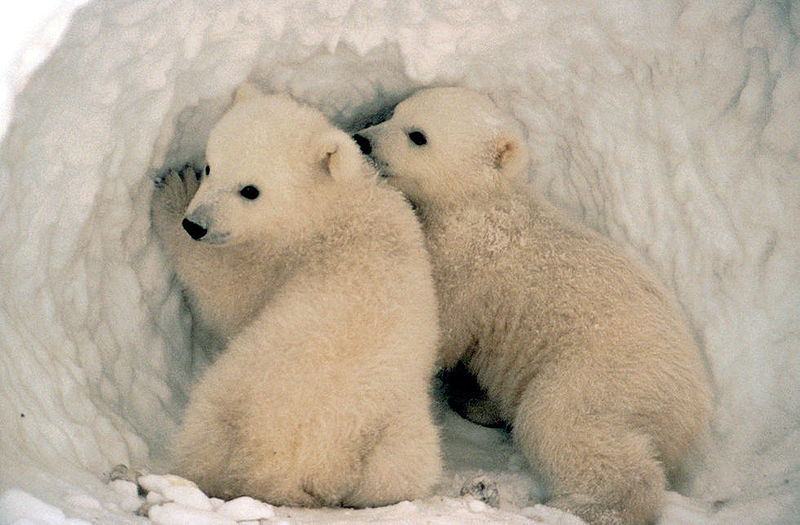
Polar bear cubs in den wikipedia

Previously, I described how a new paper by Cronin and colleagues confirmed that genetic evidence indicates polar bears have been around long enough to have survived several past Interglacial periods that were warmer than today (and therefore, would have had virtually no summer ice). Cronin, not unreasonably, had some critical things to say about computer modeled predictions that polar bears could not survive in an Arctic without summer sea ice.

On Monday, the Anchorage Daily News gave Amstrup a forum to rebuke Cronin for his comments. A similar story was also carried by the Washington Post. [In the same ADN article, geneticist Charlotte Lindqvist, offered an outdated argument against future polar bear survival that I’ll deal with later]

Today, I’ll address Amstrup’s ridiculous assertion that the current rate of warming, attributed by him primarily to human activities rather than natural variation, is something polar bears have never experienced in their evolutionary history (a period of more than 400,000 years!).

Let’s start with the offending portion of the news item (published March 31, 2014):

Continue reading

Oil money provided the foundation of polar bear research, now its “greenwash”

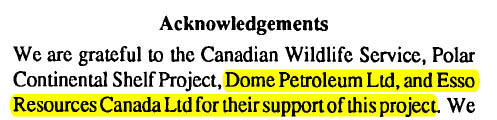
Much of the polar bear research in Canada and American Arctic in the 1970s-1980s was funded by oil and gas companies, because it was the right thing to do (and governments required it). Now, Greenpeace says providing such money is just oil company marketing, meant to make them look good.

Stirling et al 1993_oil acknowledgement

Stirling et al. 1993, oil funding acknowledgement for work in the Eastern Beaufort Sea.

Oil money helped fund the Ph.D. research of polar bear biologist and Polar Bears International spokesperson Steven Amstrup (Amstrup and Durner 1995), and made possible a number of other critical research projects in the early days of polar bear research that might not have been possible otherwise (Stirling et al. 1993; Stirling and Lunn 1997).

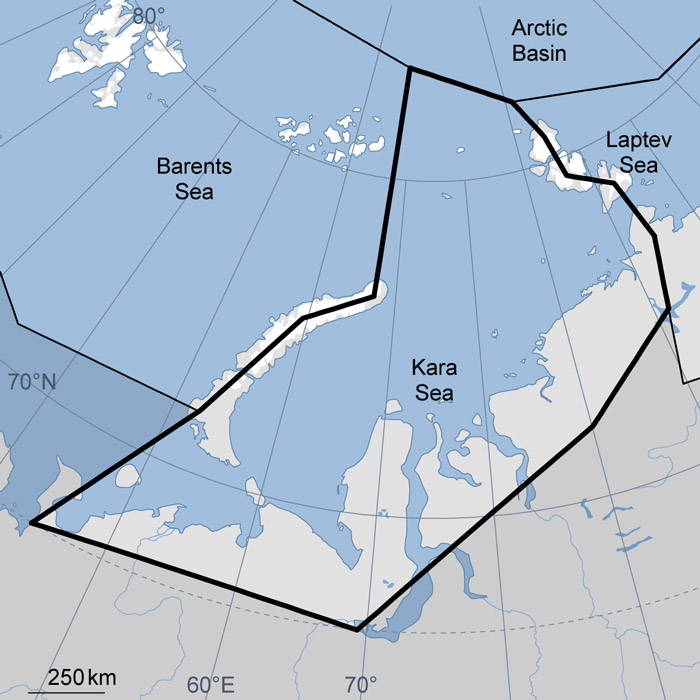
Yesterday, several media reports announced that ExxonMobil had advertised for a job counting polar bears in the Kara Sea (where very little research has been done), but a Greenpeace spokesperson called this an “obvious greenwash.

Have a look at the media reports and the oil funding acknowledgements from polar bear research papers (“References”) and see what you think.

Courtesy IUCN Polar Bear Specialist Group.

Courtesy IUCN Polar Bear Specialist Group.

Continue reading

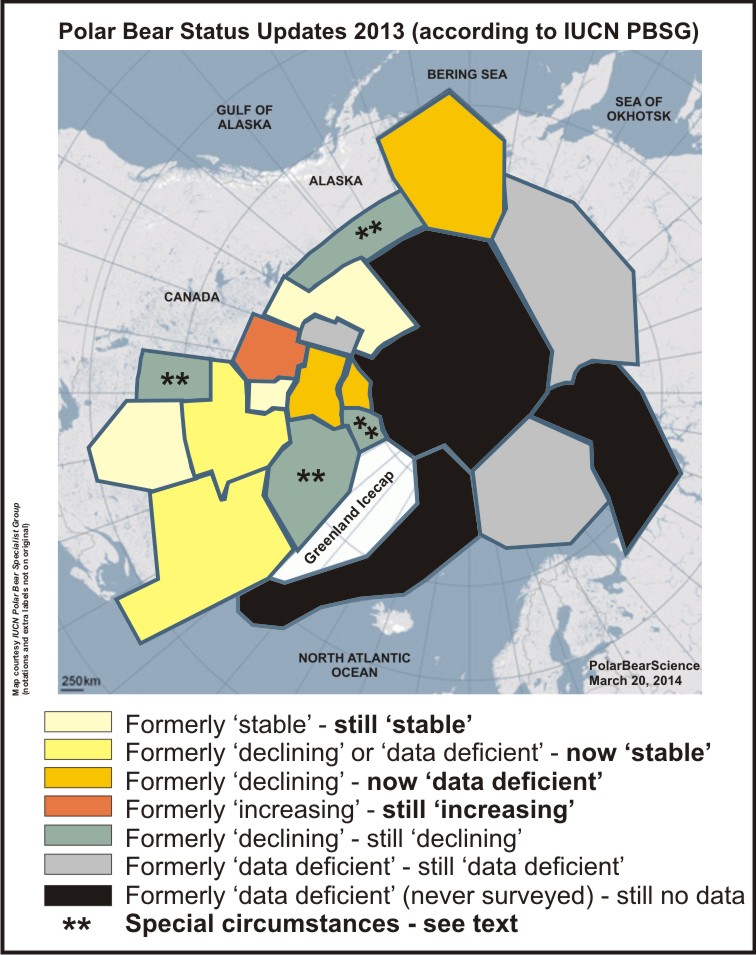
Polar bear status changes in 2013 deconstructed, with a map to the good news

You can’t figure out what’s going on with status updates from the IUCN Polar Bear Specialist Group (PBSG) without deconstructing the spin and the 2013 update is no exception. Here’s my travel guide, with a map, to the good news.

Polar Bear Subpopulations 19_2013 updates_March 20 2014_sm

I’ve finally had a chance to go through all of the details provided with the 2013 PBSG status table (pdf here). It’s just about all good news, once you wade through the spin. Numbers aside, out of the 13 populations for which some kind of data exist, five populations are now classified by the PBSG as ‘stable’ (two more than 2009), one is still increasing, and three have been upgraded from ‘declining’ to ‘data deficient’ (I explain below why this is a promotion).

That leaves four that are still considered ‘declining’- two of those judgments are based primarily on concerns of overhunting, and one is based on a statistically insignificant decline that may not be valid and is being re-assessed (and really should have been upgraded to ‘data deficient’). That leaves only one population – Western Hudson Bay – where PBSG biologists tenaciously blame global warming for all changes to polar bear biology, and even then, the data supporting that conclusion is still not available.

Continue reading

New genetic study confirms polar bears survived several warm Interglacials

There is a new polar bear genetics paper out in the Journal of Heredity, by University of Alaska Fairbanks genetics professor Matt Cronin and colleagues. Matt Cronin, in case you didn’t know, was the first to pick up the close genetic relationship between polar bears and grizzlies, as a result of research he and colleagues did back in the early 1990s (Cronin et al. 1991).

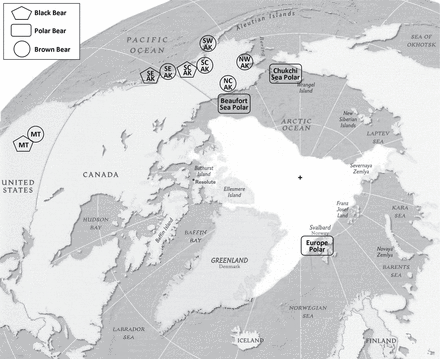
Figure1 from Cronin et al. 2014 (in press) showing the locations of bear samples used in their genetic study. MT, Montana; AK, Alaska; Polar bear samples were from the Chukchi, Beaufort and Barents Sea populations.

Figure 1 from Cronin et al. 2014 (in press) showing the locations of bear samples used in their genetic study. MT, Montana; AK, Alaska; Polar bear samples were taken from the Chukchi, Beaufort and Barents Sea populations.

While no earth-shattering new information was revealed in this new study, reported over the weekend by the Alaska paper SitNews (March 15), it used a more detailed method to confirm the results of previous work – that polar bears have been around long enough to have survived several past Interglacial periods that were warmer than today (with less ice in the Arctic) and are genetically distinct from grizzlies.

A feature that really set this work apart was how it was promoted.
Continue reading

Davis Strait polar bear habitat higher now than in 1979 and early 1980s

The Davis Strait polar bear subpopulation is said to be ‘vulnerable’ to the supposed effects of global warming because, like Hudson Bay, Davis Strait sea ice retreats every summer, leaving polar bears on land for several months.

However, Davis Strait bears have been upgraded to ‘stable’ status, according to the latest table (2013) issued by the IUCN Polar Bear Specialist Group (see their boundary map for Davis Strait bears below). Recent development of sea ice in the region can only improve that rating.

[More background here and heremap-DavisStrait

It seems that sea ice in Davis Strait is well above normal for this time of year – a recent announcement by the Canadian Ice Service (CIS) says it’s 10% above average, higher than it’s been in 25 years (h/t S. Goddard).

The Canadian Ice Service, an arm of Environment Canada, said there is 10 per cent more ice this year compared to the 30-year average.

We probably haven’t seen a winter this bad as far as ice for the past 25 years,” said Voight, referring to both the amount and thickness of the ice.

He said the Gulf of St. Lawrence is covered and some areas are “quite severe.” [my bold]

Full story here.

Latest ice map (March 12) below from the US National Snow and Ice Data Service (NSIDC).

As I pointed out recently here, Barents Sea ice is below average this year, largely due to natural variation in the Atlantic Multidecal Oscillation (AMO), but is higher over the western Atlantic (Sea of Okhotsk ice is below average too but there are no polar bears there).

There is lots of ice around Labrador and Newfoundland, however.

Sea ice extent 2014 March 12 NSIDC

I thought I let you see exactly what CIS are talking about: what did the ice look like 25 years ago, in 1989? What about 35 years ago, in 1979, the start of the satellite record for sea ice? It might surprise you. Continue reading