Tag Archives: polar bear

Swimming bear video used to promote climate change threat to polar bears

A video being hyped around the internet – “Witness a polar bear’s heartbreaking swim for ice in the Arctic” said one headline – is simply shameless propaganda, facilitated by the US Geological Survey and its polar bear biologists. USGS scientists involved in this work should be ashamed of themselves.

The caption for the Youtube video (published Jun 21, 2014) says this:

Take a swim with a polar bear family as they traverse the Arctic Ocean in search of sea ice.

This is a load of nonsense and a total misrepresentation of the facts.

In addition, the text added to the video is pure propaganda: it is being used to promote the US government position that sea ice loss due to climate change is a massive threat to polar bears. Unfortunately, recent studies contradict the contention that polar bears have already been harmed by declines in summer sea ice.

Here are some background to the video you should be aware of:

1) The bears were swimming away from the USGS researchers and film crew who had shot them full of sedatives and attached a camera to one of their necks — they were not swimming toward sea ice 100 miles away.

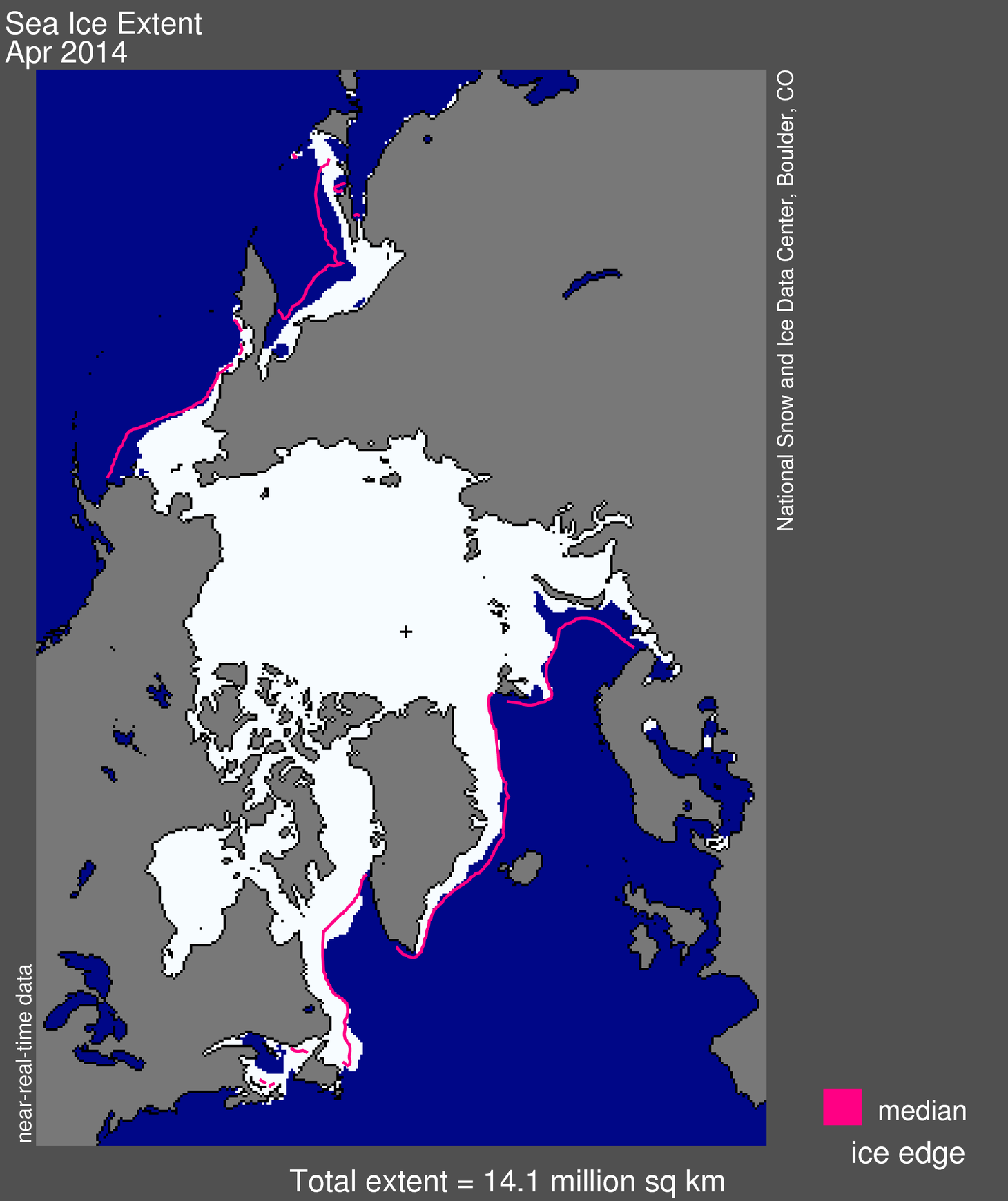
2) The video was shot in the Bering Sea, in April 2014, when sea ice was about its maximum extent of the year — there was lots of ice around when this video was filmed.

3) The company doing the filming is using this video as a fundraiser.

Details below, including a sea ice map for April 2014.

UPDATE June 27, 2014 – see follow-up post here.
Continue reading

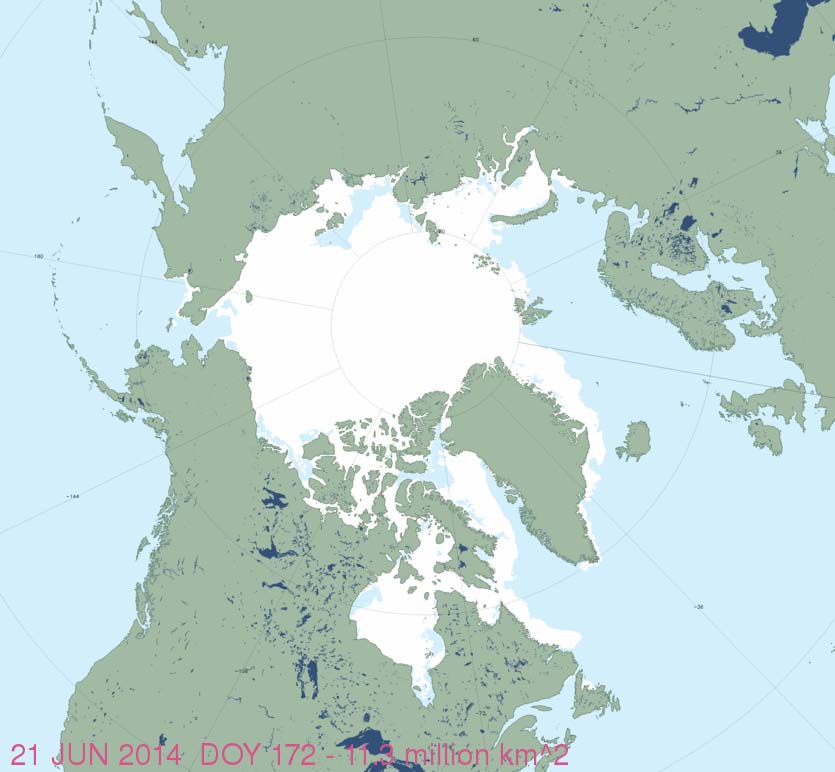
Spring/summer sea ice bonanza for polar bears – conditions excellent again for 2014

Again this year – contrary to predictions – there has been no early breakup of the sea ice on Hudson Bay and even though it’s the height of summer, there is plenty of ice throughout the Arctic to act as a feeding platform for polar bears. This makes it unlikely there will be a longer-than-average summer fast for polar bears again this year.

Figure 1. NSIDC MASIE map for June 21, 2014.

Figure 1. NSIDC MASIE map for June 21, 2014.

Sea ice maps around the Arctic for June 21 (and June 24, for Hudson Bay) reviewed and discussed below in relation to polar bear habitat — have a look.

Continue reading

Center for Biological Diversity provides a public disservice on polar bear status

Media agency Aljazeera gave free advertizing the other day (June 16, 2014, “New TV ads focus on plight of polar bears in warming world, by Renee Lewis) to the Center for Biological Diversity’s TV fear-mongering campaign about polar bears.

USFWS photo

USFWS photo

With unmitigated gall, it’s being billed as a “public service announcement.”
Continue reading

Activists pressure tactics to force Canada to list polar bears as ‘threatened’ have failed

The Center for Biological Diversity has failed in its bid to use NAFTA (North American Free Trade Agreement) to pressure Canada to list polar bears as a species ‘threatened’ with extinction — wrapping up a story I wrote about twice last year (here and here).

Chukchi male 1240 lbs labeled Durner 2008

Continue reading

Barents Sea polar bear cubs – new data for 2014 made to sound ominous

Last week, Damian Carrington (May 28, 2014) at The Guardian offered a scary-sounding polar bear story, based on the work of Jon Aars and colleagues from the Norwegian Polar Institute (Fewer polar bear cubs are being born in the Arctic islands, survey finds). As often is the case however, once you see the scientific data, you will sleep better.

[Dr Aars also gave a radio interview with CBC Canada (May 29): Is climate change the cause of lower polar bear birth rates in Norway?”; audio available]

[Update June 24, 2014 — see below]

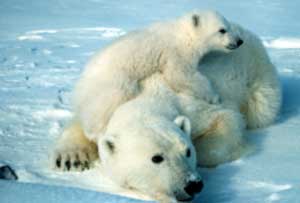
Female polar bear with cubs. (U.S. Fish & Wildlife Service/AP)

Female polar bear with cubs. (U.S. Fish & Wildlife Service)

Continue reading

IUCN Polar Bear Specialist Group says its global population estimate was “a qualified guess”

Last week (May 22), I received an unsolicited email from Dr. Dag Vongraven, the current chairman of the IUCN Polar Bear Specialist Group (PBSG).

pbsg logo

The email from Vongraven began this way:

Dr. Crockford

Below you’ll find a footnote that will accompany a total polar bear population size range in the circumpolar polar bear action plan that we are currently drafting together with the Parties to the 1973 Agreement. This might keep you blogging for a day or two.” [my bold]

It appears the PBSG have come to the realization that public outrage (or just confusion) is brewing over their global population estimates and some damage control is perhaps called for. Their solution — bury a statement of clarification within their next official missive (which I have commented upon here).

Instead of issuing a press release to clarify matters to the public immediately, Vongraven decided he would let me take care of informing the public that this global estimate may not be what it seems.

OK, I’ll oblige (I am traveling in Russia on business and finding it very hard to do even short posts – more on that later). The footnote Vongraven sent is below, with some comments from me. You can decide for yourself if the PBSG have been straight-forward about the nature of their global population estimates and transparent about the purpose for issuing it.
Continue reading

Climate bullying echoes the expulsion of Mitch Taylor from Polar Bear Specialist Group

A lone polar bear walking on ice [Kathy Crane (NOAA) photo].  We'll call this a metaphor for the expulsion of Mitch Taylor from the PBSG after the Group switched from emphasizing unregulated over-hunting as the primary threat to polar bear conservation to global warming.

Kathy Crane (NOAA) photo

Swedish meteorologist Lennart Bengtsson today declared his resignation from the Academic Advisory Board of the Global Warming Policy Foundation (GWPF), which he joined only three weeks ago, because of bullying by his colleagues. His email letter reads, in part:

“I had not expecting such an enormous world-wide pressure put at me from a community that I have been close to all my active life. Colleagues are withdrawing their support, other colleagues are withdrawing from joint authorship etc. I see no limit and end to what will happen. It is a situation that reminds me about the time of McCarthy. I would never have expecting anything similar in such an original peaceful community as meteorology.”

See WUWT for the email in its entirety, GWPF response, and other reactions (and more here).

Absolutely shameful. Alas, the reprehensible behaviour displayed by Bengtsson’s colleagues also goes on within the polar bear research community: those that refuse to parrot the “consensus” are quickly punished.

Remember Mitch Taylor and his expulsion in 2009 from the IUCN Polar Bear Specialist Group? His “crime” was objecting to the PBSG using weak evidence about future threats of global warming to have the conservation status of polar bears changed to ‘threatened’ even though populations were currently healthy. Details below for those who don’t know the story, or have forgotten.

Continue reading

Evolution by geneticists again: yet another date for when polar bears arose

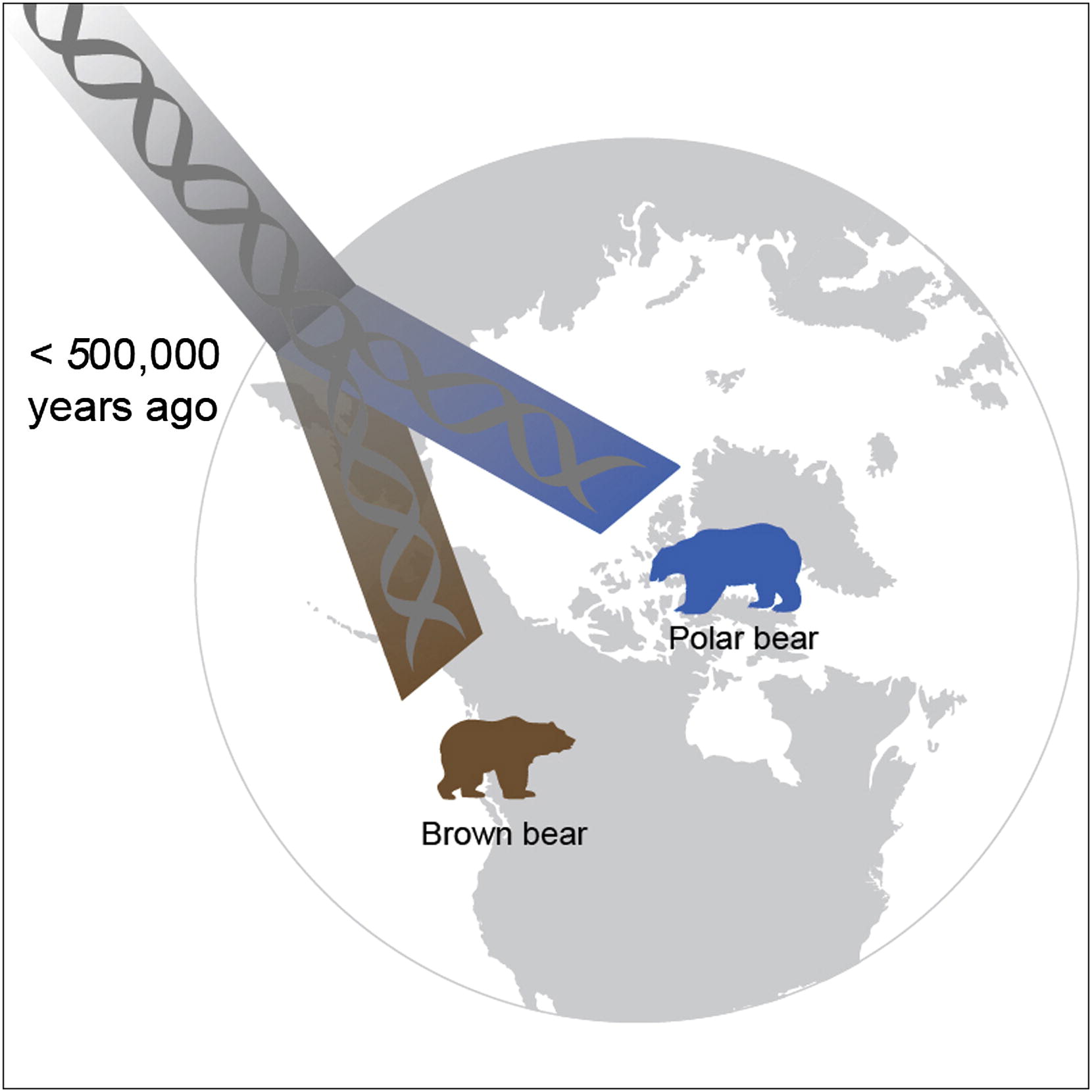
The latest addition to the never-ending story of when-and-why polar bear evolution took place according to geneticists (Liu et al. 2014 — the 8th such paper in less than 4 years, if you can believe it) is getting way, way more media attention than it deserves.

Lui et al. 2014 figure provided in the abstract.

Liu et al. 2014 figure provided in the abstract.

This multi-member research team used a new data set (mostly Scandinavian brown bears and Greenland polar bears, for a change) to add not much of anything new on the evolutionary insight front except yet another estimate of when polar bears came to be.1

However, the real focus of the paper is the description of their finding of a few genetic differences between brown bears and polar bears that they identified. They found a few genes in polar bears were different than brown bears and made a boat load of assumptions about what these might mean.

Their discovery was not accompanied by any attempt to demonstrate that the changes in gene architecture they found also involved a change in the function of the genes or were associated with different effects on bear physiology. If a changed gene cannot be shown to act differently or to have a demonstrated new physiological effect on the animal in question, the changes themselves mean next to nothing – especially for evolution!

That’s my take – see what you think. It looks long but a lot of it is quotes.
Continue reading

Tracking polar bears in the Beaufort Sea – April map not yet available

Cannot do my April follow-up to my post on the July 2013 track map for female polar bears being followed by satellite in the Beaufort Sea by the US Geological Survey (USGS) – Ten out of ten polar bears being tracked this summer in the Beaufort Sea are on the ice.

“Tracking Polar Bears by Satellite” has not yet been updated with the April map, which is unusual for this late in the month (it is usually updated within the first few working days of every month). Perhaps the sea ice data they use was late being processed?

Here is the map for March, discussed previously here.

Figure 1. Movements of 5 satellite-tagged polar bears for the month of March, 2014. Polar bears were tagged in 2013 on the spring-time sea ice of the southern Beaufort Sea. All 5 of these bears have satellite collar transmitters. Note that the dots with the polar bear icons are the end points (end March), while the other end of the string is their position in early March. These are the same 5 females that were present in January. Click to enlarge.

Figure 1. Movements of 5 satellite-tagged polar bears for the month of March, 2014. Polar bears were tagged in 2013 on the spring-time sea ice of the southern Beaufort Sea. All 5 of these bears have satellite collar transmitters. Note that the dots with the polar bear icons are the end points (end March), while the other end of the string is their position in early March. These are the same 5 females that were present in January. Click to enlarge.

Previous dates for tracking available here.

Polar bear habitat update – ice coverage at the beginning of this year’s critical feeding period

Polar bears are all out on the sea ice at this time of year, feeding on new-born seal pups. Here’s a look at what the ice conditions are like at this critical time.

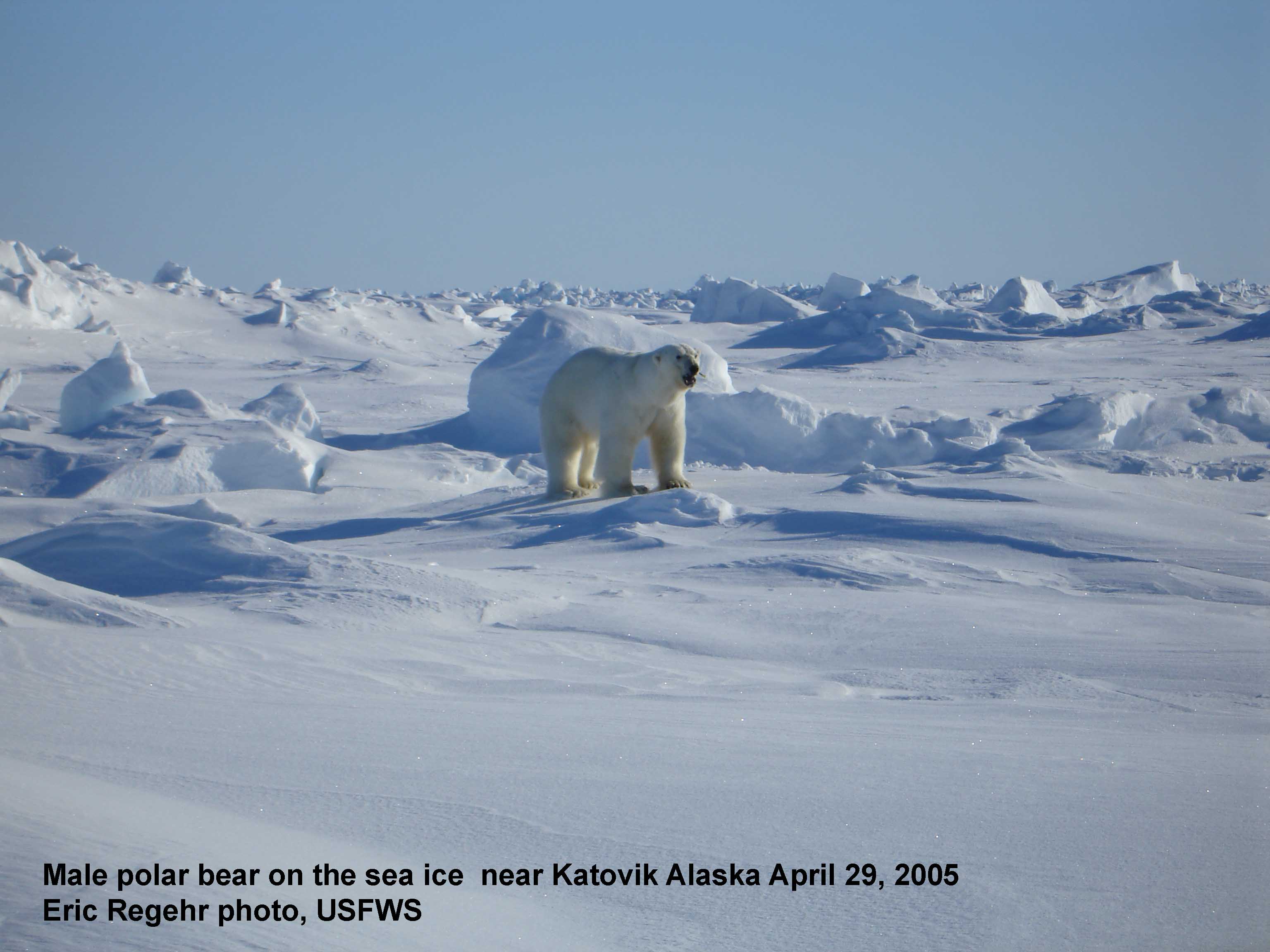
Polar_Bear_male on sea ice_Alaska Katovik Regehr photo_April 29, 2005_sm labeled

end April extent NSIDC May 4

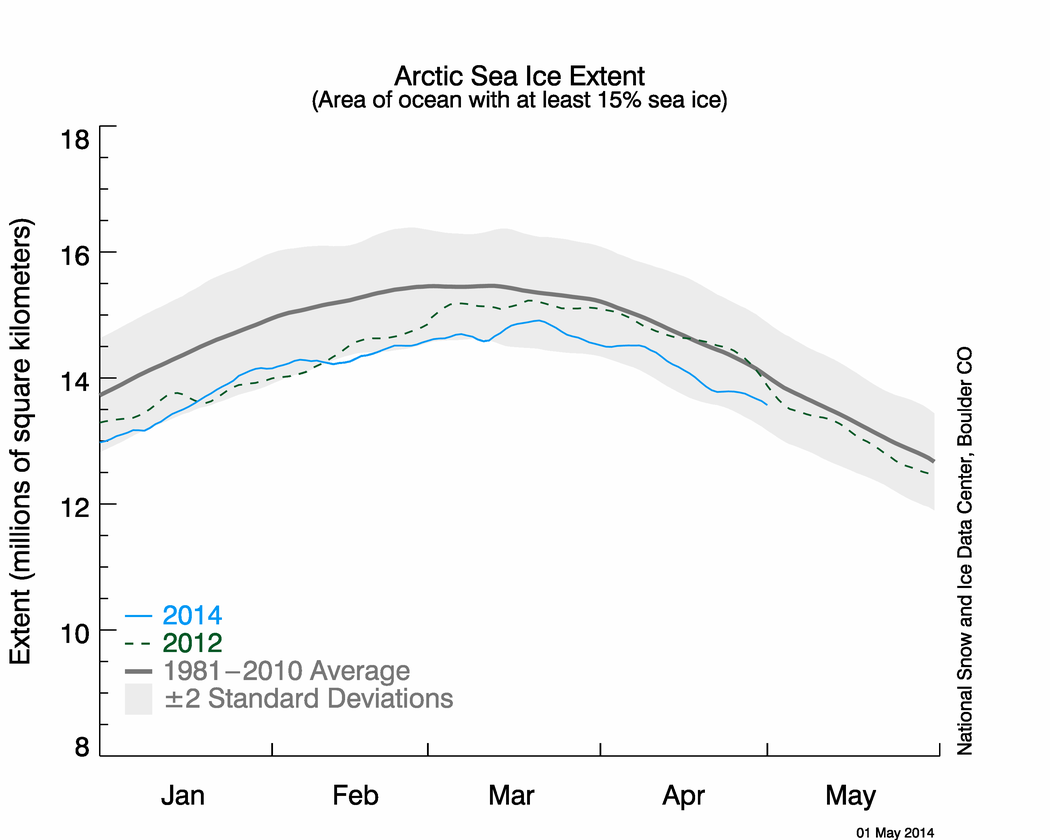
The ice extent is still well within two standard deviations from the 1981-2010 average, which indicates no deviation from natural variation, as the graph (below) for May 1, 2014 from the US National Snow and Ice Data Center (NSIDC) shows.

Sea ice extent 2014 May 1_NSIDC_graph

Between the official spring maximum (according to the NSIDC ) on March 21, with a total extent of 14.8 million km2, the ice slowly retreated in some regions and increased in others, while most regions remained pretty much the same. This is an important reminder that the Arctic as a whole is not a homogeneous region but one with marked regional variation.

As has been noted elsewhere (Sunshine Hours), ice in the Greenland Sea (habitat of ‘East Greenland’ bears) and the Barents Sea both increased in extent over this period. Bering Sea ice (habitat of southern ‘Chukchi Sea’ bears) declined markedly but Baffin Bay/Gulf of St. Lawrence ice (habitat of ‘Davis Strait’ bears) declined much less, as NOAA’s MASIE maps copied below show very well.

Continue reading