Tag Archives: polar bear

Guest Post: Invasive Research is Alive and Well in Canada

This is a guest post by Kelsey Eliasson, who blogs at Polarbearalley, with his thoughts on the issue of the invasive research involved in polar bear mark-recapture studies around Churchill, Manitoba — which, as you’ll see, is a far different situation than I described for Nunavut (previous posts here, here, and here on this topic. Map below to get you oriented).

Kelsey is a writer, artist and polar bear guide who has spent 14 bear seasons watching the polar bears of Churchill. For five years, he ran Churchill’s monthly newspaper published occasionally, the Hudson Bay Post. Currently, he divides his year between the Yukon, Churchill and, occasionally, Riverton, home of Manitoba’s largest moose statue.
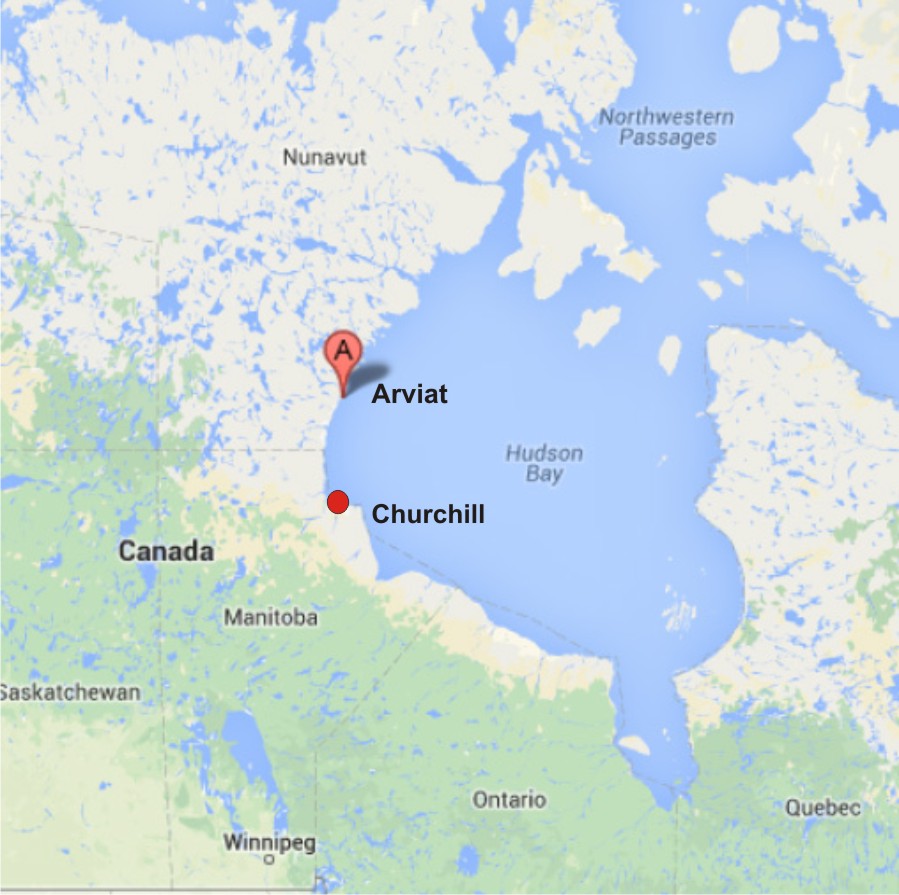
Churchill is in the Western Hudson Bay polar bear subpopulation, governed by the Province of Manitoba, while the community of Arviat, also in 'Western Hudson Bay' is overseen by the Government of Nunavut.

Churchill lies in the Western Hudson Bay (WHB) polar bear subpopulation, governed by the Province of Manitoba, while the community of Arviat, also in the Western Hudson Bay subpopulation, is overseen by the Government of Nunavut – different governments, different rules – as Kelsey points out below.

—————————————————————————-
Invasive Research is Alive and Well in Canada, by Kelsey Eliasson

The recent post about Foxe Basin was of particular interest to me, as I have been following the growing gap between the north and science for some time now. The stance taken by the Inuit is viewed as an inspiration by the guides over here in Churchill. For many years, we have tried to voice our deep concerns over the levels of handling and drugging that our bears (the Western Hudson Bay population) are subjected to on an annual basis.

This time last year, I tried to raise the topic for discussion after Andrew Derocher announced that ‘everything was on the table’ including feeding bears. At that time, the top polar bear researchers had sat down to discuss options for saving bears – except reducing handling and research – i.e. chasing bears down by helicopter and then shooting them with tranquilizers. Continue reading

Foxe Basin aerial survey a watershed moment for polar bear research, Part 2

As I outlined earlier this week, Canadian Inuit objected so strenuously to routine mark-recapture methods used by polar bear biologists during the early days of a Foxe Basin population study in 2008 that the work was abandoned and an aerial survey done instead.

In this post, I’ll examine how the polar bear biologists involved reacted to that crisis, which they called a “control of research” issue.

In a published version of a conference paper, co-authored by two of the original investigators of the Foxe Basin mark-recapture study, Lily Peacock and Andrew Derocher (Peacock et al. 2011:374), had this to say:

Control of research is a developing source of conflict. In recent years, some permits for management-oriented research on polar bears were denied by the Government of Nunavut, local hunting and trapping organizations in the Northwest Territories, and by Makivik Corporation in Quebec. Furthermore, in a 2009 resolution, Inuit Tapiriit Kanatami opposed the capture of polar bears throughout Canada (available by request from http://www.itk.ca), even though the application of physical marks is one of the most effective methods of population estimation. Co-management is particularly difficult in Nunavut because of the large number of subpopulations (12), which makes it difficult to fund and conduct research.” [my bold]

They raised an interesting point – since the Government of Nunavut has the power to insist biologists do more than reiterate that their way of counting bears is the only acceptable way, and because the government can deny permits to projects that don’t measure up, it can lock out traditional polar bear research for virtually all of Canada (the vast majority of Canada’s 13 subpopulations are in Nunavut, see Fig. 1), especially since aboriginal organizations in the Northwest Territories and Quebec have followed Nunavut’s lead.

Figure 1. Territory covered by the Government of Nunavut (top, Wikipedia) and the 13 polar bear subpopulations in Canada (bottom, Environment Canada).

Figure 1. Territory covered by the Government of Nunavut (top, Wikipedia) and the 13 polar bear subpopulations in Canada (bottom, Environment Canada).

That means if polar bear researchers can’t find a way to make their research mesh with Inuit concerns, they’ll be out of work in Canada. Let’s take a look at their approach and see how well it worked for them — explaining in part the new prominence of aerial surveys for population assessments. Continue reading

Tranquilizing polar bears and meat tainted with drugs

This follow-up to my last post has some new information about drug residues remaining in polar bear meat after the animals have been tranquilized.

Chukchi male 1240 lbs labeled Durner 2008

Continue reading

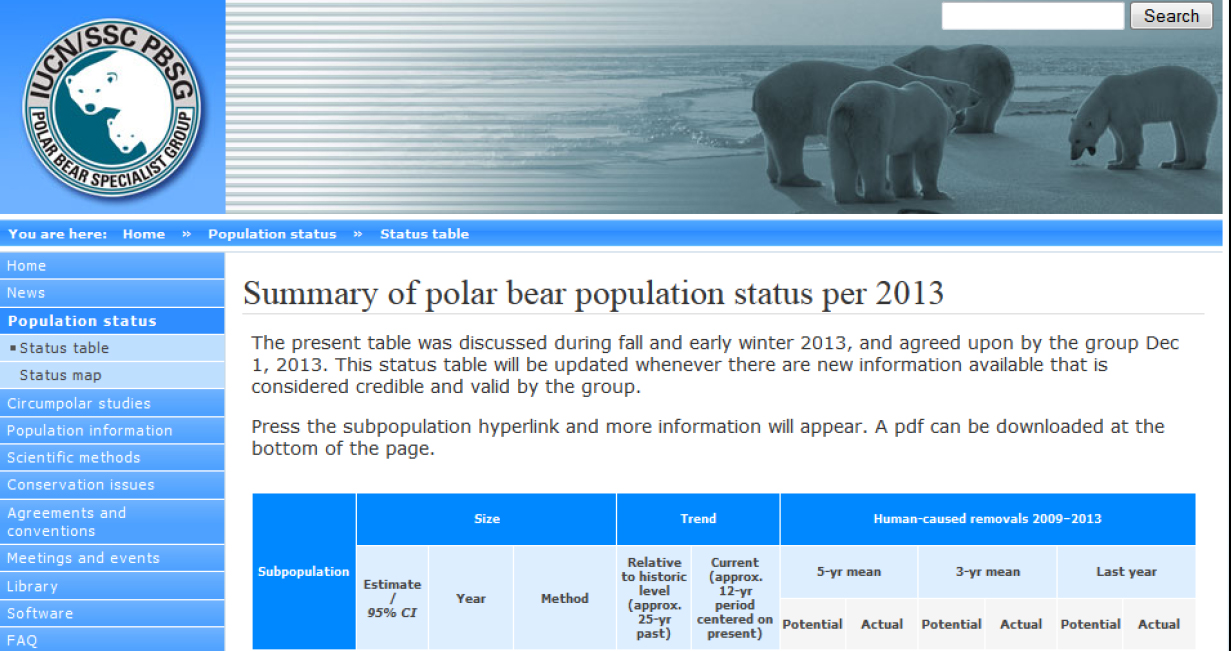
2013 PBSG polar bear status table information in one document

As I pointed out on Valentine’s Day, the IUCN Polar Bear Specialist Group (PBSG) has released a revised population estimate for polar bears of 18,349 (range 13,071-24,238), based on a new status table posted February 14, 2014.

PBSG status-table-2013_Feb 14 2014_intro

In that February 14th post, I also pointed out that as for the 2005 and 2009/2010 status tables, the PBSG did not add up the columns and give the totals — you had to do that yourself, which is how I got the numbers above (last week, I made a couple of graphs that show changes over time in their status table estimates). Oddly enough, there is now no mention of an official global polar bear estimate anywhere on the PBSG website.

In addition — and the point of this post — is that to see the details of how and why the PBSG biologists arrived at the population estimates and the status assessments they present (with references), you have to click on the hyperlinked title of each separate subpopulation in the table. While they made a one-page black and white summary of the online colour table available as a pdf (linked at the bottom of the page), they did not make the assessment details from the status table available in pdf format.

So I did it myself, via copy/paste into a Word document that I converted to a searchable pdf, without editorial comment except that I included the totals given above and noted a few glaringly obvious omissions (see below). It took me all of 30 minutes.

I offer it here for more effective scrutiny, convenient reference and archival purposes — because the way it stands now, the online table could disappear tomorrow without any hard-copy evidence of the information hyperlinked within it.

UPDATE February 26, 2014 I checked the PBSG website this morning and the omissions I noted below that were present a few days ago have been fixed. I did not receive a reply to my email notification of the issue. An updated pdf is now available.

Continue reading

Chukchi-Beaufort sea ice atlas: check out polar bear habitat 1850-2013

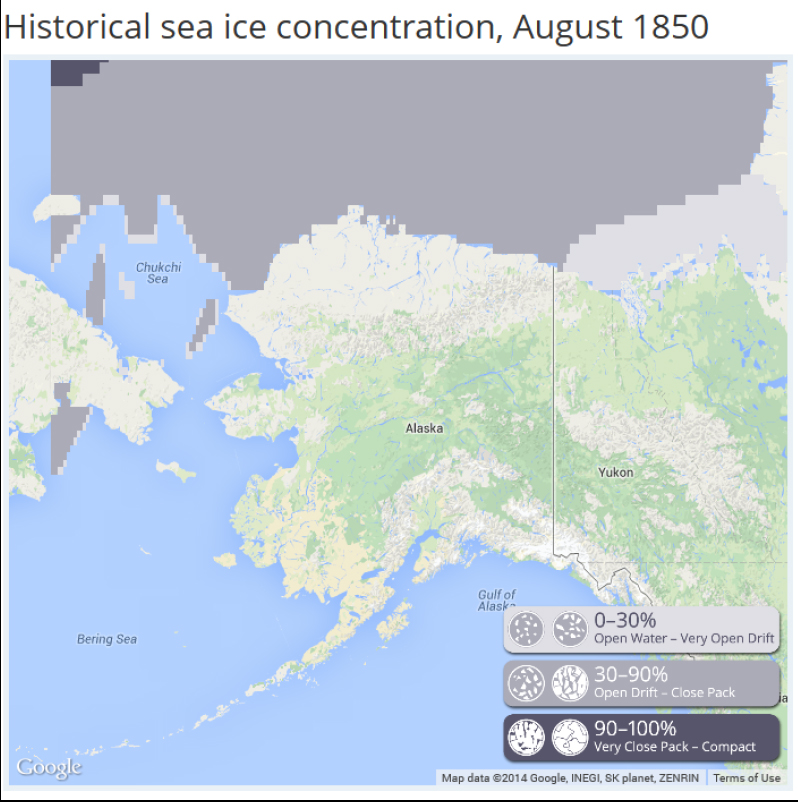
It’s here – as promised and right on schedule — the sea ice atlas put together by University of Alaska Fairbanks (UAF) now has ice concentration maps for Alaska going back to 1850 — and for every year up to 2013. 

Several examples are included below: August 1850 vs August 1870, and April 1850 vs. April 1920 and April 2012.

For background, see my post announcing the site preview, which was then limited to 1953-2012 data, when it became available in late January.

Sea ice atlas_1850_Aug
Continue reading

Graphing polar bear population estimates over time

I’ve already commented on the 2013 update of polar bear population status released by the IUCN Polar Bear Specialist Group (PBSG).

However, I thought it might be interesting to graph the changes in global population estimates over time (from 1981-2013) — not just the actual estimates from PBSG status tables (with their min/max error ranges) but those totals plus the so-called “inaccurate” estimates that the PBSG have dropped from their accounts in recent (2005-2013) assessments: Chukchi Sea, East Greenland, Queen Elizabeth Islands (now known as the “Arctic Basin”), and Laptev Sea.

In 2001, those “inaccurate” estimates contributed 5,000-5,400 bears to the global total, but now they’re gone — no bears from those regions contribute to the official totals listed on recent PBSG status tables.

Adding those dropped estimates back into the global totals makes it possible to generate a graph in which the global estimates are truly comparable over time.

To see how the dropped estimates influenced the perception of population change over time, I’ve also graphed the estimates given by the PBSG in their status tables. I’ve combined the two into one image (Fig. 1, click to enlarge) to make comparison easy.

UPDATE 5 December 2014: Links to more recent posts relevant to this issue added below. The most recent numbers, added 31 May 2015, are here.

UPDATE 26 March 2019: See “Latest global polar bear abundance ‘best guess’ estimate is 39,000 (26,000-58,000)
Continue reading

Thriving Foxe Basin and Davis Strait polar bears threaten nesting sea birds

UPDATE February 11, 2014. A reader (Kevin, at “Afton’s Waterfowl List”) has pointed out an error in Fig. 3, where I inadvertently labeled the bars on the upper graph as ending in 2011 instead of 2012 (the Pembroke graph ends at 2011. sigh..). I have corrected the figure and the text that refers to it, but do not believe it affects the overall conclusion. See for yourself. Thanks Kevin — and Alan for getting in touch!

Another round of press release inspired news stories emerged last week insisting that polar bear predation on ground-nesting birds during the summer ice-free period is evidence that they are nutritionally stressed by global warming.

A few weeks ago it was snow goose eggs in Western Hudson Bay – this time it’s thick-billed murre (Uria lomvia) and common eider (Somateria mollissima) eggs in Foxe Basin and Hudson Strait (e.g. see the story at Canada’s National Post and a short summary provided by Science [and it’s not even their paper!]). The source of the media attention this time is a newly-published paper by Samuel Iverson and colleagues (Iverson et al. 2014).

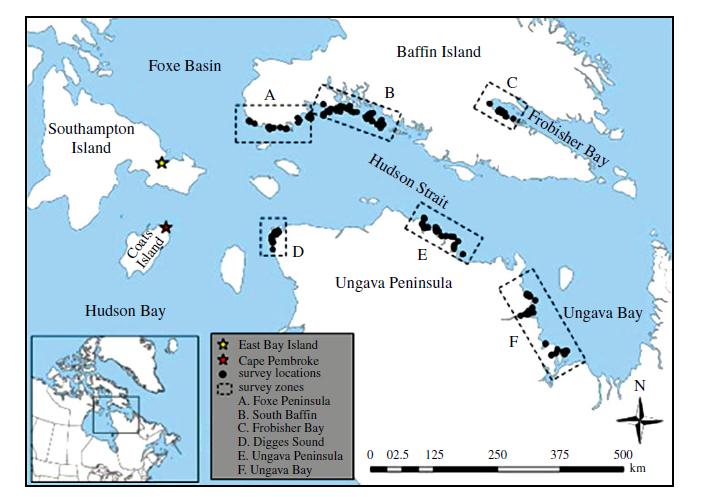
Figure 1. From Iverson et al. 2014 (their Fig.1), “map of the study area.” Most of the study sites are within the Foxe Basin polar bear subpopulation region (see Fig. 2 below), although the Ungava Peninsula (E), Ungava Bay (F) and Frobisher Bay (C) sites are in the Davis Strait subpopulation.

Figure 1. From Iverson et al. 2014 (their Fig.1), “map of the study area.” Most of the study sites are within the Foxe Basin polar bear subpopulation region (see Fig. 2 below), although the Ungava Peninsula (E), Ungava Bay (F) and Frobisher Bay (C) sites are in the Davis Strait subpopulation.

Polar bears have always preyed on ground-nesting sea bird and goose eggs while onshore (see Kelsey Eliasson’s take on the situation around Churchill, at his PolarBearAlley blog). The issue in this case is whether the increase in predation can be unquestionably blamed on reduced sea ice cover and nutritionally-stressed bears – that is, predation increases that correlate with year-to-year sea ice changes and bears in poor condition found consuming bird eggs.

As I did for the “polar bears eat more caribou and snow geese than they used to” press release, I refused to take the PR or the news stories at face value and went to the published paper and its supplemental data (it’s open access, see it for yourself here).

What I see in this paper is a spurious sea ice correlation and no data on the condition of the few bears observed consuming eggs. There is also no mention of the fact that polar bear numbers have increased in part of the study area (Davis Strait) or that bears in Foxe Basin and southern Davis Strait have been found to be in very good condition and reproducing well (Rode et al. 2014; Peacock et al. 2013). See my analysis below and judge for yourself.

Continue reading

Eat, wash up, repeat; eat, wash up, repeat…polar bears do it too!

Ah, that never-ending treadmill of meal preparation and cleanup. You might be surprised to find out that polar bears do it too.

Figure 1. How do polar bears look so clean most of the time when they get this bloody on a regular basis? They wash up! [This picture is not from Stirling’s paper].

Figure 1. How do polar bears look so clean most of the time when they get this bloody on a regular basis? They wash up!

I found an interesting description of polar bears washing during and after feeding, by a young Ian Stirling in one of his earliest published polar bear papers (Stirling 1974). At the time, he was observing polar bears on southwest Devon Island (74°43′ N; 91°10′ W, see Fig. 2 below) between 24 July and 8 August 1973. Even today, there’s ice for hunting seals in mid-to-late-summer in that part of Canada (Fig. 3).
Continue reading

Polar Bear Specialist Group population status update – officially postponed

I kept a close watch on the website of the IUCN Polar Bear Specialist Group (PBSG) over the weekend to see if an actual population status update might eventually appear (see my last post).

Nothing all weekend, but today (Monday, February 3), the “Population status – Status table” tab (where the 2010 status table was inserted on Friday), returned an error message — the out-of-date status table put up on the day an updated one was promised was simply gone.

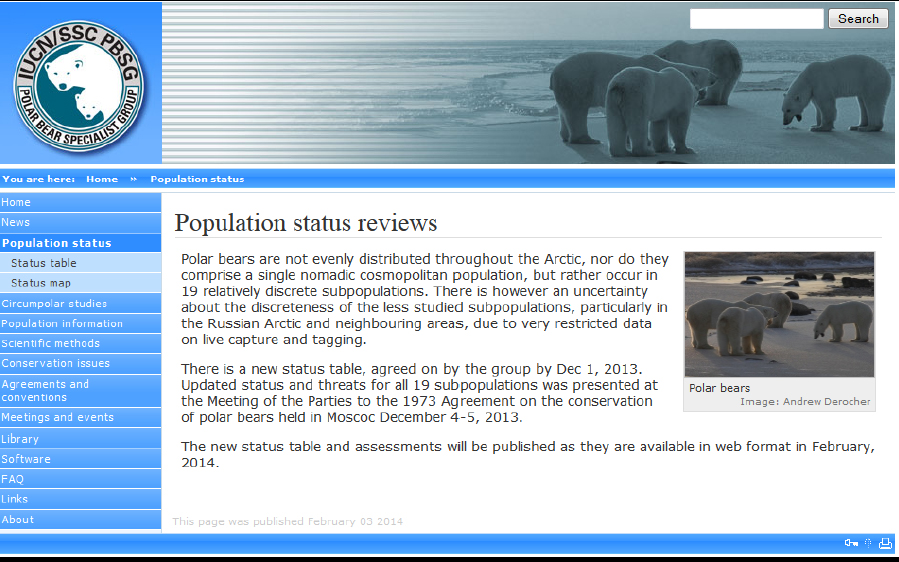
However, I noticed that the last sentence of the original December 16, 2013 “Population status reviews announcement had been changed, without any indication that it had been amended.

From December 16, 2013 until February 2, 2014 that last sentence said:

“The new status table and assessments will be published as they are available in web format no later than February 1, 2014.

Now it reads:

“The new status table and assessments will be published as they are available in web format in February, 2014.” [my bold]

The date stamp on this page is February 3, 2014, see screen cap below.

What do you call this — “Bayesian transparency”? I think it means a polar bear population status update may be forthcoming…sometime.

PBSG Population status reviews_Feb 3 2014 notice

Polar Bear Specialist Group population status update is much ado about nothing

I cannot for the life of me fathom why the IUCN Polar Bear Specialist Group (PBSG) bothered to insert an announcement on their website back in mid-December, promising an updated polar bear status assessment, since the posted January 31 “update” is nothing of the sort — there have been no changes of any consequence.

It therefore appears I interpreted the oddly worded announcement incorrectly and none of the anticipated changes were forthcoming. Baffling, to say the least. Have a look at the new updated documents that were posted yesterday and see what you think.

Continue reading