Posted onSeptember 1, 2014|Comments Off on Has the tide turned on polar bears as icons of global warming?
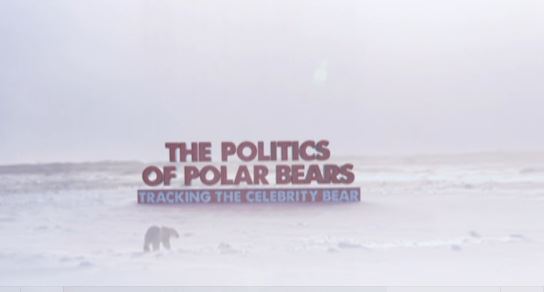
The CBC in Canada is pretty much a mirror image of the BBC in the UK, ABC in Australia and PBS in the US. So you might appreciate my shock at the almost unbelievable balance contained in the recently broadcasted CBC documentary, “The Politics of Polar Bears: Tracking the Celebrity Bear.”
The film is a profound change from the hype and pessimism that has dominated the polar bear issue in Canada and abroad, supported unchallenged by the CBC. Finally, TV viewers were given some decently balanced perspective on the status of polar bears in Western Hudson Bay.
If the take-away message tipped towards reason and optimism rather than panic over the status of polar bears, it’s because the evidence was strongly in that direction.
Posted onAugust 31, 2014|Comments Off on Must watch – “The Politics of Polar Bears: Tracking the Celebrity Bear”
This powerful, balanced documentary, with a focus on the bears of Western Hudson Bay, can now be watched online. A Canadian Broadcasting Corporation (CBC) production, it includes interviews with polar bear biologists Mitch Taylor (screen-cap below) and Seth Stapleton – juxtaposed with statements from outspoken polar bear conservation advocate Andrew Derocher.
I was not mentioned by name (making me “she who cannot be named” yet again?) but host Reg Sherren did discussthe contents of the email I received from PBSG chairman Dag Vongraven earlier this summer about their proposed clarification to the global population estimate (and posted here).
I can’t guarantee those outside Canada will be able to view it but I watched it Sunday night (August 31) from British Columbia. It’s well worth the time.
[Aired originally on “Absolutely Manitoba” (Season 2014, Episode 5, Aug 30, 2014), by Reg Sherren. See announcement article here]
[Note: the “Sharon Crockford” interviewed in the film is no relation to me, as far as I know!]
Comments Off on Must watch – “The Politics of Polar Bears: Tracking the Celebrity Bear”
Posted onAugust 28, 2014|Comments Off on Reflections on my House of Lords lecture: Healthy polar bears, less than healthy science
Here is an excerpt of an essay I wrote reflecting on the recent (11 June 2014) lecture I gave at the House of Lords in London (“Healthy polar bears, less than healthy science”). The Global Warming Policy Foundation (GWPF) has just published that 14 page essay in its entirety as its 10th such report but you can get a taste of it here.
My piece addressed the following issues that I talked about in the lecture or which came up afterwards during the question period and discussions later:
• On what do you base your assertion that polar bear populations are “healthy”?
• Are the media — or polar bear scientists — to blame for hyping the “polar bears are dying” meme?
• How significant was the recent dismissal of a petition to force Canada into listing polar bears as ‘threatened with extinction’?
• What do the recent actions of the Polar Bear Specialist Group say about their commitment to good science?
• Is my blog helping to “self-correct” the science on polar bears?
The highlighted point is copied in full below. See the full essay here. Continue reading
Comments Off on Reflections on my House of Lords lecture: Healthy polar bears, less than healthy science
Posted onAugust 5, 2014|Comments Off on Dodgy new clarification of global polar bear population estimate (yes, another)
In an attempt to get themselves out of a mess of their own making, the IUCN Polar Bear Specialist Group (PBSG) has just dug their hole even deeper.
Although the minutes of their 2014 June meeting (pdf here) contained this statement…
“K. Laidre summarized the need for the PBSG to do a better job of communicating accurate and balanced science about polar bears.” Pg. 28
…you might conclude, after reading the rest of this post, that polar bear specialists don’t really understand what these terms mean.
Due to the flack they have been catching over their global polar bear population estimates, the PBSG determined that another clarification was in order. [As opposed to the first clarification, a footnote the group planned to insert in an upcoming report, which PBSG chairman Dag Vongraven sent to me in May)]
The new clarification, apparently co-authored by Steve Amstrup and Andy Derocher (PBSG 17 minutes, pg. 33 – copied below), makes an astonishingly bold claim that I can easily show is untrue.
See that post for methods and other background on this topic, and some track maps from 2012 (also available at the USGS website here).
The USGS track map July 2004 is copied below (Fig. 1).
Compare this to June’s map (Fig. 4). The 20 bears from May (down to 14 in June) are now down to 13. All seven of the bears outfitted with glue-on satellite transmitters in April [either males or subadult animals] have either moved out of the area or their tags have fallen off or stopped transmitting. This means that all of the bears shown on the June and July maps below are females.
One bear has moved into Canadian territory and another is well into the Chukchi Sea. This is now known to be a typical rather than unusual phenomenon, and is pertinent to the bigger picture of what constitutes a discrete geographic subpopulation for polar bears. Continue reading
Comments Off on Tracking polar bears in the Beaufort Sea – July 2014 map and subpopulation boundary issues
See that post for methods and other background on this topic, and some track maps from 2012 (also available at the USGS website here).
The USGS track map for June 2004 is copied below (Fig. 1).
Compare this to May’s map (Fig. 2) – the 20 bears from last month are down to 14, and all seven of the bears outfitted with glue-on satellite transmitters in April [either males or subadult animals] have either moved out of the area or their tags have fallen off or stopped transmitting. This means that all of the bears shown on the June map below are females with satellite radio collars. Continue reading
Comments Off on Tracking polar bears in the Beaufort Sea: June 2014 map
A reader from Oregon questioned the filming techniques used for this video.
Revkin followed up.
And it turned out, the reader from Oregon was correct — the film used in this video was shot with “an assortment of traditional methods,” not with the strapped on cameras that the USGS were using on the bears.
Revkin assumed from the background provided to him that this was leading-edge technology, bear-generated video. And even though he’d interviewed the filmmaker, the truth hadn’t come out.
Update June 29, 2014 – another damning comment made, added below.
Here are some background to the video you should be aware of:
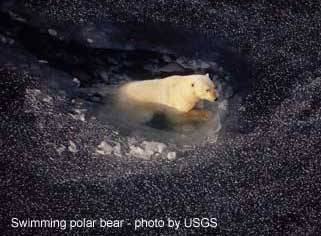
1) The bears were swimming away from the USGS researchers and film crew who had shot them full of sedatives and attached a camera to one of their necks — they were not swimming toward sea ice 100 miles away.
2) The video was shot in the Bering Sea, in April 2014, when sea ice was about its maximum extent of the year — there was lots of ice around when this video was filmed.
3) The company doing the filming is using this video as a fundraiser.
Details below, including a sea ice map for April 2014.
I’ve been traveling for a month but I am finally home — tired and jet-lagged after a journey that took me two-thirds of the way around the world and back. More on my experiences as my energy for blogging returns.
*I shouldn’t have to point this out but I will: I was not paid for this lecture, nor for the airfare to London (I was passing through town anyway). As the timing of the lecture required an overnight stay, GWPF did pick up the tab for a hotel room and dinner, as hosting organizations for such events do as a matter of course.
Comments Off on My interview with Benny Peiser about polar bears, evolution and Arctic controversies
Watch polar bear habitat reform in the Canadian Arctic: “last 10 days” Canadian Ice Service animation (works anytime) HERE.
See Quote archive for details.











 polarbearscience
You must be logged in to post a comment.