Category Archives: Advocacy

Attenborough’s tragedy porn of walruses plunging to their deaths because of climate change is contrived nonsense

A recent Netflix ‘Our Planet’ program with David Attenborough delivering a disturbing message of doom about walruses falling off a cliff to their deaths because of climate change is contrived nonsense on par with the bogus National Geographic starving polar bear video of 2017.  The walruses shown in this Netflix film were almost certainly driven over the cliff by polar bears during a well-publicized incident in 2017, not because they were “confused by a combination of shrinking ice cover and their own poor eyesight“.

Walrus plunging cliff_The Sun headline 5 April 2019

Apologies for neglecting to add, h/t to Charles the Moderator from WUWT!

UPDATE 8 April 2019: Falling off cliffs is not a new phenomenon. Here is video of US Fish and Wildlife officials in 1994 trying to explain a situation where walruses are falling even without the impetus from polar bears, at Cape Pierce in the southern Bering Sea (a haulout for adult males during the ice-free season). Explanation? Overcrowding (too many walruses)! h/t to Mark Sullivan.

Also, see this 8 April 2019 piece from The Atlantic that confirms the ‘Our Planet’ footage was filmed in 2017, and that “the sequence includes footage from two separate beaches—one with the 100,000-strong congregation and one with the falls.”

UPDATE 9 April 2019: For the details on why the two events described below (the one filmed by Attenborough’s ‘Our Planet’ crew and the event reported by the Siberian Times in 2017) are almost certainly one and the same, see Andrew Montford’s post at The Spectator. The Global Warming Policy Foundation has issued a press release.

UPDATE 14 April 2019: New details show that the film crew are still lying about the walrus death event in the Netflix ‘Our Planet’ episode, summarized by me here.
Continue reading

OK in the 80s but not now: ‘seeing more polar bears means there are more bears’

Wait for it, it will come: backlash from polar bear scientists for a statement by an Inuk bear safety guide in Labrador, reported by the CBC yesterday. The guide said there are more polar bears now than there were 25 years ago based on the fact that he is seeing more bears and that more bears mean more trouble with bears, including attacks on people. As I point out in my new book, The Polar Bear Catastrophe That Never Happened, only in the 1980s did biologists admit that seeing more bears meant there were actually more bears.

polar-bear-black-tickle_Edwin Clark submitted to CBC no date

This bear visited Black Tickle in Labrador a few years back. Edwin Clark photo.

It has not been OK anywhere else in the world over the last few years to suggest that seeing more bears meant more bears, whether you were Inuk or not – whether describing a subpopulation that’s officially ‘increasing’ or not.

According to biologist Andrew Derocher (University of Alberta), who famously said last year that ‘you can’t equate seeing more bears with there being more bears,’ all of the increased sightings and problems with bears in Labrador and Newfoundland are due to poor ice conditions. His colleague Ian Stirling (also University of Alberta) similarly puts the blame for increased polar bear/human conflicts and fatal attacks in Nunavut on a ‘shortage of ice‘. For polar bear specialists, it’s always ‘less ice‘, never ‘more bears.’

Continue reading

It’s back: Bering Sea polar bear habitat has recovered from a low earlier this month

Fancy that! After a load of handwringing earlier this month, mobile pack ice in the Bering Sea has returned. Just like ice in the Barents Sea, Bering Sea ice is highly variable (Brown et al. 2011): it moves with winds and currents, so a ‘decline’ during the winter usually indicates redistribution, not melting.

Polar_bear Bering Sea 2007 USFWS lg

Polar bear on Bering Sea ice 2007 USFWS

According to researcher Rick Thoman from the University of Alaska Fairbanks, quoted by the Canadian Press:

“Wind blew ice to Russian beaches in the west and to the south side of Norton Sound south of Nome but left open water all the way to Chukchi Sea north of the Bering Strait.”

Polar bears that venture into the Bering Sea are part of the Chukchi Sea subpopulation, which is known to be thriving (Crockford 2019; AC SWG 2018; Regehr et al. 2018; Rode and Regehr 2010; Rode et al. 2013, 2014, 2015, 2018).

Continue reading

My International Polar Bear Op-Ed at the Financial Post on 27 February 2019

In case you missed it back on 27 Februrary 2019. See the original here (with photos).**

Crockford Financial Post Opinion_photo_27 Feb 2019

Continue reading

International Polar Bear Day: a time to admit the species is not threatened with extinction due to reduced sea ice habitat

Times have changed: where once many scientists worried that polar bears could not survive an Arctic with 40% less ice, now the concern is that people of the Arctic might not be able to keep themselves safe from growing numbers of increasingly fearless bears.

International Polar Bear Day is tomorrow, 27 February. It’s a good time to reconsider polar bear conservation in light of current realities. Polar bears are not threatened with extinction by loss of sea ice habitat but continue to thrive in spite of it (Crockford 2017).

Polar bear Aug 2017 near area where June 19 2018 bear was spotted Gordy Kidlapik

Fat bear in August 2017 outside Arviat, Nunavut. Gordy Kidlapik photo.

Tomorrow, the 2018 State of the Polar Bear Report will be released. But for now, see some of the failed claims below.

Continue reading

Bear on shore in January that threatened residents of Foxe Basin community was shot

According to a report by CBC News earlier this week (18 February 2019), there was a defence kill of a potentially dangerous polar bear and her cub in Foxe Basin, Nunavut on January 4th that we are just hearing about now. Yet another bear on shore in winter, when there is plenty of sea ice, looking for food in an Arctic community and threatening the lives of its residents while a polar bear specialist blames such incidents on lack of ice.

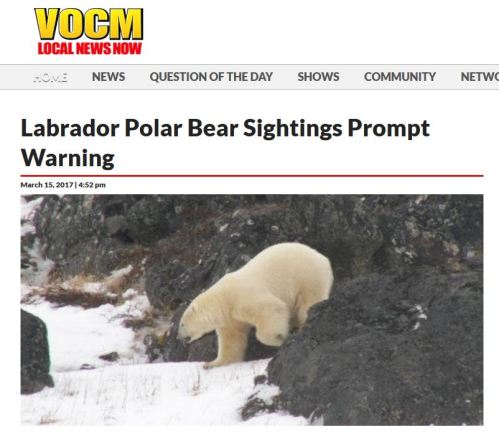
Black Tickle bears again 15 March 2017 headline VOCM

Polar bear on shore in Labrador, early March 2017, VOCM report

Continuereading

Polar bears driven out of Novaya Zemlya town onto the ice by persistent harassment

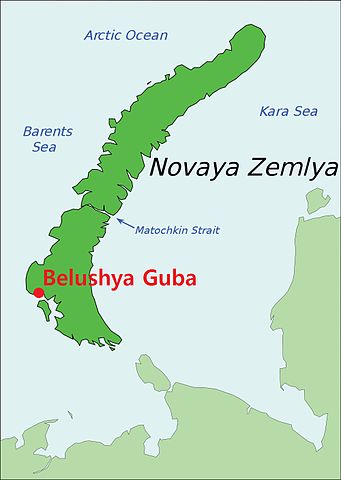
The state of emergency in Belushya Guba on Novaya Zemlya is over, according to a report yesterday from the Russian news agency TASS (18 February 2019), as no bears had been spotted over the previous 24 hours.

Belushaya Guba garbage dump_Daily Mail_11 Feb 2019

Continue reading

Polar bears walking the streets on Novaya Zemlya are habituated garbage bears, not victims of climate change

What a bunch of sensationalist claptrap about the polar bears on Novaya Zemlya but I guess it sells papers and raises donations (WWF and PBI, I mean you).1

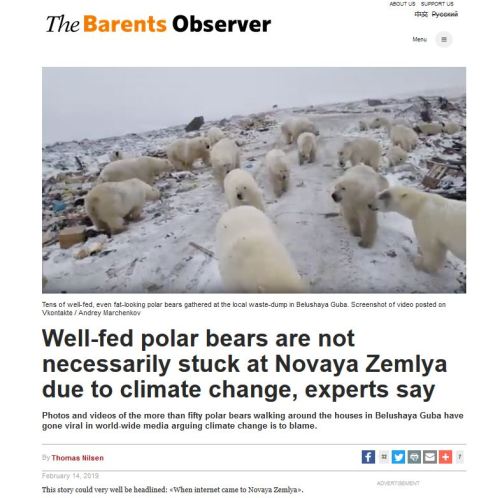
Nilsen_when the internet came to Novaya Zemlya_cites my blog post_14 Feb 2019

Seriously, if the bears were coming for us, people in Belushaya Guba would have died already, probably EATEN. These particular bears know there is stored food and refuse available that does not come packaged in human form and they know from experience that humans won’t hurt them. As I pointed out in my last post, these bears have known this since early December, when they chose to stay on land over the winter and ignored the sea ice when it arrived.

Lack of sea ice is not the problem here. These are habituated garbage bears that are no longer safe to have around: the responsible option is to shoot them. It’s harsh, I know, but the population will recover from the loss.

Belushaya Guba garbage dump_Daily Mail_11 Feb 2019

If you suddenly cut off their passive food supply (fence or close the dump, deal more carefully with individual refuse and stored food), all of these bears in the photos and videos being flashed across the Internet will become desperate and truly dangerous. Remember, just last summer an emaciated, desperate bear almost killed a cruise ship guard: he had a loaded gun and was actively looking for bears, yet the bear managed to ambush him. He’d have died if he’d been alone.

Of course the refuse and stored food problem needs to be dealt with, in Belushaya Guba and elsewhere across the Arctic, but these particular bears cannot be saved. Cleaning up these issues takes time, coordination, and money. Ask Churchill, Manitoba, who for years wrestled with these issues before a workable solution was agreed upon. And while few Arctic communities can afford to do it the Churchill way, virtually all must contend with the very real threat of polar bears both inside and outside their communities. Ask the Inuit of Arviat and Naujaat, who each lost a young man last summer to a predatory attack by a polar bear that happened well outside their respective villages and where lack of sea ice was not an issue.

Blaming this on climate change is the Paul Nicklen starving polar bear video all over again. You remember the one, the video that National Geographic got so much push-back about that they had to make a public apology for spreading misinformation?

Do climate change promoters really need another fiasco featuring polar bears?

Continuereading

Polar bears have been terrorizing a Russian town on the Barents Sea since December

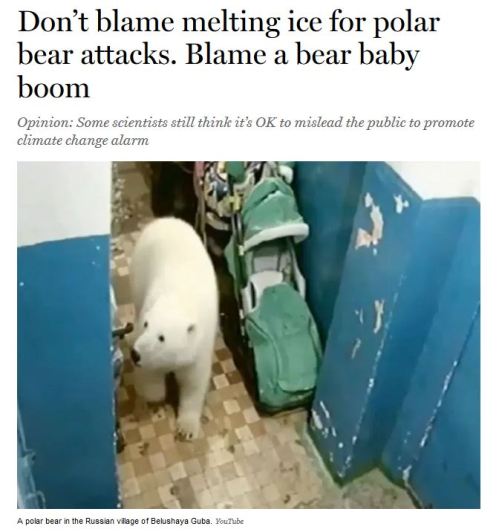
Since early December, a group of 52 polar bears have terrorized the Russian village of Belushaya Guba on southern Novaya Zemlya. The aggressiveness of some of the bears, their boldness in entering local buildings and fearlessness in the face of the usual deterrents has caused the local government to call a state of emergency to help the town residents. Global warming is blamed for the problem but as is so often the case, that claim does not stand up to scrutiny.

Belushaya Guba garbage dump_Daily Mail_11 Feb 2019

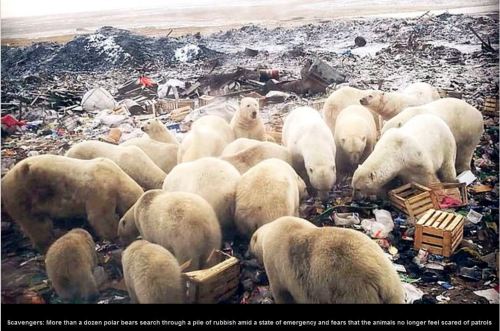
Large group of polar bears at the Belushya Guba town dump on Novaya Zemlya, Russia. From the 11 Feb. 2019 story at The Daily Mail.

Belushaya Guba is located on the southwest coast of Novaya Zemlya in the eastern Barents Sea. It is a town of mostly military personnel and their families:

Belushya_Guba_on_map_of_Novaya_Zemlya_SM wikipedia

The predictable claims that this situation is due to global warming are confounded by the fact that the region has not had abundant sea ice by December in more than 30 years, yet this is the first time the town has had such a problem with polar bears. Polar bears in winter can be very dangerous, as they are often lean and desperately hungry. [except these ones are not, see update below]

UPDATE 11 February 2019: The international media have gone mad for this story and some photos are now available. Best series of photos and video is at The Daily Mail, UK (11 Feb 2019: State of emergency is declared after more than 50 polar bears invade Russian town and ‘chase terrified residents’). No new information is available on the story itself but plenty of hyperbole has been added. The photos show how fat and healthy these so-called ‘desperate’ bears are, which makes the claims that global warming is to blame for the crisis even more ludicrous (see the ice charts below). So far, the most over-the-top take on this goes to the Washington Post (11 Feb 2019: A ‘mass invasion’ of polar bears is terrorizing an island town. Climate change is to blame): they went to the most trouble to make the link to climate change and bring up the vilified ‘starving polar bear’ video that National Geographic was forced to apologize for last August and the debunked 2007 prediction that 2/3 of the world’s bears would be gone by 2050 (Crockford 2017). The Guardian‘s effort is weak by comparison, as is CNN‘s. The news outlet (not a blog) Daily Caller has some quotes from this page. Competition amongst bears for scarce natural resources in winter makes dump sites and stored food available around Arctic communities all the more attractive. When polar bear numbers are high, as they are now, this competition can get fierce. It’s no wonder the bears don’t want to leave.

Continue reading

Abundant polar bear habitat across the Arctic at the start of winter

January is the first month of the Arctic winter, the season when most polar bears really struggle to find enough to eat.

Polar bears feeding_Shutterstock_sm

Here is what the sea ice looked like around the Arctic at the end of this month.

masie_all_zoom_4km 2019 Jan 31

Compare to last year:

Continue reading