January is the first month of the Arctic winter, the season when most polar bears really struggle to find enough to eat.
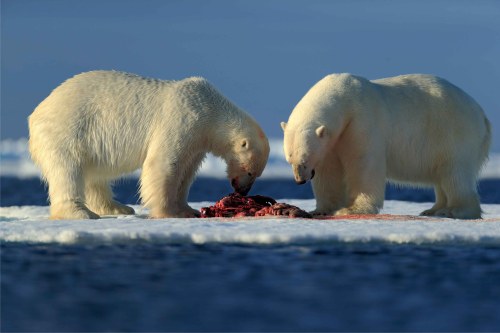
Here is what the sea ice looked like around the Arctic at the end of this month.

Compare to last year:

January is the first month of the Arctic winter, the season when most polar bears really struggle to find enough to eat.
Here is what the sea ice looked like around the Arctic at the end of this month.
Compare to last year:
Comments Off on Abundant polar bear habitat across the Arctic at the start of winter
Posted in Advocacy, Conservation Status, Life History, Sea ice habitat
Tagged Arctic, Barents Sea, Canada, denning, Derocher, East Coast, Franz Josef Land, polar bear, sea ice, Svalbard, winter
A man from Arctic Village (Alaska), out checking his trap-line, killed a polar bear at his cabin when it came after him: only odd things were it was the first week of January and the cabin was more than 100 miles south of the Beaufort Sea coast.
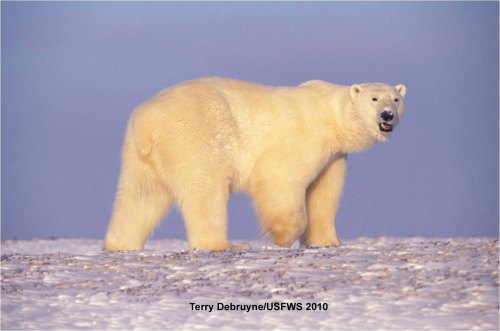
Winter is hard for polar bears, as I’ve mentioned before: it’s cold, dark, and hard to find seals. Most bears are at their lightest weight at the end of winter (March). Looking for food in the dead of winter, the bears can be very destructive as well as dangerous. See previous posts here, here, here, and here.
The map below shows how far south Arctic Village is from the Beaufort coast. This hunter is lucky he had his wits about him and his gun handy, because he came awfully close to being a polar bear’s dinner.
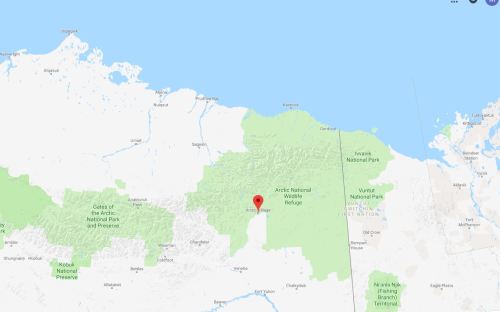
Here’s an excerpt of the story (my bold): “Polar bear encounter reported in Arctic Village, many miles south of normal range” (KTOO, Ravenna Koenig, 15 January 2019):
Comments Off on Southern Beaufort polar bear attack far from the Alaskan coast: another winter example
Posted in Life History, Polar bear attacks
Tagged Alaska, ANWR, Arctic Village, attack, damage, extralimital, polar bear, winter
Despite a wild claim that a “slow Arctic freeze” this year increases the risk that polar bears will become extinct, sea ice charts show ice returning earlier than it has for decades everywhere except the Svalbard area of the Barents Sea. That’s good news for pregnant polar bears. Although Svalbard is without ice, that’s been true for so many years that pregnant Svalbard females long ago abandoned the use of islands they used in good ice years and now make their dens in the Franz Josef Land archipelago to the east (which is still within the Barents Sea subpopulation region).
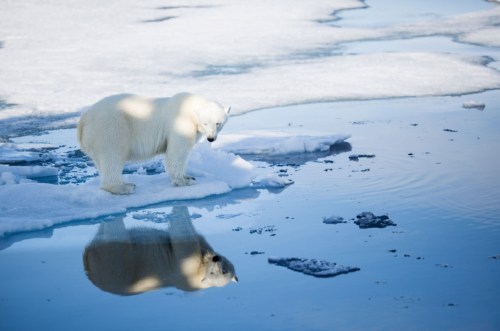
Polar bears give birth around 25 December each year, so pregnant females prefer to be snug in a safe den by around the end of November at the latest. That’s been possible for all regions of the Arctic this year, including the Barents Sea — because sea ice returned to Franz Josef Land weeks ago, even though Svalbard is still ice-free.
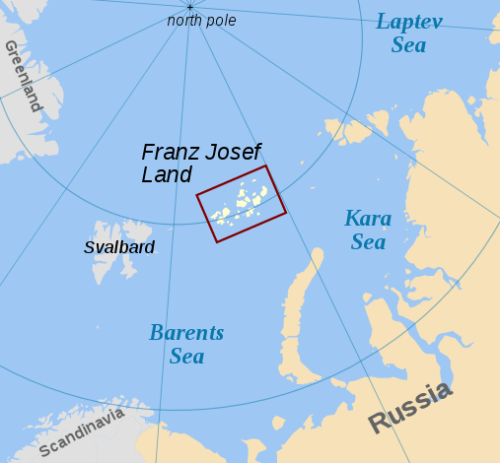
Major denning areas in Russia, including Wrangel Island, have been surrounded by ice since the middle of the month, allowing pregnant females that did not remain on shore over the summer to return to make maternity dens. Elsewhere, bears that have been confined to shore over the ice-free season (such as along Hudson Bay and Baffin Island in eastern Canada) returned to the ice to hunt seals weeks ago after the earliest freeze-up in more than two decades.
Comments Off on No extirpation looms for Svalbard polar bears: no pending catastrophe in Norway
Posted in Advocacy, Conservation Status, Life History, Sea ice habitat
Tagged Aars, Barents Sea, Derocher, extinction, extirpation, polar bear, Russia, sea ice, Svalbard
More ice in Hudson Bay and adjacent regions than we’ve seen at this time of year for more than two decades: not since 1993 has there been as much polar bear habitat in the 2nd-last week of November.
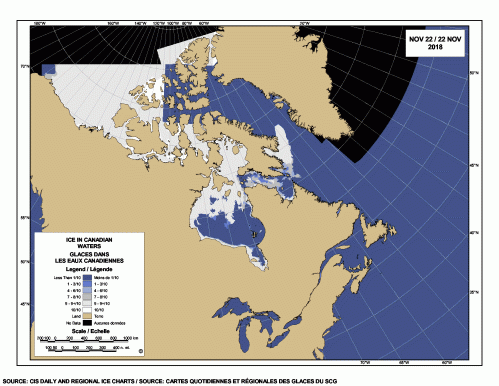
The anomaly chart for this week is almost all blue:
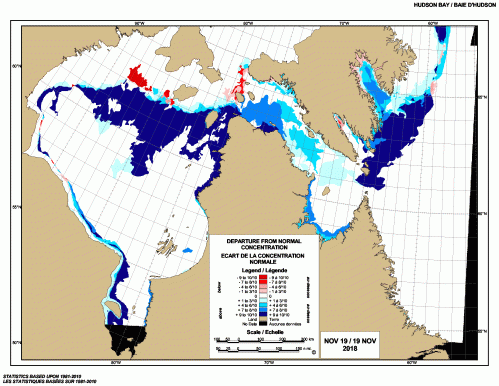
Other years back to 1994 had much less ice for the 2nd-last week in November, as the charts below show. Colour charts are only available from 2004.
Comments Off on Hudson Bay polar bear habitat is highest in more than two decades for this time of year
Posted in Life History, Sea ice habitat
Tagged Foxe Basin, Hudson Bay, polar bears, sea ice, Southern Hudson Bay, western hudson bay
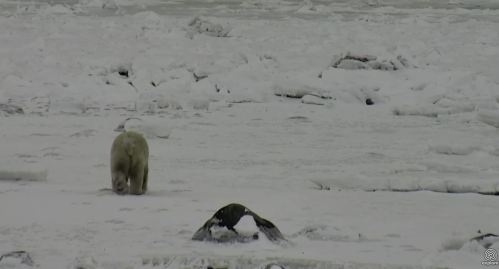
This is the second year in a row that freeze-up of Western Hudson Bay ice has come earlier than average. Movement of tagged bears and reports by folks on the ground in WH show some polar bears are starting to hunt seals on the sea ice that’s developing along the shore. It’s unlikely that a strong wind will again blow the newly-formed ice offshore (as happened earlier this year) because the ice is more extensive. It seems polar bear viewing season in Churchill will be ending early this year, just like it did last year.
The 9 November map Andrew Derocher (University of Albera) published on twitter showing tagged and collared polar bear movements on Hudson Bay makes it look like almost no ice is present:
However, the Canadian Ice Service chart for 10 November shows the ice very clearly:
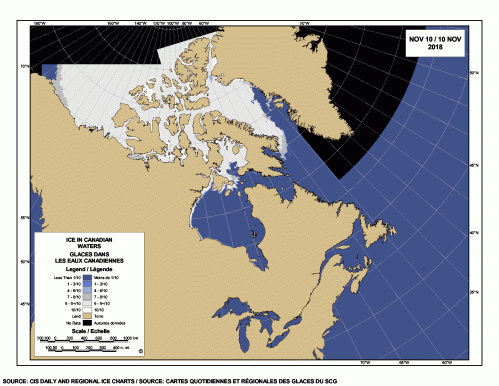
UPDATE 13 November 2018: See more recent ice charts and the latest (November 4-11, week 19) report from the Polar Bear Alert Program in Churchill that confirms the bears are moving offshore.
Comments Off on W Hudson Bay freeze-up earlier than average for 2nd year in a row, polar bear hunt resumes
Posted in Conservation Status, Life History, Sea ice habitat
Tagged alert, charts, Churchill, concentration, freeze-up, Hudson Bay, hunting, polar bear, problem bears, sea ice, seals
Ryrkaypiy on the Chukotka coast of Russia is similar to Churchill, Manitoba: both human settlements are of similar size and are close to where polar bears wait for sea ice to form in the fall and where some pregnant females make their maternity dens in preparation for the birth of cubs over the winter (Durner et al. 2018:xxii). Sea ice advances from the west along the Chukotka shore and bears cannot move offshore to resume hunting until the sea ice reaches the village of Ryrkaypiy. According to the Siberian Times, the village is again having problems with local polar bears, as they have for the last several years (including 2013).
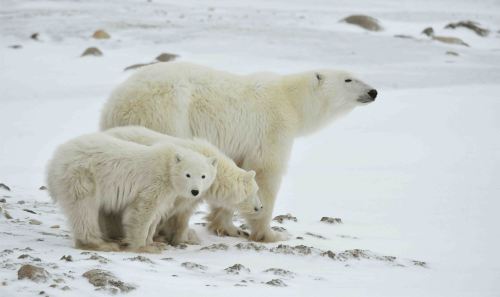
“At least twelve polar bears are inside the village, with some of them paying daily visits.
The rest are within three kilometres away.
‘We have to constantly scare the bears away with signal rockets, so far thanks to efforts of the Bear Patrol we manage well’, said acting head of Ryrkaypiy Yevgenia Malakhova.
The large group of bears started to form a month ago when they came close to Cape Kozhevnikov.
‘Now the bears moved close to the village, they also walk back and forth all along the shore line. The animals are irritated because they are ready to leave the area and start hunting in the deep sea, but ice is too thin’, said Malakhova.
All 760 locals are aware of the dangerous situation and take extreme care when moving around the place.”
More below, including map and ice chart.
Comments Off on Polar bears waiting for ice on Russian coast of Chukchi Sea threaten village residents
Posted in Life History, Polar bear attacks, Sea ice habitat
Tagged attractants, carcasses, Chukchi Sea, Chukotka, Churchill, polar bear, problem bears, Russian, sea ice, Wrangel Island
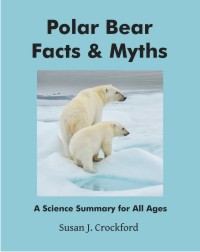
Given my strong Dutch heritage through my maternal grandfather (via Middelharnis), I am especially proud to announce that the Dutch translation of my popular science book, Polar Bear Facts and Myths (suitable for children aged seven and up), is now available through Amazon worldwide in paperback.

The translation was done by native Dutch speaker Marcel Crok who is a journalist and science writer in The Netherlands (see @marcelcrok on twitter). In Dutch the book is called Feiten en Mythes over IJsberen.
Please pass along to your friends, relatives, and colleagues in North America and abroad. The English version is still available in paperback and ebook formats, and the Norwegian translation will be available shortly. Other translations in French and German are already available.
Children around the world have been led to believe that only a few hundred polar bears are left in the world. However, the relentless messaging that polar bears are doomed (and that this is all the fault of humans) is fortunately false. It is time that children learned the truth, including those that speak and read only Dutch.
Here is the good news the children need to hear: polar bears have not been driven to the brink of extinction by anthropogenic global warming. In fact, there are many more polar bears now than there were 50 years ago and the global population of polar bears is a healthy size, despite the fact that summer sea ice has been at levels predicted to cause catastrophe since 2007. Polar bears have managed just fine with low summer ice: against all expectations, their number have increased in recent years, not declined.
Polar Bear Facts & Myths is an uplifting science book about survival in the Arctic that is sure to please children and parents alike.
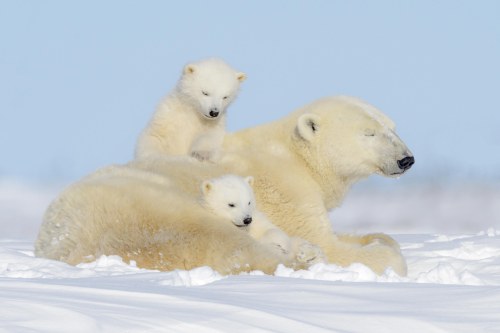
Details below. Continue reading
Comments Off on Fabulous polar bear science book for kids now available in Dutch
Posted in Book review, Life History
Tagged children, Dutch, facts, IJsberen, myths, Netherlands, non-fiction, polar bear, science, translation
What’s a good analogy for sea ice as essential polar bear habitat? Biologist Andrew Derocher claims that the soil in a forest is appropriate, because without the soil you can’t have the forest ecosystem. However, that’s a specious comparison because the amount of soil in a forest does not change markedly with the seasons the way that Arctic sea ice does.
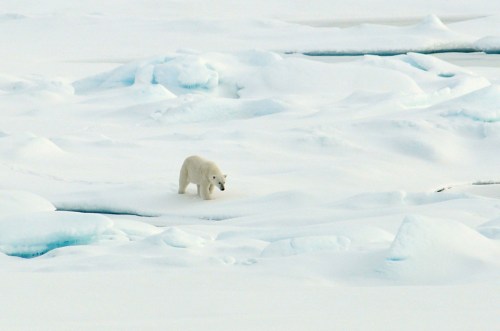
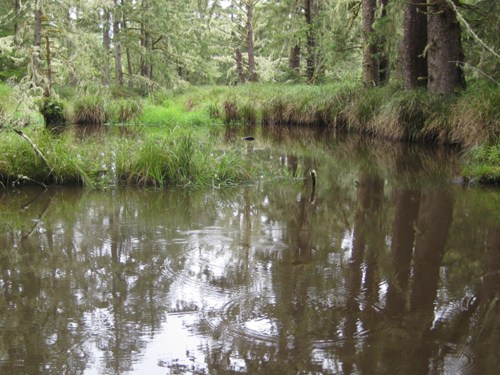
A much better analogy is a big pond that dries up a bit every summer. The amount of habitat available to sustain aquatic plants, amphibians and insects is reduced in the dry season but many species have special adaptations for surviving reduced water availability. For the rest of the year, however, the pond provides an abundant and non-limiting habitat for all the creatures and plants that live there.
Comments Off on Arctic sea ice habitat for polar bears is like a big pond that dries up partially in summer
Posted in Advocacy, Life History, Sea ice habitat
Tagged analogy, ecosystem, extinction, forest, habitat, Interglacials, polar bears, resilience, sea ice, wetlands
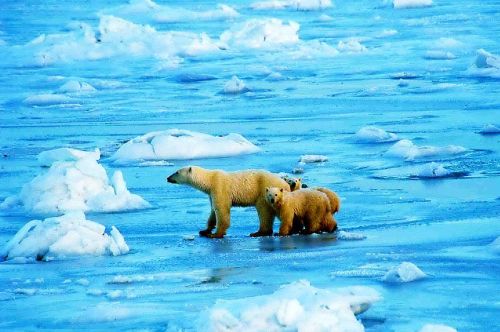
Last year, an early freeze-up of Western Hudson Bay sea ice almost ruined the Polar Bear Week campaign devised by Polar Bears International to drum up donation dollars and public sympathy for polar bear conservation. Many bears were on the ice hunting by 7-8 November in 2017 before the celebratory week was done (the average date that bears left the ice in the 1980s): sea ice charts suggest the same may be happening this year.
Ice is forming along the Hudson Bay coast more than a week earlier than it was last year (barely discernible on the map below but detailed ice charts show it clearly), consistent with early build-up of ice in the Canadian Archipelago, East Greenland, and Foxe Basin since mid-September.
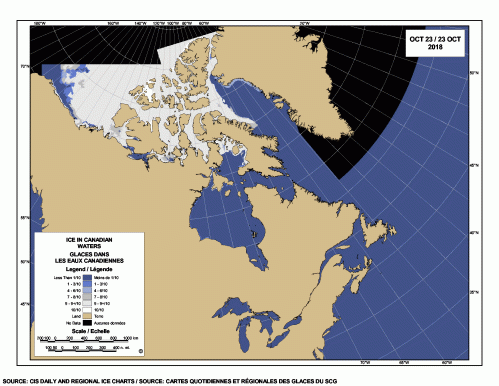
The question is: will the ice continue to build over the next few weeks or get blown offshore? See the ice charts below for this year and 2017.
Continue reading
Comments Off on New ice on Hudson Bay a week earlier than 2017: another early freeze-up ahead?
Posted in Life History, Sea ice habitat
Tagged Churchill, freeze-up, gray ice, Hudson Bay, new ice, polar bear alert, polar bears, sea ice, shorefast ice, western hudson bay, winds
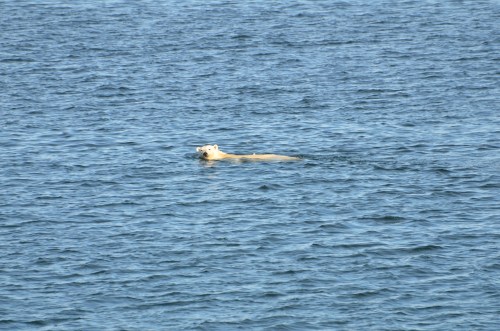
A recent study by Norwegian biologist Karen Lone and colleagues, who tagged 57 polar bear females with sensors around Svalbard, discovered that polar bears can dive to a maximum depth of 13.9m and can swim long distances across open water without rest. Contrary to previous claims, polar bears are excellent divers and their breath-holding ability did not seem to limit how deep they could dive.
From the abstract of the new paper by Lone and colleagues (Lone et al. 2018):
“Some bears undertook notable long-distance-swims. Dive depths up to 13.9 m were recorded, with dives ≥5 m being common. The considerable swimming and diving capacities of polar bears might provide them with tools to exploit aquatic environments previously not utilized.”
Compare the above statement to one made by Stirling and van Meurs (2015), after describing a 3 minute dive video-taped during an aquatic stalk of a bearded seal, also in the Svalbard area:
“…increased diving ability cannot evolve rapidly enough to compensate for the increasing difficulty of hunting seals because of the rapidly declining availability of sea ice during the open-water period resulting from climate warming.” [my bold]
These two papers really show the difference between using anecdotal accounts as if they were evidence of species-wide physical abilities and doing a scientific study on the physical ability of interest.
Comments Off on Scientific study finds polar bears excel at diving, contradicting previous expert opinion
Posted in Advocacy, Life History, Sea ice habitat
Tagged continuous swims, depth, dive, harbour seals, polar bear, Spitsbergen, stalk, Stirling, Svalbard, swimming, underwater





 polarbearscience
You must be logged in to post a comment.