Category Archives: Population

Experts’ vision of an ice-free summer is already wrong & benefitting polar bears

Polar bear populations in most of the Canadian Arctic Archipelago (CAA) must be booming, as they are elsewhere. That’s because the ‘experts’ were even more wrong in their predictions of future sea ice conditions than most people realize: they expected the CAA would remain choked with ice during a ‘nearly ice-free’ summer driven by human-caused global warming.
polar-bear-feeding_shutterstock_sm

Wang and Overland 2012 fig 3b marked

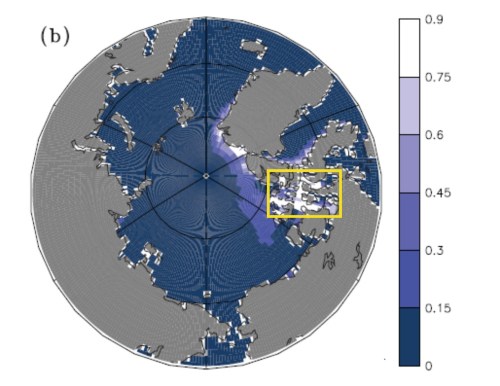
Map presented by Wang and Overland (2012: Fig 3) shows what these experts thought a ‘nearly ice-free’ summer would look like, which they expected to occur by 2030 or so.

Look at the map from Wang and Overland (2012) above, which is what they thought a ‘nearly ice-free’ summer would look like in the year 2030 or so.

Wang and Overland used the same models used by USGS biologists to predict the future survival of polar bears based on habitat loss (Amstrup et al. 2007; Atwood et al. 2016; Durner et al. 2007, 2009). Note the thick ice in the CAA — what USGS experts call the ‘Archipelago’ sea ice ecoregion (denoted by white in the map), indicating ice about 1 metre thick (2-3 feet) — expected to remain at the height of summer in 2030.

[Earlier renditions of sea ice projections (e.g. ACIA 2005) show something similar. The second update of the ACIA released just yesterday (AMAP 2017, described here by the CBC) has prudently included no such firm predictions in their Summary for Policy Makers, just dire warnings of future catastrophe. But see the 2012 update.]


The problem is that ice in this region has been largely absent most summers since 2006, even though overall ice extent has been much more extensive than expected for a ‘nearly ice-free’ summer, as I show below.

This is not another “worse than we thought” moment (Amstrup et al. 2007) — this is sea ice models so wrong as to be useless: failed models used to inform future polar bear survival models that got the bears declared ‘threatened’ with extinction in the US in 2008 (Crockford 2017).

It also means polar bears are almost certainly doing much better than recent population counts indicate, since only one subpopulation out of the six in the CAA has recently been assessed. But since polar bear specialists have consistently underestimated the adaptability of this species and the resilience of the Arctic ecosystem to respond to changing conditions, it’s hard to take any of their hyperbole about the future of polar bears seriously. Continue reading
Global polar bear population size is about 28,500 when updates are included

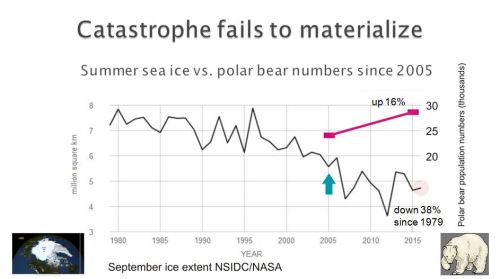
Polar bear numbers have risen since 2005, no matter how you look at it:

Svalbard polar bear Jon Aars_Norsk Polarinstitutt

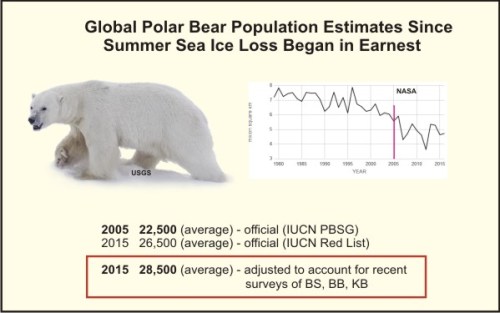
USGS estimated 24,500 (average) polar bears in 2005.

IUCN estimated 26,500 (average of 22,000-31,000) in 2015
(assessment completed in July, released in November).

Subpopulation surveys completed or reported after July 2015 (Baffin Bay, Kane Basin, Barents Sea) added ~2,000 bears.

This brings the adjusted average total at 2015 to ~28,500.

This may not be a statistically significant increase but it is also not the catastrophic decline that was predicted to occur in association with the abrupt drop of summer sea ice in 2007 to a new average of about 3-5 mkm2 [updated 1 June 2017].

Crockford 2017_Slide 12 screencap

Explained in full in this published paper, pgs 20-21:

Crockford, S.J. 2017 V3. Testing the hypothesis that routine sea ice coverage of 3-5 mkm2 results in a greater than 30% decline in population size of polar bears (Ursus maritimus). PeerJ Preprints 2 March 2017. Doi: 10.7287/peerj.preprints.2737v3 Open access. https://doi.org/10.7287/peerj.preprints.2737v3

UPDATE 26 March 2019: See “Latest global polar bear abundance ‘best guess’ estimate is 39,000 (26,000-58,000)

Recent incident in Foxe Basin shows the danger of hungry polar bears in winter

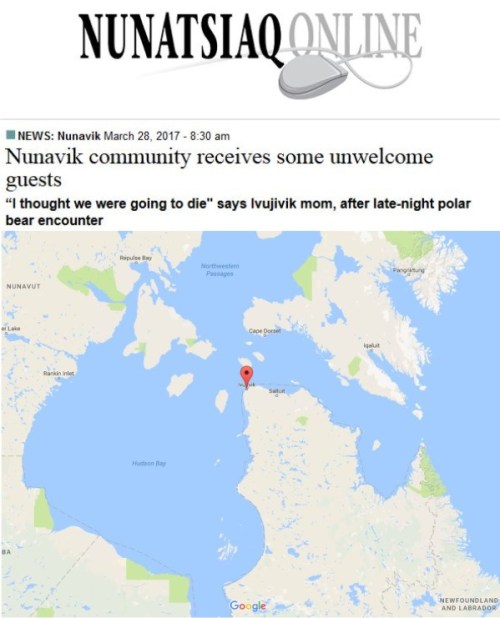
A late-night encounter with a thin and hungry polar bear in the northern Quebec community of Ivujivik in early March was a nightmare-inspiring event.

Ivujivik polar bear encounter plus headline_NunatsiaqOnline 28 March 2017

Reported this morning by NunatsiaqOnline (Nunavik community receives some unwelcome guests, 28 March 2017), the thwarted polar bear attack at the edge of Hudson Bay was the fourth defense kill this year (and the second this month) after a large number of bear sightings by residents this winter.

In contrast to reports of other encounters this winter that involved unusually fat bears for this time of year, this bear was thin and obviously dangerous.

Continue reading

Exposing the failed polar bear scare to a an enthusiastic and influential audience

I’ve just returned from a few days in Washington DC, where I presented the details on the global warming icon that refused to die as modeled (see my slide #12 below) to an enthusiastic and influential audience at The Heartland Institute‘s 12th International Climate Change Conference (ICCC-12).

Crockford 2017_Slide 12 screencap

Polar bear science got some long overdue scrutiny by a large number of people at this meeting. Not unexpectedly, a good many folks were surprised and outraged to learn how the polar bear/sea ice situation has actually unfolded compared to the predicted outcome and on-going media hype.

Continue reading

Science behind the video Polar Bear Scare Unmasked – updated paper now available

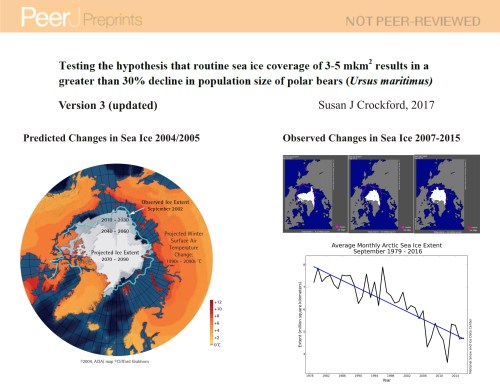
Announcing the publication today of Version 3 2 of my paper that tests the hypothesis that polar bear population declines result from rapid declines in summer sea ice, updated with recently available data. Version 2 provides the scientific support for the information presented in the GWPF video published yesterday, “Polar Bear Scare Unmasked: The Sage of a Toppled Global Warming Icon” (copied below).

Crockford 2017 V3 title page graphic 3

[The graphic above was created by me from the title page and two figures from the paper]

Updated 1 March 2017: I added an important reference to the paper below that got overlooked in previous versions (the work of Armstrong et al. 2008, see this post), making Version 3 the latest and most up-to-date.

Crockford, S.J. 2017 V3. Testing the hypothesis that routine sea ice coverage of 3-5 mkm2 results in a greater than 30% decline in population size of polar bears (Ursus maritimus). PeerJ Preprints 2 March 2017. Doi: 10.7287/peerj.preprints.2737v3 Open access. https://doi.org/10.7287/peerj.preprints.2737v3

Version 3, published 2 March 2017, adds an important reference; Version 2, published 28 February, incorporates additional reviewer comments and suggestions received on Version 1, as well as the updates noted above.

Continue reading

Polar Bear Scare Unmasked: The Saga of a Toppled Global Warming Icon [video]

For more than ten years, we’ve endured the shrill media headlines, the hyperbole from conservation organizations, and the simplistic platitudes from scientists as summer sea ice declined dramatically while polar bear numbers rose.

Now, just in time for International Polar Bear Day, there’s a video that deconstructs the scare. It runs about 8 minutes, written and narrated by me, produced by the Global Warming Policy Foundation.

Polar Bear Scare Unmasked: The Saga of a Toppled Global Warming Icon

Update 28 February 2017 See my follow-up post for the science behind the video, featuring a new version of my sea ice/polar bear hypothesis paper, just published (and updated with new data).

Crockford, S.J. 2017 V3. Testing the hypothesis that routine sea ice coverage of 3-5 mkm2 results in a greater than 30% decline in population size of polar bears (Ursus maritimus). PeerJ Preprints 2 March 2017. Doi: 10.7287/peerj.preprints.2737v3 Open access. https://doi.org/10.7287/peerj.preprints.2737v3

Thriving numbers – & two great books – are ample reason to rejoice on Polar Bear Day

Ten years of summer sea ice levels expected to kill 2/3 of the world’s polar bears by 2050 instead saw polar bear numbers grow. And this year, there are also two fabulous books about polar bears and their outstanding success story to celebrate on International Polar Bear Day (Monday 27 February 2017).

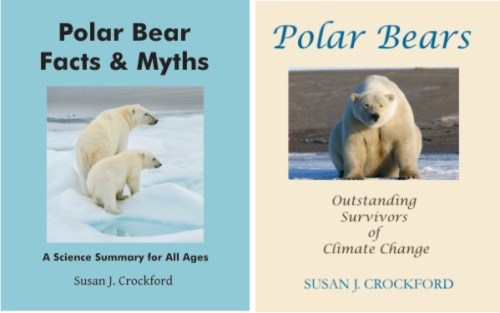
os-and-fm-cover-drafts-14-dec-2016

One is suitable for kids (Polar Bear Facts & Myths) and another for adults and teens who want the details (Polar Bears: Outstanding Survivors of Climate Change) – see the right sidebar to buy on Amazon or my author website for details on all additional formats. A couple of excerpts from them are below.

So forget turning down your thermostat in a pointless gesture to “reduce your carbon emissions and help polar bears” — as Polar Bears International advocates for Polar Bear Day. Instead, treat yourself or a friend and order a book with a rational approach to species survival.

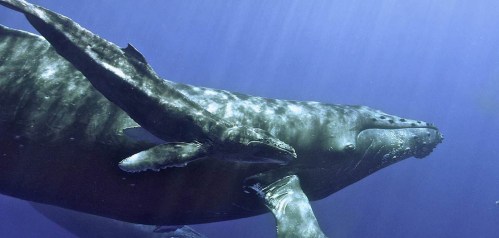
Speaking of species survival, think about the inconsistency in how some species are treated according to the US Endangered Species Act (ESA). Humpback whale numbers recovered after decades of protection; in 2016, after the state of Alaska filed a petition to delist, most populations were officially removed from the ESA list of ‘threatened’ species.

humpback-whale-and-calf-012016-noaa

Humpback whale and calf, NOAA image.

In contrast, by 2015, polar bear numbers had also recovered despite years of low sea ice loss not predicted until 2050, yet remain officially ‘threatened’ with extinction.

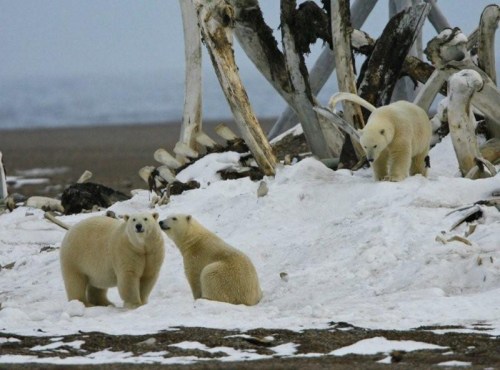
polar_bear_family_at_bone_pile-kaktovik-20-april-2016

Fat bear family at Kaktovik, Alaska (Southern Beaufort), April 2016. USGS photo.

US National Marine Fisheries Service defended the delisting of humpback whales against activists who insisted human-caused global warming threatened the species, but the US Fish and Wildlife Service defends flawed polar bear prophesies.

My books lay out the polar bear success story: in simple form for younger readers and in detail for others. See the excerpts below.

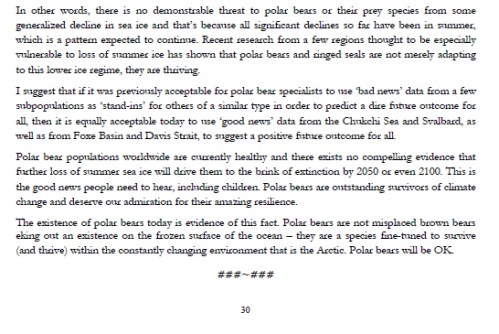
crockford-pb-outstanding-survivors-2017_end-of-pg-30

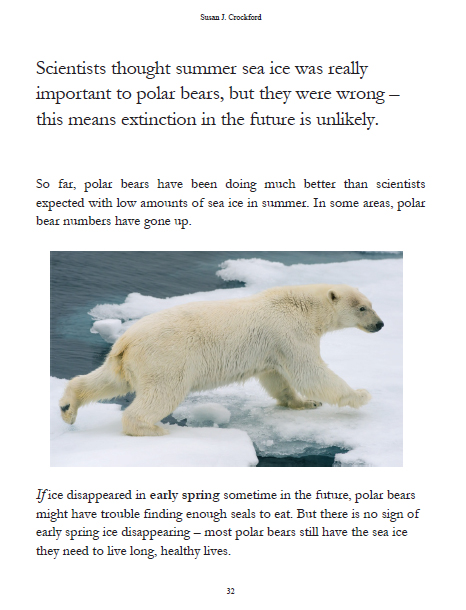
Polar bears have not been driven to the brink of extinction by global warming. In fact, they are thriving (see my final conclusions on pg. 30 of Polar Bears: Outstanding Survivors of Climate Change, above and pg. 32 of Polar Bear Facts & Myths below.

crockford-pb-facts-and-myths-2017-pg-32

If you’d like to support my efforts to bring this to everyone’s attention, please consider buying a copy or two of my books. If you’ve already done so, keep in mind that your local library might be glad to have copies donated. They also make great gifts.

Save

Save

Global polar bear population larger than previous thought – almost 30,000

The results of three recently-released studies that were not included in the last IUCN Red List assessment add more than 2,050 bears (on average)1 to the official 2015 global polar bear estimate, a point you won’t likely hear next Monday (27 February) from most polar bear specialists, conservation organizations, their cheerleaders and corporate sponsors on International Polar Bear Day.

global-pb-population-size-graphic2_2017-feb-polarbearscience-corrected

This means the adjusted 2015 global estimate for polar bears should be about 28,500 (average), a marked increase over the official estimate of 26,500 (average) for 2015 — and an even larger increase over the 2005 estimate of about 22,500 (average)2, despite the dramatic loss of summer sea ice since 2007 that we hear about endlessly.

It is increasingly obvious that polar bears are thriving despite having lived through summer sea ice levels not predicted to occur until 2050 – levels of sea ice that experts said would wipe out 2/3 of the world’s polar bears (Amstrup et al. 2007; Crockford 2017 v3).

Update 26 March 2019: see “Latest global polar bear abundance ‘best guess’ estimate is 39,000 (26,000-58,000)

Updated 1 June 2017:  see addition to Footnote 2.
Continue reading

Baffin Bay and Kane Basin polar bears not ‘declining’ concludes new report

The 2016 Scientific Working Group report on Baffin Bay and Kane Basin polar bears was released online without fanfare last week, confirming what local Inuit have been saying for years: contrary to the assertions of Polar Bear Specialist Group scientists, Baffin Bay and Kane Basin subpopulations have not been declining but are stable.

polar-bear-feeding_shutterstock_sm

Until recently, the Baffin Bay (BB) and Kane Basin (KB) polar bear subpopulations, that live between NW Greenland, and Baffin and Ellesmere Islands, were assessed with confidence by the IUCN Polar Bear Specialist Group (PBSG) to be declining due to suspected over-hunting (see 2016 Report, Ch. 1, pg. 4).

It turns out they were wrong.

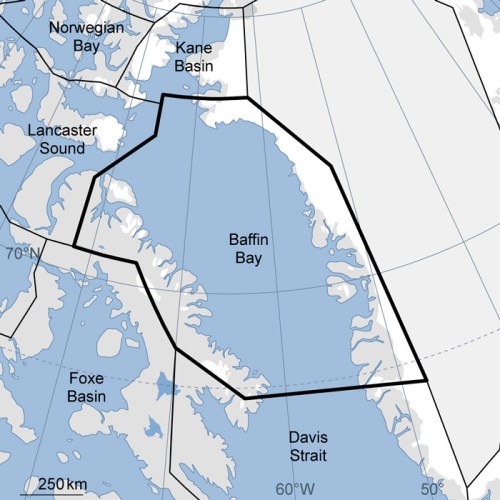
map-baffinbay

New (2016) polar bear subpopulation estimates for BB and KB:

Baffin Bay 2,826 (95% CI = 2,059-3,593) at 2013

                  [vs. 1546 (95% CI = 690-2,402) expected 2004]

                  vs. 2,074 (95% CI = 1,553-2,595) in 1997

  Kane Basin357 (95% CI: 221 – 493) at 2013

                    vs. 164 (95% CI: 94 – 234) in 1997

[1997 figures from 2015 IUCN Red List estimates, from Supplement, pg. 8); 2004 “expected” figure for Baffin Bay from 2016 SWG report, Ch. 1, pg. 4]

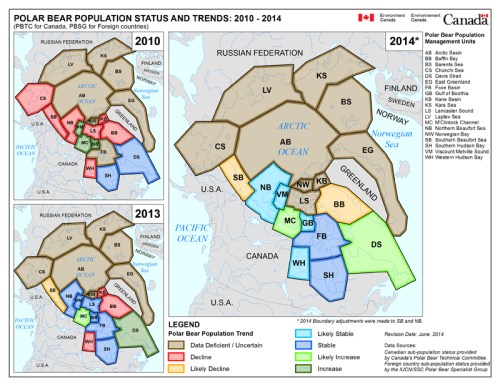
In 2014, Environment Canada’s assessments were ‘data deficient’ for Kane Basin and ‘likely declining’ for Baffin Bay (see map below):
ec_polarbearstatus_and-trends-lg_2010-2014-mapscanada_oct-26-2014

However, the results of this new study (conducted 2011-2013) would likely make KB in the map above dark blue (‘stable’), and BB light blue (‘likely stable’), depending on how the new information is interpreted (given differences in methodology between the 1991-1997 and 2011-2013 counts). Note that a recent paper by Jordan York, Mitch Taylor and others (York et al. 2016) suggested this outcome for Baffin Bay was likely (i.e. ‘stable’) but thought that the status of Kane Basin would remain ‘declining.’

This new information leaves only the Southern Beaufort subpopulation (SB) in a ‘likely declining’ condition, but since that decline was due to thick spring ice conditions in 2004-2006 (Crockford 2017), it does not reflect a response to recent loss of summer sea ice. The new population estimates for Baffin Bay and Kane Basin also suggests that a revision needs to be made to the 2015 IUCN Red List assessment with respect to the global population estimate because polar bears are clearly more abundant in Baffin Bay and Kane Basin than previously thought.

Continue reading

Listen to the evidence: polar bears are thriving in current sea ice habitat

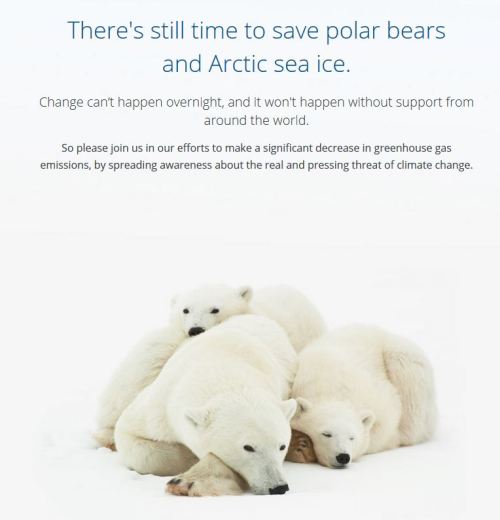
Oddly, activist organization Polar Bears International recently updated their website and now suggest there is still time to save polar bears and sea ice – even though the IUCN Red List documented more polar bears alive in 2015 than at any time in the last 50 years, despite the recent decline of summer sea ice – and even more bizarrely, call for a public uprising.

2017-pbi-save-polar-bears-and-sea-ice

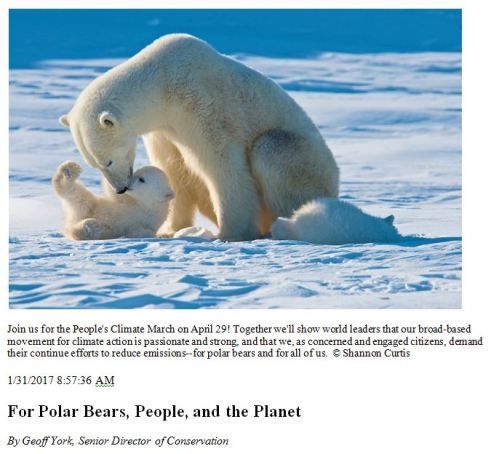
Polar Bears International (with three polar bear scientists on staff and other as active advisors) suggest that people who love polar bears should march the streets on Earth Day with scientists to demand (as concerned and engaged citizens) that world leaders take them seriously.

2017-peoples-climate-march-in-april-for-polar-bears-pbi-plea

Wow. I’ve been a career scientist for more than 40 years and I have to say, this is the oddest phenomenon I’ve encountered being advanced in the name of science. To me, it shows how disconnected these people are from what science is meant to be and what scientists are meant to do. Not just the polar bear scientists but the others like them that are behind this proposed march.

I recommend this blog post by Willis Eschenbach – an excerpt below.

Continue reading