Category Archives: Sea ice habitat

The polar bear problem no one will talk about – the downside to large populations

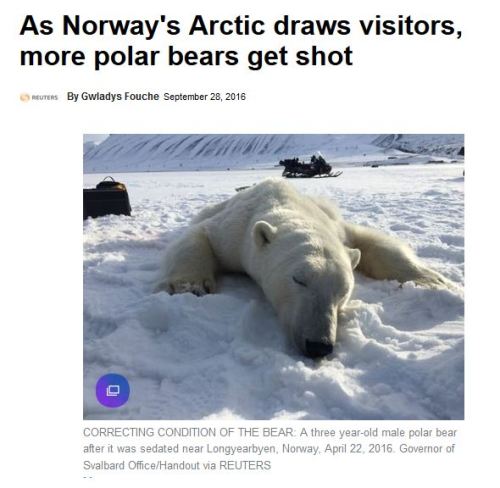
A large polar bear population with lots of adult males – due to bans on hunting – means more survival pressure on young bears, especially young males. To blame more problems with young male bears on lack of sea ice due to global warming ignores the downside to the reality Norway asked for when it banned hunting more than 40 years ago.

More hungry young males coming ashore looking for food is one of the potential consequences of living with a large, healthy population of polar bears. Biologist Ian Stirling warned of such problems back in 1974.

UPDATE: added below 6 Oct. 2016, statistics of defense of life shootings of polar bears in Svalbard since 1973.

svalbard-more-visitors-more-bears-shot_28-sept-2016-yahoo

Svalbard area polar bear numbers have increased 42% since 2004 and more hungry young polar bears almost certainly mean more polar bear problems, as folks in Svalbard (see map and quotes below) have experienced this year.
Continue reading

Polar bears seldom catch seals they stalk in summer – it’s why they fast

This short BBC video shows why polar bears are so often unsuccessful in their summer hunts – adult bearded seals are the species most often available on the ice. These seals are not only predator-savvy but there are lots of escape routes in the melting ice, and this has always been so.

“Hungry polar bear surprises a seal – The Hunt: Episode 2 Preview – BBC One”

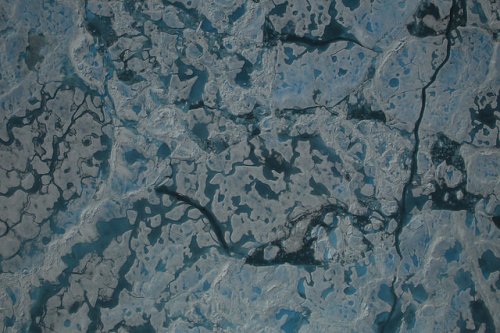
Melting ice in summer is not a new phenomenon (e.g. NASA photo below from mid-July 2016) – Thomas Grenfell and Gary Maykut described the process of melt pond development back in the 1970s:

“Melt ponds reach the maximum extent shortly after the disappearance of the snow, when they may cover upwards of 50% of the ice.”

sea-ice_melt-ponds_nasa-taken-13july2016_sm

Melting summer ice has always made it challenging for polar bears to catch seals, as this quote from Ian Stirling (1974) show, based on his work in the Central Canadian Arctic in the summer of 1973 (July and August):

There is a great abundance of natural holes in the ice during summer, anyone of which a seal could surface through.

This is still true in areas like the Southern Beaufort Sea today (e.g. Whiteman et al. 2015): the ice melts and in some areas, disappears completely in summer.

It’s why polar bears – unlike other species of bears in summer – depend on their stored fat to see them through until the ice reforms in the fall.

The meme “If there’s no ice, there’s no ice bear” is political-style rhetoric, not science.

[When polar bear scientists say “sea ice” or “ice” – they mean summer sea ice. Sea ice in winter and spring are not predicted to decline by 2100 to any appreciable degree and that has been true since sea ice predictions began]

Polar bears in Hudson Bay and Davis Strait routinely go 4-5 months without sea ice in the summer and have done since studies on them began. Yet, all of the polar bear subpopulations in Hudson Bay and Davis Strait are stable or increasing.

Continue reading

Polar bear tragedy porn dressed up as science features in new BBC Earth video

This new effort by the BBC would make the PR department of the Center for Biological Diversity proud, with it’s prominent use of animal tragedy porn pretending to be science. In contrast, the actual science shows something quite different: though summer sea ice since 2007 has declined to levels not predicted until 2040-2070, there has been virtually no negative impact on polar bear health or survival, a result no one predicted back in 2005.

bbc-video-15-sept-2016-screencap-breaking-ice-02

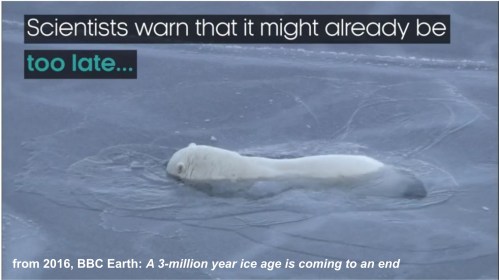
Bizarrely entitled  A 3-million-year ice age is coming to an end (15 September 2016), this slick video pretends it’s promoting the recently released paper by Harry Stern and Kristen Laidre (2016) that got a lot of media attention last week (see here and here).

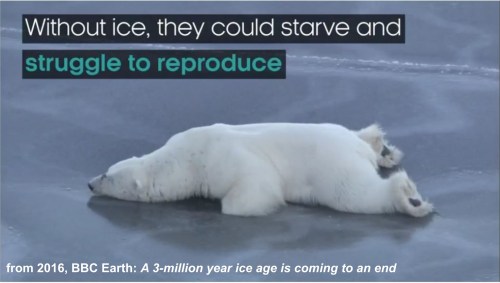
Who exactly suggested the profound prophesy stated in their chosen title, the BBC Earth folks don’t say: the Stern and Laidre paper certainly does not. And the use of a bear that appears to drown before our eyes is Hollywood-style emotional manipulation. Note the careful use of “might” (above) and “could” (below).

bbc-video-15-sept-2016-screencap-breaking-ice-01

Watch the videos below and weep not for the plight of the polar bear, but for the downfall of science journalism. Continue reading

Recent studies show Sept ice of 3-5 mkm2 did not kill polar bears off as predicted

The annual Arctic sea ice minimum for 2016 is imminent and the hand-wringing about polar bear survival has already begun. While this year is shaping up to be another very low sea ice minimum in the Arctic – not as low as 2012 but lower than as low as 2007 (previously the 2nd lowest since 1979) – contrary to predictions, several recent studies show that such low sea ice coverage in summer has had no (or very limited) negative effects on polar bear health and survival. In fact, for polar bears in some areas low summer sea ice has been quite beneficial (although these are not the populations that polar bear specialists predicted would do better).
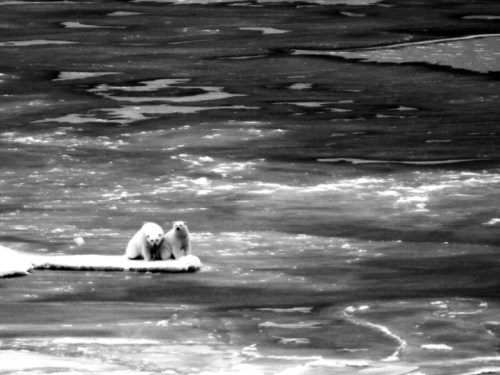
polar_thin_ice Jessica Robertson_USGS

Since low summer extents of recent magnitude (3.0 – 5.0 mkm2) are clearly not any sort of threat to polar bears, it seems improbable that even an ice-free (≤ 1.0 mkm2) summer (e.g. Wang and Overland 2015) would be devastating to the species [don’t forget Cronin and Cronin 2016: they’ve survived such conditions before] – as long as conditions in spring allow for the necessary concentrated feeding on young seals.
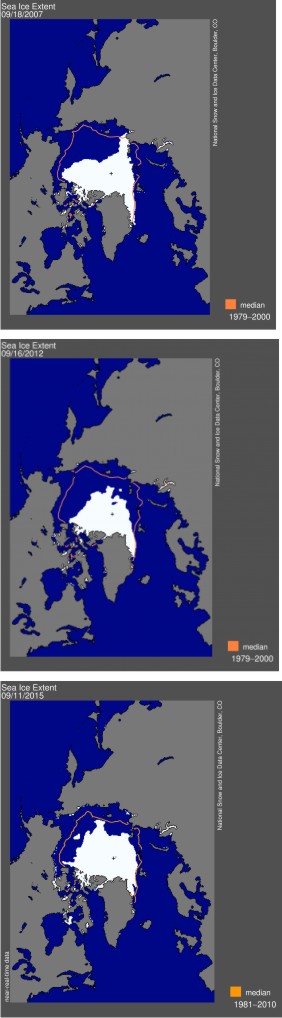
sea-ice-mins_2007_2012_2015_polarbearscienceAbove: Top, minimum at 2012 (16 Sept, 3.41 mkm2, lowest since 1979); Center, 2007 (18 Sept, 4.17 mkm2); Bottom, 2015 (9 Sept, 4.50 mkm2), from NSIDC. Below: sea ice at 10 Sept 2016, 4.137 mkm2 – minimum not yet called).
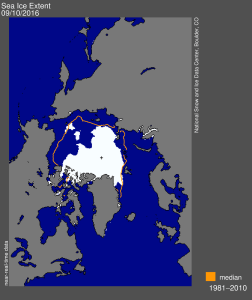
sea-ice-extent-2016-sept-10_nsidc

Recall that in 2006, the IUCN Polar Bear Specialist Group based their conservation status of ‘vulnerable’ (likely to become threatened within the next 45 years due to reduced habitat) on the predictions of sea ice specialists (see 2008 update here).

Sea ice experts in 2005 predicted such low summer sea ice extents as polar bears have endured since 2007 (3.0 – 5.0 mkm2) would not happen until 2040-2070, at which time PBSG biologists said that >30% of the world’s bears would be gone.

Evidence to the contrary comes from polar bear specialists working in the Chukchi, Beaufort, and Barents Seas – and in Southern Hudson Bay – since 2007. Overall, the latest IUCN Red Book assessment (2015) put the global population size at 22,000-31,000 (or about 26,500).

All of this means that those polar bear experts were wrong: polar bears are more resilient to low summer sea ice conditions than they assumed.

UPDATE 2 January 2017: I’ve added some quotes from the original USGS reports that explicitly state their dire predictions for 2050 that differ from the predictions made by the IUCN Polar Bear Specialist Group.
Continue reading

Tracking polar bears in the Beaufort Sea during August 2016

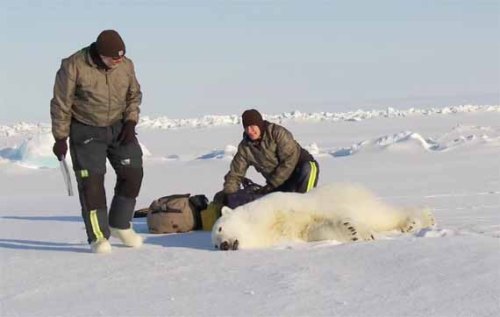
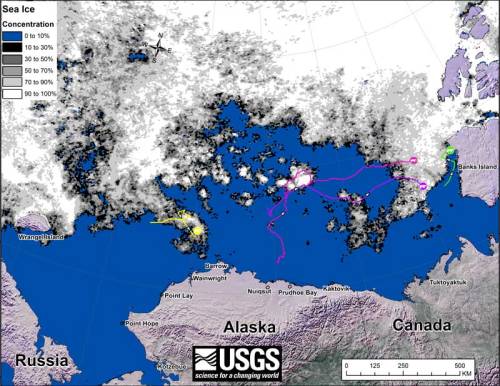
Only three females with collars are still being tracked by USGS researchers in the Beaufort Sea and all of them spent August 2016 on the sea ice in the eastern portion, off the coast of Banks Island.

tranquilized_pb570_s-beaufort-march-2014_usgs

Meanwhile, as Arctic sea ice nears the annual low, NSIDC predicts that 2016 will likely not set a new record but may bottom-out below 2007 (the second-lowest since 1979). The impact of low September sea ice on polar bear health and survival, based on recent research reports, will be the topic of an upcoming post.
Continue reading

Add human graves to the list of things that attract polar bears to communities

A report last week that a polar bear dug a human cadaver out of a coffin buried in the cemetery on the west coast of Hudson Bay did not get the media attention it perhaps deserved: it takes the term ‘grisly’ to a new level.

Early arrival of polar bears at Nunavut hamlet prompts early monitoring: One bear digs into burial plot at Arviat cemetery (NunatsiaqOnline, 29 August 2016).

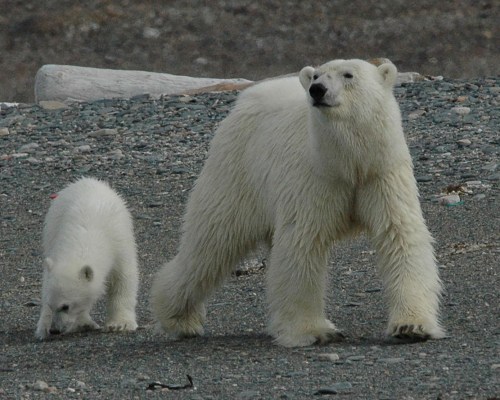
mother-and-cub-on-beach_Stirling

Quotes from the story, a map, and comments on problem bears below.
Continue reading

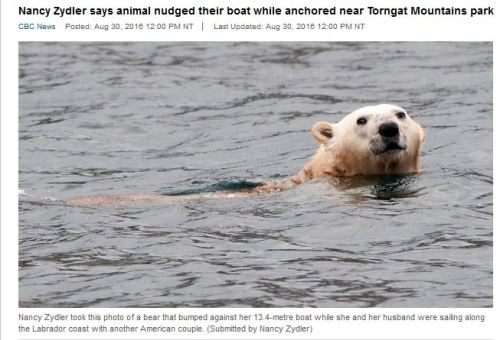
Most polar bears easily deterred this time of year, lucky Labrador boaters discover

A polar bear female accompanied by a cub recently attempted to board a small sailboat anchored in a remote harbour off central Labrador – giving the two American boaters below deck a mighty big surprise.

Labrador polar bear encounter Torngat boat_CBC 30 Aug 2016

‘He said ‘it’s a bear, it’s right on the boat, make some noise.'” – Nancy Zydler

The encounter occurred south of the same national park where a much-publicized attack occurred in July 2013 (see previous posts here and here) but had a happier ending. See more below from a CBC report released this morning (based on a radio interview) and some ecological context for the sighting not mentioned by the reporter.
Continue reading

Narwhal and beluga ice entrapment is natural – not caused by global warming

A part-time Arctic researcher eager for media attention suggested earlier today that the ice entrapment of narwhals in 2008 and again in 2015 at Pond Inlet (that made headlines around the world) was the result of “sudden changes in temperature” caused by climate change. This grossly misleading claim ignores the facts: ice entrapment of narwhals is an entirely natural feature of the Arctic that has been known about for hundreds of years.

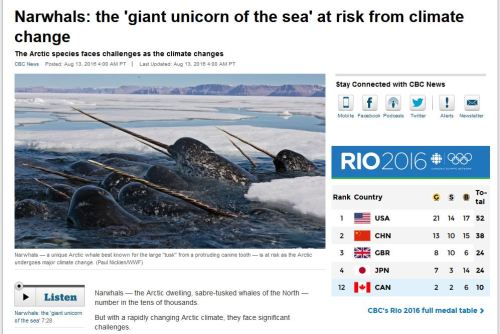
Narwhals_at risk from climate change_CBC 13 Aug 2016 headline

Narwhals: the ‘giant unicorn of the sea’ at risk from climate change” (CBC, 13 August 2016), a print version of a CBC Radio interview with Clint Wright that aired 8 August 2016. Wright is the general manager at the Vancouver Aquarium and apparently has “joined a team of researchers to tag and study” narwhals for several years – but does not seem to know much about the history or circumstances of natural ice entrapment.

Ice entrapment of small whales is nothing new. The first formally documented incident – in English – occurred in 1915 (Porsild 1918) and the phenomenon has probably occurred as long as there has been ice in the Arctic (millions of years).

Animals routinely become trapped in a few specific areas due to local geography: when ice that forms in the north moves south quickly, it blocks the entrances to inlets or coastal bays that still have open water. The presence of the pack ice causes nearby  temperatures to drop quickly. Rapid development of ice on the bay proceeds from the mouth toward the head of the bay. Any whales present cannot escape to open water and will eventually die or be eaten.

Pond Inlet at the north end of Baffin Island is one such place but Disko Bay in western Greenland is another. In fact, Pond Inlet and Disko Bay are almost identical in geographic layout even though they lie on opposite sides of Baffin Bay, so it’s not surprising that both are locations of repeated entrapment events.

Three highly informative journal articles on the phenomenon of ice entrapment of narwhals and beluga are open access documents that reveal some fascinating details of such incidents, including polar bear predation on trapped whales. h/t T. Nelson Continue reading

Tracking polar bears in the Beaufort Sea in July & sea ice comparison with 2007/2012

Only four Alaskan polar bear females had USGS satellite collars left transmitting locations in the Beaufort Sea and all four of these bears were on the ice during July, 2016. The same was true in June and May.

Beaufort tracking USGS bear-movements-July 2016 sm

Original caption: “Movements of 4 satellite-tagged polar bears for the month of July, 2016. Polar bears were tagged in 2015 and 2016 on the spring-time sea ice of the southern Beaufort Sea. All 4 of these bears have satellite collar transmitters. Polar bear satellite telemetry data are shown with AMSR2 remotely-sensed ice coverage from 31 July, 2016.” Original here.


There looks like a lot of open water for this time of year but in terms of absolute extent there is somewhat less ice than there was in 2007 and only slightly less than 2012, according to NSIDC Masie charts. And of course, what we know is that polar bears of the Chukchi Sea and the Southern Beaufort not only survived the low ice summers of 2007 and 2012, they thrived: CS bears were in great condition and reproducing well, and BS bears were recovering from the devastating thick ice conditions of the 2004-2006. Have a look at the maps below. Continue reading

Polar bears off the ice in W. Hudson Bay are “well fed and in great shape” this year

Churchill_Polar_Bear_2004-11-15 Wikipedia

Reports from Seal River, just north of Churchill at Churchillwild, at July 26 were crowing about seeing lots of bears onshore, with a veritable beehive of activity the weekend of 16/17 July:

“This has without a doubt been Churchill Wild’s most spectacular start to the summer polar bear watching season. …Bear numbers are up spectacularly this year and all are looking very fat and healthy, perhaps much to the chagrin of climate change “experts.” Our best day for the seductive white carnivores over the past week featured 21 polar bears sighted between the Lodge and our whale swim spot!

The ice pack, which was still visible a week ago [i.e, 17 July or so], has finally dissipated and pushed a large number of bears on to our coastline here at Seal River, with the end result being many very happy cameras!” [my bold]

And in Churchill proper, the Polar Bear Alert program has issued three reports so far this season (courtesy the Town of Churchill), which confirm that bears in the Polar Bear Capital of the World are also in great shape.

For the week of July 11-17, 2016:

“Bears are off the sea ice and on land. They are looking well fed and in great shape.”

See all three PBA reports below, compared to one from last year at this time (as well as a map and some ice charts).

More fat, healthy bears than last year, enough to keep the Polar Bear Alert folks hopping and tourists in the north happy. Sure doesn’t sound like a suffering population to me. Continue reading