Environment Canada maps of polar bear population and status assessments 2018

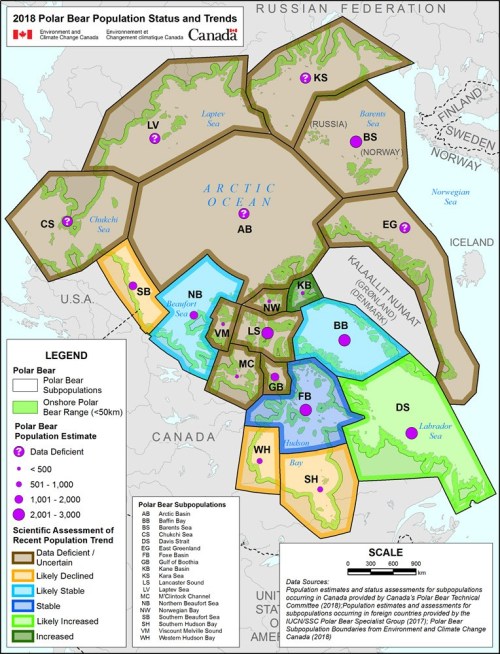
Just out (6 June 2018) — new population assessment and status maps of the 19 polar bear subpopulations according to Environment Canada. Contrary to the map presented at the Range State meeting in February 2018 (pdf here), these maps show Western Hudson Bay and Southern Hudson Bay (along with the Southern Beaufort) as “likely declined.” A new category has been added for the Barents Sea: it’s considered “data deficient/uncertain,” but a population estimate of 2,001-3,000 has been provided.

No press release or other notice regarding the availability of these new maps was issued, as far as I know: I came across them by accident while looking for something else.

Global pb status and population map EC 2018

Global map above, more below, including a comparative map that shows 2010, 2014, and 2018 together. I will update the two recent posts of mine (here and here) that used the February Range State map with the information that more recently revised maps are now available.

Continue reading

Lingering late season sea ice brings polar bear visitor to northern Newfoundland

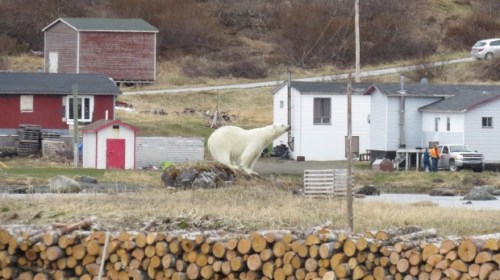
Polar bear season for St. Lunaire-Griquet Newfoundland ran from 6 March to 10 June this year — three long months when polar bears came to visit the community during the season when bears are usually occupied with feeding on young seals and mating.

Newfoundland polar bear 10 June 2018_Iceberg Festival Committee_Thresa Burden photo

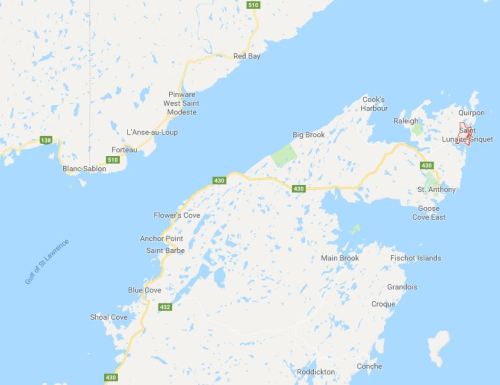
Below is a map of the region: St. Lunaire-Griquet is at the tip of the Northern Peninsula of Newfoundland, just north of St. Anthony (where some of the action in my polar bear attack thriller, EATEN, takes place):

Saint Lunaire Griquet Newfoundland location_Google maps

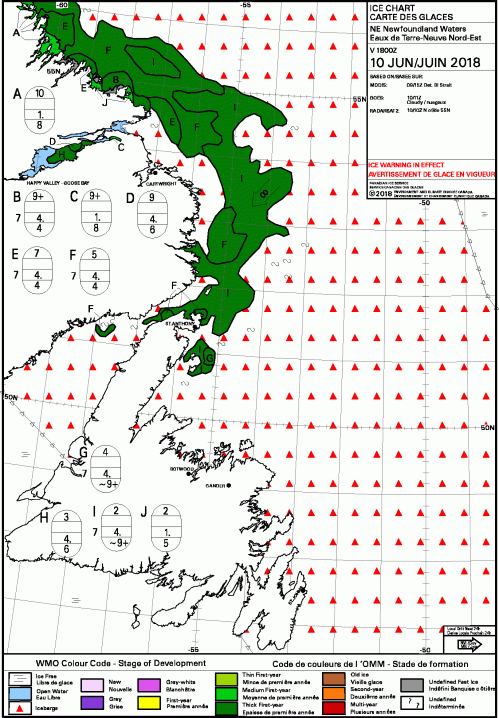
As of yesterday (June 10), when the last sighting of a fat and healthy polar bear took place, there was still quite a mass of thick first year ice (>1.2 m thick) off the northern peninsula of Newfoundland, amongst a field of icebergs:

Hudson Bay North daily stage of development 2018 June 10 ice warning

The first sighting in the area this year was back in early March, which I blogged about here. Fortunately, the Davis Strait bears that occupy the East Coast pack ice are usually well feed at this time of year and seldom pose a serious threat to humans: the fact that visitors ashore are often easily pursuaded to leave (or do so on their own) suggests they are more curious than hungry.

Continue reading

Critical evidence on W Hudson Bay polar bears still not published after 25 years

Polar bear researchers have been doing capture/recapture studies in Western Hudson Bay for decades yet most of the data claimed to be critical for assessing effects of human-caused global warming on this species have not been published. I raised this point in one of my early blog posts (27 Sept 2012) but the situation has not changed in 6 years. Here’s an update.

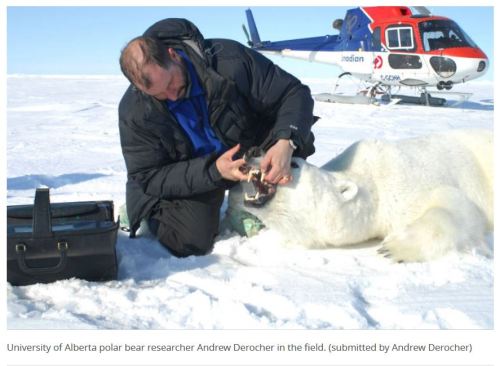
Derocher in the field in WH_CBC story 2016

From CBC story 14 Sept 2016.

Years ago now, in an oft-cited paper, Stirling and Derocher (2012) claimed to summarize the evidence that climate warming was negatively impacting polar bear health and survival. Several life history parameters were considered crucial, particularly body condition.

Despite almost a dozen papers (and perhaps more) on various aspects of WH polar bear health and life history studies based on capture/recapture data published since 2004  (e.g. Castro de la Guardia 2017; Lunn et al. 2016; Pilfold et al. 2017), none have reported the body condition data that supposedly support the claim that sea ice loss is having a severe impact — and the same is true for litter size, proportion of independent yearlings, and cub survival.1

continue reading

Southern Hudson Bay polar bear region shows slight decline after decades of low sea ice

A newly-published paper by Martyn Obbard and colleagues in the journal Arctic Science claims a 17% decline in abundance of polar bears in the Southern Hudson Bay region after years of reduced sea ice and declining body condition (Obbard et al. 2018). The decline in numbers was not statistically significant but an additional statistical analysis (“Monte Carlo simulation”) not applied to any other estimate in recent years suggested the decline could be real, so a real decline is what was reported to the press.
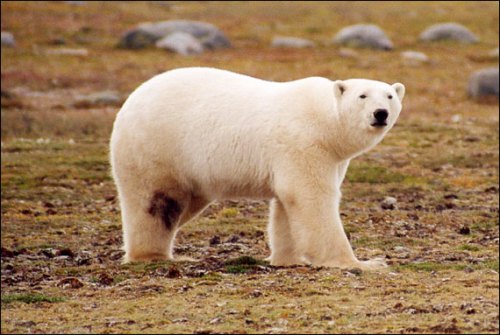
James Bay polar bear_ministry of Ontario_Walton photo

Only one Canadian Press story has so far been circulated amongst outlets in the media (published hours after the paper appeared online, not at the same time), suggesting there was no press release issued for this study. Odd, that — especially if the decline is as real and significant as the authors suggest.

While no evidence was provided for a correlation of this decline in numbers to recent (2012-2016) sea ice decline, previous evidence from the region (Obbard et al. 2016) showed a decline in body condition was correlated only with much later than usual freeze-up, a situation that did not occur from 2012 to 2015 (freeze-up was late in the fall of 2016 but occurred months after the Obbard et al. (2018) survey was completed).

Moreover, the paper reports that a decline in survival of yearling cubs (from 12% of the population in 2011 to 5% in 2016) was not associated with especially poor sea ice conditions in spring. We are likely to see a follow-up paper next year reporting the body condition and sea ice data from this study (as for the previous survey: Obbard et al. 2015, 2016), but there is no suggestion in this paper that body condition declined further from 2011/2012 levels or that sea ice conditions deteriorated markedly enough after 2012 to precipitate a population decline.

UPDATE 11 June 2018: See below, more recent versions of population and status assessment maps has been issued by Environment Canada that conclude Southern Hudson Bay is “likely declined.”

Continue reading

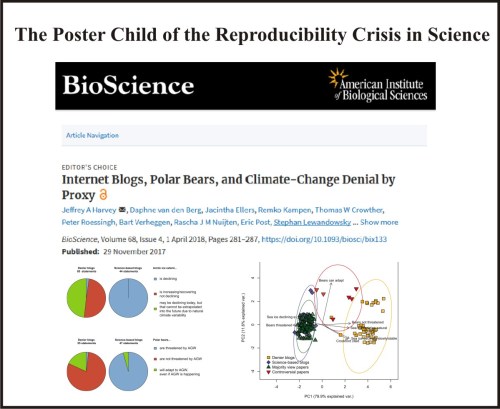
Harvey et al. paper becomes the poster child of the reproducibility crisis in science

Josh’s ‘stupidest paper ever’ cartoon is a reminder of the depths to which some people will descend to silence the voices of rational scientific debate just as the authors of the 2018 Harvey et al. BioScience paper qualifies it for the honour of poster child of the reproducibility crisis in science.

Poster Child of the reproducibilty crisis in science

By insisting — repeatedly and as recently as this month — that the information they released as supplementary data (find it here) was all that was used to construct the two figures in the paper (see Rajan and Tol 2018), the authors tacitly admit:

1) the data used to construct the figures were not derived from the methods they said they used

2) the work is not replicable

In other words, it is not science. That surely qualifies the Harvey et al. (2018) paper for the honour of poster child of the reproducibility crisis in science, discussed here and here (Baker 2016; Nosek et al. 2015). It’s an example the public will readily grasp, since the data said to have been used are easily accessible (and understood) by anyone who uses the Internet.

Below is the letter outlining the data release issue sent more than a week ago (18 May 2018) by Dr. Richard Tol, University of Sussex, to the president of the university highest academic authority in the Netherlands, where Jeff Harvey, lead author of the Harvey et al. 2018 BioScience paper, is employed as an academic [h/t R. Tol for the correction]. While Koninklijke Nederlandse Akademie van Wetenschappen [KNAW] in Amsterdam has a clearly stated data sharing policy, it is clearly not being upheld for the Harvey et al. paper — which nullifies the point of having a policy at all.

Continue reading

Does thick first year ice on Hudson Bay mean a late date ashore for WH polar bears in 2018?

Following up on my previous post, it appears sea ice conditions on Hudson Bay this year might be headed for a late breakup due to the dominance of thick first year ice. That would mean a relatively longer on-ice season for polar bears in Western and Southern Hudson Bay.

James Bay female and cub_Ontaro Govt

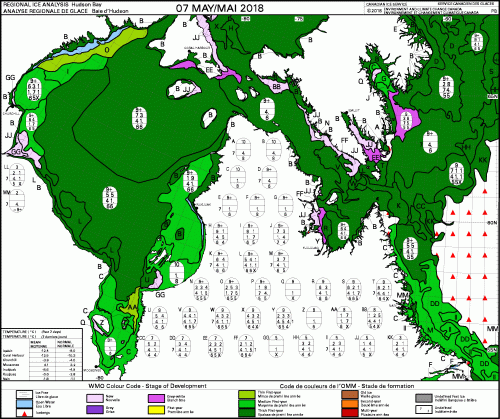
As of the 1st week in May 2018, most of Hudson Bay, Foxe Basin and Hudson Strait were covered with thick 1st year ice (dark green, >1.2 m thick):

Hudson Bay weekly stage of development 2018 May 7

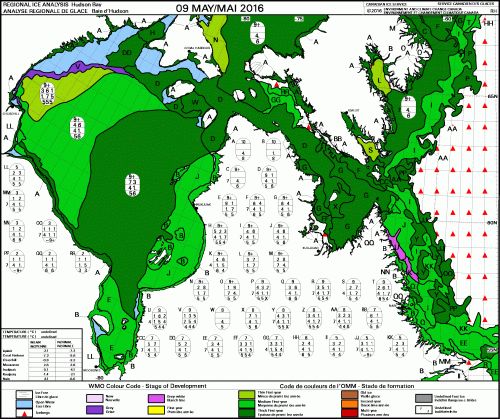
Compare that to the 1st week of May 2016, which had much less thick first year ice than 2018 and more medium first year ice (70-120cm, bright green):

Hudson Bay ice stage of development weekly at 9 May 2016

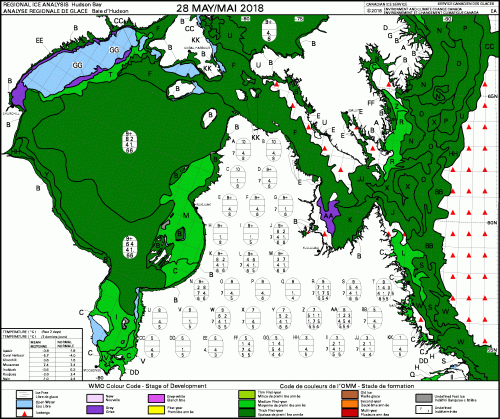
To update the situation, at the end of May this year (week of 28 May), thick first year ice covered even more of the bay with a large patch of open water in the NW corner:

Hudson Bay weekly stage of development 2018 May 28

Thick first year ice does not melt as quickly as medium or thin first year ice (lime green) under most conditions, so the amount of thick first year ice present in May strongly affects the rate of breakup of the ice over the summer (temperature and wind also contribute). Here are some charts of ice melt sequences from the past (2016 and a couple others) that give a hint at what might be in store for Hudson Bay polar bears this year.

Continue reading

Activist laments ESA listing of polar bears in 2008 failed to achieve her political goals

The activist lawyer primarily responsible for polar bears being listed as ‘threatened’ on the US Endangered Species List (ESA) in 2008 is frustrated that those efforts have not generated her preferred political action. Kassie Siegel also claims in another 10 years it will be too late to save polar bears from extinction — despite clear evidence to the contrary.

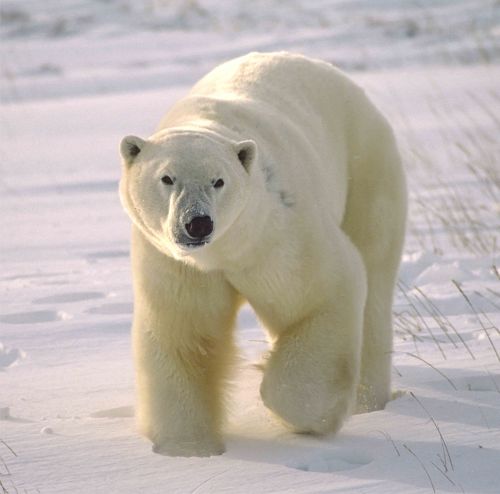
Walking bear_129029633_web size

In an emotional rant over at The Hill with a predictably hysterical headline, Siegel perhaps reveals more than she should about her motivation (“Keeping fossil fuels in the ground is the only way to save polar bears ravaged by climate change,” 26 May 2018).

Continue reading

Status of Canadian polar bears updated map from Environment Canada

During a meeting of polar bear range states (Canada, Russia, Greenland, Norway, and the USA) in late January 2018 to discuss conservation issues, Canada — home to ~2/3 of the world’s polar bears — included in its presentation an updated population status and trend map approved by the Polar Bear Technical Committee in its presentation. This 2017 map replaces one from 2014 but is not yet available on the Environment Canada website.

Lunn et al 2016 EA cover image WH bear

UPDATE 11 June 2018: More recent versions of population and status assessment maps, published by Environment Canada 6 June 2018, conclude Southern Hudson Bay and Western Hudson Bay subpopulations have “likely declined.” See 11 June post here for more details and copies of the maps.

Contine reading

IUCN polar bear specialists reject IPCC- supported forecasts of sea ice based on CO2

In case you missed it — or missed the significance of it — polar bear specialist Mitch Taylor correctly pointed out in his recent essay (a response to the New York Times article that appeared Tuesday (10 April) about the Harvey et al. (2018) BioScience paper) that the IUCN Polar Bear Specialist Group have given up using computer models of future sea ice extent based on rising CO2 levels supported by the IPCC.

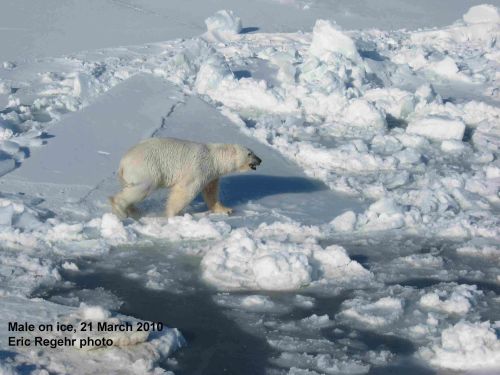
Polar_Bear_male_Regehr photo_March 21 2010_labeled

Their latest assessment (Regehr et al. 2016) does not link polar bear survival models to climate modeled forecasts of Arctic sea ice decline but rather to an assumption that declines already documented will continue in linear fashion over this century.

This means that CO2 emissions blamed on human fossil fuel use is no longer directly tied to the predicted future decline of polar bear numbers: IUCN polar bear specialists simply assume that sea ice will continue to decline in a linear fashion with no cause attributed to that decline except the broad assumption that anthropogenic climate change is to blame for Arctic sea ice declines since 1979.

No wonder former USGS polar bear biologist Steve Amstrup never refers to this IUCN PBSG study: he and the organization that now employs him, Polar Bears International, are still firmly wedded to the concept that CO2 is the sea ice control knob.

Continue reading

Tracking polar bears in the Beaufort Sea resumes after a one year hiatus

Fourteen bears tagged by the US Geological Survey (USGS) on or near the central Southern Beaufort Sea coast in April 2018 (near Kaktovik) will be tracked online over the coming months.

The break in published USGS tagging data from March 2017 to April 2018 was the first since the project began in December 2009 but no explanation for the hiatus has been provided. It is therefore unclear whether no tagging occurred in spring 2017 or data was simply not published online. The last bears followed were tagged in March 2016.

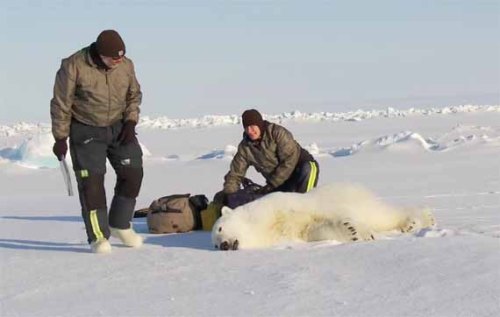
Tranquilized_pb570_S Beaufort March 2014_USGS

In contrast to previous years, this spring all fourteen of the bears have glue-on ear transmitters, which means they are either adult males or juvenile bears rather than females (which are fitted with satellite collars):

“In collaboration with the U.S. Fish and Wildlife Service we are also experimenting with glue-on and ear tag satellite transmitters, which can be deployed on adult male bears and younger, still-growing bears.”

Continue reading