Tag Archives: Arctic

Polar bear tragedy porn dressed up as science features in new BBC Earth video

This new effort by the BBC would make the PR department of the Center for Biological Diversity proud, with it’s prominent use of animal tragedy porn pretending to be science. In contrast, the actual science shows something quite different: though summer sea ice since 2007 has declined to levels not predicted until 2040-2070, there has been virtually no negative impact on polar bear health or survival, a result no one predicted back in 2005.

bbc-video-15-sept-2016-screencap-breaking-ice-02

Bizarrely entitled  A 3-million-year ice age is coming to an end (15 September 2016), this slick video pretends it’s promoting the recently released paper by Harry Stern and Kristen Laidre (2016) that got a lot of media attention last week (see here and here).

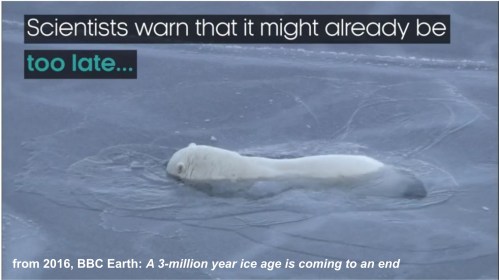
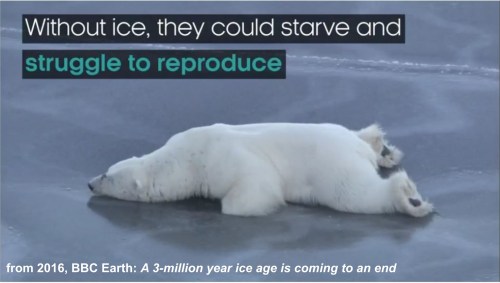
Who exactly suggested the profound prophesy stated in their chosen title, the BBC Earth folks don’t say: the Stern and Laidre paper certainly does not. And the use of a bear that appears to drown before our eyes is Hollywood-style emotional manipulation. Note the careful use of “might” (above) and “could” (below).

bbc-video-15-sept-2016-screencap-breaking-ice-01

Watch the videos below and weep not for the plight of the polar bear, but for the downfall of science journalism. Continue reading

Narwhal and beluga ice entrapment is natural – not caused by global warming

A part-time Arctic researcher eager for media attention suggested earlier today that the ice entrapment of narwhals in 2008 and again in 2015 at Pond Inlet (that made headlines around the world) was the result of “sudden changes in temperature” caused by climate change. This grossly misleading claim ignores the facts: ice entrapment of narwhals is an entirely natural feature of the Arctic that has been known about for hundreds of years.
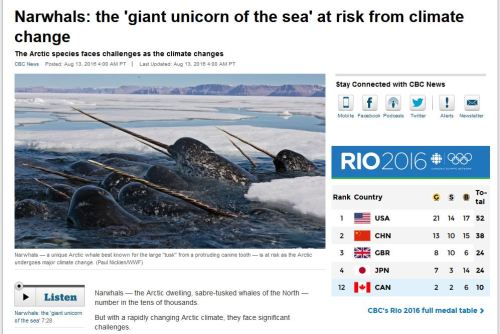
Narwhals_at risk from climate change_CBC 13 Aug 2016 headline

Narwhals: the ‘giant unicorn of the sea’ at risk from climate change” (CBC, 13 August 2016), a print version of a CBC Radio interview with Clint Wright that aired 8 August 2016. Wright is the general manager at the Vancouver Aquarium and apparently has “joined a team of researchers to tag and study” narwhals for several years – but does not seem to know much about the history or circumstances of natural ice entrapment.

Ice entrapment of small whales is nothing new. The first formally documented incident – in English – occurred in 1915 (Porsild 1918) and the phenomenon has probably occurred as long as there has been ice in the Arctic (millions of years).

Animals routinely become trapped in a few specific areas due to local geography: when ice that forms in the north moves south quickly, it blocks the entrances to inlets or coastal bays that still have open water. The presence of the pack ice causes nearby  temperatures to drop quickly. Rapid development of ice on the bay proceeds from the mouth toward the head of the bay. Any whales present cannot escape to open water and will eventually die or be eaten.

Pond Inlet at the north end of Baffin Island is one such place but Disko Bay in western Greenland is another. In fact, Pond Inlet and Disko Bay are almost identical in geographic layout even though they lie on opposite sides of Baffin Bay, so it’s not surprising that both are locations of repeated entrapment events.

Three highly informative journal articles on the phenomenon of ice entrapment of narwhals and beluga are open access documents that reveal some fascinating details of such incidents, including polar bear predation on trapped whales. h/t T. Nelson Continue reading

Canadian Prime Minister risked being EATEN by polar bears on Fogo this year

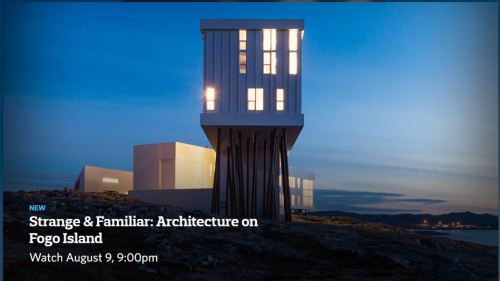
This week (Tuesday 9 August), British Columbia’s Knowledge Network is re-running the 2015 documentary about the revitalization of Fogo Island, the Newfoundland location featured in my polar bear attack thriller, EATEN. It’s called Strange and Familiar: Architecture on Fogo Island and highlights the Fogo Island Inn, where our recently elected Prime Minister Justin Trudeau apparently spent a weekend earlier this year – gambling he could avoid a lethal encounter with a hungry polar bear when fictional others haven’t been so lucky.

Fogo Island special on Knowledge Network_9 Aug 2016

The Prime Minister and his family stayed at the Fogo Island Inn over Easter (25-28 March 2016). Did Justin Trudeau know they could have been EATEN by a polar bear at that time of year? Were members of his security detail actually prepared for a polar bear attack?

Did Trudeau’s advisors do any preparatory reading? I mean, seriously: aside from reading my terrifying science-based novel (where polar bear attacks take place right outside the Fogo Island Inn where the Trudeaus were staying), Fogo (see maps below) has a recent history of polar bear visits.

Most bears come ashore on Newfoundland in late March-early April, although this year one came ashore on Fogo in late January. Another was shot in early May this year as it advanced on an RCMP officer near one of the artist’s studios on Fogo. I guess I’ll have to send a complimentary copy to Ottawa…because next time, what with polar bear numbers increasing in that region, this high-profile family might not be so lucky.

“What-if” indeed…the risks they took are mind-boggling. Continue reading

Beaufort Sea fractured ice due to strong Beaufort Gyre action – not early melt

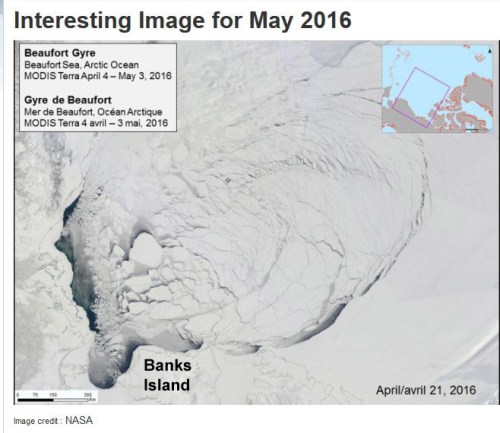
The Canadian Ice Service has a cool NASA animated video showing the Beaufort Gyre in action – you can actually see the solid mass of ice crack and swirl west and north under the pressure of the massive corkscrew current – see original here (tips on getting yourself oriented in the video below the screencap) and view below, for Apri 4- May 3, 2016:

Beaufort Gyre video screencap_21 April 2016_labelled

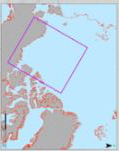
Note that the video is oriented with Banks Island on the bottom and the shore of Alaska along the left-hand side, as if the locator map provided was rotated as below:

Beaufort Gyre video screencap_locator map_rotated

The big ‘bite” of ice being torn out to the south of Banks Island is the Amundsen Gulf.

The caption for the NASA video says this (my bold):

“MODIS Terra imagery taken between April 4 and May 3, 2016 of the Beaufort Sea. The animation highlights the gradual ice breakup due to the Beaufort gyre.

So, early breakup here is due to Beaufort Gyre action – not early seasonal melt.
Continue reading

A new count planned for Southern Beaufort polar bears

I know I was not the only one that thought the last polar bear count conducted by the US Geological Survey (USGS) in the Southern Beaufort generated an untenable result but it appears that some of those challengers are in a position to demand a recount.

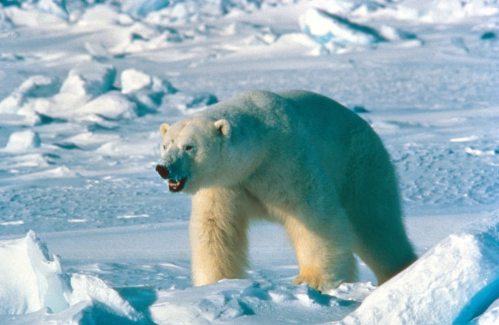
polar_bear_usfws_no date_sm

CBC News ran a story late last week announcing a plan is in the works to do an aerial survey of Southern Beaufort Sea polar bears across their entire range over two years starting in 2017 (11 March 2016, “Joint U.S.-Canada Beaufort Sea polar bear survey planned“).

With luck, this period will not include another bout of the same thick spring ice conditions that decimated the population in the mid-2000s (which many reporters concluded was due to reduced summer sea ice because that’s what leading biologists implied). Even if it does, lucky timing will not negate the fact that this population is routinely subjected to devastating population declines caused by natural changes to spring sea ice conditions from which they have recovered on numerous occasions. Continue reading

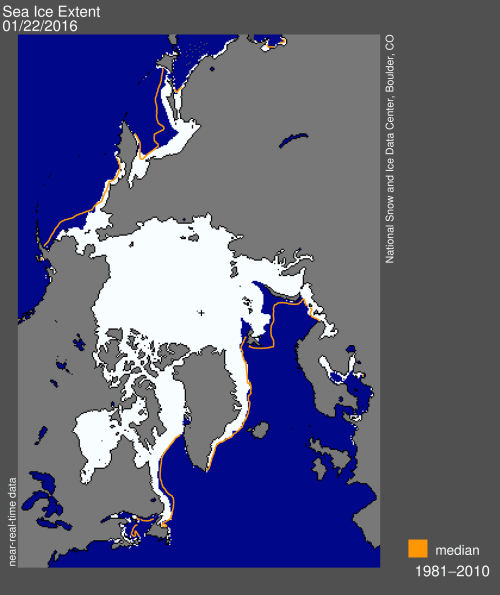
Polar bear survival: habitat 2013 vs. 2016 for 22 January

Using sea ice maps issued by the National Sea Ice Data Center (NSIDC), it’s interesting to compare these two years with respect to polar bear health and survival (keeping in mind that no polar bears live in what I like to call the armpits of the Arctic – the Sea of Okhotsk, the Baltic Sea or in the Gulf of St. Lawrence)1:

22 January 2016

Sea ice extent 2016 Jan 22 NSIDC

Continue reading

Paleoclimate + genetic study confirms: Arctic species adapted to sea ice changes

A new paper that combines paleoclimatology data for the last 56 million years with molecular genetic evidence concludes there were no biological extinctions [of Arctic marine animals] over the last 1.5M years despite profound Arctic sea ice changes that included ice-free summers: polar bears, seals, walrus and other species successfully adapted to habitat changes that exceeded those predicted by USGS and US Fish and Wildlife polar bear biologists over the next 100 years.

Healy Aug  24 2015 Polar-Bear V Tim Kenna

Cronin, T. M. and Cronin, M.A. 2015. Biological response to climate change in the Arctic Ocean: the view from the past. Arktos 1:1-18 [Open access] http://link.springer.com/article/10.1007/s41063-015-0019-3

Thomas Cronin is a USGS paleoclimatologist at the Eastern Geology and Paleoclimate Science Center, and Matthew Cronin is a molecular geneticist at the University of Alaska Fairbanks (see previous posts here and here about Matt’s work on the genetics of polar bear evolution).

From the Abstract:

Arctic climatic extremes include 25°C hyperthermal periods during the Paleocene-Eocene (56–46 million years ago, Ma), Quaternary glacial periods when thick ice shelves and sea ice cover rendered the Arctic Ocean nearly uninhabitable, seasonally sea-ice-free interglacials and abrupt climate reversals.

The final discussion and two summary graphics from this paper (copied below) are especially useful:

Continue reading

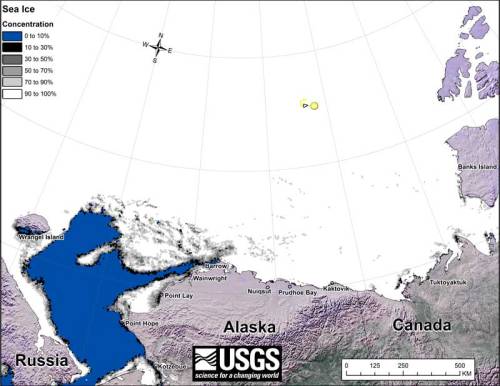
Tracking polar bears in the Beaufort Sea – one tagged bear left at year end 2015

I’ve combined the months of November and December for this post on USGS polar bear tracking in the Beaufort Sea because there’s not much to tell: there’s one tagged bear left and she’s going almost nowhere. Where’s the news in that?

Beaufort tracking USGS bear-movements-November 2015 sm

Movements of 1 satellite-tagged polar bear female for the month of November, 2015; shown with sea ice coverage at 30 November 2015. This bear was tagged in the spring of 2015 in the Southern Beaufort Sea. See original image here and December movements below.

Actually, it does tell us something: this female is probably in a sea ice den, a relative common phenomenon in the Beaufort Sea. And she’s on ice that’s out over very deep water. Continue reading

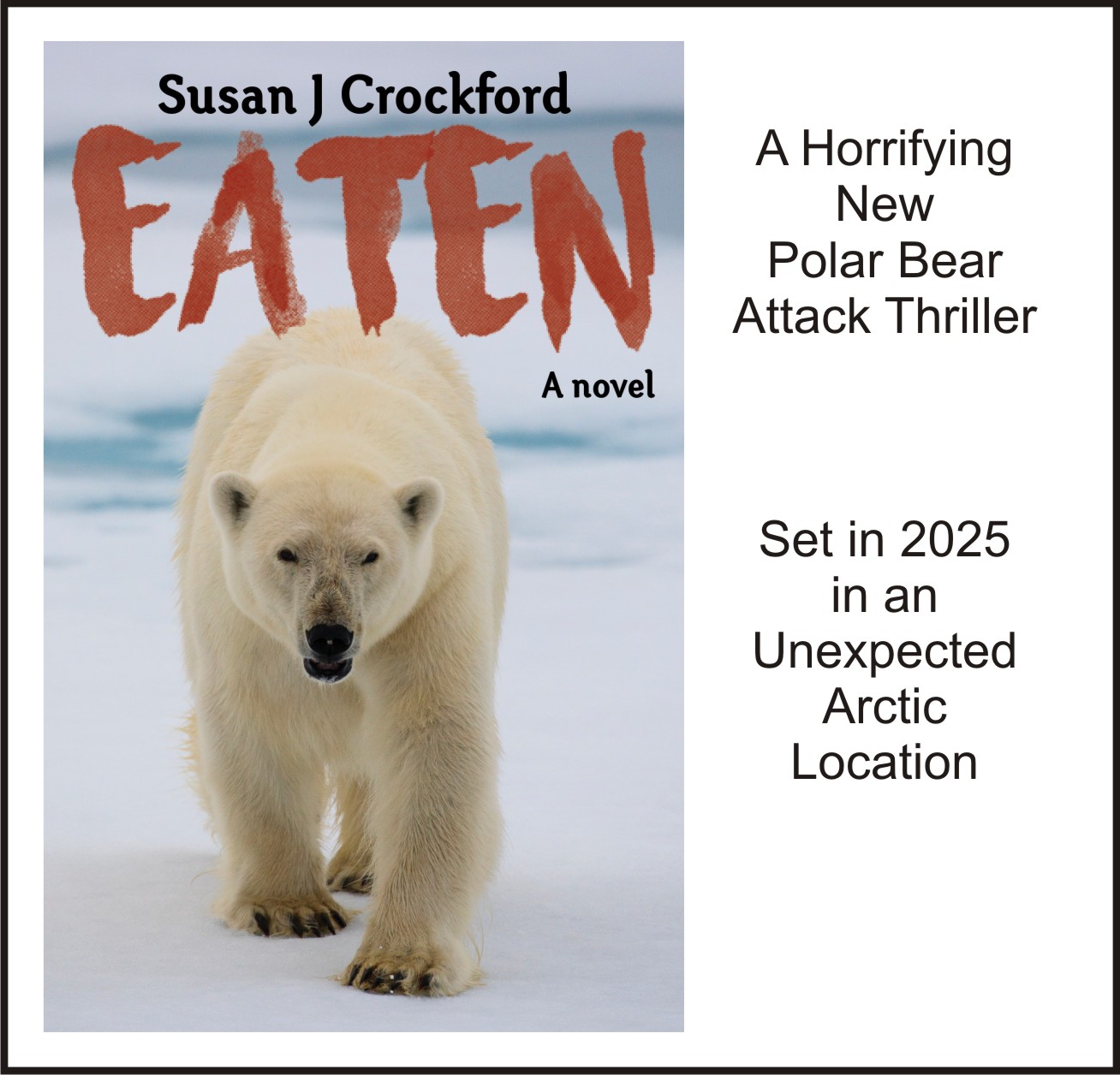
Eaten: A novel, now available

My new novel has been published! The paperback is ready to order and will ship immediately; the ebooks are available for pre-order and will download November 30, 2015.

More detail and links here: www.susancrockford.com

Paperback book or Kindle ebook can be ordered on Amazon.com (US and Canada), click here: http://www.amazon.com/Eaten-novel-Susan-Crockford/dp/151930255X [temporary Kindle link here, until Amazon gets it linked to the paperback: http://www.amazon.com/dp/B0182FUIV0 ]

In the UK, find the paperback here and the Kindle version here.

ePub version (via Smashwords, which ships to Apple, Barnes & Noble, and Kobo), see https://www.smashwords.com/books/view/592875

LIMITED TIME OFFER for the ePub version: November 30, 2015 until December 3, 2015 only

     FREE with promotion code GW98Q (not case-sensitive)

This will make a great Christmas/holiday present for friends and family who don’t read science books – give them an alternative with this great story with a bit of science lite.

EATEN – My first novel, coming soon!

Watch for it!

EATEN_A new novel_final_lg

For years, polar bear specialists have being playing “what-if.”

They’ve used computer models to predict polar bear responses to computer predicted sea ice conditions 25-90 years into the future and insist their prophecies will become reality unless human behaviour changes. They like to call their “what-if” science.

I decided to play too – except I call my “what-if” a novel. Perfect for people who never read science books and everyone who likes a good story.

Coming soon in Paperback , Kindle, and ePub formats!