Tag Archives: population size

Polar bear doom and gloom from USGS vs. biologist Mitch Taylor’s reasoned thoughts

A few days ago polar bear biologist Mitch Taylor and Nunavut’s Gabriel Niryungaluk talked to Toronto radio host Roy Green about the recent USGS dire model predictions for the future of polar bears.

Taylor interview_5 July 2015 Polar bear numbers_radio

There’s an audio podcast and, courtesy of the valuable efforts of fellow blogger Alex Cull, a transcript. Links below, plus some excerpts of Mitch Taylor’s commentary.
Continue reading

My new Arctic Fallacy paper- Sea ice stability and the polar bear

I have a new paper out that explains a fundamental problem with polar bear conservation.

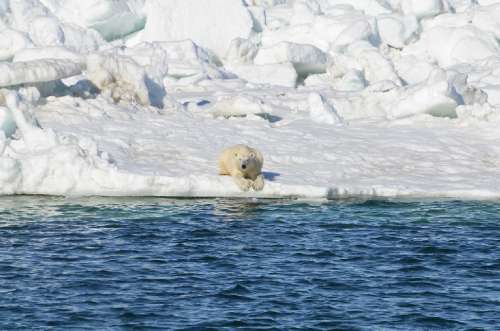
Chukchi June 15 2014_USGS_Brian Battaile_after swim_sm

I’m convinced that a flawed and out-dated ecological concept — that sea ice, under natural conditions, provides a stable, predictable habitat — is what has allowed the present doom and gloom attitude of most polar bear specialists to develop.

Sea ice changes, of course, from season to season. However, the concept that sea ice is a stable habitat assumes that these seasonal changes are predictable and virtually the same from one year to the next – at least, similar enough that the differences are not responsible for causing marked declines in population size.

The assumption is that under natural, stable conditions populations of Arctic animals will either stay the same over time or increase. Biologists were taught at university that sea ice should be a stable habitat and as a result, they’ve glossed over evidence they collected to the contrary. [see recent posts here and here, for example]

Negative effects on populations of short-term natural variations in spring sea ice or spring snow cover on sea ice have been entirely ignored in modeled predictions of future conditions. The focus has been on summer ice extent.

I have summarized this evidence in a fully referenced, peer-reviewed essay that explores how the acceptance of this fallacy (“sea ice is a stable habitat”) has so skewed the conservation biology of polar bears that to outsiders it may look like a scientific integrity issue.

The summary and the essay are below (with embedded links and references). The Global Warming Policy Foundation (GWPF) has published the essay in their “Briefing Paper” series (#16, The Arctic Fallacy: Sea Ice Stability and the Polar Bear), which includes a must-read foreword by Dr. Matthew Cronin, Professor of Animal Genetics at the University of Alaska Fairbanks. Press release here, pdf here.

I think you’ll find it timely and thought-provoking.

Continue reading

Walrus and sea ice, a summary

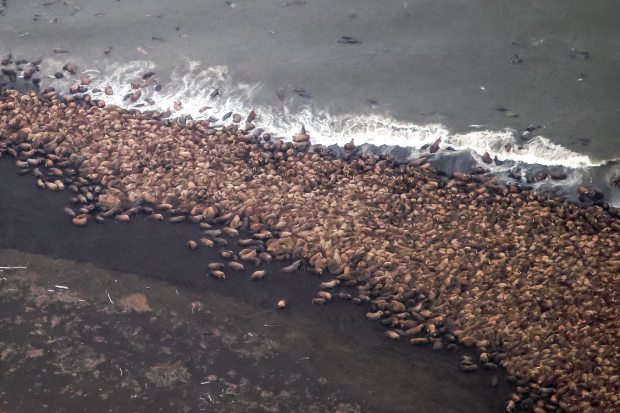
I’ve written a briefing paper for the GWPF refuting claims that huge herds of Pacific walruses hauled out on land are a sign of global warming.

Here’s the GWPF press release:

London, 20 October: A briefing paper published today by the Global Warming Policy Foundation refutes claims that Arctic walruses are in distress and danger due to global warming.

The paper, written by Canadian zoologist Dr Susan Crockford, assesses the recent mass haulouts of walrus females and calves on the beaches of Alaska and Russia bordering the Chukchi Sea. The events have been blamed by US government biologists and WWF activists on lack of summer sea ice, amplified into alarming scare stories by news media around the world.

Such claims ignore previous haulouts that suggest a different cause. Scientific reports about large walrus haulouts that have occurred repeatedly over the last 45 years show that they are not new phenomena for this region.

At least two documented incidents of similar magnitude have occurred in the recent past: one in 1978, on eastern St. Lawrence Island and the other in 1972, on the western end of Wrangel Island. The 1978 event involved an estimated total of almost 150,000 walrus hauled out within in a small geographic area.

Moreover, sea ice maps for the months when known mass haulouts occurred, compared to years when they did not, suggest no strong correlation with low sea ice levels.

“The WWF and American walrus biologists have categorically linked the Point Lay mass haulout event to global warming, but available evidence suggests that’s alarmist nonsense,” Dr Crockford said.

“Blaming lack of sea ice for recent events ignores the documented factor – large population size – that drove walruses onto beaches en masse in the past, when plenty of ice was available. Conservation measures have almost certainly led to a spectacular recovery of walrus numbers over the last few years. This suggests that recent mass haulouts are more an indicator that Chukchi walrus are nearing maximum capacity than a sign of impending global warming catastrophe,” Dr Crockford added.

Here’s the paper. [Link fixed, h/t HO]

Save

Mass haulouts of female Pacific walrus as a sign of population health

Mass haulouts of female Pacific walrus and their calves in fall don’t happen all the time but they do occur. I recently pointed out (here and here) two instances of such incidents from the 1970s.

I said this provided evidence that the September 2014 incident reported in the media was not “a new phenomenon” for this region, as WWF spokepersons and Alaskan biologists have claimed (reiterated in this PBS interview).

Figure 1. Walrus females and calves hauled out on a beach in Svalbard, photo accompanying an October 6, 2014 news report in “Eye on the Arctic” of the rapidly increasing Atlantic walrus population there. (Photo: Thomas Nilsen/Barents Observer).

Figure 1. Walrus females and calves hauled out on a beach in Svalbard, photo accompanying an October 6, 2014 news report in “Eye on the Arctic” of the rapidly increasing Atlantic walrus population there. (Photo: Thomas Nilsen, Barents Observer).

One aspect of the recent occurrence of a large herd on an Alaskan beach that apparently needs reiterating is that the population of walruses declined rather markedly after a 1970s peak and has rebounded since. This suggests that huge herds of females and calves hauling out on beaches in the fall to feed might only be seen when the population is very large.
Continue reading

Low genetic diversity will not make polar bears more vulnerable to extinction

You’ve probably heard the argument: animal populations that have been through a major decline in numbers often have such low genetic diversity that they are extremely vulnerable to subsequent extinction.

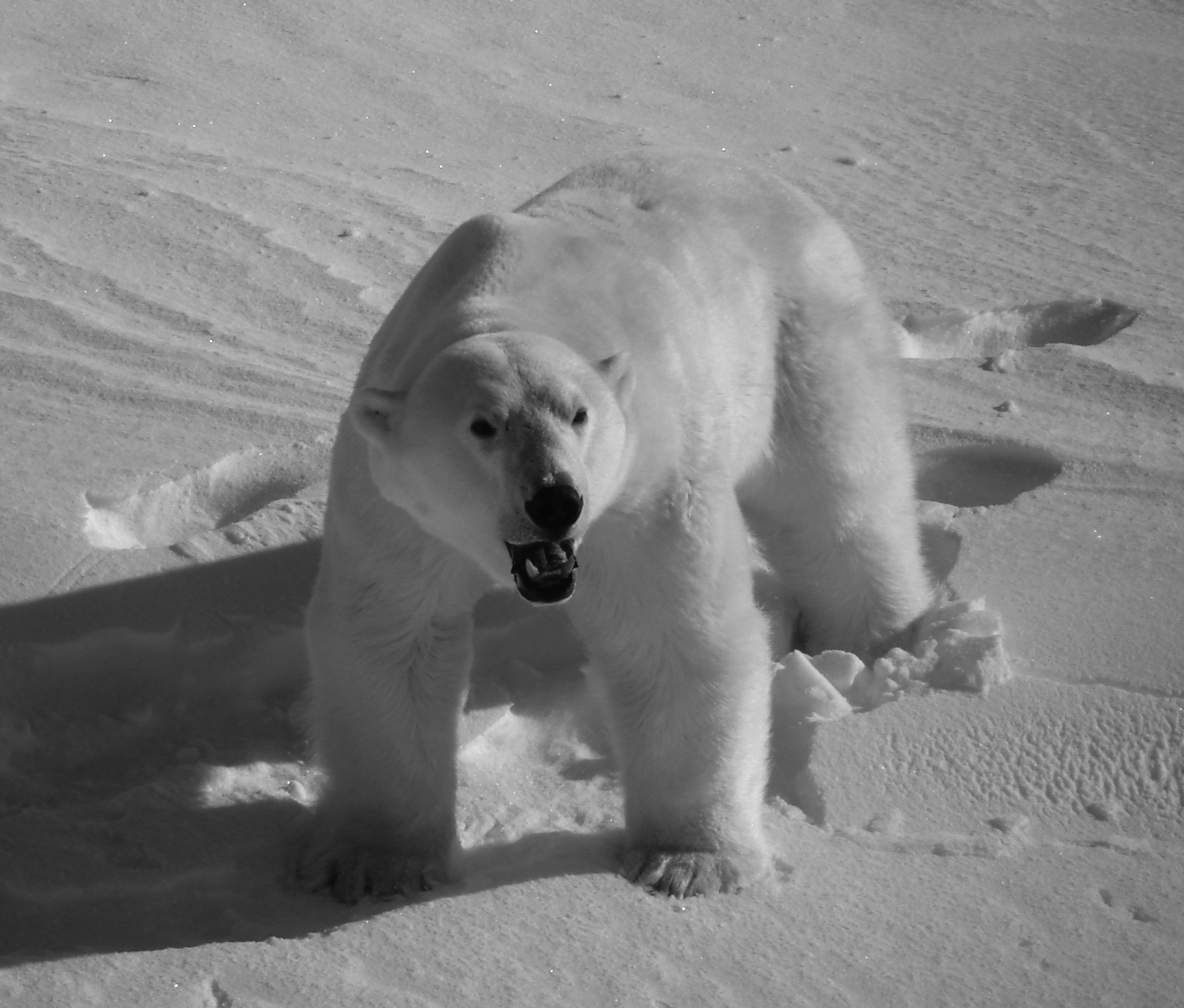
Photo credit USGS

Photo credit USGS

In an interview in late March regarding a new genetic paper on polar bear evolution (by Matt Cronin and colleagues), polar bear biologist and Polar Bears International spokesperson Steve Amstrup made a ridiculous statement: that polar bears have never experienced a rate of warming like they’ve seen over the last 30 years. I countered that easily here.

In that same interview about the Cronin et al. paper, fellow geneticist Charlotte Lindqvist offered an outdated argument against future polar bear survival that is as easy to refute as Amstrup’s “unprecedented rate of warming” nonsense.

I didn’t have time to deal with it back in April [where has the time gone?] but want to get back to it now because it’s important: there is lots of evidence to support my contention that polar bears are not more vulnerable to extinction just because they have low genetic diversity.
Continue reading

IUCN Polar Bear Specialist Group says its global population estimate was “a qualified guess”

Last week (May 22), I received an unsolicited email from Dr. Dag Vongraven, the current chairman of the IUCN Polar Bear Specialist Group (PBSG).

pbsg logo

The email from Vongraven began this way:

Dr. Crockford

Below you’ll find a footnote that will accompany a total polar bear population size range in the circumpolar polar bear action plan that we are currently drafting together with the Parties to the 1973 Agreement. This might keep you blogging for a day or two.” [my bold]

It appears the PBSG have come to the realization that public outrage (or just confusion) is brewing over their global population estimates and some damage control is perhaps called for. Their solution — bury a statement of clarification within their next official missive (which I have commented upon here).

Instead of issuing a press release to clarify matters to the public immediately, Vongraven decided he would let me take care of informing the public that this global estimate may not be what it seems.

OK, I’ll oblige (I am traveling in Russia on business and finding it very hard to do even short posts – more on that later). The footnote Vongraven sent is below, with some comments from me. You can decide for yourself if the PBSG have been straight-forward about the nature of their global population estimates and transparent about the purpose for issuing it.
Continue reading

Polar Bear Specialist Group population status update – officially postponed

I kept a close watch on the website of the IUCN Polar Bear Specialist Group (PBSG) over the weekend to see if an actual population status update might eventually appear (see my last post).

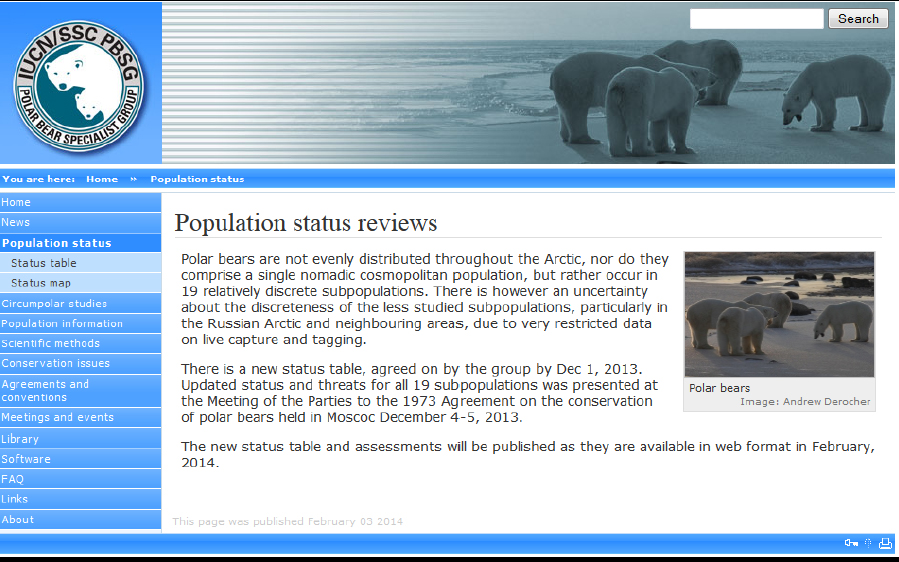
Nothing all weekend, but today (Monday, February 3), the “Population status – Status table” tab (where the 2010 status table was inserted on Friday), returned an error message — the out-of-date status table put up on the day an updated one was promised was simply gone.

However, I noticed that the last sentence of the original December 16, 2013 “Population status reviews announcement had been changed, without any indication that it had been amended.

From December 16, 2013 until February 2, 2014 that last sentence said:

“The new status table and assessments will be published as they are available in web format no later than February 1, 2014.

Now it reads:

“The new status table and assessments will be published as they are available in web format in February, 2014.” [my bold]

The date stamp on this page is February 3, 2014, see screen cap below.

What do you call this — “Bayesian transparency”? I think it means a polar bear population status update may be forthcoming…sometime.

PBSG Population status reviews_Feb 3 2014 notice

Barents Sea polar bear status and sea ice declines

So far, I’ve not discussed the Barents Sea subpopulation in very much detail, except in comparison to other groups. For example, the Barents is considered to be the same type of sea ice “ecoregion” as the Chukchi Sea and the Southern Beaufort (discussed here). Previous studies on the Barents Sea polar bear population (Derocher 2005) indicate it may have recovered from extreme levels of overhunting (discussed here) and had stabilized, or was increasing very slowly, as early as 2002 (discussed here) — similar to what has happened in Davis Strait (discussed here).

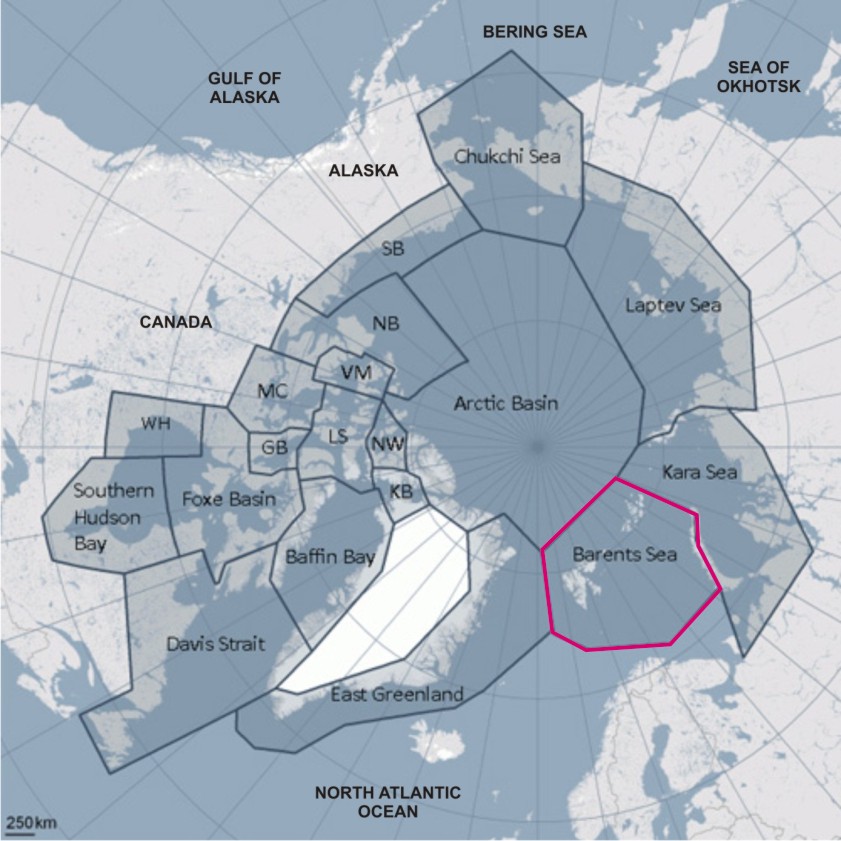
Figure 1. Polar bear subpopulations, with the Barents Sea region highlighted; map courtesy the IUCN Polar Bear Specialist Group (PBSG), extra labels added.

Figure 1. Polar bear subpopulations, with the Barents Sea region highlighted; map courtesy the IUCN Polar Bear Specialist Group (PBSG), extra labels added.

The most recent Barents Sea population estimate was done in 2004 (2,650; range ~1900-3600), based on an aerial survey (Aars et al. 2009). Aerial surveys are the only practical method of establishing population counts in regions like this where many bears never set foot on land. The previous estimate for the Barents (1982) was “2,000-5,000” but its accuracy was considered “poor” (discussed here).

The IUCN Polar Bear Specialist Group (PBSG), in their most recent report, lists the Barents Sea population as “data deficient” for status, current trend and estimated risk of decline within 10 years (Obbard et al. 2010:62, Table 1) and the “notes” for this entry say:

Population estimate is based on a new aerial survey. There was likely an increase in the subpopulation size after 1973 until recently. Current growth trend is unknown.

This 2004 estimate is now almost a decade old and potentially no longer an accurate representation of what’s happening in the Barents Sea. The most up-to-date information has not yet been published but it is available online. It’s eye-opening to say the least, if only that it appears to be yet another example of a polar bear population that is so far not showing signs of being harmed by sea ice declines, as I’ve discussed before (here).

[Update October 15, 2013: I’ve simplified the text discussion and figure regarding the Aars and Andersen denning study from the original posted]

Continue reading

Southern Hudson Bay subpopulation status, farthest south of all polar bears

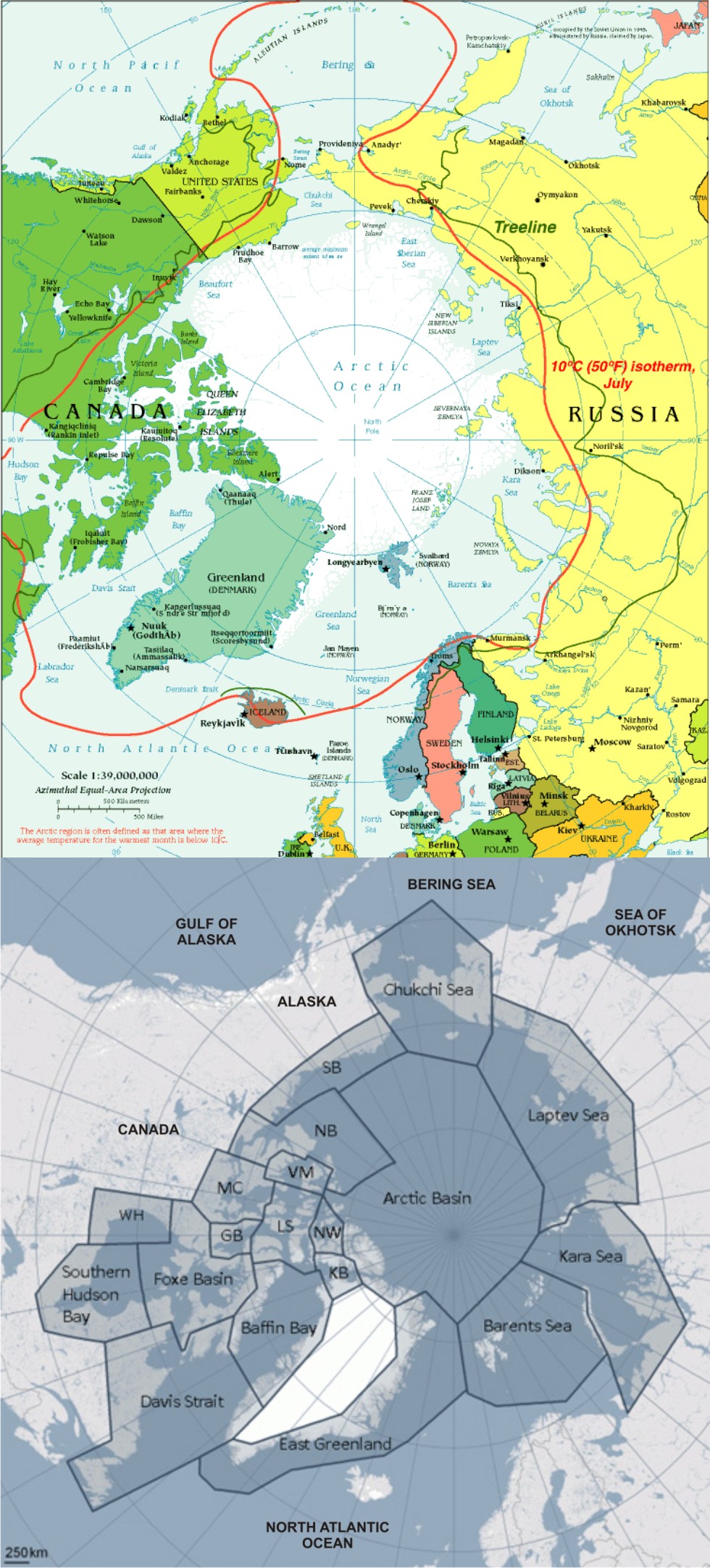
“The Arctic” is a bit hard to define. While the Arctic Circle works as a good boundary for some purposes and the 100C isotherm for July for others, neither work for polar bears because several subpopulations live well south of these limits (Fig. 1).

In the east, Western Hudson Bay, Southern Hudson Bay and Davis Strait are all located well south of the Arctic Circle and the first two (and half of Davis Strait) are beyond the 100C July isotherm as well. In the western Arctic, the Chukchi Sea subpopulation is within the 100C July isotherm but at least half of its bears reside south of the Arctic Circle (Fig. 1) in the Bering Sea (see previous post here).

Unique amongst all of these is Southern Hudson Bay – all of its polar bears make maternity dens and/or spend the summer south of 600N.

Southern Hudson Bay (SH) bears live in the Canadian provinces of Ontario, while Western Hudson Bay (WH) bears reside in Manitoba and Nunavut. The two groups mix over the winter but appear to spend the summer/fall in their respective regions (Stirling et al. 2004). [See previous posts on Western Hudson Bay bears here, here, and here]

“Further south” in the Arctic usually means warmer, with open water present more weeks every summer, sea ice for fewer weeks over the winter. So, shouldn’t the bears of Southern Hudson Bay be already suffering more harm from global warming than virtually all other subpopulations, including those in Western Hudson Bay?

After all, Western Hudson Bay bears appear to have experienced a statistically significant decline in numbers, among other effects (Regehr et al. 2007; Stirling and Derocher 2012) — surely Southern Hudson Bay bears are doing worse?

You’d think so, but they aren’t.

Figure 1. Boundary limits for “the Arctic” (top map) such as the Arctic Circle (dashed line) or the 100C isotherm for July (solid red line) would not include several polar bear subpopulations that live south of these.

Figure 1. Boundary limits for “the Arctic” (top map) such as the Arctic Circle (dashed line) or the 100C isotherm for July (solid red line) would not include several polar bear subpopulations that live south of these.

UPDATED October 28, 2014: Reference added, Obbard et al. 2013 (aerial survey results).
Continue reading

Global population of polar bears has increased by 2,650-5,700 since 2001

The official population estimates generated by the IUCN Polar Bear Specialist Group (PBSG) give the impression that the global total of polar bears has not changed appreciably since 2001:

2001 PBSG report                  21,500-25,000

2005 PBSG report                  20,000-25,000

2009 PBSG report                  20,000-25,000

2013 PBSG website                20,000-25,000

2015 IUCN Red List              22,000-31,000 [see latest update note]

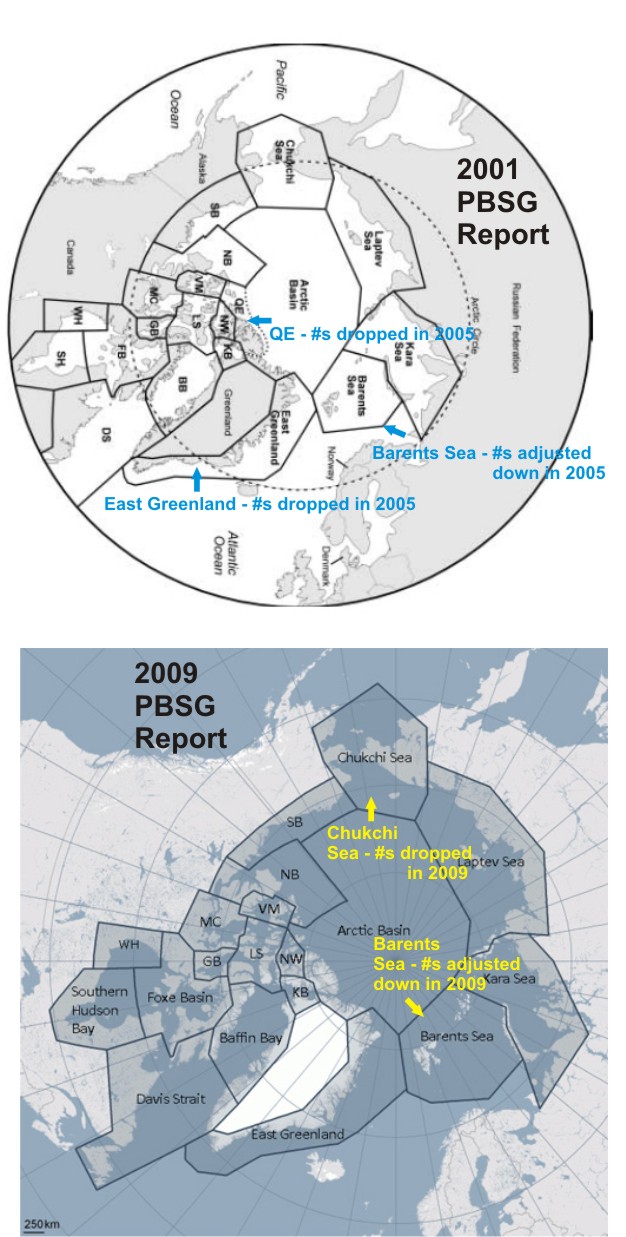
However, some accounting changes were done between 2001 and 2009 (the latest report available) that mean a net increase in numbers had to have taken place (see summary map below and previous post here. Note this is a different issue than the misleading PBSG website graphic discussed here).

And while it is true that population “estimates” are just that — rather broad estimates rather than precise counts — it is also true that nowhere do the PBSG explain how these dropped figures and other adjustments were accounted for in the estimated totals. 

The simple details of these changes are laid out below, in as few words as I could manage, to help you understand how this was done and the magnitude of the effect. It’s a short read — see what you think.

UPDATE 15 May 2016: In late November 2015, the IUCN Red List of Threatened Species published a new assessment for polar bears that estimated the global population at 22,000-31,000 and stated the trend was ‘Unknown’. See details here and here – which includes links to the official report and the press release. Sorry for the delay in updating this post.

UPDATE 31 May 2015: See the latest population numbers here.

UPDATE 5 December 2014: Links to more recent posts relevant to this issue added below. [including this one: Status of Canadian polar bear populations has been changed – more good news October 28, 2014

UPDATE February 14, 2014a new status table has been released, see new post here 

UPDATE February 18, 2014 — see graphs of the 1981-2013 estimates here.
Polar bear subpopulations as defined by the PBSG: Top, in the 2001 report; Bottom, 2009 report. Map courtesy PBSG, with a few labels added and the subpopulations identified where “accounting” changes or adjustments to estimates took place.SB, Southern Beaufort; NB, Northern Beaufort; VM, Viscount Melville; MC, M’Clintock Channel; LS, Lancaster Sound; GB, Gulf of Boothia; NW, Norwegian Bay; KB, Kane Basin; WH, Western Hudson Bay. Click to enlarge.

Polar bear subpopulations as defined by the PBSG: Top, in the 2001 report; Bottom, 2009 report. Map courtesy PBSG, with a few labels added and the subpopulations identified where “accounting” changes or adjustments to estimates took place.
SB, Southern Beaufort; NB, Northern Beaufort; VM, Viscount Melville; MC, M’Clintock Channel; LS, Lancaster Sound; GB, Gulf of Boothia; NW, Norwegian Bay; KB, Kane Basin; WH, Western Hudson Bay. Click to enlarge.

Continue reading