Tag Archives: Stirling

Natural selection helps polar bears adapt to sea ice variability – which means some bears die

Evolution is not just for the long-term – natural selection also goes on over short time periods. In the case of polar bears, this adaptation is almost certainly critical for its long-term survival.

Hudson Bay female with cub_Wapusk_Thorsten Milse_Gov CA

Hudson Bay female with cub Wapusk National Park, Thorsten Milse, Government of Canada

Not all polar bears are identical — that is the reality that allows natural selection to operate.

I will argue that early breakup years in Western Hudson Bay weed out individual polar bears that do not have the physiological or behavioral characteristics necessary to be useful members of the population – and that this is a good thing for the entire population.

Continue reading

About the time I asked a challenging question at a global warming workshop

When you really want to challenge a speaker at a scientific meeting or public lecture, deciding what’s the best question to ask is often difficult. Here’s an example that might inspire you.

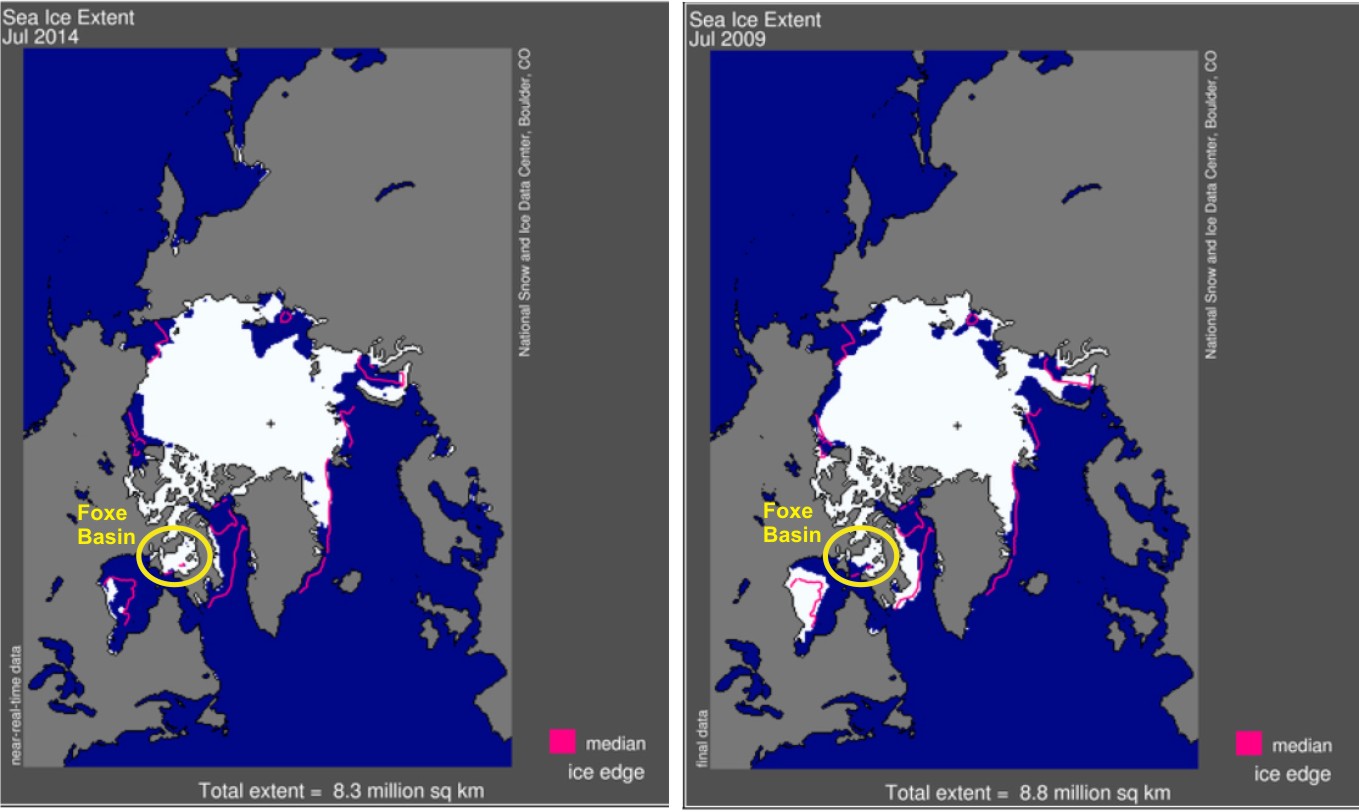
In 2009, I asked polar bear biologist Lily Peacock what appeared to be an innocuous question about Foxe Basin sea ice1 at a scientific workshop that got everyone’s attention.

The question — and the reaction — might surprise you.

Arctic sea ice 2009 vs 2014 NSIDC BIST Foxe Basin marked_PolarBearScience Continue reading

Ian Stirling now says the polar bear that “died of climate change” last year was “in his prime”

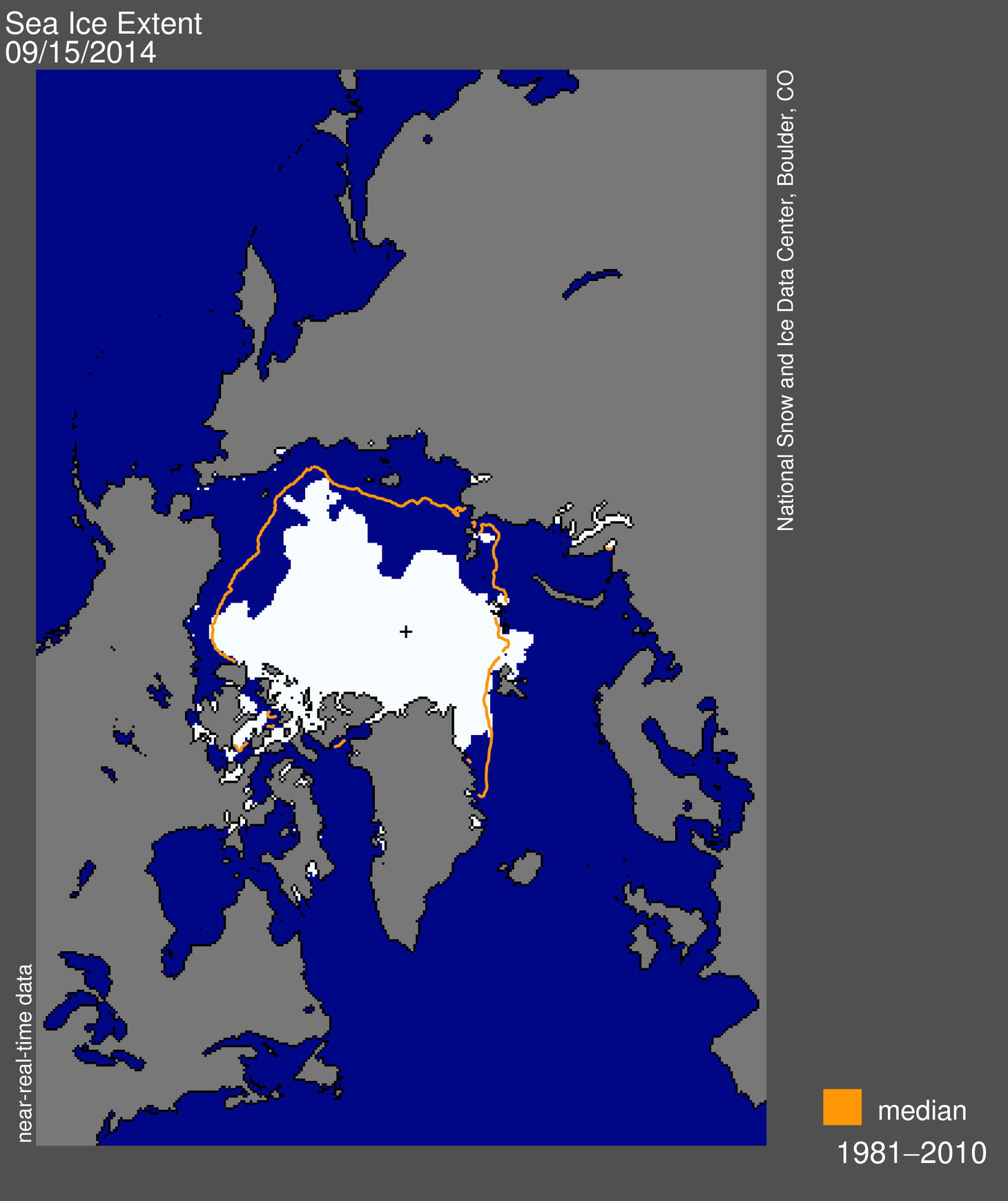
With Barents Sea ice way above average this summer, Polar Bear Specialist Group biologist Ian Stirling now claims the old polar bear that he said died of climate change last year on Svalbard was “in his prime” and still blames the bear’s death on lack of sea ice — despite all evidence to the contrary.

UPDATE Sept. 19, 2014 typo fixed in Fig. 1 caption [sea ice low for 2012 was 3.41 m2km, not 4.1, see here.]

Figure 1. The National Snow and Ice Data Center (NSIDC) says the September minimum for 2014 is “imminent” and suggests the low may come in at 5.1 million square kilometers (far short of the 4.1 m2km low reached in 2012. About the much larger than average amount of ice around Svalbard and Franz Josef Land, they said only: “As was the case for the beginning of the month, extent remains below average in all sectors of the Arctic except for a region in the Barents Sea, east of Svalbard.”

Figure 1. The National Snow and Ice Data Center (NSIDC) says the September minimum for 2014 is “imminent” and suggests the low may come in at 5.1 million square kilometers (far short of the 4.1 3.41 m2km low reached in 2012. About the much larger than average amount of ice around Svalbard and Franz Josef Land, they said only: “As was the case for the beginning of the month, extent remains below average in all sectors of the Arctic except for a region in the Barents Sea, east of Svalbard.”

Continue reading

Polar bears and melting ice: three facts that shouldn’t surprise you

If I was invited by USA TODAY to discuss how climate change is affecting polar bears now – summed up in three talking points – this is what I’d say. I’d use some meaningful images rather than cute pictures of cuddly bear cubs and I’d provide links to my work with references and details to back up my answers.

Compare my responses to those supplied by Steve Amstrup in his capacity as spokesperson for Polar Bears International (“Save our sea ice!”) to Jolie Lee at USA TODAY last week, who’s word is expected to be taken as gospel.

AK PB N Shore-USFWS Barrow_labeled

Continue reading

IUCN Polar Bear Specialist Group says its global population estimate was “a qualified guess”

Last week (May 22), I received an unsolicited email from Dr. Dag Vongraven, the current chairman of the IUCN Polar Bear Specialist Group (PBSG).

pbsg logo

The email from Vongraven began this way:

Dr. Crockford

Below you’ll find a footnote that will accompany a total polar bear population size range in the circumpolar polar bear action plan that we are currently drafting together with the Parties to the 1973 Agreement. This might keep you blogging for a day or two.” [my bold]

It appears the PBSG have come to the realization that public outrage (or just confusion) is brewing over their global population estimates and some damage control is perhaps called for. Their solution — bury a statement of clarification within their next official missive (which I have commented upon here).

Instead of issuing a press release to clarify matters to the public immediately, Vongraven decided he would let me take care of informing the public that this global estimate may not be what it seems.

OK, I’ll oblige (I am traveling in Russia on business and finding it very hard to do even short posts – more on that later). The footnote Vongraven sent is below, with some comments from me. You can decide for yourself if the PBSG have been straight-forward about the nature of their global population estimates and transparent about the purpose for issuing it.
Continue reading

Oil money provided the foundation of polar bear research, now its “greenwash”

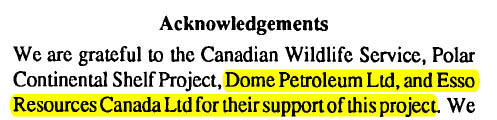
Much of the polar bear research in Canada and American Arctic in the 1970s-1980s was funded by oil and gas companies, because it was the right thing to do (and governments required it). Now, Greenpeace says providing such money is just oil company marketing, meant to make them look good.

Stirling et al 1993_oil acknowledgement

Stirling et al. 1993, oil funding acknowledgement for work in the Eastern Beaufort Sea.

Oil money helped fund the Ph.D. research of polar bear biologist and Polar Bears International spokesperson Steven Amstrup (Amstrup and Durner 1995), and made possible a number of other critical research projects in the early days of polar bear research that might not have been possible otherwise (Stirling et al. 1993; Stirling and Lunn 1997).

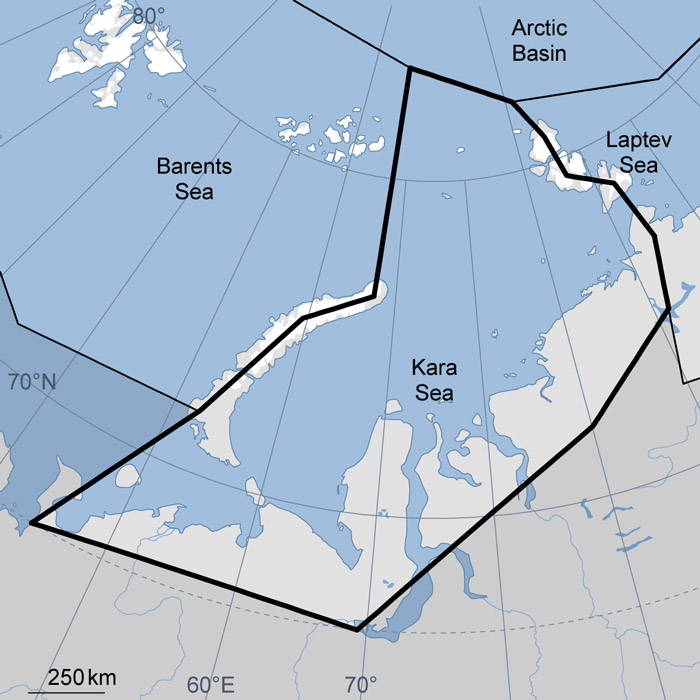
Yesterday, several media reports announced that ExxonMobil had advertised for a job counting polar bears in the Kara Sea (where very little research has been done), but a Greenpeace spokesperson called this an “obvious greenwash.

Have a look at the media reports and the oil funding acknowledgements from polar bear research papers (“References”) and see what you think.

Courtesy IUCN Polar Bear Specialist Group.

Courtesy IUCN Polar Bear Specialist Group.

Continue reading

Guest Post: Invasive Research is Alive and Well in Canada

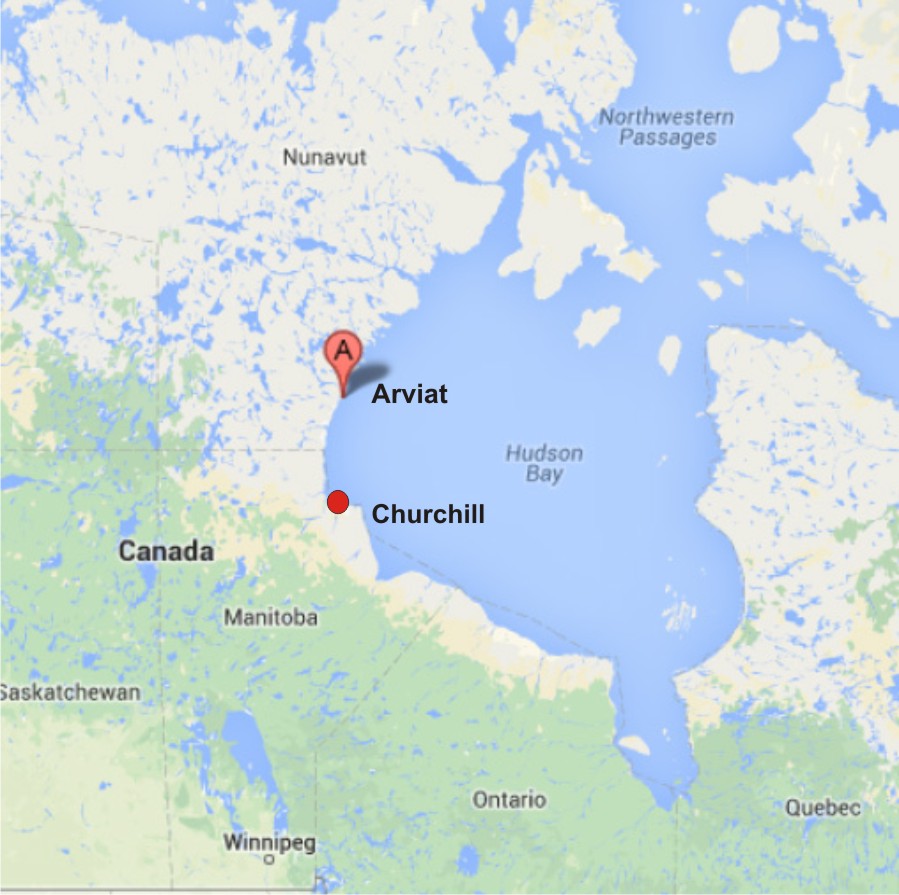
This is a guest post by Kelsey Eliasson, who blogs at Polarbearalley, with his thoughts on the issue of the invasive research involved in polar bear mark-recapture studies around Churchill, Manitoba — which, as you’ll see, is a far different situation than I described for Nunavut (previous posts here, here, and here on this topic. Map below to get you oriented).

Kelsey is a writer, artist and polar bear guide who has spent 14 bear seasons watching the polar bears of Churchill. For five years, he ran Churchill’s monthly newspaper published occasionally, the Hudson Bay Post. Currently, he divides his year between the Yukon, Churchill and, occasionally, Riverton, home of Manitoba’s largest moose statue.
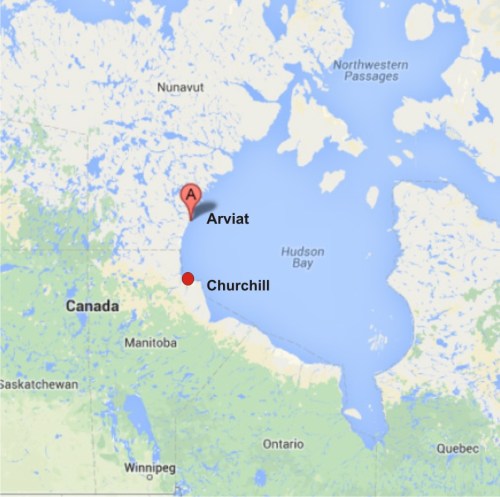
Churchill is in the Western Hudson Bay polar bear subpopulation, governed by the Province of Manitoba, while the community of Arviat, also in 'Western Hudson Bay' is overseen by the Government of Nunavut.

Churchill lies in the Western Hudson Bay (WHB) polar bear subpopulation, governed by the Province of Manitoba, while the community of Arviat, also in the Western Hudson Bay subpopulation, is overseen by the Government of Nunavut – different governments, different rules – as Kelsey points out below.

—————————————————————————-
Invasive Research is Alive and Well in Canada, by Kelsey Eliasson

The recent post about Foxe Basin was of particular interest to me, as I have been following the growing gap between the north and science for some time now. The stance taken by the Inuit is viewed as an inspiration by the guides over here in Churchill. For many years, we have tried to voice our deep concerns over the levels of handling and drugging that our bears (the Western Hudson Bay population) are subjected to on an annual basis.

This time last year, I tried to raise the topic for discussion after Andrew Derocher announced that ‘everything was on the table’ including feeding bears. At that time, the top polar bear researchers had sat down to discuss options for saving bears – except reducing handling and research – i.e. chasing bears down by helicopter and then shooting them with tranquilizers. Continue reading

Eat, wash up, repeat; eat, wash up, repeat…polar bears do it too!

Ah, that never-ending treadmill of meal preparation and cleanup. You might be surprised to find out that polar bears do it too.

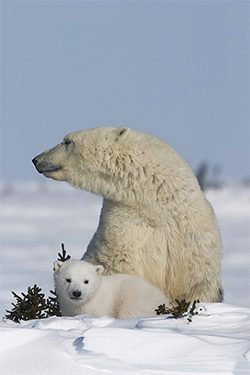
Figure 1. How do polar bears look so clean most of the time when they get this bloody on a regular basis? They wash up! [This picture is not from Stirling’s paper].

Figure 1. How do polar bears look so clean most of the time when they get this bloody on a regular basis? They wash up!

I found an interesting description of polar bears washing during and after feeding, by a young Ian Stirling in one of his earliest published polar bear papers (Stirling 1974). At the time, he was observing polar bears on southwest Devon Island (74°43′ N; 91°10′ W, see Fig. 2 below) between 24 July and 8 August 1973. Even today, there’s ice for hunting seals in mid-to-late-summer in that part of Canada (Fig. 3).
Continue reading

Polar bear researchers still withholding Hudson Bay data

The latest polar bear propaganda emanating from The Guardian is unscientific nonsense fed to them by activist Canadian polar bear researchers: Polar bear numbers in Hudson Bay of Canada on verge of collapse.

This episode of Goldenberg’s polar bear grandstanding includes a photo caption with a totally unsubstantiated claim that some folks might call a lie:

Melting ice is cutting polar bears off from their food source in Hudson Bay, and death rates have soared.

“Death rates have soared”? Where are all the bodies? Show us the starving bears!

In fact, the ice of Hudson Bay melts every summer and always has done. When it does, polar bears go ashore and live off the many inches of stored blubber they put on during their spring feasting on fat baby seals. The last three years, the open-water season has been only about two weeks longer than it was in the 1980s. There has been no steady increase but lots of variability.

Below I dismantle the rest of this transparently political posturing ahead of the international polar bear forum next week.
Continue reading

Polar bear researchers – are they protecting the bears or their own jobs?

Poor polar bear researchers: there are few full time jobs worldwide and research is underfunded.

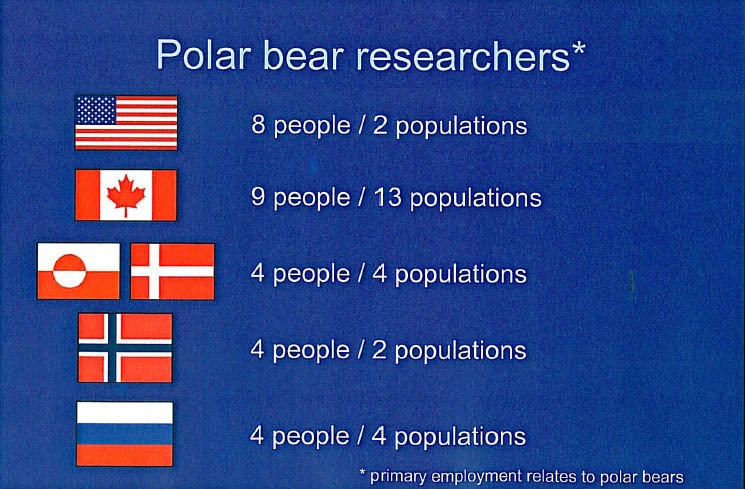
This is not my opinion but the facts according to Andrew Derocher and Ian Stirling (2011) — see Fig. 1 and 2 below. I do not dispute them.

Figure 1. The distribution of full-time polar bear researchers worldwide. Graduate students carry out much of the field work, funded by research grants – but eventually, they are going to want full-time jobs too. Where will the money come from? From Derocher and Stirling 2011. Slide 8 from “Conservation status, monitoring, and information gaps.” Invited speaker presentation to the 2011 Polar Bear Meeting in Nunavut, USA contingent. Oct 24-26, 2011.

Figure 1. The distribution of full-time polar bear researchers worldwide. From Derocher and Stirling 2011, invited speaker presentation to the 2011 Polar Bear Meeting in Nunavut, Oct 24-26.

Figure 2. The sad state of polar bear research. From Derocher and Stirling 2011. Slide from “Conservation status, monitoring, and information gaps.” Invited speaker presentation to the 2011 Polar Bear Meeting in Nunavut, USA contingent. Oct 24-26, 2011.

Figure 2. The sad state of polar bear research. From Derocher and Stirling 2011, Invited speaker presentation to the 2011 Polar Bear Meeting in Nunavut, Oct 24-26.

Since Derocher and Stirling have raised the issue, I contend it’s perfectly valid to ask: are polar bear biologists who proclaim their heartfelt fear for the future of polar bears at every opportunity behaving as advocates for polar bears or protecting their own careers?

Continue reading