Tag Archives: Svalbard

Ian Stirling now says the polar bear that “died of climate change” last year was “in his prime”

With Barents Sea ice way above average this summer, Polar Bear Specialist Group biologist Ian Stirling now claims the old polar bear that he said died of climate change last year on Svalbard was “in his prime” and still blames the bear’s death on lack of sea ice — despite all evidence to the contrary.

UPDATE Sept. 19, 2014 typo fixed in Fig. 1 caption [sea ice low for 2012 was 3.41 m2km, not 4.1, see here.]

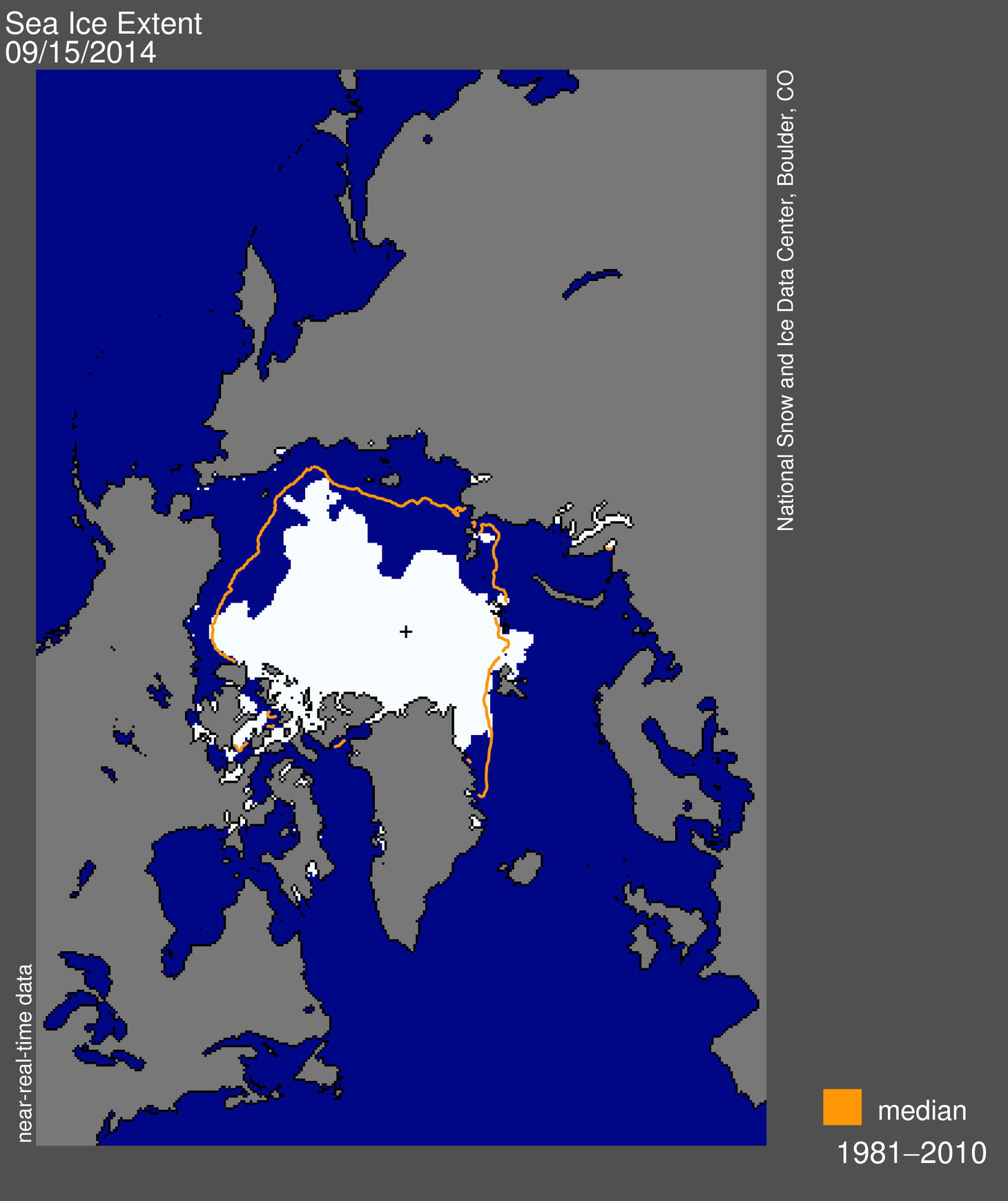
Figure 1. The National Snow and Ice Data Center (NSIDC) says the September minimum for 2014 is “imminent” and suggests the low may come in at 5.1 million square kilometers (far short of the 4.1 m2km low reached in 2012. About the much larger than average amount of ice around Svalbard and Franz Josef Land, they said only: “As was the case for the beginning of the month, extent remains below average in all sectors of the Arctic except for a region in the Barents Sea, east of Svalbard.”

Figure 1. The National Snow and Ice Data Center (NSIDC) says the September minimum for 2014 is “imminent” and suggests the low may come in at 5.1 million square kilometers (far short of the 4.1 3.41 m2km low reached in 2012. About the much larger than average amount of ice around Svalbard and Franz Josef Land, they said only: “As was the case for the beginning of the month, extent remains below average in all sectors of the Arctic except for a region in the Barents Sea, east of Svalbard.”

Continue reading

Spring/summer sea ice bonanza for polar bears – conditions excellent again for 2014

Again this year – contrary to predictions – there has been no early breakup of the sea ice on Hudson Bay and even though it’s the height of summer, there is plenty of ice throughout the Arctic to act as a feeding platform for polar bears. This makes it unlikely there will be a longer-than-average summer fast for polar bears again this year.

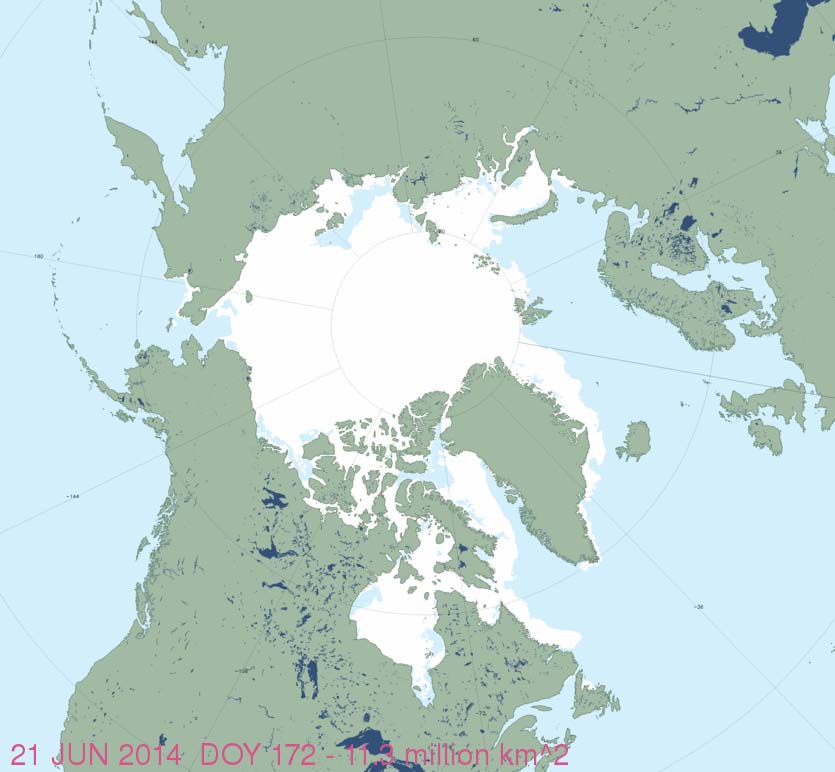
Figure 1. NSIDC MASIE map for June 21, 2014.

Figure 1. NSIDC MASIE map for June 21, 2014.

Sea ice maps around the Arctic for June 21 (and June 24, for Hudson Bay) reviewed and discussed below in relation to polar bear habitat — have a look.

Continue reading

PBI Facebook posts on Stirling’s polar bear that “died of climate change” have disappeared

It seems the two PBI Facebook posts about polar bear expert Ian Stirling’s bear that supposedly “died of climate change” last summer, which included some scathing comments and links to this blog, were removed sometime between late August 2013 and yesterday, when I happened to look for them.

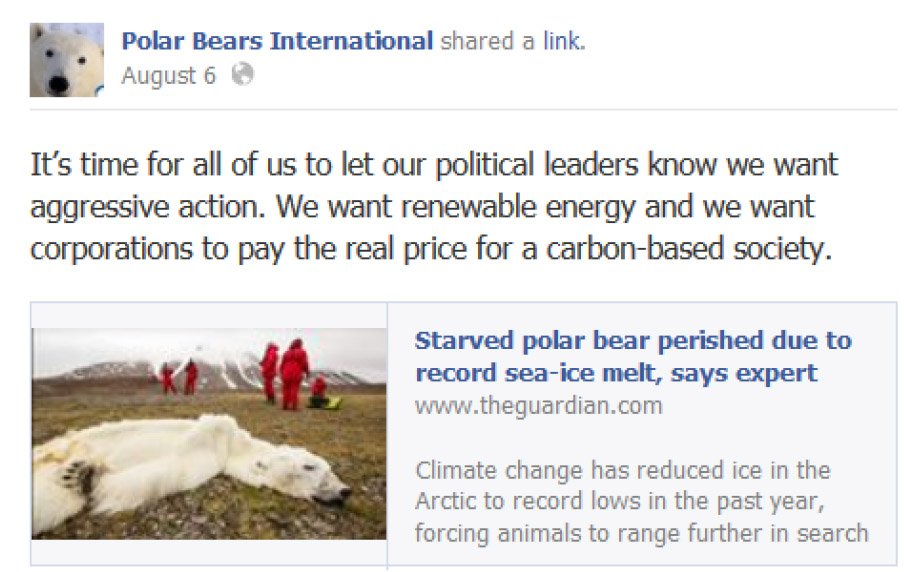
See the screen-caps below. The first one, posted August 6, linked to the original Guardian article on the Svalbard bear and added some activist spin for good measure!
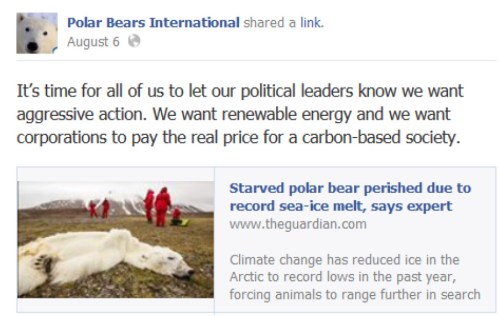
Polar Bears International Facebook_Aug 6

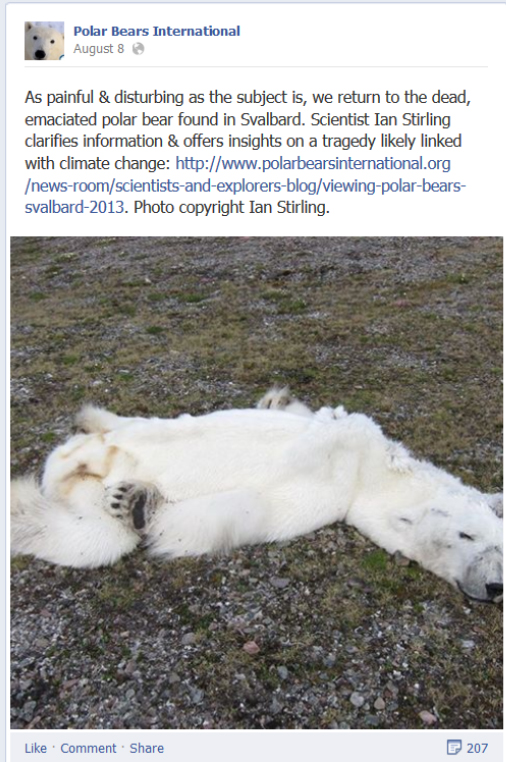
The second one, posted August 8, linked to an PBI news item that introduced a PBI blog post written by Stirling, in which he attempted some damage control.1
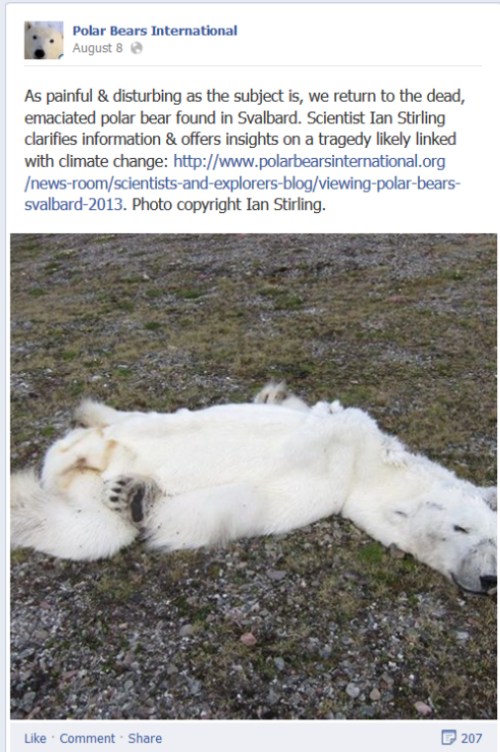
PBI link to Stirlings blog post on the bear that died of climate change_with activist spin_Aug 8 2013

[Reprise: Stirling speculated that a 16 year old bear found emaciated and dead in Svalbard, three months after it had been captured by researchers in good condition, had died of starvation due to lack of sea ice caused by global warming. Guardian writers transformed this into a bear that “died of climate change.” No mention from in the original story that 16 years is near the maximum life expectancy for male bears in the wild, that death by starvation is the usual cause of death for very old bears, or that other bears in the area were doing just fine (based on the fact that the Norwegian team working that area had just posted their data online). See my original post here, followup here, Featured Quote #44, here and footnote below]

Stirling himself (a “scientific advisor” to Polar Bears International, PBI), and the-polar-bears-are-dying message generally, took a big hit over that incident. But attempting to rewrite history? See the screen-cap below, taken yesterday (pdf here):

PBI_Fan Photo Day Aug 6 to Aug 13 gap_Svalbard bear story gone_April 29 2014

The deletion of these two entire entries suggests that PBI and Ian Stirling would rather their faithful Facebook followers and donors not have a chance to revisit the scathing comments and links to this blog. I assume it is the comments and links that were the offending parts, since Stirling’s blog post at PBI is still there, and of course, the news stories carried elsewhere are still out there. So instead of deleting comments, they removed the entire posts.

Good thing I saved screen caps of many of the more critical comments, from at least two PBI Facebook followers I’ve never heard of — have a look. [August 6th post was also captured by the cache machine]
Continue reading

Polar bears move around as sea ice habitat changes – this is what resilience looks like

Oddly, it seems some people expect polar bears to sit around and suffer (or die) when local conditions deteriorate, rather than move elsewhere.

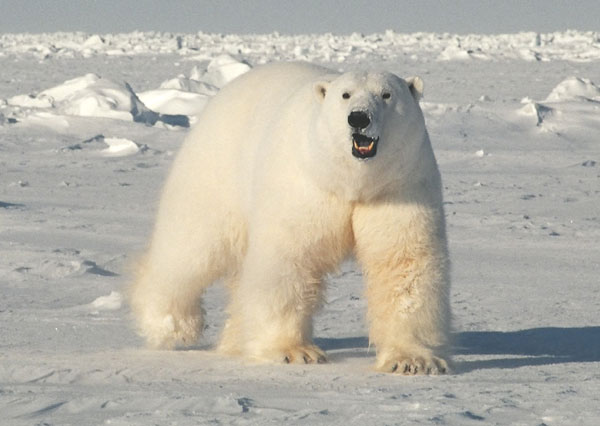
PolarBear_2008_USGS

While there are perhaps a few places where moving is not really an option over the short term, over the long term (more than one season) polar bears are free to shift to another locale if ice conditions change (either too much ice or too little).

An announcement by the WWF last week (10 April) caught my eye, as it talked about bears moving from one area to another because of changing ice conditions — as if this was surprising, extraordinary and newsworthy. That said, at least they weren’t suggesting the bears are all going to die because of declining ice, which is a huge improvement.

See what you think of this part of the press release (below), in the context of what we know about the movement of bears between regions:

Continue reading

Polar bear habitat update, end of November 2013

Freeze-up in the Arctic (~October-November) is important to polar bears because for those animals that have spent the ice-free period on shore (not all do), it marks the end of their summer fast — they can finally resume seal hunting.

Polar bears in the most southern regions, like Southern Hudson Bay, Western Hudson Bay, and Davis Strait (see Fig. 1), routinely experience the longest ice-free period. As these bears all spend the summer on shore, they appreciate a timely return of the ice.

 Figure 1. Polar bear subpopulations defined by the IUCN Polar Bear Specialist Group (PBSG), with a few extra labels added. I’ve rotated the original map 90 degrees (right) to make it easier to relate to the ice maps below. WH is Western Hudson Bay. Courtesy PBSG.  Click to enlarge.


Figure 1. Polar bear subpopulations defined by the IUCN Polar Bear Specialist Group (PBSG), with a few extra labels added. I’ve rotated the original map 90 degrees (right) to make it easier to relate to the ice maps below. WH is Western Hudson Bay; SB is Southern Beaufort. Courtesy PBSG. Click to enlarge.

Southern Hudson Bay bear populations routinely experience an ice-free season that is just as long as it is for Western Hudson Bay bears. However, Southern Hudson Bay polar bears numbers have remained stable over the last 30 years. Some folks insist that Western Hudson Bay bear numbers are shrinking to a worrisome degree, despite indications that the recent decline could be nothing more than a return to sustainable levels after a rapid population increase in the late 20th century (similar to changes documented for the Davis Strait and Barents Sea subpopulations).

Have a look at how sea ice – essential polar bear hunting habitat – has developed within these regions over the last 10 days or so (end of November 2013) and how November 2013 compares to November 1979. The ice maps tell the freeze-up story.
Continue reading

Polar bear habitat virtually everywhere now

What did I tell you, back in mid-September?

Have a look at all the polar bear habit, ten days shy of the end of November!

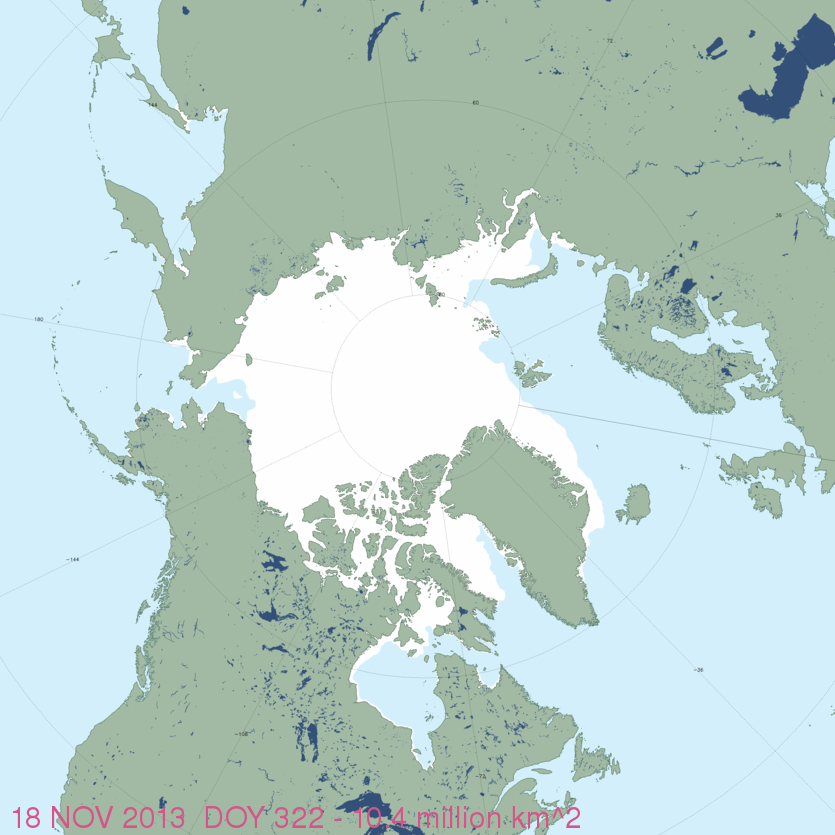
Figure 1. MASIE sea ice extent for November 18, 2013 (using US National Ice Center data). You have to look closely but there is indeed ice forming around Svalbard (just above the tip of Greenland) and in James Bay (southern Hudson Bay). Click to enlarge. High resolution map here.

Figure 1. MASIE sea ice extent for November 18, 2013 (using US National Ice Center data). You have to look closely but there is indeed ice forming around Svalbard (just above the tip of Greenland) and in James Bay (southern Hudson Bay). Click to enlarge. High resolution map here.

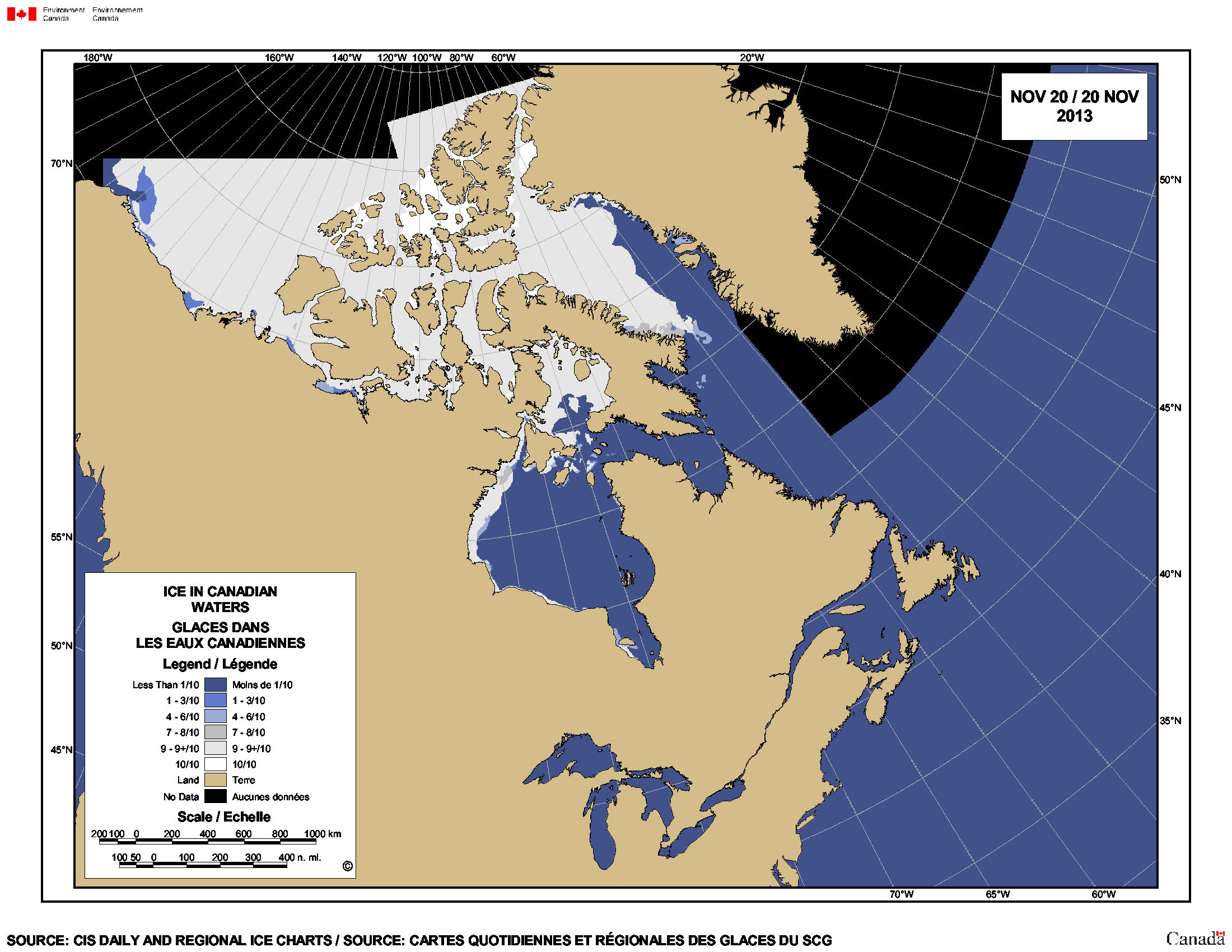
Figure 2. Canadian Ice Service map. Good amounts of ice developing in northern Hudson Bay, Foxe Basin and Davis Strait (between southern Greenland and Baffin Island), with ice forming along the shore in James Bay (the southern-most region where polar bears are on-shore at the moment). Click to enlarge.

Figure 2. Canadian Ice Service map. Ice developing rapidly in northern Hudson Bay, Foxe Basin and Davis Strait (between southern Greenland and Baffin Island), with ice also forming along the shore in James Bay (the southern-most region where polar bears are onshore at the moment). Click to enlarge.

Barents Sea polar bear status and sea ice declines

So far, I’ve not discussed the Barents Sea subpopulation in very much detail, except in comparison to other groups. For example, the Barents is considered to be the same type of sea ice “ecoregion” as the Chukchi Sea and the Southern Beaufort (discussed here). Previous studies on the Barents Sea polar bear population (Derocher 2005) indicate it may have recovered from extreme levels of overhunting (discussed here) and had stabilized, or was increasing very slowly, as early as 2002 (discussed here) — similar to what has happened in Davis Strait (discussed here).

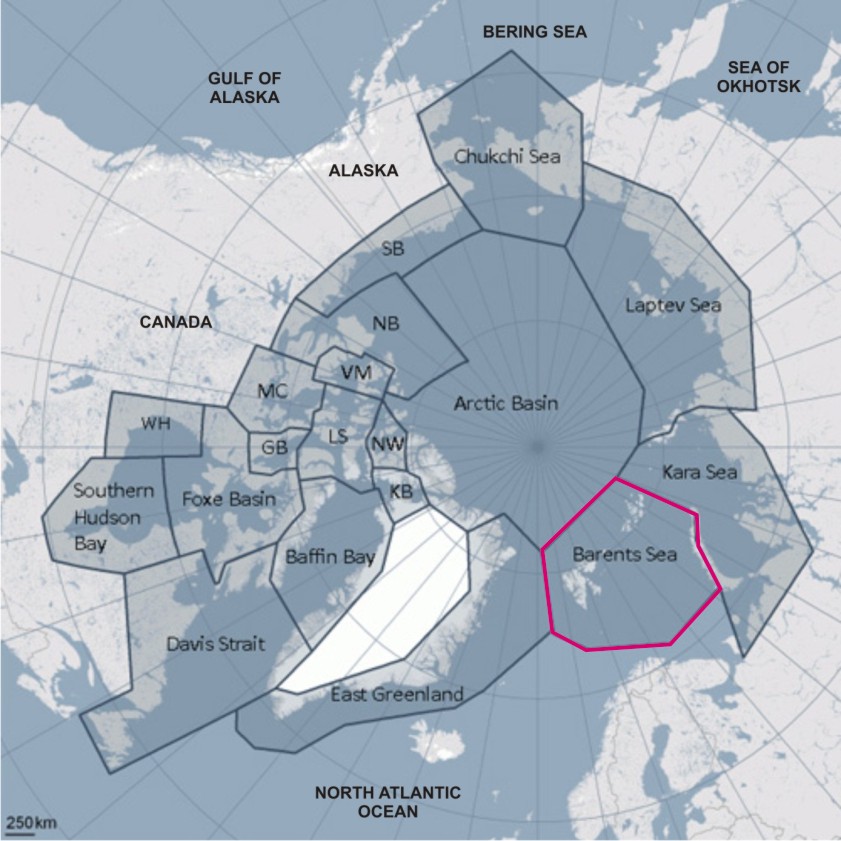
Figure 1. Polar bear subpopulations, with the Barents Sea region highlighted; map courtesy the IUCN Polar Bear Specialist Group (PBSG), extra labels added.

Figure 1. Polar bear subpopulations, with the Barents Sea region highlighted; map courtesy the IUCN Polar Bear Specialist Group (PBSG), extra labels added.

The most recent Barents Sea population estimate was done in 2004 (2,650; range ~1900-3600), based on an aerial survey (Aars et al. 2009). Aerial surveys are the only practical method of establishing population counts in regions like this where many bears never set foot on land. The previous estimate for the Barents (1982) was “2,000-5,000” but its accuracy was considered “poor” (discussed here).

The IUCN Polar Bear Specialist Group (PBSG), in their most recent report, lists the Barents Sea population as “data deficient” for status, current trend and estimated risk of decline within 10 years (Obbard et al. 2010:62, Table 1) and the “notes” for this entry say:

Population estimate is based on a new aerial survey. There was likely an increase in the subpopulation size after 1973 until recently. Current growth trend is unknown.

This 2004 estimate is now almost a decade old and potentially no longer an accurate representation of what’s happening in the Barents Sea. The most up-to-date information has not yet been published but it is available online. It’s eye-opening to say the least, if only that it appears to be yet another example of a polar bear population that is so far not showing signs of being harmed by sea ice declines, as I’ve discussed before (here).

[Update October 15, 2013: I’ve simplified the text discussion and figure regarding the Aars and Andersen denning study from the original posted]

Continue reading

What polar bear habitat could look like in another 5-6 weeks

According to the National Snow and Ice Data Center (NSIDC, Sept. 20 report), the annual sea ice minimum extent was reached on Sept. 13, 2013.

At 5.10 million square kilometers, this year’s low was a whopping 1.69 million square kilometers above the minimum extent for 2012 (which was the lowest since 1979) and well within two standard deviations of the 1979-2010 average. (Two standard deviations: “Measurements that fall far outside of the two standard deviation range or consistently fall outside that range suggest that something unusual is occurring that can’t be explained by normal processes”).

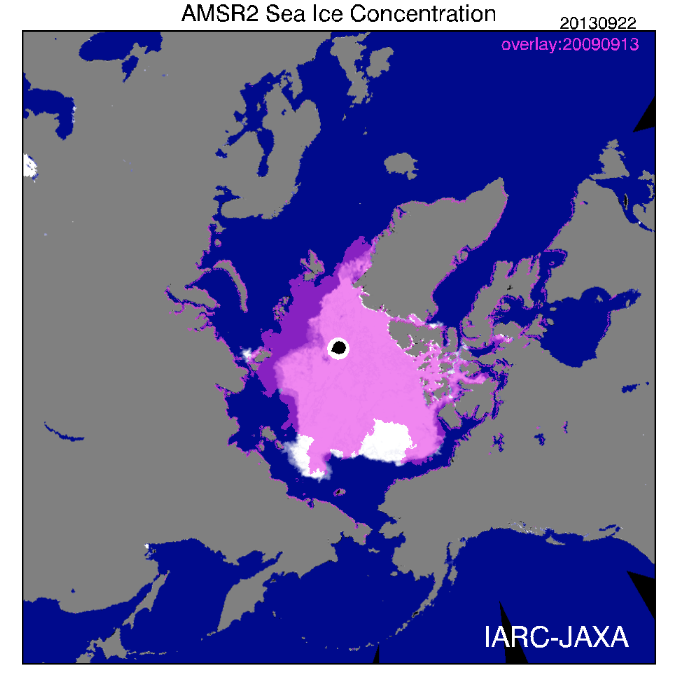
The minimum extent for 2013 is virtually indistinguishable from the minimum for 2009, which was 5.13 million square kilometers. The ice was distributed a bit differently in 2009 – more in the east and less in the west — than it was this year (see Fig. 1 below).

Figure 1. Using the JAXA “Sea ice monitor” feature, I plotted the date the 2013 minimum was reached (September 13, 5.10 million square kilometers, white) with an overlay (purple) for the same date back in 2009 (September 13, 2009, 5.13 million square kilometers), when that year’s minimum was reached (according to the NSIDC report). Areas of overlap are pink.

Figure 1. I used JAXA to plot the date the 2013 minimum was reached (September 13, 5.10 million square kilometers, white) with an overlay (purple) for the same date back in 2009 (September 13, 2009, 5.13 million square kilometers), when that year’s minimum was reached. Areas of overlap are pink.

You’ll know from previous discussions here that the annual minimum reached in late summer has little impact on polar bear health and survival (see excellent summary of the evidence for that here). What matters most to polar bears is the presence of ample ice in spring and early summer (March-June), which is their critical feeding period.

But after the fast that many polar bears endure over the height of the summer, they are eager to get back onto the ice and resume hunting. When in the fall does that become possible?

I wondered what the similarity in extent for 2013 and 2009 might tell us about polar bear habitat development over the next month or so.

In other words, what might polar bears this year expect in the way of sea ice development by say, the end of October? When might they be able to start hunting?

Continue reading

Ian Stirling’s howler update: contradicted by scientific data

Following up on my last post (Ian Stirling’s latest howler: “the polar bear who died of climate change”), I tracked down some details contained in the original Norwegian news report but which were left out of the articles that spread the story around the world. I also found some pertinent research posted online that appears to be the work of the researchers who captured this bear in April.

Figure 1. The Norwegian newpaper, The Local (Aug. 7, 2013), identifies the location that the bear was found as “a small island near Texas Bar” (marked by the square on the above map) in the very north of Spitsbergen and states it was found on July 7 – details other reports did not bother to include. To have been 250km south of that position in April (when he was tagged), he must have left the ice near the southern tip of Spitsbergen when there was still lots of ice further north.

Figure 1. The Norwegian newspaper, The Local (Aug. 7, 2013), says the bear was found on “a small island near Texas Bar” (marked by the square on the above map) in the very north of Spitsbergen, and states it was found on July 7 – details other reports did not bother to include. [“Texas Bar” is a hut built by a Norwegian hunter in 1927]. To have been 250km south of that position in April (when he was tagged), he must have left the ice near the southern tip of Spitsbergen when there was still lots of ice further north.


Continue reading

Ian Stirling’s latest howler: “the polar bear who died of climate change”

Will wildlife biologist and Polar Bear Specialist Group member Ian Stirling now say anything – no matter how unscientific – to garner more sympathy and media attention for polar bears? It appears so.  [see followup post published Aug. 11, here]

A tabloid-style picture-is-worth-a-thousand-words article appeared in the environment section of the UK newspaper The Guardian yesterday (August 6, 2013) with a picture of a dead polar bear meant to wring your heart. The picture is a vehicle for statements from Ian Stirling and others that this polar bear died from climate change. A longer article was alongside.

The caption below the photo of a dead polar bear (animal tragedy porn) is this:

This 16-year-old male polar bear died of starvation resulting from the lack of ice on which to hunt seals, according to Dr Ian Stirling.”

Many folks have been asking questions about this and so have I.

I suggest this is what really happened: the polar bear biologists working in Svalbard earlier this year knew this bear was going to die back in April when they captured him – they simply waited, with a photographer on hand, until he died. It was an orchestrated photo-op.

[Update, Aug. 8, 2013: I suggest it was not necessary for anything more to happen to “orchestrate” this photo than for the researchers who captured the bear in April to tell colleagues and local tour boat operators (who always have avid photographers on board) to “keep an eye out for a dead bear, we don’t think this guy is going to make it.” However, very little real information is provided. Who knows when (or from whom) we’ll get the whole story — if ever? That’s why anecdotal accounts like these aren’t “evidence” of anything, in the scientific sense. That’s the real take-home message here.  If this dead bear was being presented as scientific evidence, we’d have been given all the details, including necropsy results, local ice conditions, precise dates, locations, and photos of any other bears that were seen that were in poor condition. In other words, a proper scientific report. ]

Continue reading