Tag Archives: Beaufort Sea

Sickening effect of satellite radio collars polar bear researchers don’t want you to see

A report at CBC News (Photo shows polar bear injured by tight radio collar,” Martin Zeilig, 28 October 2015) shows the bloodied neck of a male Southern Beaufort Sea polar bear, taken near Kaktovik, Alaska, whose radio collar is too tight.

polar-bear-radio-collar_CBC Oct 28 2015

Researchers should not be putting collars on young animals and male bears – they know the problems! Who did the USGS have working for them that did not know this or couldn’t tell a male bear from a female? [see below] The other question is: how many more bears are in the same condition but out of sight on the sea ice – or dead due to their injuries? Don’t forget, this is a population that researchers claim is endangered because of climate change but which really declined recently due to thick spring ice in 2004-2006. [SJC – ambiguity fixed]

UPDATE 28 October 2015: 5:41 pm – in a comment under the CBC story, Churchill polar bear guide Kelsey Eliasson wrote (“4 hours ago”):

“This isn’t a he, it’s a she. Saw this bear during our trip, its a female with one cub.

Male polar bears are not radio collared.”

The statement in the CBC article that the bear with the collar is a male thus seems to be an error.  That makes more sense but does not negate the suffering of the animal.

UPDATE 5 November 2015: 8:30 am – I just received an email from a reader who contacted USGS about this bear and with their permission, I have copied the response below (leaving out the USGS contact person’s details), my bold:

Hello xxxx,

I do not believe USGS banded the bear. I have talked with staff at the USGS Alaska Science Center and found that the polar bear in the news was an adult male. The USGS scientists will band female polar bears, but not male bears. If you have questions, see this site. there is a link to the staff on the left. Click it and you will see a list with the project manager at the top. http://alaska.usgs.gov/science/biology/polar_bears/tracking.html

It may be that USGS is accepting the word of one of the experts quoted in the story [Vince Crichton] that the bear is a male and have denounced their involvement on that basis. Obviously, other polar bear researchers must be working in the area, and Geoff York statements (below) suggest a crew from University of Alberta, led by Andrew Derocher.  But if Kelsey Eliasson is right that this is a female with a cub (see above update), it may indeed be a USGS bear, perhaps one who’s collar has stopped transmitting. The plot thickens.
Continue reading

Winter returns to the Arctic – freeze-up 2015 at October 20 expands polar bear habitat

Fall is the season when polar bears that have spent the summer fasting can return to the refreezing sea ice to resume successful hunting. For polar bears, fall is the second-most important time of year for hunting, after spring.

masie_all_zoom_4km_2015 Oct 20

The date when freeze-up occurs across the Arctic varies from place to place and year to year, but the process is well underway this year. The US National Snow and Ice Data Center’s MASIE map for 20 October 2015 (above) shows 7.7 mkm2 of sea ice, up from the annual low of 4.41 mkm2 almost 6 weeks ago.

Continue reading

Tracking polar bears – 3 out of 4 S. Beaufort bears on the ice during September 2015

The shore of Alaska is not very important to Southern Beaufort polar bears – most of them stay on the sea ice during the summer and early fall, where they may or may not continue eating. These results of on-going satellite tracking studies by USGS1 confirm results of previous studies.

Tranquilized_pb570_S Beaufort March 2014_USGS

Continue reading

Beaufort Sea swimming polar bears far from land but not very far from sea ice

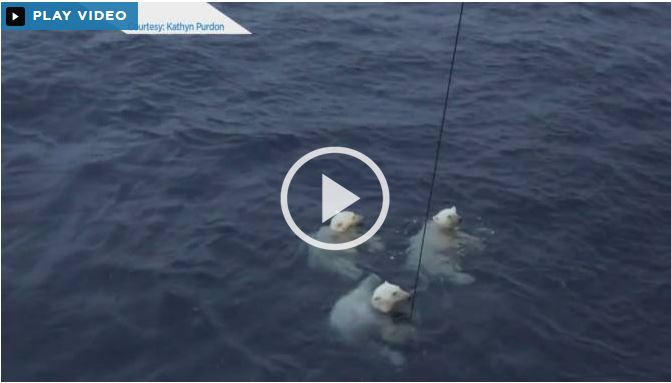
Recent accounts of an encounter with a curious polar bear female and her two older cubs in the Beaufort Sea on 16 September give contradictory details about the position of sea ice at the time. The same researcher told one reporter that the ship was 240 km from land, another that it was 240 km from the sea ice, and in another account (that he wrote himself), said the ship had been far from land and sea ice.

Beaufort swimming polar bears_Sept 30 2015_Global news

University of Victoria (Canada) chemical oceanographer Jay Cullen said on the expedition web site:

“After arriving on station and beginning work the crew noticed three polar bears in the water together which swam around to the ship when our water sampling system was nearly 3500 meters below the surface. The ship was located far from sea ice and land. Indeed, Arctic sea ice extent was the fourth lowest on record this year and there has been speculation that this imposes stress on polar bears which rely on the ice to hunt.”  [my bold]

But the maps below show that at the time of the incident (taken from the expedition web site) and the NSIDC Masie sea ice map for 16 September 2015, the ship [the CCGS Amundsen, acting as a research vessel] was actually quite close to an isolated large patch of sea ice, although further from the edge of the main pack. A patch of sea ice plenty big enough for a polar bear to rest upon – no wonder the bears did not appear stressed.

And the polar bear biologist Cullen consulted (Dr. Andrew Derocher) implied by his response that the bear was indeed far from sea ice. Reminds me of the swimming polar bear off the Hibernia oil platform off Newfoundland March 2015, which turned out to be not far from ice at all. See what you think.
Continue reading

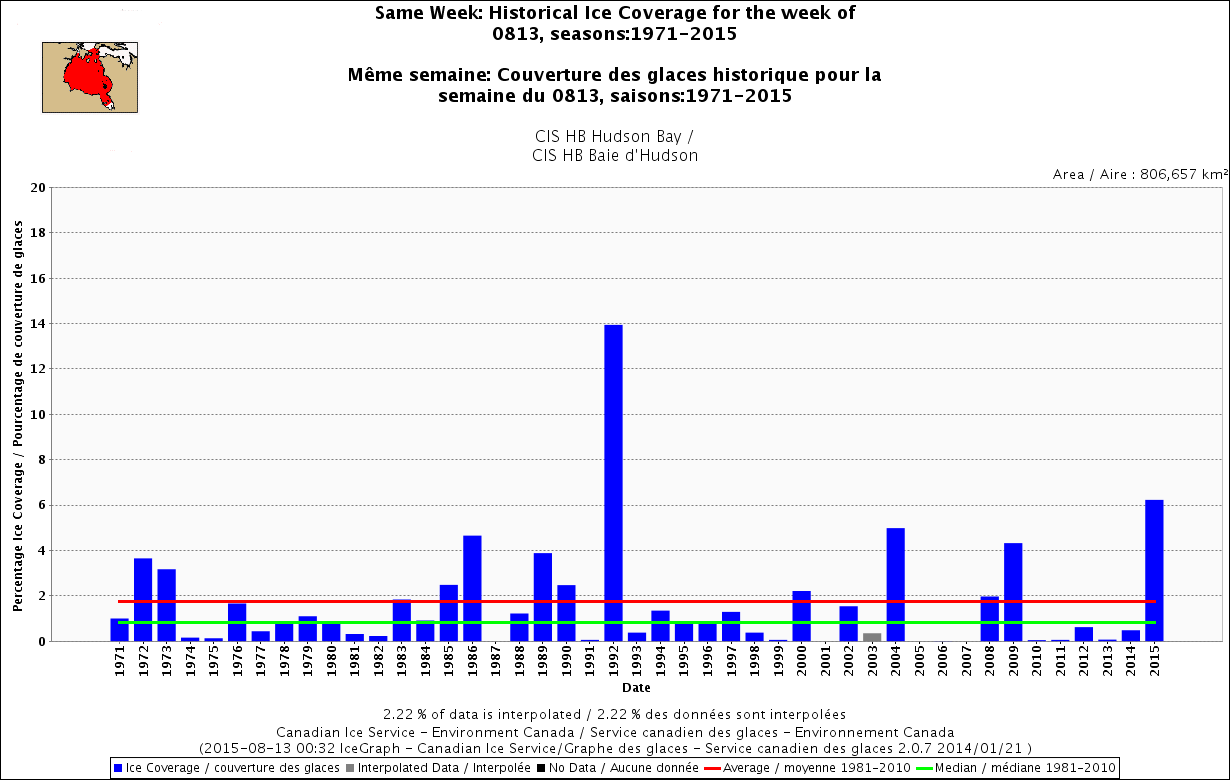
2nd highest ice coverage for Hudson Bay since 1971 at mid-August – only 1992 higher

Since 1971, there has been no year when there was as much ice left on Hudson Bay as there is this year at August 13th, except 1992 – the year when Mt. Pinatubo seemingly affected Hudson Bay ice levels but not any other region in Eastern Canada or the Beaufort Sea. Odd, that – see the graphs below.

Hudson Bay same week 13 Aug 1971-2015

Doesn’t mean that much to polar bears, since they will mostly be fasting whether they are onshore for the summer or riding the ice – they primarily live off their fat this time of year. Still, the relative ice levels are interesting because it could impact freeze-up dates later this fall, which will influence the bears’ ability to hunt before the winter fast sets in.

Continue reading

New paper finds experts were wrong: polar bears are not “walking hibernators”

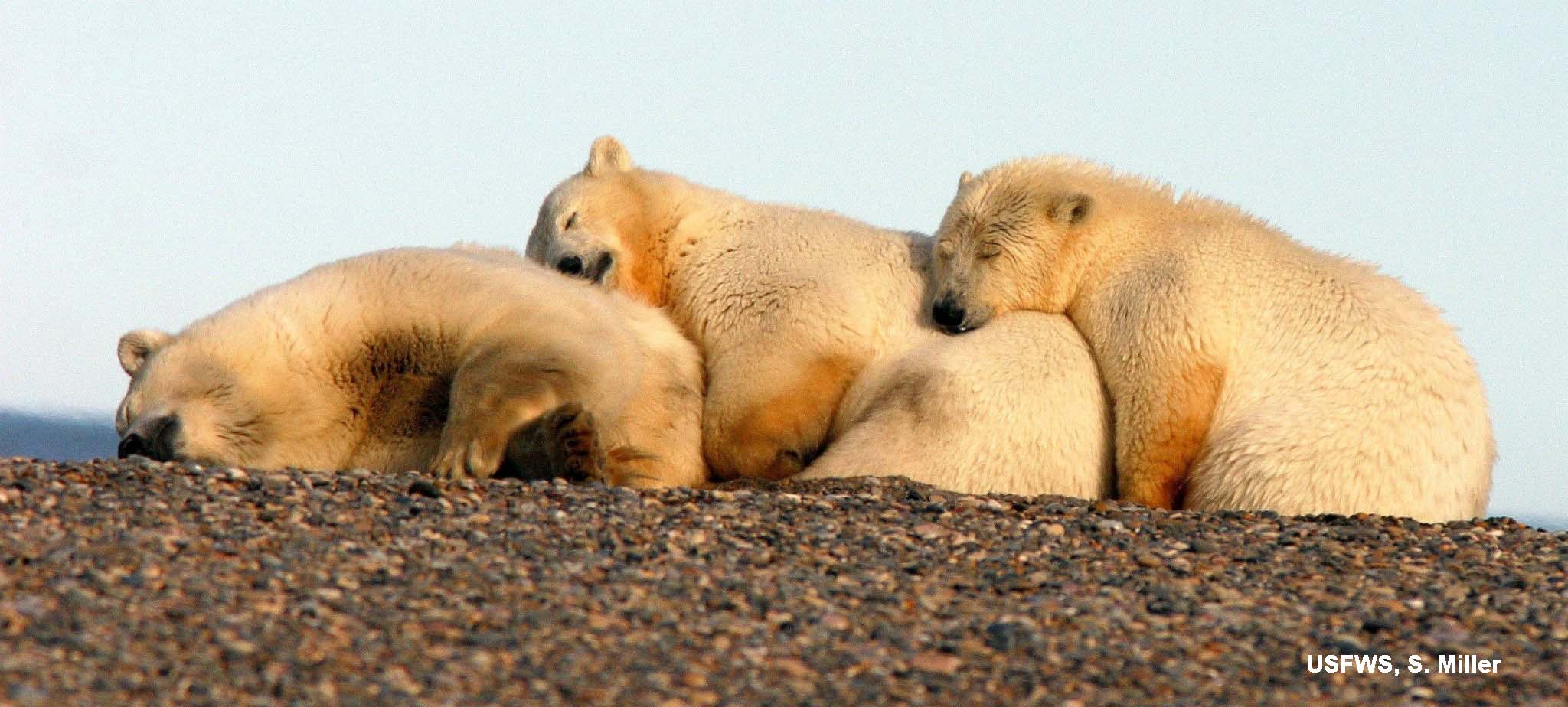
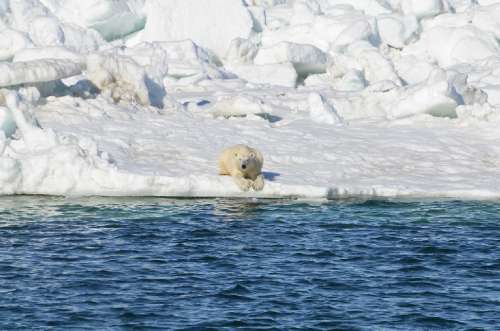
A polar bear paper just out in Science concludes the experts were wrong, polar bears are not “walking hibernators” – in summer, they slow down and live off their accumulated fat just like other mammals. Take home message: experts are not infallible and spring fat is critical for polar bear survival over the summer.

polarbears-arcticnatlwildliferefuge-suzannemiller-usfws_labeled_sm

This paper presents no compelling evidence that Southern Beaufort polar bears, or those in any other region, lack the ability to survive predicted summer sea ice declines in future decades – although they claim it does. See what you think.
Continue reading

Sea ice breakup update: high ice coverage just about everywhere, even Hudson Bay

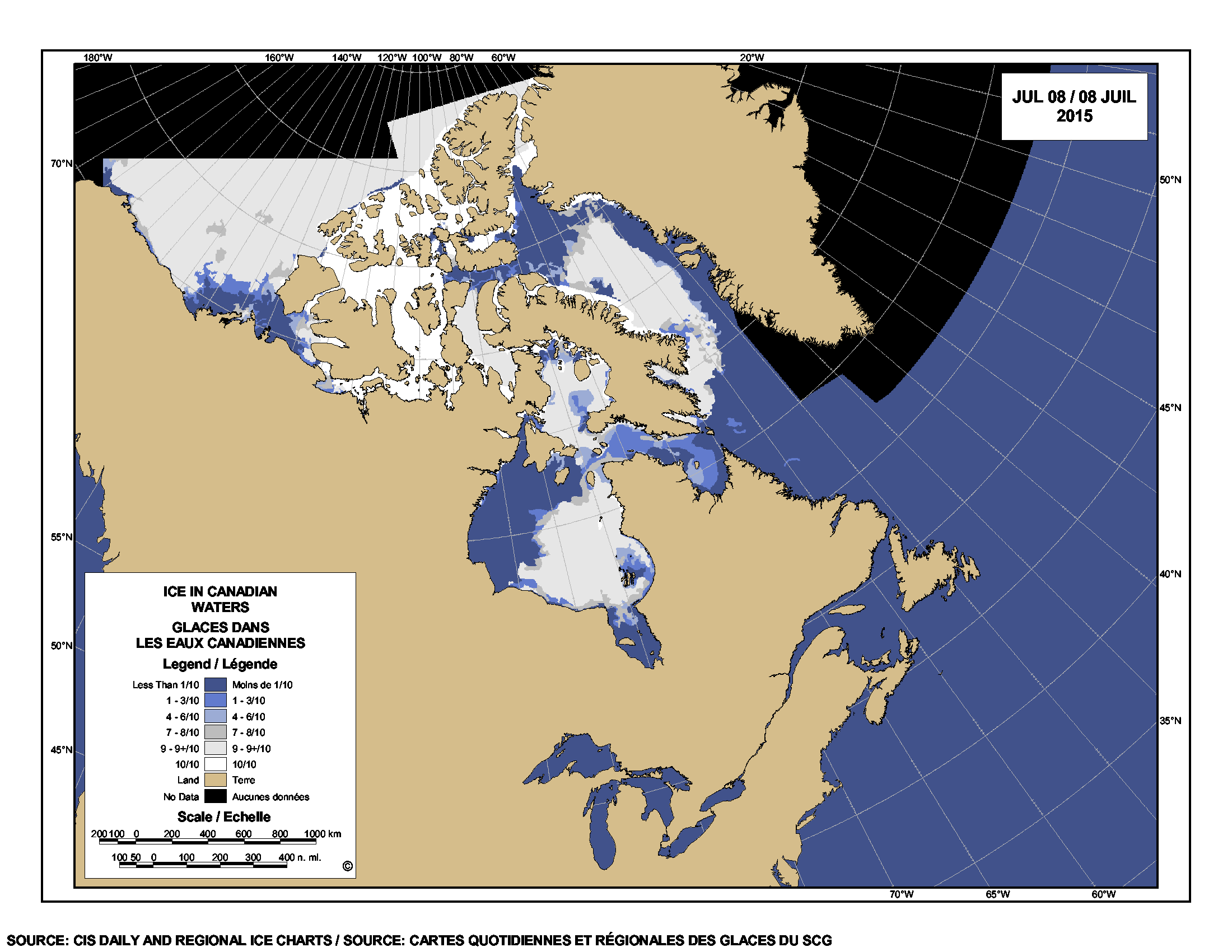
There is still a lot of sea ice in Hudson Bay, Foxe Basin, Davis Strait and Baffin Bay this week – more than average for this date – with slightly less than average in the Beaufort Sea. Past behaviour of Western and Southern Hudson Bay polar bears suggests the mean date that bears come ashore for the summer this year will be later than average due to the plentiful ice available, regardless of when polar bear biologists decide that “breakup” has occurred.

Hudson Bay breakup July 8 2015_CIS

Hudson Bay, with almost 50% of the bay still covered in ice, has the third highest coverage this week since 1992 (after 2009 and 2004); Davis Strait has the highest coverage since 1992; and Foxe Basin and Baffin Bay have the highest coverage since 1998. For this week, the Beaufort Sea has the second highest coverage since 2006 (after 2013), and more ice than was present in 1971, 1982, 1987, 1988 and 1998 – among others.

Published data shows that most polar bears of Western Hudson Bay traditionally come ashore in July, but this year it might be late July or even August. Have a look at the charts below.
Continue reading

Polar bear habitat update: many bears on the ice in Hudson Bay, lots of sea ice globally

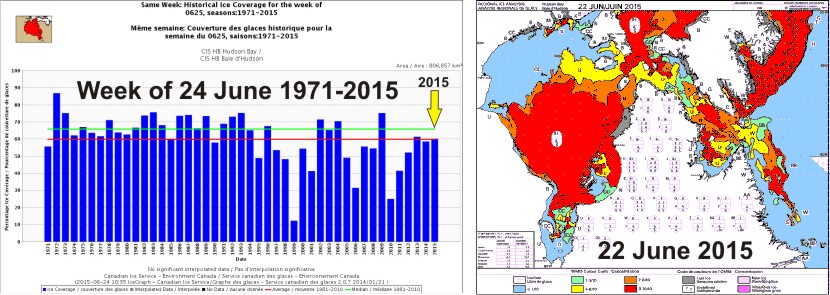
Polar bear habitat over Hudson Bay was average this week (at 60% coverage), despite the odd pattern of breakup – but the end of spring in the Arctic is only 5 days away and there is still plenty of polar bear habitat in all regions.

Hudson Bay breakup 2015 June 22 and 24_sm

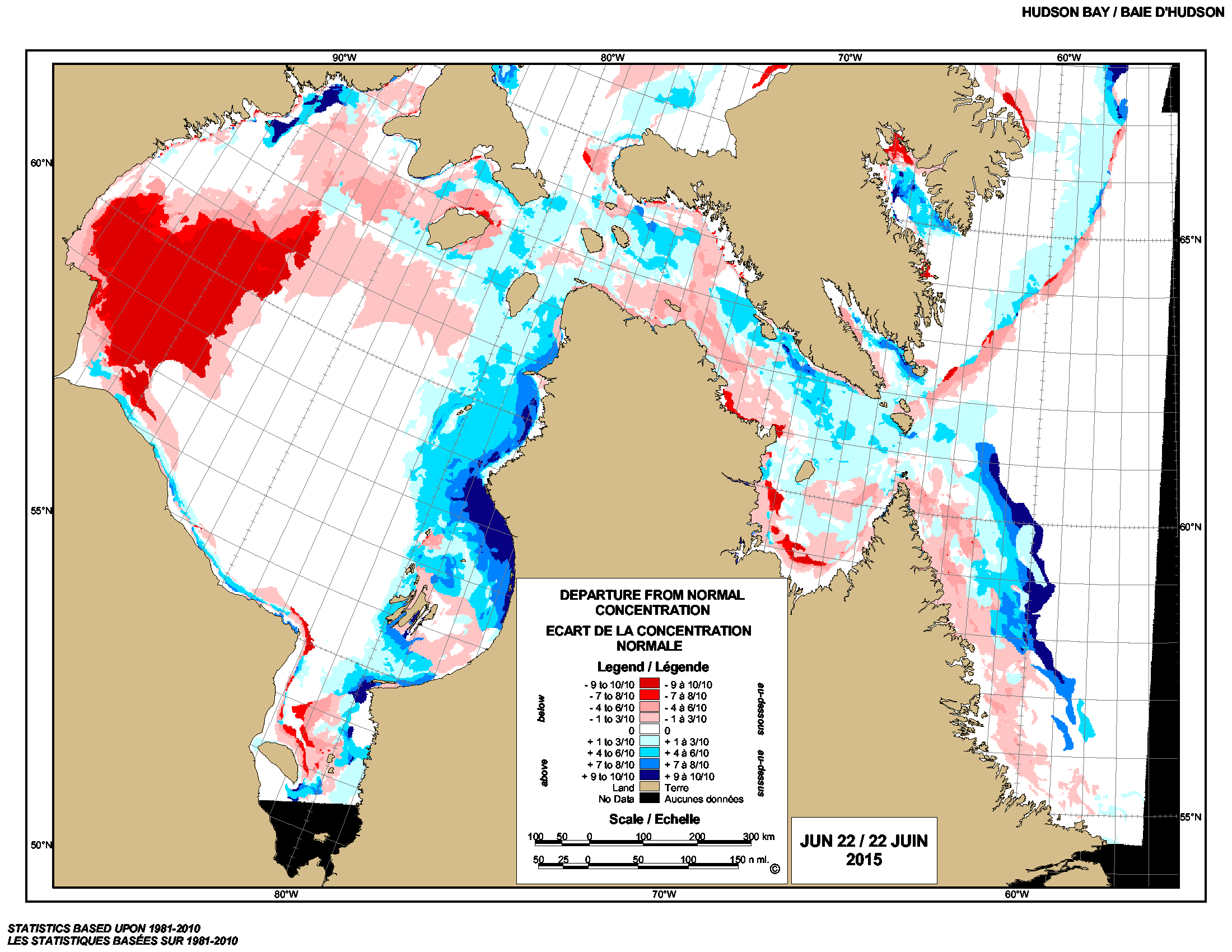
According to the Canadian Ice Service (CIS), there is still more ice in the eastern portion of the bay than usual and much less in the northwest (Fig. 1 below). There is far more ice than average ice in Hudson Strait, the approach to southern Davis Strait.

Figure 1. Hudson Bay sea ice, difference from average at 22 June 2015. Blue is less than average, red is more than average. CIS.

Figure 1. Hudson Bay sea ice, difference from average at 22 June 2015. Blue is less than average, red is more than average. CIS. Click to enlarge.

Continue reading

My new Arctic Fallacy paper- Sea ice stability and the polar bear

I have a new paper out that explains a fundamental problem with polar bear conservation.

Chukchi June 15 2014_USGS_Brian Battaile_after swim_sm

I’m convinced that a flawed and out-dated ecological concept — that sea ice, under natural conditions, provides a stable, predictable habitat — is what has allowed the present doom and gloom attitude of most polar bear specialists to develop.

Sea ice changes, of course, from season to season. However, the concept that sea ice is a stable habitat assumes that these seasonal changes are predictable and virtually the same from one year to the next – at least, similar enough that the differences are not responsible for causing marked declines in population size.

The assumption is that under natural, stable conditions populations of Arctic animals will either stay the same over time or increase. Biologists were taught at university that sea ice should be a stable habitat and as a result, they’ve glossed over evidence they collected to the contrary. [see recent posts here and here, for example]

Negative effects on populations of short-term natural variations in spring sea ice or spring snow cover on sea ice have been entirely ignored in modeled predictions of future conditions. The focus has been on summer ice extent.

I have summarized this evidence in a fully referenced, peer-reviewed essay that explores how the acceptance of this fallacy (“sea ice is a stable habitat”) has so skewed the conservation biology of polar bears that to outsiders it may look like a scientific integrity issue.

The summary and the essay are below (with embedded links and references). The Global Warming Policy Foundation (GWPF) has published the essay in their “Briefing Paper” series (#16, The Arctic Fallacy: Sea Ice Stability and the Polar Bear), which includes a must-read foreword by Dr. Matthew Cronin, Professor of Animal Genetics at the University of Alaska Fairbanks. Press release here, pdf here.

I think you’ll find it timely and thought-provoking.

Continue reading

Tracking polar bears in the Southern Beaufort May 2015 – thick ice and polynyas

Polar bear habitat in the Southern Beaufort for May 2015 was a contrast between the development of recurring polynyas (patches of open water) and tremendously thick sea ice. So it’s interesting to see where the polar bears tagged by USGS biologists chose to hang out.

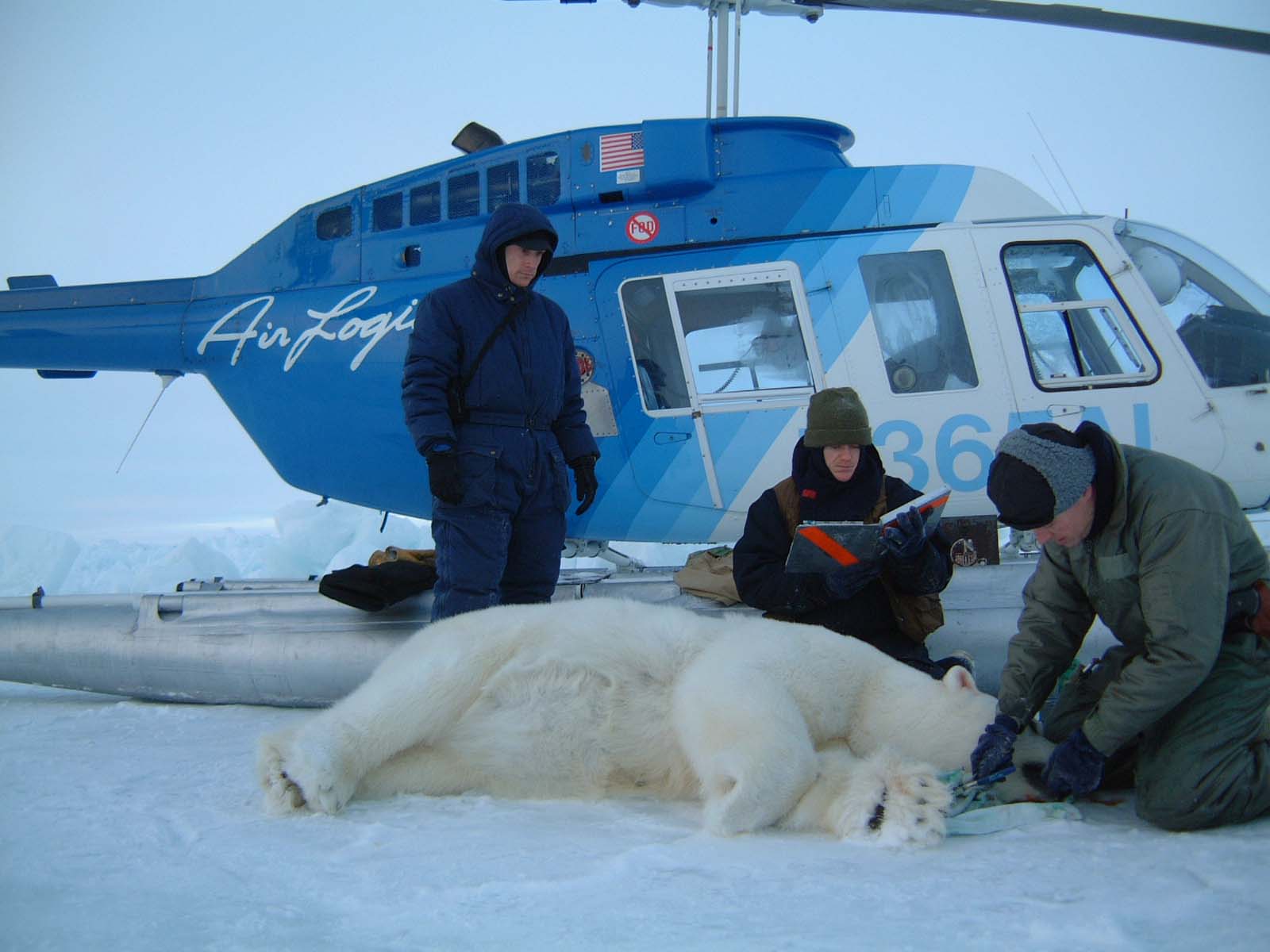
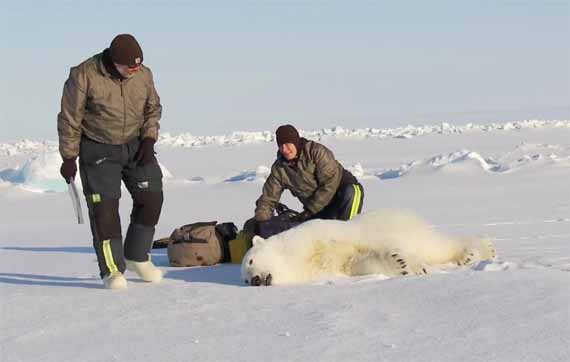
Polar_Bear_Biologist_USFWS_working_with_a_Bear_Oct 24 2001 Amstrup photo

The total number of bears being tracked in May – 23 – is down markedly from the 30 bears USGS biologists started with in April.

Most of the collared bears were concentrated in May along the shore lead (crack of open water) that normally develops between the shorefast ice and the pack ice offshore. That’s especially understandable this year, since most of that pack ice is 3-5 m thick (10-16 ft) – see the maps below.
Continue reading