Posted onFebruary 26, 2025|Comments Off on No News is Good News on Polar Bear Day: Celebrate With 35% Off Polar Bear Evolution
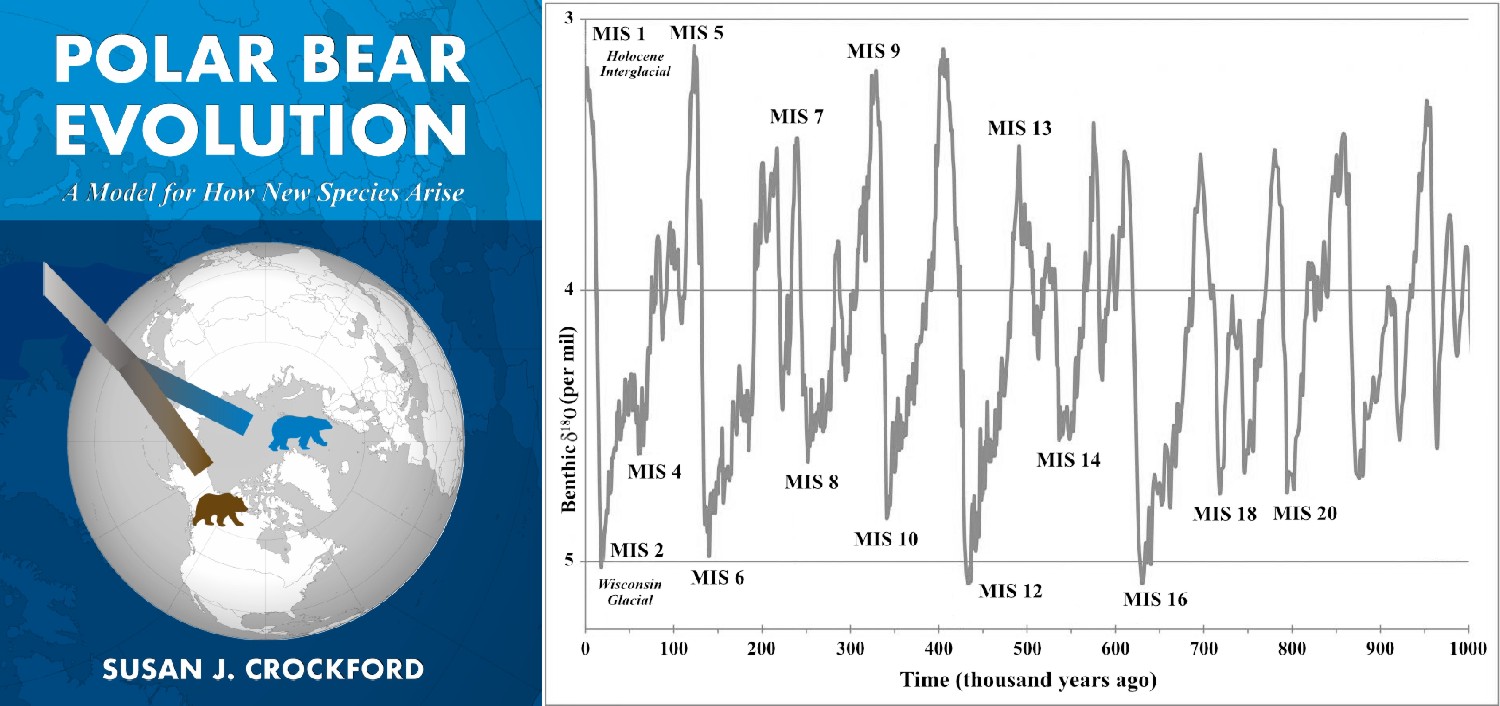
In honour of International Polar Bear Day coming up on Thursday February 27, I’ve discounted the price of my Polar Bear Evolution book by 40% for the next month in order to encourage evolutionary thinking about polar bears (in all markets: see links at the end of this post). UPDATE: Sale extended until June.
Instead of asking whether polar bears will survive a bit of warming over the next few decades, ask yourself how they survived more than 100,000 years of unimaginable changes in Arctic climate (both much warmer and colder) before now?
Posted onAugust 1, 2024|Comments Off on Polar bear “boom” reported in East & Southwest Greenland comes with the usual problems
Reports over the last week of an unexpected abundance of polar bears onshore in East and Southwest Greenland have locals and tourists concerned. The former Prime Minister of Greenland claims the unusual number of bear sightings and problems with bears near communities (including an attack involving serious injury to a German researcher) are due to abundant sea ice offshore. This explanation is contrary to what polar bear specialists predict: i.e., that problems with bears occur when there is less ice than usual. None of the bears sighted have been described as thin or starving.
The Polar Bear Specialist Group has previously estimated that there are only about 650 bears in East Greenland, while a recent study estimated that an additional 234 bears lived in SE Greenland.
Polar bears don’t often show up in Southern or Western Greenland any more, but this year has been an exception. Only yesterday, two appeared near Nuuk, Greenland’s capital. And according to Aleqa Hammond, Greenland’s former Prime Minister, that’s just been the tip of the, well, iceberg.
“There are bears everywhere in West Greenland this year,” she told ExplorersWeb. “Quite a few have been way too close to towns in South Greenland this summer, too. Several polar bears have been shot in Qaqortoq, as the bears were literally in town.”
Another polar bear has been observed – and shot as an emergency – in Ittoqqortoormiit on Thursday morning. This is confirmed by the head of duty at the Greenland Police, Jørgen Madsen, to Sermitsiaq.
It is the second time a polar bear has been shot in emergency situations in Ittoqqortoormiit this week. On Tuesday evening around 19:30, the police received a report about a polar bear that had been shot in an emergency.
Here, the police could say that the polar bear came close to a dog crate, and then headed directly for a soccer field where children are playing.
Last week, a polar bear attacked a German researcher in East Greenland. The researcher, part of a team on Traill Island, encountered the bear on Friday morning.
Posted onApril 22, 2023|Comments Off on Earth Day sea ice habitat during critical spring season for Arctic seals, polar bears, and walrus
This is the most important time of year for Arctic marine mammals that spend time above the ice: birthing, breeding, and feeding. And there is plenty of the right kind of ice available for those activities this year, as there was two years ago at the same time.
Posted onMarch 15, 2023|Comments Off on Birthing season for harp seals in Labrador Sea just in time to feed hungry polar bears
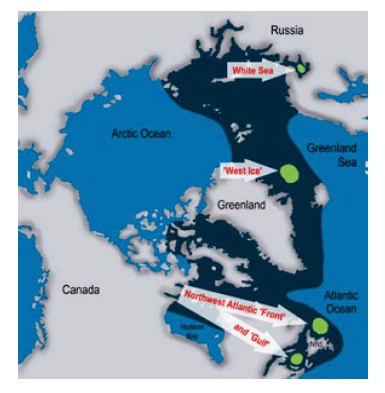
The main birthing period for NW Atlantic harp seals has arrived. Local populations of ringed and bearded seal pups will soon follow but in the Gulf of St. Lawrence in eastern Canada, the pupping season for harp seals that is usually in progress by this time has likely been redirected north due to lack of suitable ice conditions. Sea ice off Labrador and Newfoundland is in good condition and this is where the vast majority of the global population go to give birth (ca. 7.6 million vs. 1.5 million in the White Sea and 434,000 in east Greenland).
Posted onMay 1, 2017|Comments Off on IUCN Specialist Group now rejects polar bear numbers it used for 2015 IUCN Red List review
Is there a mutiny in the works between the IUCN Red List and the IUCN Polar Bear Specialist Group (PBSG) over polar bear population estimates or has there simply been a breach of ethics? What else explains the fact that some of the subpopulation estimates used by the PBSG to support the status of ‘vulnerable’ for the IUCN Red List in 2015 are unacceptable to them in 2017? And why are the PBSG refusing to embrace the Red List global estimate of 22,000-31,000?
The latest version of the IUCN PBSG status table was posted online 30 March 2017 without fanfare or even a note on their home page. It seems the result came from much discussion at their official meeting last summer (June 2016) that they say continued into early March 2017.
PBGS members voted to reject four subpopulation estimates used in the 2015 Red List polar bear status review — even though the inclusion of those numbers was required in order for the Red List status of ‘vulnerable’ to be upheld. The group has also chosen not to update their global population page with the Red List estimate of 22,000-31,000.
And surprise, surprise — now that only one subpopulation out of nineteen worldwide has shown a recent decline, the PBSG have removed the “trend” columns from their summary table for subpopulations.
Posted onJanuary 20, 2016|Comments Off on Human sees cute – polar bear sees dinner
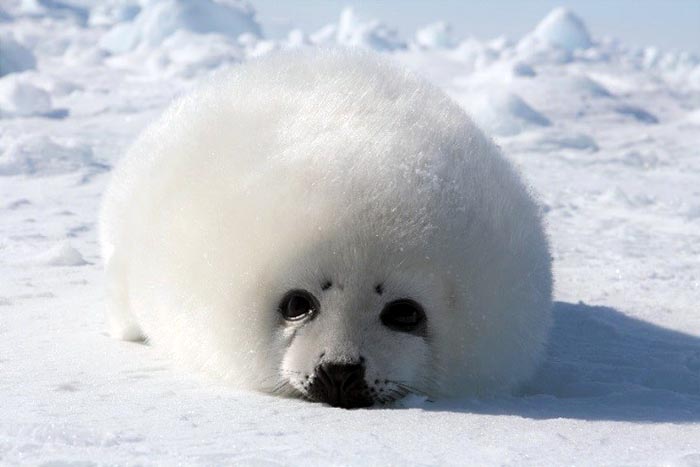
Newborn harp seals are food for Davis Strait, East Greenland and Kara Sea polar bears but wildlife photographers see only cute furry babies with big eyes and trusting natures.
See these photos taken some unknown spring (early March) in the Gulf of St. Lawrence, Canada (published 29 December 2015 by Mailonline): the pups are kind of skinny when first born but fatten up quickly on fat-rich milk from their attentive mothers. Ask yourself: does this photographer know that the fattest of these baby seals he oh’s and ah’s over in his commentary are just what polar bears depend on for their existence – and that the bears will eat as many of them as they can catch, peeling them like bananas so that they can eat the skin and fat first?
The title of the piece is: “Eye-eye! Cheeky seal cubs just a few days old wink and pose for the camera as they wait for their mother to feed them:
The young Harp seal pups had never seen humans before the pictures were taken
They were photographed in their habitat of Madeleine Island in Quebec, Canada
Harp seals are solitary animals except during breeding season, when they congregate in their thousands“
“These seal-ebrities from Canada are pictured striking hilarious poses that even Cara Delevingne would be proud of.
The three Harp seal pups – just days old – were passing time while they waited for their mother to return from hunting.
One pup looked straight to the camera with a cheeky wink, while another lay on its back looking longingly at the lens.
The impressive poses were captured by photographer Gunther Riehle, who was lucky enough to get just feet away from the baby seals on Madeleine Island in Quebec.”
See the photos here. Harp seal and hooded seal distribution and breeding areas in the Eastern Arctic (from DFO Canada).
More polar bear seal prey info here. See potential consequences of lots of polar bears depending on abundant harp seals north of Newfoundland in my novel, EATEN.
Comments Off on Human sees cute – polar bear sees dinner
Posted onJune 21, 2015|Comments Off on Polar bear news: 1st fat bear ashore in WHB, trouble in S. Greenland, and more hybrid hype
Last week, among other events, the first fat polar bear of the season was photographed on shore in Western Hudson Bay, a fat bear was run out of town in South Greenland, and media outlets spread misinformation – apparently preferring global warming hype to rational facts.
1) First polar bears have been seen onshore in Western Hudson Bay in Wapusk National Park near Cape Churchill (map below) on 18 June this year, apparently fat and well prepared for the summer fast. My informants tell me a few bears usually come ashore in June near Churchill before ice conditions make this necessary; the bulk of the population will probably continue seal hunting for a few more weeks. Those bears will come ashore along the southwest coast (near Polar Bear Provincial Park, in Ontario, see Fig. 2 below). They’ll make their way north to the Churchill area in time for freeze-up in the fall. Watch one fat bear caught on camera on 18 June, below :
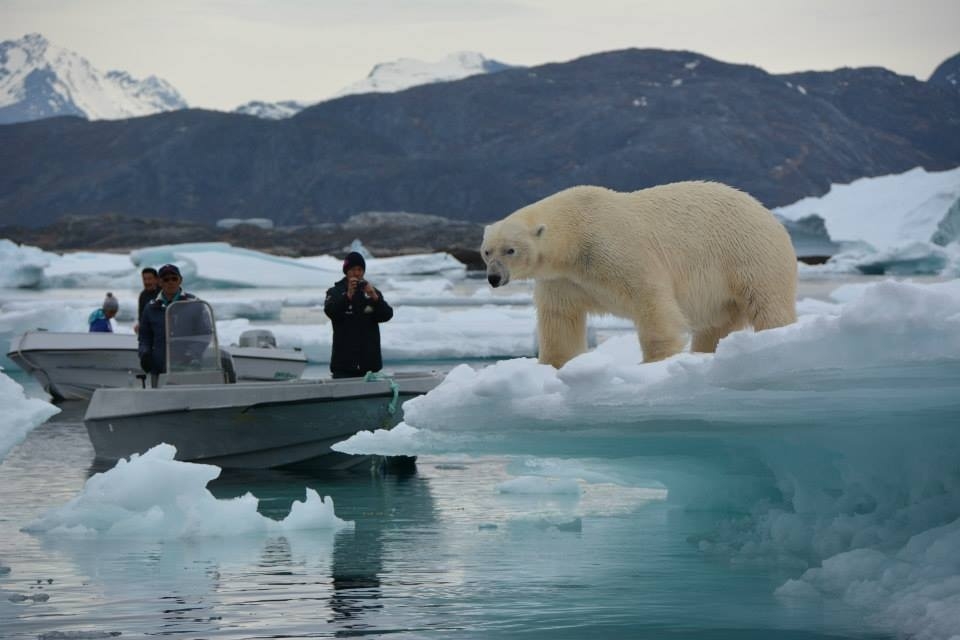
2) Fat polar bear spotted in Nanortalik, Southern Greenland 18 June 2015, a bit further south than usual. People from the community drove it away, but not before taking lots of pictures.
Some very cool photos, including the one above (taken by Henrik Hansen), worth a look. This bear was in excellent condition, well prepared for the summer fast ahead, whether he ends up spending it on shore somewhere (but not near this community!) or on the sea ice further north in SE Greenland (Fig. 1 below). The ice in that areas is probably broken up (~15-30% concentration) but this is enough for the bear to swim from flow to flow to make it’s way up the northeast coast where most East Greenland bears spend the summer. Continue reading
Comments Off on Polar bear news: 1st fat bear ashore in WHB, trouble in S. Greenland, and more hybrid hype
Posted onApril 1, 2015|Comments Off on Polar bear consumption of terrestrial foods – new paper misses the point
A new paper by polar bear biologists (Rode et al. 2015) argues that terrestrial (land-based) foods are not important to polar bears now and will not be in the future – a conclusion I totally agree with – but they miss the point entirely regarding the importance of this issue.
Whatever food polar bears consume in the summer – whether they are on land or on the ice – doesn’t really matter. What matters is how many fat-rich seals they can consume between March and June each year. The fat put on in late winter/spring from gorging on baby seals carries polar bears over the summer, no matter where they spend it.
USGS polar bear biologist Karyn Rode and colleagues (press release here) have tried to frame this issue as one about future survival of polar bears in the face of declining sea ice. However, the fact that polar bears in the Chukchi Sea and Southern Davis Strait are thriving despite dramatic declines in summer sea ice (aka an extended open-water season), proves my point and disproves their premise. Bears in these regions are doing extremely well – contrary to all predictions – because they have had abundant baby seals to eat during the spring (see here and here).
Posted onMarch 1, 2015|Comments Off on IUCN Specialist Group quietly adds “sea ice changes” to their polar bear status table
In late January, the IUCN PBSG made significant changes to its polar bear status table but did not think it was worth bringing to the public’s attention via a tweet, press release or note on their web site’s home page.
What changes? Well, while the group did not see fit to agree with all of Environment Canada’s assessments (e.g. listing Davis Strait bears as “likely increasing” compared to the PBSG’s “stable”, see full list here), it did upgrade their status of Western Hudson Bay bears to ‘stable’ (which EC did back in June 2014).
More significantly, however, they also added two metrics of sea ice change to their assessment table, presumably because alongside ‘human-caused removals’ (which they also track in their tables)1, sea ice changes are supposedly critical ‘threats’ to polar bear health and survival.
So critical, in fact, that they’ve only just now gotten around to measuring it consistently across polar bear territory. Funny thing is, they cite no document that shows the sea ice change calculations for each subpopulation region, nor who generated them.
Let me be clear:no one has ever generated such a sea ice metric before – it is a unique PBSG construct that you will find nowhere else. By providing no documentation that lays out the calculations for inspection, the PBSG are simply insisting the public accept their unpublished, non-peer-reviewed work on faith. Details below. Continue reading
Comments Off on IUCN Specialist Group quietly adds “sea ice changes” to their polar bear status table
Posted onFebruary 4, 2015|Comments Off on East Greenland polar bears – said to be the most polluted but appear to be doing just fine
I’ve not written much about this subpopulation before but with the flurry of interest over “weakened” penis bones and toxic chemicals, I thought it was time to remedy the situation.
Watch polar bear habitat reform in the Canadian Arctic: “last 10 days” Canadian Ice Service animation (works anytime) HERE.
See Quote archive for details.









 polarbearscience
You must be logged in to post a comment.