Tag Archives: polar bear

Ice formation in W Hudson Bay slower than 2015 but not likely as slow as 1983

After a great start this year for Churchill-area polar bears of Western Hudson Bay – who came off the ice in better than usual condition after what must have been a good spring hunting season – ice maps suggest that freeze-up will be later than last year, an impression confirmed by on-the-ground observers.

Ice coverage this year at 7 November (2016):

sea-ice-extent-canada-2016-nov-7_cis

Ice coverage last year at this date (7 November 2015), see this post for details:

UPDATED 23 November 2021: see below.
Continue reading

Tracking west Alaskan polar bears in the Beaufort in October – all at Banks Is., CAN

polar-bear-habitat_usgs-from-cbc-story-sept-19-2015

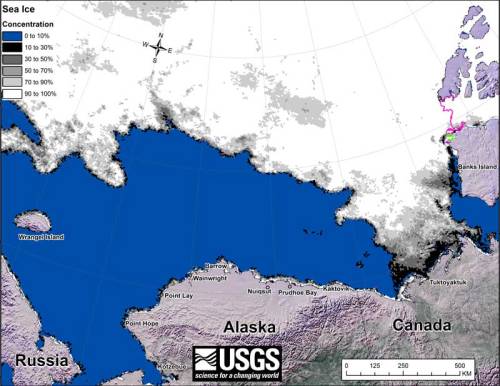
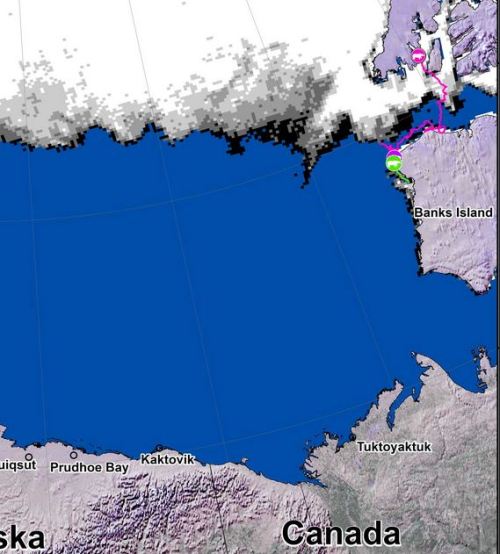
Two out of three polar bear females that were collared by USGS researchers near Barrow, Alaska last spring are hanging out on the northwest coast of Banks Island, Canada. The other bear (bright green icon) appears to have been collared on the ice off Prudoe Bay in April. And as I discussed last month, it’s unusual for bears from the western end of the Southern Beaufort subpopulation (or even the central region) to end up in the Northern Beaufort subpopulation territory.

beaufort-tracking-usgs-bear-movements-october-2016-sm

Original caption: “Movements of 3 satellite-tagged polar bears for the month of October, 2016. Polar bears were tagged in 2016 on the spring-time sea ice of the southern Beaufort Sea. All 3 of these bears have satellite collar transmitters. Polar bear satellite telemetry data are shown with AMSR2 remotely-sensed ice coverage from 29 October, 2016.” See full resolution image here and close-up below.

Continue reading

If experts had been right about sea ice, there would be no polar bears in Churchill

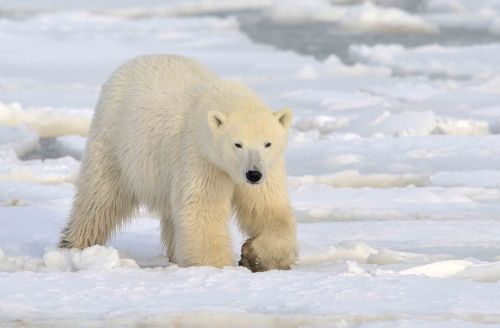
The simple fact is that if polar bear experts had been right about the threat to polar bears from the loss of summer sea ice in the Arctic, there would be no polar bears in Churchill this fall. No bears for tourists to photograph, none for biologists to study, and certainly none for the BBC to film for an upcoming three-part TV special called “Arctic Live.

polar-bear-stock-image-gg66298544_sm

The low-ice future that biologists said would doom polar bears to extinction by 2050 has already happened in 8 out of the last 10 years. The sea ice future has been realized.

Polar bears have experienced those supposedly deadly low-ice summers for almost a decade but the global population did not drop by 2/3 as predicted and not a single one of the ten subpopulations predicted to be extirpated under those conditions has been wiped out.

How much more wrong can you be than that? Will the BBC mention this conundrum in their show? Will the polar bear experts they consult share this fact with viewers? We’ll all have to watch and see [show times and summaries of each program here, 1-3 November] but here are some background facts that might enhance your viewing experience.

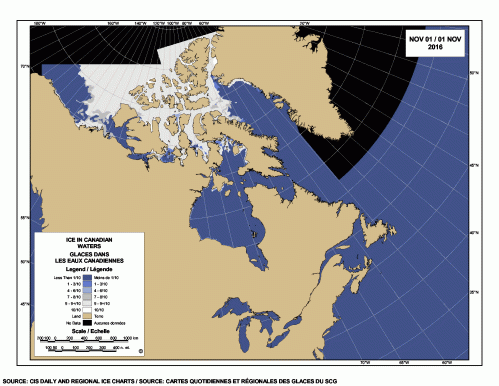
UPDATE: Sea ice condition of Hudson Bay at 1 November 2016 below from the Canadian Ice Service (some slushy ice looks to be forming along the coast north of Churchill – this is how freeze-up starts). See the animation for the last 10 days here:

sea-ice-extent-canada-2016-nov-1_cis

Continue reading

IUCN Polar Bear Specialist Group website still silent on 2015 Red List assessment

It’s now been 11 months since the IUCN Red List announced the completion of a new conservation assessment for polar bears – but you wouldn’t know that if you visited the website of the IUCN Polar Bear Specialist Group (PBSG).
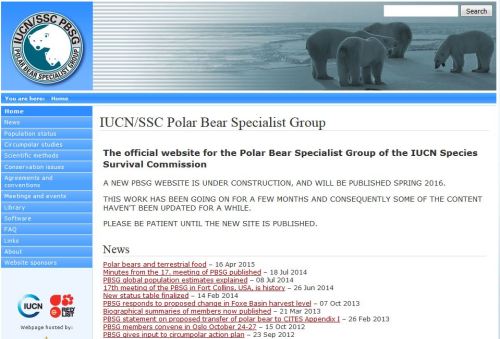
pbsg-website-notice_home-page-2016-oct-18

Back in May 2016, I wrote to the folks at the IUCN Red List asking them why the PBSG had not yet added a link to their website regarding the 19 November 2015 update to the Red List polar bear assessment (submitted by PBSG members in July 2015), a shortcoming I first notice in December 2015. I also inquired why the IUCN Red List folks were not taking the PBSG to task for their failure to keep the public informed of this new development.

After a wait of more than 6 weeks (23 June), I finally received a reply. The Red List official accepted as reasonable the PBSG excuse that since a link to the IUCN Red List was present on their home page as an icon (here), a direct link to the actual Red List polar bear assessment was not necessary. He was informed by the PBSG that the website upgrade had simply taken longer than expected but that it would be completed by the end of July.

And yet, here it is – almost three months later and still no revised website – and more importantly, still no mention of the 2015 Red List assessment update, see screencap above taken 18 October 2016 (which has been up since 14 January 2016).

Note that my complaint is not that the website upgrade has taken longer than expected (doesn’t it always?) – it’s about the continued refusal to provide a simple link to the 2015 Red List assessment at the top of their “News” feature which sits prominently on their home page.

The PBSG is considered the scientific authority on polar bears and in my opinion, the fact that for 11 months their website has lacked a link to the 2015 Red List assessment (which contains many significant changes, including a larger population estimate, a revised population trend, and a prediction of future change with error bars) raises concerns about transparency, potential bias, and lack of accountability of the PBSG organization – and displays a similar kind of contempt for the public that its chairman revealed back in 2014 when he said that population size estimates were “simply a qualified guess given to satisfy public demand.”

Copies of my email exchange with the Red List associate who answered my inquiry are below – decide for yourself if I’m over-reacting.

UPDATE 22 Nov. 2016: A cursory check of the PBSG website today revealed that a few days ago (16 Nov. 2016) the PBSG Chairman finally did what I have been suggesting for almost a year: post a simple notice and link to the 2015 IUCN Red List polar bear assessment.

A simple line in the NEWS section of the home page:

pbsg-website_home-page-2016-nov-16-news-red-list

They even added a short notice with links to the documents (screen cap below).
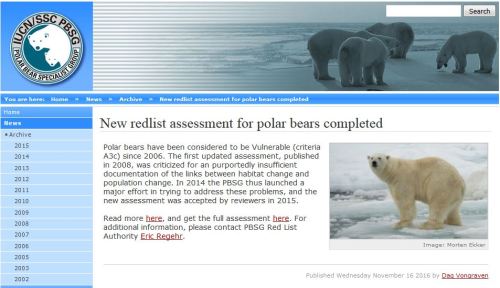
pbsg-website-redlist-news-notice_2016-nov-16

Yes, pretty much exactly what I suggested in January. I’d hazard a guess I wasn’t the only one complaining.

Continue reading

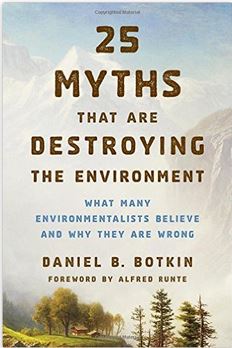
New ecology book: 25 MYTHS THAT ARE DESTROYING THE ENVIRONMENT

Veteran Yale University research ecologist Dan Botkin has a new book coming out tomorrow (Saturday 15 October) that you might want to look at:

botkin-2017-25-myths-cover

A number of chapters are relevant to polar bears, including these three:

“Myth 11: Without Human Interference, Earth’s Climate is Stable”

“Myth 13: Climate Change Will Lead to Huge Numbers of Extinctions”

“Myth 25: Compared to Climate Change, All Other Environmental Issues Are Minor”

I found the book clearly written in a readable style (Table of Contents here). It provides timely insight into critical issues related to conservation and species extinction, with many real-world examples that counter theoretical assumptions (polar bears are discussed in the Overview). I found the energy issues (Myths 23 and 24) an awkward distraction but others might find them of interest. It’s a good companion to Bjorn Lomborg’s The Skeptical Environmentalist (an excellent reference from 2001 but much more detailed).

Pre-0rders now being taken:

Twenty-five Myths That Are Destroying the Environment: What Many Environmentalists Believe and Why They Are Wrong. Daniel B. Botkin 2017. Rowman & Littlefield Publishers, Inc., Lanham, MD 20706. $12.71 PAPERBACK; $7.51 KINDLE

Peak inside via Amazon, more about Dan Botkin and his publication record, and the book below.

Continue reading

Arctic sea ice grows & Churchill polar bears into their 4th month of fasting

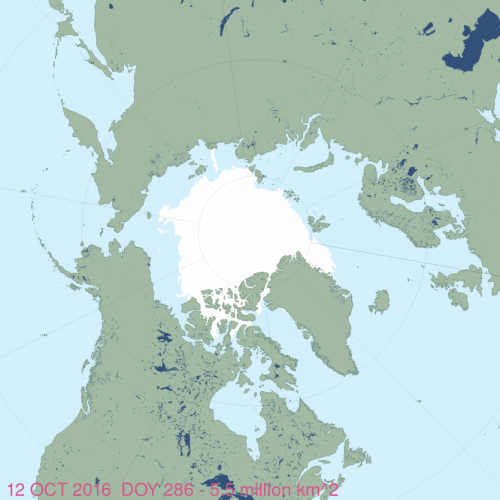
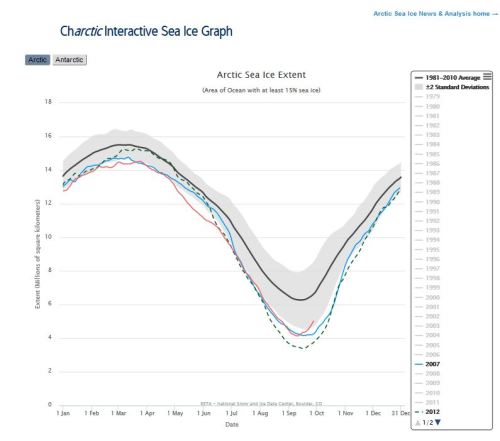
A quiet year for problems in the polar bear capital of the world (Churchill, Manitoba) so far – despite this year tying for the second-lowest minimum since 1979 – and the ice is growing fast. In fact, Arctic ice growth in the second half of September was rapid and there is now more ice than there was at this date in 2007 and 2012 (when polar bears in those regions considered most at risk did not die off in droves).

masie_all_zoom_4km-2016-oct-12

Pessimistic polar bear specialists are wrong  – polar bears are much more resilient to low sea ice levels in summer than they assume: their own data from low summer ice years proves it.  If you’ll recall from my previous post, polar bears seem to have barely survived the extensive sea ice coverage during the Last Glacial Maximum – in other words, too much ice (even over the short term) is their biggest threat. Polar bear numbers, as confirmed by the latest estimates in the 2015 IUCN Red List assessment, are higher now than they have been since the 1960s, despite almost 10 years of summer sea ice minimums below 5.0 mk2.

Churchill Polar Bear Alert reports and Arctic sea ice comparisons at this date, in detail below.

Continue reading

In case you missed it…writer James Delingpole puts my novel in context

From Saturday 8 October, English journalist, author and broadcaster James Delingpole (via his Breitbart column) writes about polar bears:

delingpole-8-oct-2016-headline

The Truth About Polar Bears: They’re a Dangerous, Out of Control Pest…

Crockford is the author of a Jaws-style thriller on ravenous polar bears killing humans called Eaten. At least one polar scientist who has read it considers its “science-based scenario” to be frighteningly plausible.

In field-level polar bear management circles, people don’t talk about the kind of scenario that forms the premise of this novel as an “if”. Instead, they describe it as a “when” and they are not looking forward to it.

Eek.

Eek is right! The book has been nightmare-inducing for many readers. Put EATEN on your Christmas shopping list (all purchase options here). It makes a great gift and supports the work I do here. Colleagues have said their young adult children really enjoyed it.

[I’m reminded of Christmas since we had turkey for Canadian Thanksgiving this weekend – a fabulous gathering of all the local family at my place, including the two (!!) grandbabies, both of whom are now walking. I’ll be sending Nico to Churchill before you know it]

[And FYI, I’ve updated the Svalbard “problem no one is talking about” post with statistics by year (1974-2015) for polar bears killed to protect life and property]

Tracking Western Alaskan polar bears in the Beaufort in Sept – all 3 chose Canada

All three polar bear females tagged in the Southern Beaufort Sea far west of Kaktovik (near Barrow) spent all or most of September onshore in the Northern Beaufort area of Canada.

beaufort-tracking-usgs-bear-movements-september-2016-lg-closeup

Continue reading

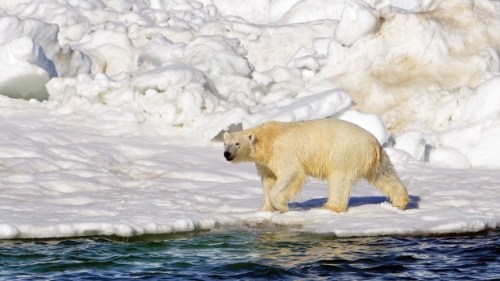
Polar bear onshore in Tuktoyaktuk got so close to kids they heard it breathing

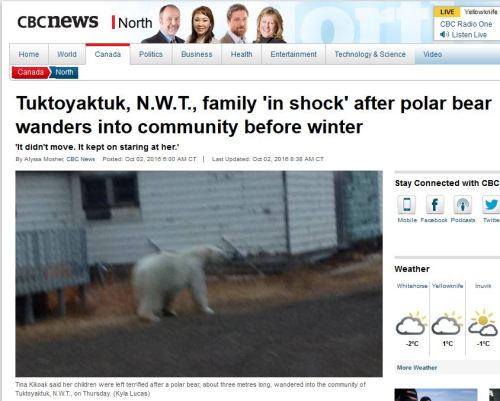
A report from the CBC this morning (with video) of a large polar bear wandering about the village of Tuktoyaktuk on the (Canadian) shore of the Eastern Beaufort Sea on Thursday (29 September) that got very close to a group of children playing outside. Fortunately, no one was hurt.

tuk-polar-bear-sighting-sept-29_cbc-oct-1-2016-headline

That this was a rare event is evident in the awe and excitement in the voices of the residents as someone recorded the movements of the bear through town (picture quality is not the best, but clear enough).

As I’ve said before, with more bears we can expect more interactions with people and more sightings like this that haven’t happened in decades. Map and quotes below.
Continue reading

Polar bear habitat this fall shaping up fast – more like 2010 than 2007

Arctic sea ice tied 2007 for extent at the September minimum less than 3 weeks ago but with the refreeze proceeding much faster than 2007, seals will soon be returning to the ice edge and polar bears will be back to feeding like they did in 2010.

sea-ice-at-28-sept_2016_vs-2007_2012_5-point-0_nsidc-interactive

Sea ice extent less than 5.0 mkm2 lasted less than 6 weeks (23 August – 28 September), according to NSIDC.

Continue reading