Tag Archives: polar bears

Tracking polar bears in the Beaufort Sea: November map

Here is the November follow-up to my post on the July track map for female polar bears being followed by satellite in the Beaufort Sea by the US Geological Survey (USGS) – Ten out of ten polar bears being tracked this summer in the Beaufort Sea are on the ice.

See that post for methods and other background on this topic, and some track maps from 2012 (also available at the USGS website here).

The track map for November is copied below (Figure 1).

By the end of November, ice covered the entire Alaska coast. Six of the bears that were being tracked in October were still present (down from ten in July) and one bear that went Arctic walkabout in October has returned. So, a total of seven bears were tracked in November.
Continue reading

Polar bear habitat update, end of November 2013

Freeze-up in the Arctic (~October-November) is important to polar bears because for those animals that have spent the ice-free period on shore (not all do), it marks the end of their summer fast — they can finally resume seal hunting.

Polar bears in the most southern regions, like Southern Hudson Bay, Western Hudson Bay, and Davis Strait (see Fig. 1), routinely experience the longest ice-free period. As these bears all spend the summer on shore, they appreciate a timely return of the ice.

 Figure 1. Polar bear subpopulations defined by the IUCN Polar Bear Specialist Group (PBSG), with a few extra labels added. I’ve rotated the original map 90 degrees (right) to make it easier to relate to the ice maps below. WH is Western Hudson Bay. Courtesy PBSG.  Click to enlarge.


Figure 1. Polar bear subpopulations defined by the IUCN Polar Bear Specialist Group (PBSG), with a few extra labels added. I’ve rotated the original map 90 degrees (right) to make it easier to relate to the ice maps below. WH is Western Hudson Bay; SB is Southern Beaufort. Courtesy PBSG. Click to enlarge.

Southern Hudson Bay bear populations routinely experience an ice-free season that is just as long as it is for Western Hudson Bay bears. However, Southern Hudson Bay polar bears numbers have remained stable over the last 30 years. Some folks insist that Western Hudson Bay bear numbers are shrinking to a worrisome degree, despite indications that the recent decline could be nothing more than a return to sustainable levels after a rapid population increase in the late 20th century (similar to changes documented for the Davis Strait and Barents Sea subpopulations).

Have a look at how sea ice – essential polar bear hunting habitat – has developed within these regions over the last 10 days or so (end of November 2013) and how November 2013 compares to November 1979. The ice maps tell the freeze-up story.
Continue reading

International polar bear forum Moscow, Dec. 3-6

International Forum on Conservation of Polar Bears
December 3-6, Moscow.

[Updated November 30, 2013]
If you’ve wondered why there’s been so much polar bear hype circulating over the last couple of weeks, the reason is almost certainly this upcoming meeting.

This year marks the 40th anniversary of the signing of an international agreement to protect polar bears from commercial and unregulated sport hunting. Next week, the five Arctic nations that signed the original agreement will meet again, in Moscow, to renew their vows.

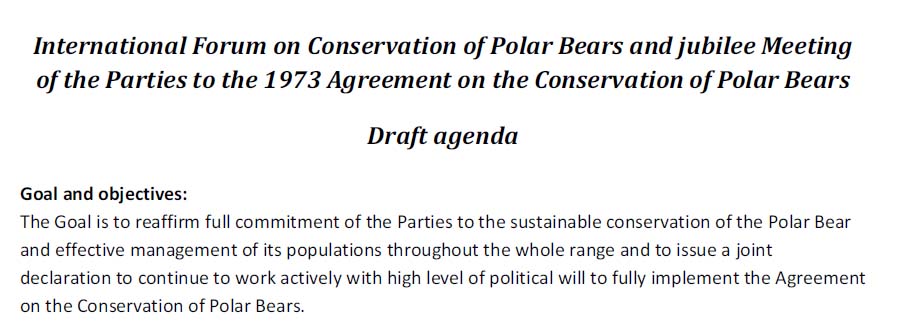
Polar bear forum_Moscow_Goals and objectives_01

One of stated goals of the meeting is to redefine the original agreement, which focused on over-hunting (see the complete draft agenda here). Can you guess what the changes will involve?
Continue reading

Canada again under international pressure to list polar bears as threatened

There was a story in The Guardian on Friday (November 21) about an issue I covered earlier this year (in January): Canada under international pressure to list polar bears as threatened, so far holds out.

This time, Suzanne Goldenberg’s headline proclaims “Canada’s refusal to protect polar bears comes under scrutiny.

The story is all about a petition filed by the ever-litigious Center for Biological Diversity (CBD) to the North American free trade organization, the Commission for Environmental Co-operation (CEC), pdf here. The CEC, it seems, has now agreed to investigate the CBD claims.

At issue here is the fact that Canada hasn’t done exactly what the US has done in terms of enacting formal legislation to protect polar bears. Canada, home to 2/3’s of the worlds polar bears (as well as a relatively large Arctic human population) vs. the USA, with the fewest bears in the world but perhaps the loudest, “we know best” attitude. Canada has not declared polar bears to be a species threatened with extinction but the Center for Biological Diversity not only thinks otherwise but thinks someone should force Canada to change its opinion.

It’s more of the same bullying of governments by environmental groups that we’ve come to expect, aided and abetted by activist polar bear biologists.

That said, I suggest you brace yourselves: it’s only going to get worse. We can expect even more of this over the next few weeks, because an important international polar bear meeting is coming up in early December. I expect that the propaganda, aided by an all-too-willing-media, is going to get intense.  Continue reading

Polar bear habitat virtually everywhere now

What did I tell you, back in mid-September?

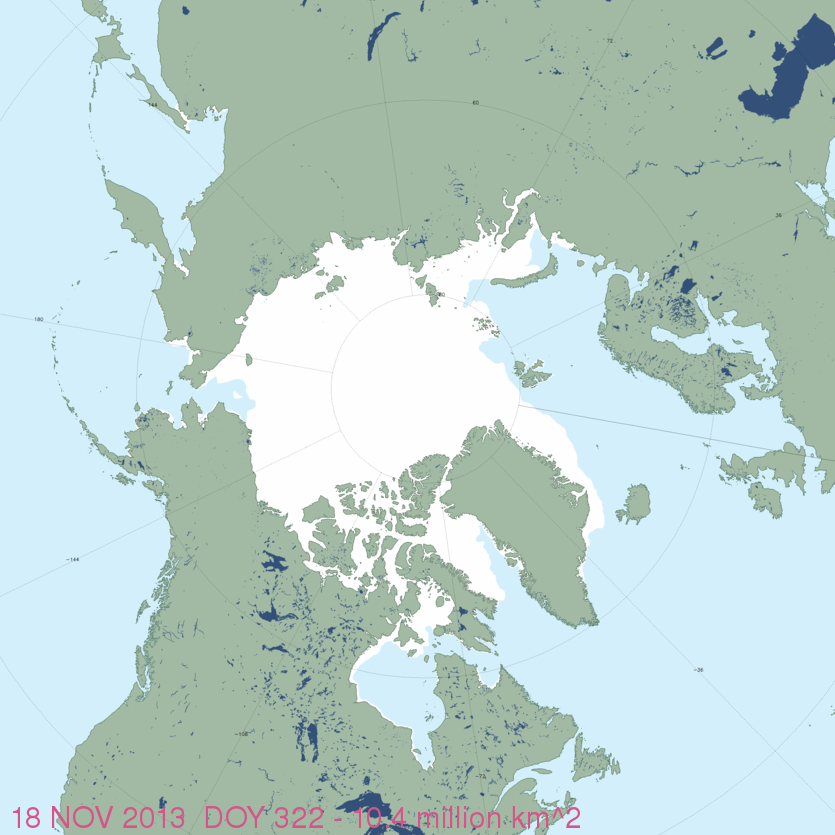
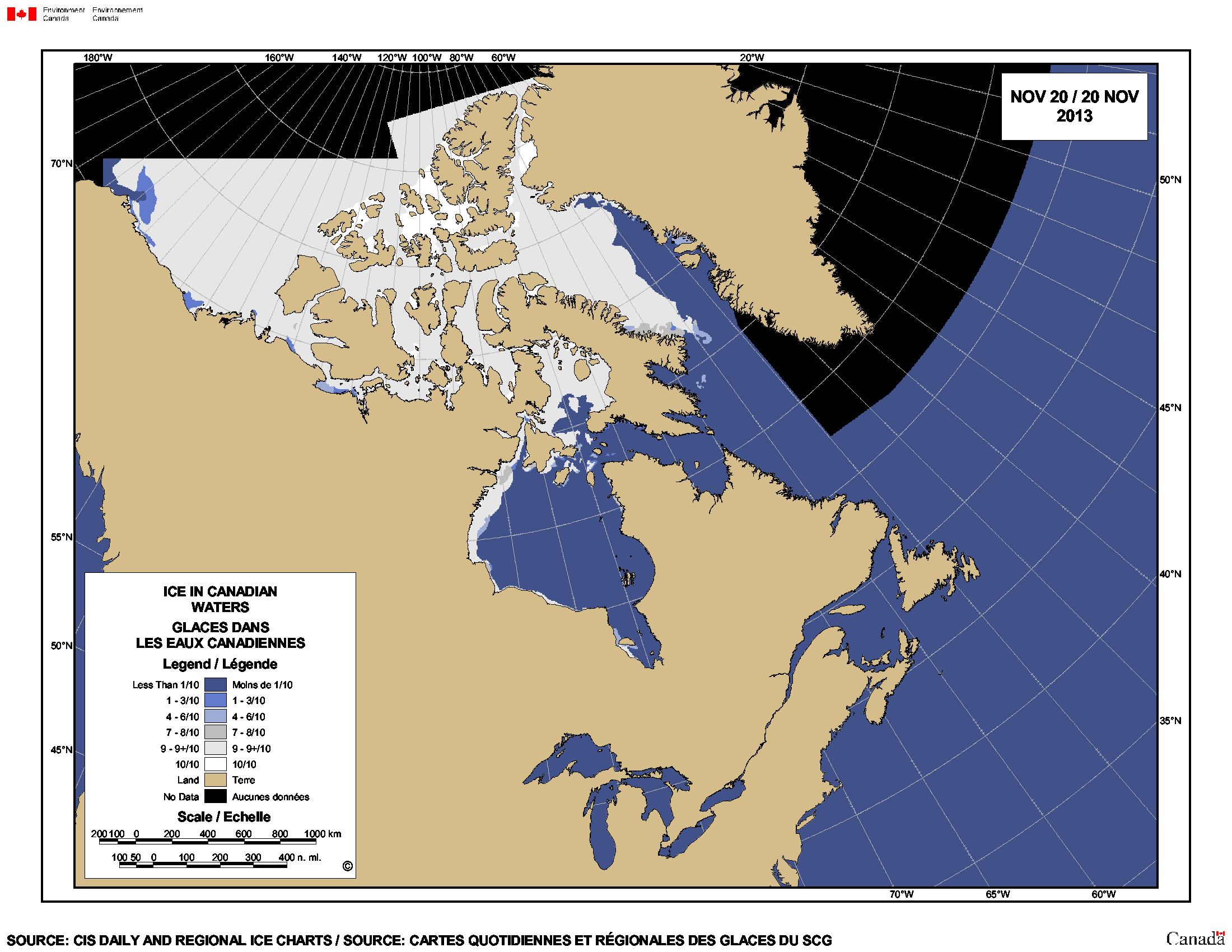
Have a look at all the polar bear habit, ten days shy of the end of November!

Figure 1. MASIE sea ice extent for November 18, 2013 (using US National Ice Center data). You have to look closely but there is indeed ice forming around Svalbard (just above the tip of Greenland) and in James Bay (southern Hudson Bay). Click to enlarge. High resolution map here.

Figure 1. MASIE sea ice extent for November 18, 2013 (using US National Ice Center data). You have to look closely but there is indeed ice forming around Svalbard (just above the tip of Greenland) and in James Bay (southern Hudson Bay). Click to enlarge. High resolution map here.

Figure 2. Canadian Ice Service map. Good amounts of ice developing in northern Hudson Bay, Foxe Basin and Davis Strait (between southern Greenland and Baffin Island), with ice forming along the shore in James Bay (the southern-most region where polar bears are on-shore at the moment). Click to enlarge.

Figure 2. Canadian Ice Service map. Ice developing rapidly in northern Hudson Bay, Foxe Basin and Davis Strait (between southern Greenland and Baffin Island), with ice also forming along the shore in James Bay (the southern-most region where polar bears are onshore at the moment). Click to enlarge.

Polar bear problems in N Hudson Bay not due to late freeze-up

The myth that northern Hudson Bay communities are having problems with polar bears this year because freeze-up is later than usual just won’t go away.

I discussed the well publicized craziness in Churchill last week (here and here), but there’s more. Polar bears are already leaving the shore of Northern Hudson Bay as the ice rapidly forms but I saw a story yesterday (dated late last week) that quoted a local official in Repulse Bay blaming their polar bear problems on late freeze-up.

I’ve written before about the peer-reviewed paper by polar bear researchers Seth Cherry and colleagues published earlier this year on breakup and freeze-up dates between 1991 and 2009. But perhaps the freeze-up data needs more emphasis. I’ve copied that graph again below, with notes, and added some ice maps. See for yourself.

Bottom line: A “late freeze-up” for northwestern Hudson Bay occurs when ice formation is delayed until early December or beyond. Freeze-up was nowhere near “late” this year, nor was the ice “slow to freeze.” It wasn’t last year either.
Continue reading

Amstrup compares climate change to a Titanic for polar bears

Steven Amstrup, spokesperson for Polar Bears International, has ramped up his “save the polar bear” rhetoric over last week’s nonsense.

Last night (November 13), the NBC News online story (here) that accompanied their evening news clip (h/t DB) included this appalling analogy:

“…Amstrup said greenhouse gases created by humans threaten future generations of bears by threatening their ice. He said he likes to compare climate change’s effect on polar bears to the infamous Titanic ocean liner.

“[It] didn’t matter how many people were on the Titanic or how well they were doing,” he said. “When the Titanic slipped beneath the waves and they lost their habitat, that was it. So polar bears will also go away because of their dependence on sea ice.” [my bold]

Amstrup really wants people to believe that all the polar bears in the world will die some day, all at once, in some mega ice-loss catastrophe!
Continue reading

Hudson Bay freeze-up average this year – not late

Freeze-up in Western Hudson Bay is finally underway. It’s no later this year than average, similar to last year.

This rather contradicts the hysterical hue and cry from the tag-team of Polar Bears International (PBI) spokesperson Steven Amstrup and Guardian reporter Suzanne Goldenberg last week during PBI’s “Polar Bear Week” propaganda blitz (see previous posts here, here, and here), 

So much for the trend towards later freeze-up dates that PBI says is endangering polar bears in Western Hudson Bay.

On-the-ground observers confirm polar bears are preparing to move out and sea ice maps show the ice is forming very rapidly — see maps and quotes below.

Continue reading

Baffin Bay polar bear population survey done, results due end 2014

From this story in today’s Alaska Dispatch (via CBC NewsEye on the Arctic), November 11, 2013, which adds a few more details regarding the progress of ongoing population surveys and the next PBSG meeting:

“The Nunavut government has wrapped up three years of fieldwork on Baffin Bay polar bears, and is preparing to release a new population estimate sometime next year….
Continue reading

Tracking polar bears in the Beaufort Sea: October map

Here is the October follow-up to my post on the July track map for female polar bears being followed by satellite in the Beaufort Sea by the US Geological Survey (USGS) – Ten out of ten polar bears being tracked this summer in the Beaufort Sea are on the ice. See that post for methods and other background on this topic, and some track maps from 2012 (also available at the USGS website here).

The track map for October is copied below (Figure 1).

By the end of October, ice reached the coast in several areas. The ten bears from July were down to seven – their collars might have stopped working or fallen off (most likely), they might have left the area entirely (also possible) or they might have died (the researchers don’t say which).
Continue reading