Category Archives: Conservation Status

Svalbard polar bear data 2016 through 2018 shows no impact of low ice years

Last week, the Norwegian Polar Institute updated their online data collected for the Svalbard area to include 2017 and 2018 — fall sea ice data and spring polar bear data. Older data for comparison go back to 1993 for polar bears and 1979 for sea ice, showing little to no impact of the reduced ice present since 2016 in late spring through fall.
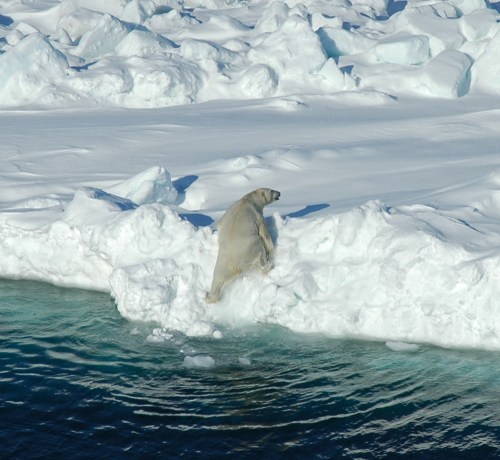
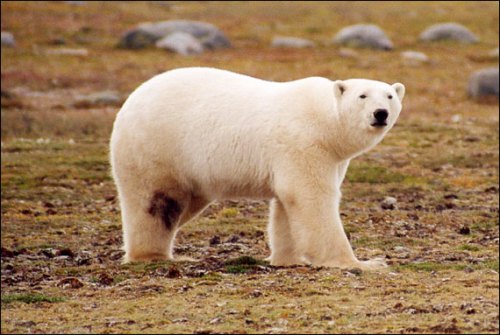
Svalbard polar bear_NP015991-isbjorn-JA

Here’s what the introduction says, in part [my bold]:

“…The polar bear habitat is changing rapidly, and the Polar Basin could be ice-free in summer within a few years. Gaining access to preferred denning areas and their favourite prey, ringed seals, depends on good sea ice conditions at the right time and place. The population probably increased considerably during the years after hunting was banned in 1973, and new knowledge indicates that the population hasn’t been reduced the last 10-15 years, in spite of a large reduction in available sea ice in the same period.”

See Aars et al. 2017 for details on the 2015 Svalbard polar bear population count, keeping in mind that the subpopulation region is called “Barents Sea” for a reason: only a few hundred individuals currently stick close to Svalbard year round while most Barents Sea bears inhabit the pack ice around Franz Josef Land to the east (Aars et al. 2009; Crockford 2017, 2018).
Continue reading
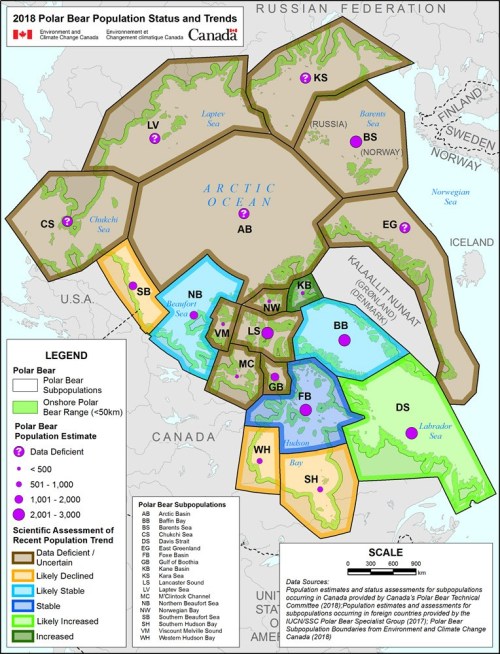
Environment Canada maps of polar bear population and status assessments 2018

Just out (6 June 2018) — new population assessment and status maps of the 19 polar bear subpopulations according to Environment Canada. Contrary to the map presented at the Range State meeting in February 2018 (pdf here), these maps show Western Hudson Bay and Southern Hudson Bay (along with the Southern Beaufort) as “likely declined.” A new category has been added for the Barents Sea: it’s considered “data deficient/uncertain,” but a population estimate of 2,001-3,000 has been provided.

No press release or other notice regarding the availability of these new maps was issued, as far as I know: I came across them by accident while looking for something else.

Global pb status and population map EC 2018

Global map above, more below, including a comparative map that shows 2010, 2014, and 2018 together. I will update the two recent posts of mine (here and here) that used the February Range State map with the information that more recently revised maps are now available.

Continue reading

Critical evidence on W Hudson Bay polar bears still not published after 25 years

Polar bear researchers have been doing capture/recapture studies in Western Hudson Bay for decades yet most of the data claimed to be critical for assessing effects of human-caused global warming on this species have not been published. I raised this point in one of my early blog posts (27 Sept 2012) but the situation has not changed in 6 years. Here’s an update.

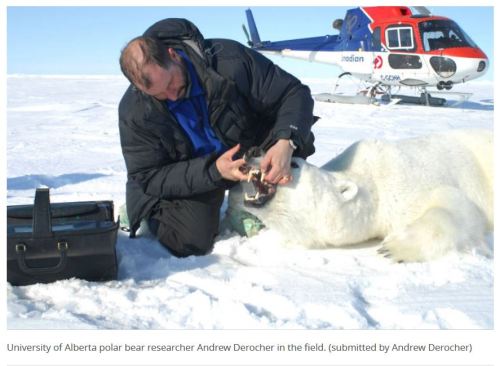
Derocher in the field in WH_CBC story 2016

From CBC story 14 Sept 2016.

Years ago now, in an oft-cited paper, Stirling and Derocher (2012) claimed to summarize the evidence that climate warming was negatively impacting polar bear health and survival. Several life history parameters were considered crucial, particularly body condition.

Despite almost a dozen papers (and perhaps more) on various aspects of WH polar bear health and life history studies based on capture/recapture data published since 2004  (e.g. Castro de la Guardia 2017; Lunn et al. 2016; Pilfold et al. 2017), none have reported the body condition data that supposedly support the claim that sea ice loss is having a severe impact — and the same is true for litter size, proportion of independent yearlings, and cub survival.1

continue reading

Southern Hudson Bay polar bear region shows slight decline after decades of low sea ice

A newly-published paper by Martyn Obbard and colleagues in the journal Arctic Science claims a 17% decline in abundance of polar bears in the Southern Hudson Bay region after years of reduced sea ice and declining body condition (Obbard et al. 2018). The decline in numbers was not statistically significant but an additional statistical analysis (“Monte Carlo simulation”) not applied to any other estimate in recent years suggested the decline could be real, so a real decline is what was reported to the press.

James Bay polar bear_ministry of Ontario_Walton photo

Only one Canadian Press story has so far been circulated amongst outlets in the media (published hours after the paper appeared online, not at the same time), suggesting there was no press release issued for this study. Odd, that — especially if the decline is as real and significant as the authors suggest.

While no evidence was provided for a correlation of this decline in numbers to recent (2012-2016) sea ice decline, previous evidence from the region (Obbard et al. 2016) showed a decline in body condition was correlated only with much later than usual freeze-up, a situation that did not occur from 2012 to 2015 (freeze-up was late in the fall of 2016 but occurred months after the Obbard et al. (2018) survey was completed).

Moreover, the paper reports that a decline in survival of yearling cubs (from 12% of the population in 2011 to 5% in 2016) was not associated with especially poor sea ice conditions in spring. We are likely to see a follow-up paper next year reporting the body condition and sea ice data from this study (as for the previous survey: Obbard et al. 2015, 2016), but there is no suggestion in this paper that body condition declined further from 2011/2012 levels or that sea ice conditions deteriorated markedly enough after 2012 to precipitate a population decline.

UPDATE 11 June 2018: See below, more recent versions of population and status assessment maps has been issued by Environment Canada that conclude Southern Hudson Bay is “likely declined.”

Continue reading

Activist laments ESA listing of polar bears in 2008 failed to achieve her political goals

The activist lawyer primarily responsible for polar bears being listed as ‘threatened’ on the US Endangered Species List (ESA) in 2008 is frustrated that those efforts have not generated her preferred political action. Kassie Siegel also claims in another 10 years it will be too late to save polar bears from extinction — despite clear evidence to the contrary.

Walking bear_129029633_web size

In an emotional rant over at The Hill with a predictably hysterical headline, Siegel perhaps reveals more than she should about her motivation (“Keeping fossil fuels in the ground is the only way to save polar bears ravaged by climate change,” 26 May 2018).

Continue reading

Status of Canadian polar bears updated map from Environment Canada

During a meeting of polar bear range states (Canada, Russia, Greenland, Norway, and the USA) in late January 2018 to discuss conservation issues, Canada — home to ~2/3 of the world’s polar bears — included in its presentation an updated population status and trend map approved by the Polar Bear Technical Committee in its presentation. This 2017 map replaces one from 2014 but is not yet available on the Environment Canada website.

Lunn et al 2016 EA cover image WH bear

UPDATE 11 June 2018: More recent versions of population and status assessment maps, published by Environment Canada 6 June 2018, conclude Southern Hudson Bay and Western Hudson Bay subpopulations have “likely declined.” See 11 June post here for more details and copies of the maps.

Contine reading

IUCN polar bear specialists reject IPCC- supported forecasts of sea ice based on CO2

In case you missed it — or missed the significance of it — polar bear specialist Mitch Taylor correctly pointed out in his recent essay (a response to the New York Times article that appeared Tuesday (10 April) about the Harvey et al. (2018) BioScience paper) that the IUCN Polar Bear Specialist Group have given up using computer models of future sea ice extent based on rising CO2 levels supported by the IPCC.

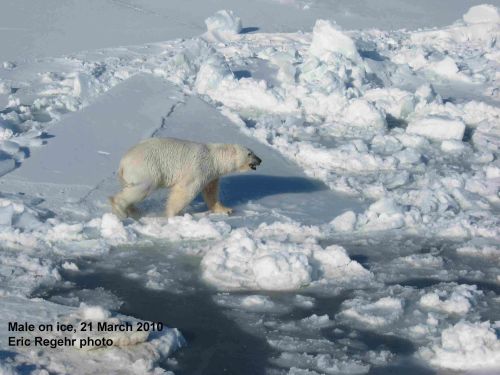
Polar_Bear_male_Regehr photo_March 21 2010_labeled

Their latest assessment (Regehr et al. 2016) does not link polar bear survival models to climate modeled forecasts of Arctic sea ice decline but rather to an assumption that declines already documented will continue in linear fashion over this century.

This means that CO2 emissions blamed on human fossil fuel use is no longer directly tied to the predicted future decline of polar bear numbers: IUCN polar bear specialists simply assume that sea ice will continue to decline in a linear fashion with no cause attributed to that decline except the broad assumption that anthropogenic climate change is to blame for Arctic sea ice declines since 1979.

No wonder former USGS polar bear biologist Steve Amstrup never refers to this IUCN PBSG study: he and the organization that now employs him, Polar Bears International, are still firmly wedded to the concept that CO2 is the sea ice control knob.

Continue reading

Polar bear habitat update mid-May: little change since 1989 despite CO2 increase

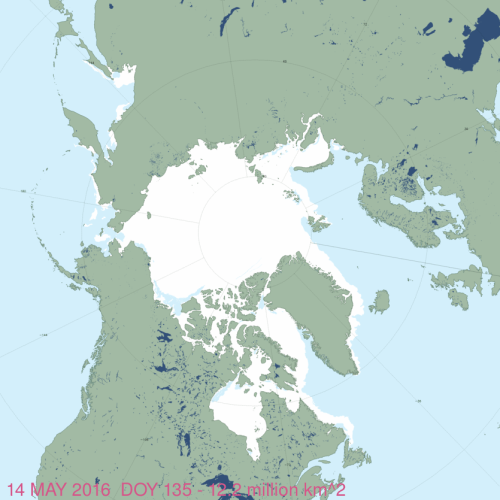
Sea ice habitat for polar bears has not become progressively worse each year during their season of critical feeding and mating, as some scaremongers often imply. It’s true that absolute extent of Arctic ice is lower this spring than it was in 1979. However, according to NSIDC Masie figures, polar bear habitat at mid-May registers about 12 million km2, just as it did in 2006 (although it is distributed a little differently); other data show spring extent has changed little since a major decline occurred in 1989, despite ever-rising CO2 levels.

Polar bear feeding_Shutterstock_sm

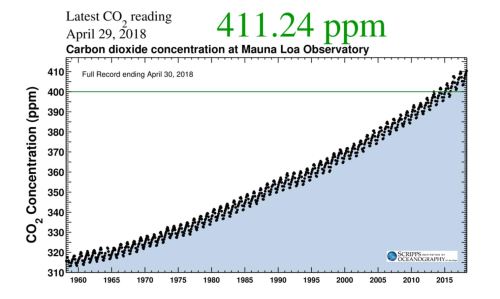
In other words, there has been virtually no change in sea ice cover over the last 12 years, despite the fact that atmospheric CO2 has now surpassed 410 parts per million, a considerable and steady increase over levels in 2006 which were about 380 ppm (see below, from the Scripps Oceanographic Laboratory, included in the Washington Post story 3 May 2018):

Scripps CO2 curve at 29 April 2018

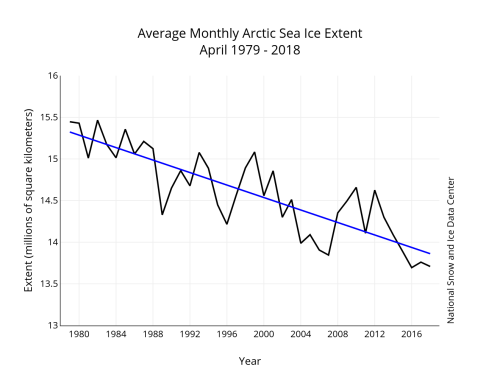
Not only that, but if rising CO2 levels were responsible for the decline of sea ice and implied effects on polar bears since 1979 (when CO2 levels were around 340 ppm), why has spring ice extent been so variable since 1989 (when the first big decline occurred) but so little changed overall since then? See the NSIDC graph below for April:

Sea ice 2018 April average_NSIDC graph

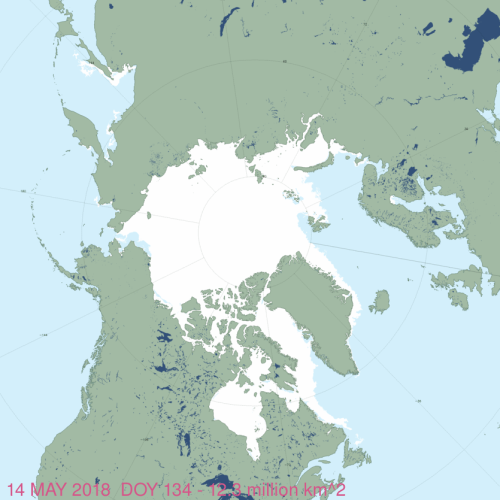
This year on day 134 (14 May), global ice cover registered 12.3 mkm2:

masie_all_zoom_4km 2018 May 14

In 2016 on the same day, the overall extent was much the same but there was more ice in the Chukchi and Bering Seas and less in the eastern Beaufort:

masie_all_zoom_4km 2016 May 14

More close-up charts of different regions below for 2018 vs. 2016, showing more detail.

Continue reading

Polynya refresher: open water in spring is due to winds & currents, not ice melt

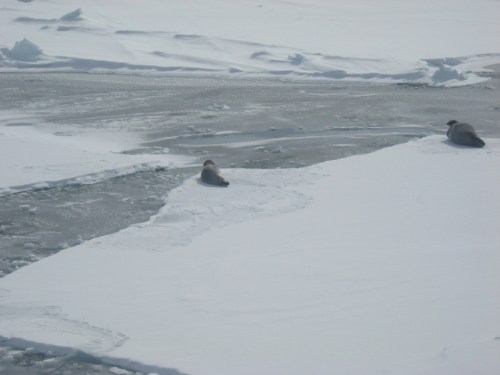
Arctic sea ice begins to open up in spring at predictable locations due to currents and prevailing winds and this was as true in the 1970s as it is today. Polynyas and widening shore leads that most often get mistaken for early sea ice melt are those in the Beaufort and Chukchi Seas and in Hudson Bay.

Beaufort Sea male polar bear USGS_2005 Amstrup photo

But contrary to concerns expressed about possible negative implications of these early patches of open water, these areas have always been critical congregation areas for Arctic seals and are therefore important feeding areas for polar bears.

Seal habitat frozen open lead_Beaufort 2008_Miller

Seals hauled out beside a lightly frozen over lead in Beaufort Sea ice, 2008. USFWS.

Continue reading

Polar bear numbers, margins of error, & consequences for conservation status

Large margins of error in polar bear population estimates means the conservation status threshold of a 30% decline (real or predicted) used by the US Endangered Species Act and the IUCN Red List is probably not valid for this species.

Polar_Bear_Biologist_USFWS_working_with_a_Bear_Oct 24 2001 Amstrup photo

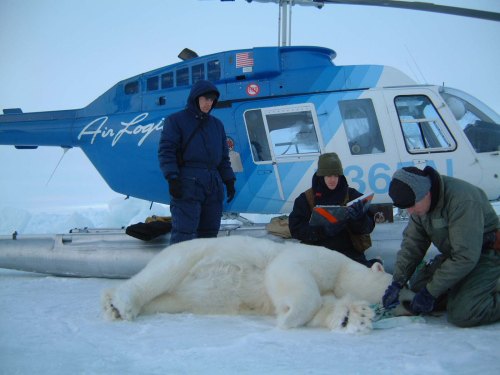
Several recent subpopulation estimates have shown an increase between one estimate and another of greater than 30% yet deemed not to be statistically significant due to large margins of error. How can such estimates be used to assess whether population numbers have declined enough to warrant IUCN Red List or ESA protection?

What do polar bear population numbers mean for conservation status, if anything?

Continue reading