Category Archives: Sea ice habitat

Hudson Bay freeze-up has not been a day later each year since 1981

[Update Nov. 23, 2013: I’ve added a few comments, noted, in the text]

This is a follow-up to an earlier post, Polar bear problems in N Hudson Bay not due to late freeze-up, to counter some misinformation that’s being circulated about the history of Hudson Bay freeze-up dates.

Polar bear biologists working in Western Hudson Bay published new definitions of breakup and freeze-up earlier this year. The new method better reflects how polar bears interact with seasonal changes in sea ice on the bay.

Formerly, 50% ice coverage levels were used to assign the date when major ice change phenomena were reached each year (breakup in summer, freeze-up in fall (e.g. Gagnon and Gough 2005). The new method (Cherry et al. 2013, see discussion here) defines breakup at 30% ice coverage and freeze-up at 10%.

Cherry and colleagues had a fairly complicated method of defining 30% coverage for breakup in Western Hudson Bay. However, freeze-up in the fall is much simpler because ice always forms first along the western shore, starting in the north.

This means that the weekly graphs of ice development provided by the Canadian Ice Service for Hudson Bay, which are expressed as a percentage (just like the Cherry et al. study), can be used to compare freeze-up dates historically.

These graphs refute the absurd claim that freeze-up on Hudson Bay has been “one day later each year” over the last 30 years – an assertion repeated just the other day at PBI. Let’s take a closer look, shall we?
Continue reading
Polar bear habitat virtually everywhere now

What did I tell you, back in mid-September?

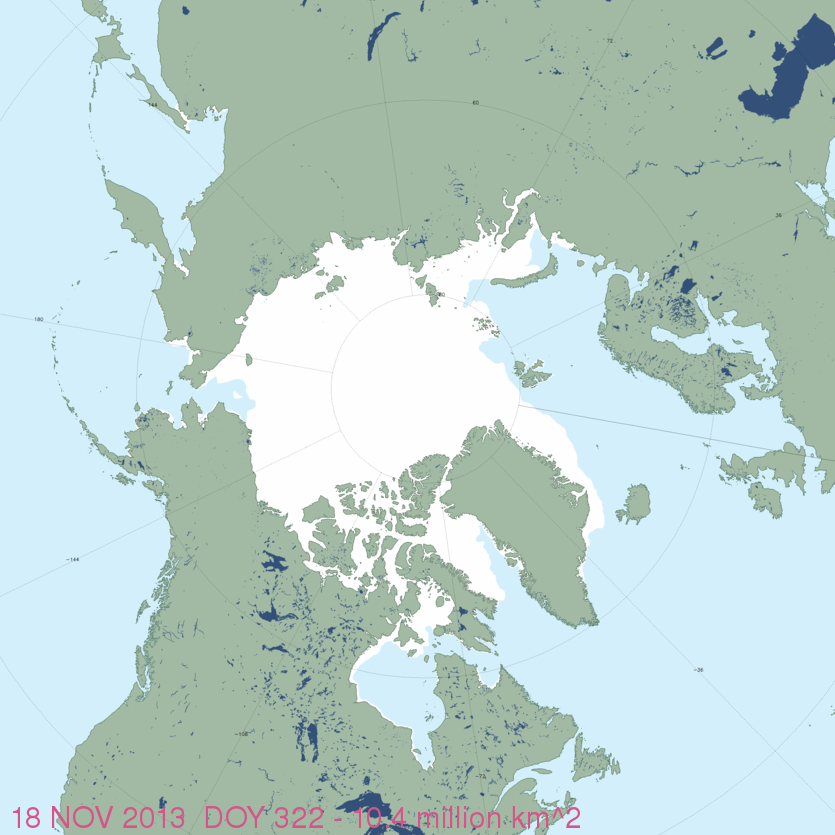
Have a look at all the polar bear habit, ten days shy of the end of November!

Figure 1. MASIE sea ice extent for November 18, 2013 (using US National Ice Center data). You have to look closely but there is indeed ice forming around Svalbard (just above the tip of Greenland) and in James Bay (southern Hudson Bay). Click to enlarge. High resolution map here.

Figure 1. MASIE sea ice extent for November 18, 2013 (using US National Ice Center data). You have to look closely but there is indeed ice forming around Svalbard (just above the tip of Greenland) and in James Bay (southern Hudson Bay). Click to enlarge. High resolution map here.

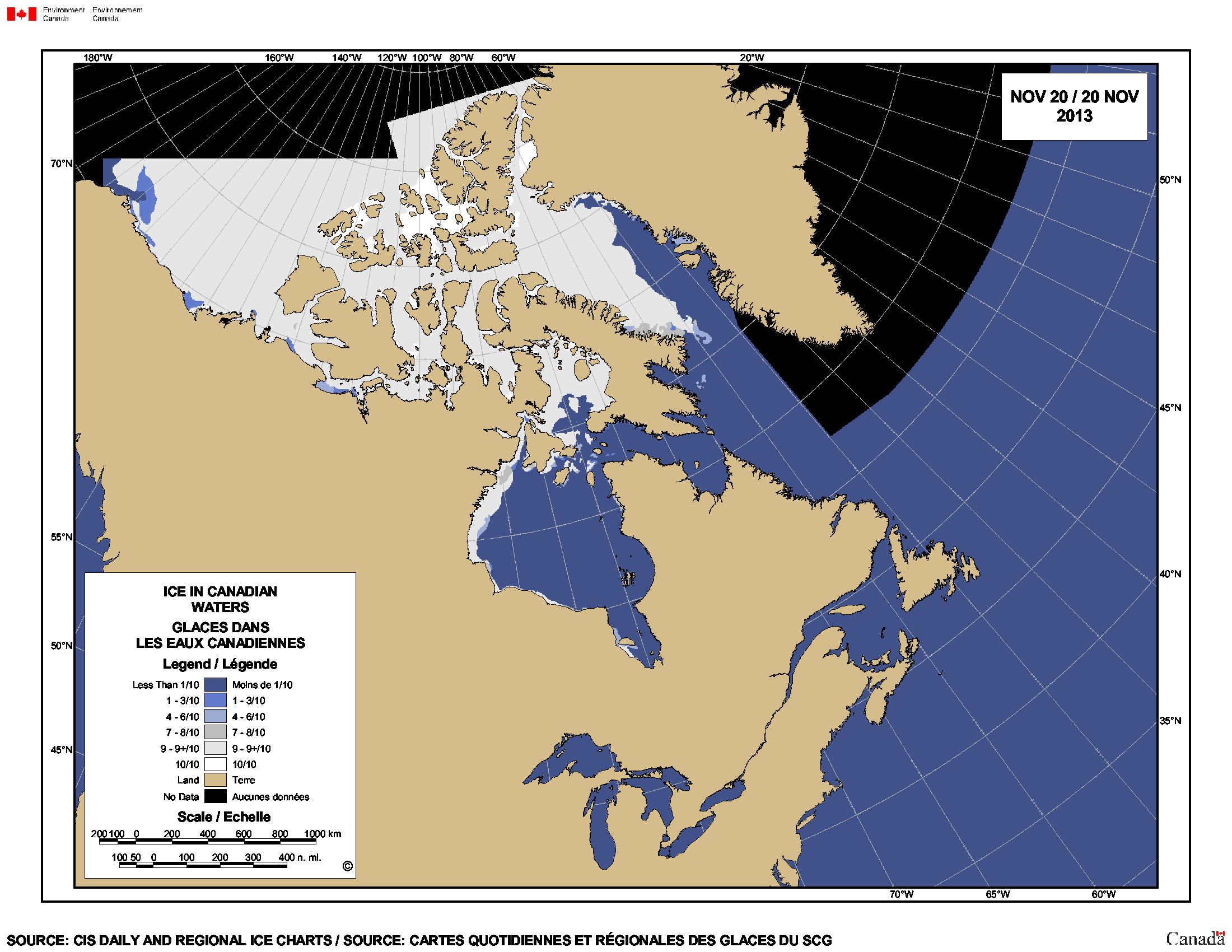
Figure 2. Canadian Ice Service map. Good amounts of ice developing in northern Hudson Bay, Foxe Basin and Davis Strait (between southern Greenland and Baffin Island), with ice forming along the shore in James Bay (the southern-most region where polar bears are on-shore at the moment). Click to enlarge.

Figure 2. Canadian Ice Service map. Ice developing rapidly in northern Hudson Bay, Foxe Basin and Davis Strait (between southern Greenland and Baffin Island), with ice also forming along the shore in James Bay (the southern-most region where polar bears are onshore at the moment). Click to enlarge.

Polar bear problems in N Hudson Bay not due to late freeze-up

The myth that northern Hudson Bay communities are having problems with polar bears this year because freeze-up is later than usual just won’t go away.

I discussed the well publicized craziness in Churchill last week (here and here), but there’s more. Polar bears are already leaving the shore of Northern Hudson Bay as the ice rapidly forms but I saw a story yesterday (dated late last week) that quoted a local official in Repulse Bay blaming their polar bear problems on late freeze-up.

I’ve written before about the peer-reviewed paper by polar bear researchers Seth Cherry and colleagues published earlier this year on breakup and freeze-up dates between 1991 and 2009. But perhaps the freeze-up data needs more emphasis. I’ve copied that graph again below, with notes, and added some ice maps. See for yourself.

Bottom line: A “late freeze-up” for northwestern Hudson Bay occurs when ice formation is delayed until early December or beyond. Freeze-up was nowhere near “late” this year, nor was the ice “slow to freeze.” It wasn’t last year either.
Continue reading

Amstrup compares climate change to a Titanic for polar bears

Steven Amstrup, spokesperson for Polar Bears International, has ramped up his “save the polar bear” rhetoric over last week’s nonsense.

Last night (November 13), the NBC News online story (here) that accompanied their evening news clip (h/t DB) included this appalling analogy:

“…Amstrup said greenhouse gases created by humans threaten future generations of bears by threatening their ice. He said he likes to compare climate change’s effect on polar bears to the infamous Titanic ocean liner.

“[It] didn’t matter how many people were on the Titanic or how well they were doing,” he said. “When the Titanic slipped beneath the waves and they lost their habitat, that was it. So polar bears will also go away because of their dependence on sea ice.” [my bold]

Amstrup really wants people to believe that all the polar bears in the world will die some day, all at once, in some mega ice-loss catastrophe!
Continue reading

Hudson Bay freeze-up average this year – not late

Freeze-up in Western Hudson Bay is finally underway. It’s no later this year than average, similar to last year.

This rather contradicts the hysterical hue and cry from the tag-team of Polar Bears International (PBI) spokesperson Steven Amstrup and Guardian reporter Suzanne Goldenberg last week during PBI’s “Polar Bear Week” propaganda blitz (see previous posts here, here, and here), 

So much for the trend towards later freeze-up dates that PBI says is endangering polar bears in Western Hudson Bay.

On-the-ground observers confirm polar bears are preparing to move out and sea ice maps show the ice is forming very rapidly — see maps and quotes below.

Continue reading

Eemian excuses: the warm was different then, polar bears were fine

Today I’ll discuss the response by Polar Bears International representative Steven Amstrup to a comment submitted during their recent “webchat” at The Guardian (Wednesday, November 6), which had to do with the fact that polar bears survived warm periods in the geological past, particularly interglacials.

[Here’s a pdf file of all the questions that were answered by PBI staff: PBI webchat Q&A, also available here]

This is the comment (the first portion of #4 on my list), submitted by MarkBLR:

There was a paper in Science magazine last year (link …) indicating that polar bears became a distinct species about 600kya (+/- 300k years).

This means that they have survived at least two (and possibly eight) previous inter-glacials, in particular the Eemian (130kya to 110kya), when temperatures in the Arctic were 5 to 8 degrees Celcius warmer than current temperatures for several thousand years.

Note that their numbers apparently decreased significantly during the Eemian, and slowly increased as temperatures cooled, but “climate change” was not enough on its own to make them extinct. [my bold]

[We can perhaps forgive Mark for not being able to spell “Celsius” correctly, but Amstrup (see below) has no excuse. The paper in Science Mark refers to is Hailer et al. 2012, discussed in a previous post here. Note that the actual question Mark asked is not included here because Amstrup responded to this portion of his comment only]

Amstrup tries to convince Mark and other readers that polar bear resilience through Eemian warming is irrelevant to the issue of future survival, which I’ll demonstrate is not the case at all.

Here is what Amstrup had to say:
Continue reading

Tracking polar bears in the Beaufort Sea: October map

Here is the October follow-up to my post on the July track map for female polar bears being followed by satellite in the Beaufort Sea by the US Geological Survey (USGS) – Ten out of ten polar bears being tracked this summer in the Beaufort Sea are on the ice. See that post for methods and other background on this topic, and some track maps from 2012 (also available at the USGS website here).

The track map for October is copied below (Figure 1).

By the end of October, ice reached the coast in several areas. The ten bears from July were down to seven – their collars might have stopped working or fallen off (most likely), they might have left the area entirely (also possible) or they might have died (the researchers don’t say which).
Continue reading

Churchill polar bear attack shamelessly used to advance global warming agenda

I guess Suzanne Goldenberg, writing for The Guardian, just couldn’t help herself with this latest story (November 4):Polar bear attacks: scientists warn of fresh dangers in warming Arctic. Two people injured in latest attack as hungry bears deprived of access to sea ice increasingly look for food on land.

Reporting on the attack is one thing — several papers covered this over the weekend (see Featured Quote #46, posted yesterday, for links to two of them). However, Goldenberg shamelessly makes this about global warming, aided and abetted by Polar Bears International (PBI) representative Steven Amstrup, a claim that doesn’t hold up to even minor scrutiny.

Continue reading

Polar bear habitat update for October 31, 2013

Here’s the ground-truth follow-up to my suggestion of what polar bear habitat would likely look like 6 weeks after the minimum extent was reached this year – which was looking then like it would mirror 2009.

You’ll find my discussion, posted on September 22, here. At that point (September 13), ice extent was 5.1 million square kilometers; now it is 9.1 million square kilometers (Fig.1).

Figure 1. Oct 30 2013 Maisie sea ice extent, 9.1 mkm2. This does not take thickness or concentration into account.

Figure 1. Oct 30 2013 Maisie sea ice extent, 9.1 mkm2. Click to enlarge.

Have a look at the maps below: Fig. 2 to see how ice extent at October 31st compares to ice extent at the end of October 2009, and Fig. 3 to see what ice concentrations looked like in the Canadian Arctic.

Continue reading

Polar bear cannibalism and sea ice, the spring of 1976

Remember Ian Stirling’s claim that late freeze up in Western Hudson Bay in 2009 was forcing polar bears to resort to cannibalism (here and here), with gut-wrenching images and video provided for the media? Or Steve Amstrup’s claim for a similar phenomenon in the Southern Beaufort in 2004?

I pointed out that Stirling’s claim was way overblown and that Amstrup’s incidents were almost certainly the result of heavy ice in the spring (not low ice in summer), similar to the heavy ice conditions and polar bear starvation documented in the same region back in 1974-1976.

It turns out that the heavy ice conditions documented in the Eastern Beaufort in the mid-1970s had much broader effects on polar bears and ringed seals than has been appreciated.
Continue reading