Tag Archives: Canadian Ice Service

Polar bear habitat update, December – still like 2009

From the end of October to mid-December, there has been a rapid expansion of polar bear habitat.

This month, I’ve constructed two all-in-one images that show the progressive growth of the ice relative to some critical polar bear onshore summer refuge areas and denning territory. I’ve also included a map that compares 2013 to 2009 at 18 December with the average for the 1980s, and one that shows ice thickness.
Continue reading

Polar bear habitat update, end of November 2013

Freeze-up in the Arctic (~October-November) is important to polar bears because for those animals that have spent the ice-free period on shore (not all do), it marks the end of their summer fast — they can finally resume seal hunting.

Polar bears in the most southern regions, like Southern Hudson Bay, Western Hudson Bay, and Davis Strait (see Fig. 1), routinely experience the longest ice-free period. As these bears all spend the summer on shore, they appreciate a timely return of the ice.

 Figure 1. Polar bear subpopulations defined by the IUCN Polar Bear Specialist Group (PBSG), with a few extra labels added. I’ve rotated the original map 90 degrees (right) to make it easier to relate to the ice maps below. WH is Western Hudson Bay. Courtesy PBSG.  Click to enlarge.


Figure 1. Polar bear subpopulations defined by the IUCN Polar Bear Specialist Group (PBSG), with a few extra labels added. I’ve rotated the original map 90 degrees (right) to make it easier to relate to the ice maps below. WH is Western Hudson Bay; SB is Southern Beaufort. Courtesy PBSG. Click to enlarge.

Southern Hudson Bay bear populations routinely experience an ice-free season that is just as long as it is for Western Hudson Bay bears. However, Southern Hudson Bay polar bears numbers have remained stable over the last 30 years. Some folks insist that Western Hudson Bay bear numbers are shrinking to a worrisome degree, despite indications that the recent decline could be nothing more than a return to sustainable levels after a rapid population increase in the late 20th century (similar to changes documented for the Davis Strait and Barents Sea subpopulations).

Have a look at how sea ice – essential polar bear hunting habitat – has developed within these regions over the last 10 days or so (end of November 2013) and how November 2013 compares to November 1979. The ice maps tell the freeze-up story.
Continue reading

Hudson Bay freeze-up has not been a day later each year since 1981

[Update Nov. 23, 2013: I’ve added a few comments, noted, in the text]

This is a follow-up to an earlier post, Polar bear problems in N Hudson Bay not due to late freeze-up, to counter some misinformation that’s being circulated about the history of Hudson Bay freeze-up dates.

Polar bear biologists working in Western Hudson Bay published new definitions of breakup and freeze-up earlier this year. The new method better reflects how polar bears interact with seasonal changes in sea ice on the bay.

Formerly, 50% ice coverage levels were used to assign the date when major ice change phenomena were reached each year (breakup in summer, freeze-up in fall (e.g. Gagnon and Gough 2005). The new method (Cherry et al. 2013, see discussion here) defines breakup at 30% ice coverage and freeze-up at 10%.

Cherry and colleagues had a fairly complicated method of defining 30% coverage for breakup in Western Hudson Bay. However, freeze-up in the fall is much simpler because ice always forms first along the western shore, starting in the north.

This means that the weekly graphs of ice development provided by the Canadian Ice Service for Hudson Bay, which are expressed as a percentage (just like the Cherry et al. study), can be used to compare freeze-up dates historically.

These graphs refute the absurd claim that freeze-up on Hudson Bay has been “one day later each year” over the last 30 years – an assertion repeated just the other day at PBI. Let’s take a closer look, shall we?
Continue reading

Polar bear habitat virtually everywhere now

What did I tell you, back in mid-September?

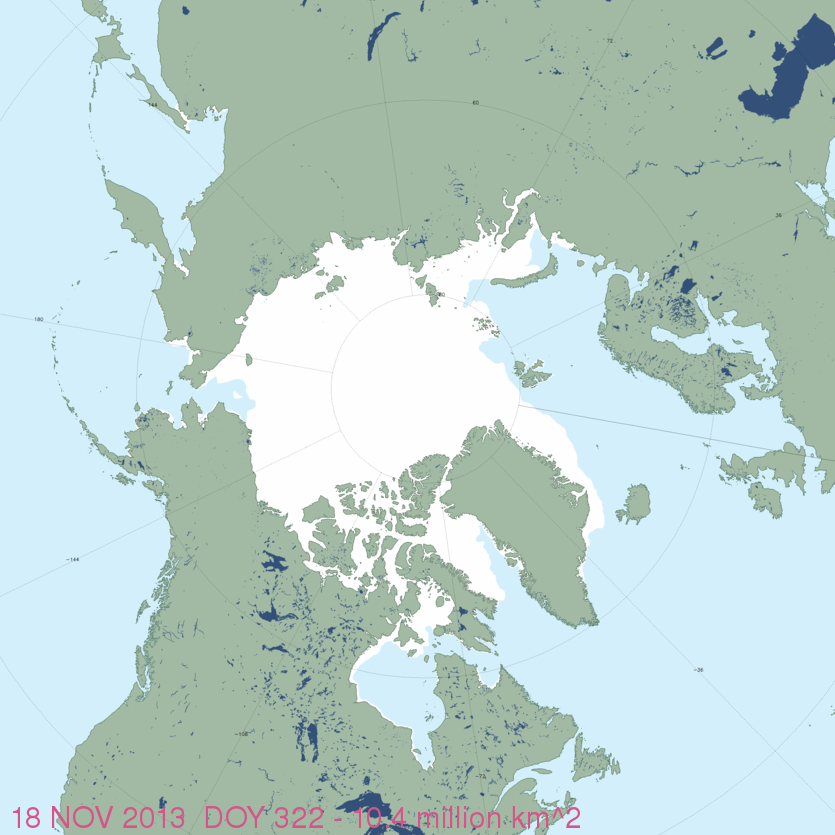
Have a look at all the polar bear habit, ten days shy of the end of November!

Figure 1. MASIE sea ice extent for November 18, 2013 (using US National Ice Center data). You have to look closely but there is indeed ice forming around Svalbard (just above the tip of Greenland) and in James Bay (southern Hudson Bay). Click to enlarge. High resolution map here.

Figure 1. MASIE sea ice extent for November 18, 2013 (using US National Ice Center data). You have to look closely but there is indeed ice forming around Svalbard (just above the tip of Greenland) and in James Bay (southern Hudson Bay). Click to enlarge. High resolution map here.

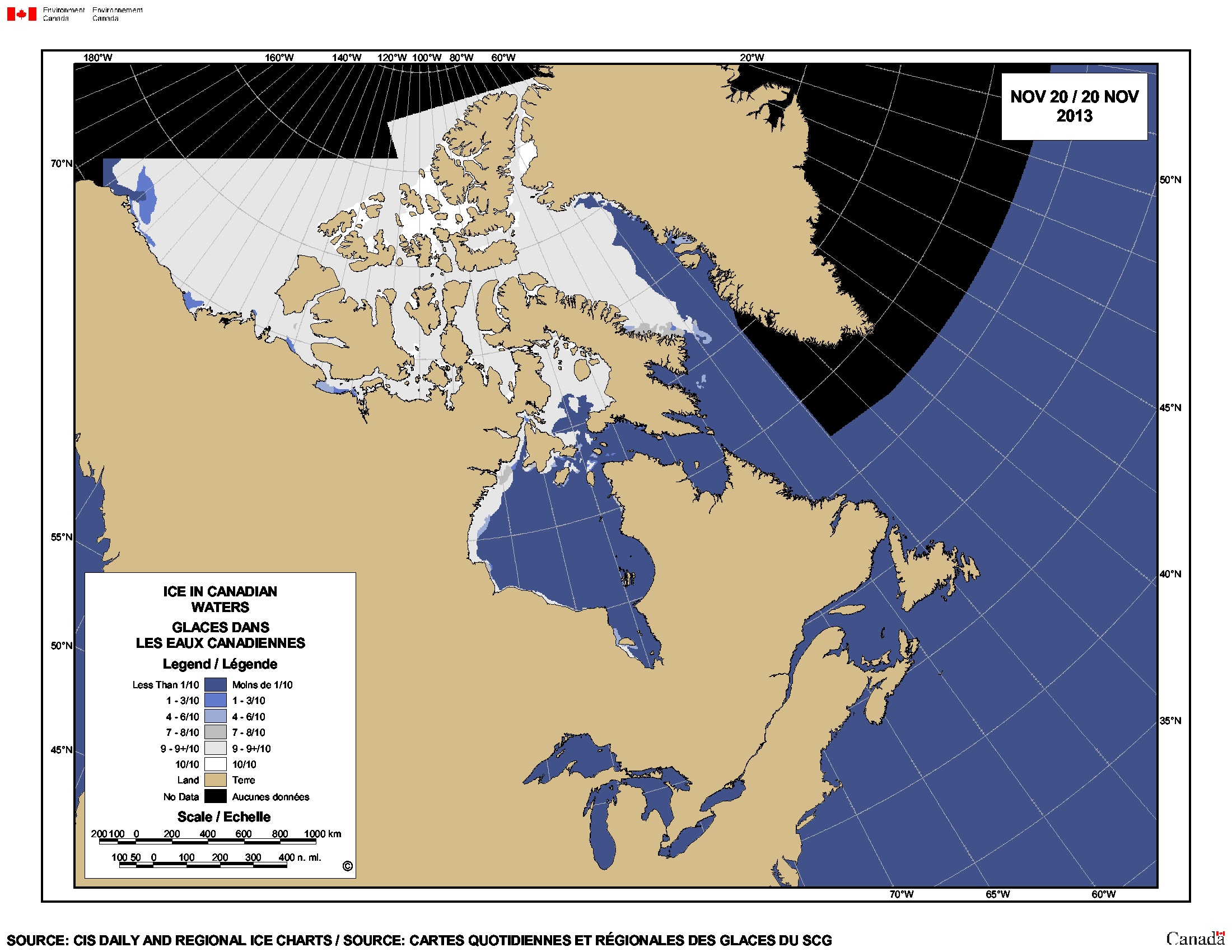
Figure 2. Canadian Ice Service map. Good amounts of ice developing in northern Hudson Bay, Foxe Basin and Davis Strait (between southern Greenland and Baffin Island), with ice forming along the shore in James Bay (the southern-most region where polar bears are on-shore at the moment). Click to enlarge.

Figure 2. Canadian Ice Service map. Ice developing rapidly in northern Hudson Bay, Foxe Basin and Davis Strait (between southern Greenland and Baffin Island), with ice also forming along the shore in James Bay (the southern-most region where polar bears are onshore at the moment). Click to enlarge.

Polar bear problems in N Hudson Bay not due to late freeze-up

The myth that northern Hudson Bay communities are having problems with polar bears this year because freeze-up is later than usual just won’t go away.

I discussed the well publicized craziness in Churchill last week (here and here), but there’s more. Polar bears are already leaving the shore of Northern Hudson Bay as the ice rapidly forms but I saw a story yesterday (dated late last week) that quoted a local official in Repulse Bay blaming their polar bear problems on late freeze-up.

I’ve written before about the peer-reviewed paper by polar bear researchers Seth Cherry and colleagues published earlier this year on breakup and freeze-up dates between 1991 and 2009. But perhaps the freeze-up data needs more emphasis. I’ve copied that graph again below, with notes, and added some ice maps. See for yourself.

Bottom line: A “late freeze-up” for northwestern Hudson Bay occurs when ice formation is delayed until early December or beyond. Freeze-up was nowhere near “late” this year, nor was the ice “slow to freeze.” It wasn’t last year either.
Continue reading

Hudson Bay freeze-up average this year – not late

Freeze-up in Western Hudson Bay is finally underway. It’s no later this year than average, similar to last year.

This rather contradicts the hysterical hue and cry from the tag-team of Polar Bears International (PBI) spokesperson Steven Amstrup and Guardian reporter Suzanne Goldenberg last week during PBI’s “Polar Bear Week” propaganda blitz (see previous posts here, here, and here), 

So much for the trend towards later freeze-up dates that PBI says is endangering polar bears in Western Hudson Bay.

On-the-ground observers confirm polar bears are preparing to move out and sea ice maps show the ice is forming very rapidly — see maps and quotes below.

Continue reading

Polar bear habitat update for October 31, 2013

Here’s the ground-truth follow-up to my suggestion of what polar bear habitat would likely look like 6 weeks after the minimum extent was reached this year – which was looking then like it would mirror 2009.

You’ll find my discussion, posted on September 22, here. At that point (September 13), ice extent was 5.1 million square kilometers; now it is 9.1 million square kilometers (Fig.1).

Figure 1. Oct 30 2013 Maisie sea ice extent, 9.1 mkm2. This does not take thickness or concentration into account.

Figure 1. Oct 30 2013 Maisie sea ice extent, 9.1 mkm2. Click to enlarge.

Have a look at the maps below: Fig. 2 to see how ice extent at October 31st compares to ice extent at the end of October 2009, and Fig. 3 to see what ice concentrations looked like in the Canadian Arctic.

Continue reading

Kaktovik polar bears could be back on the ice this weekend

This is a quick follow up on my last post (here) on Kaktovik polar bears of the Southern Beaufort Sea subpopulation.

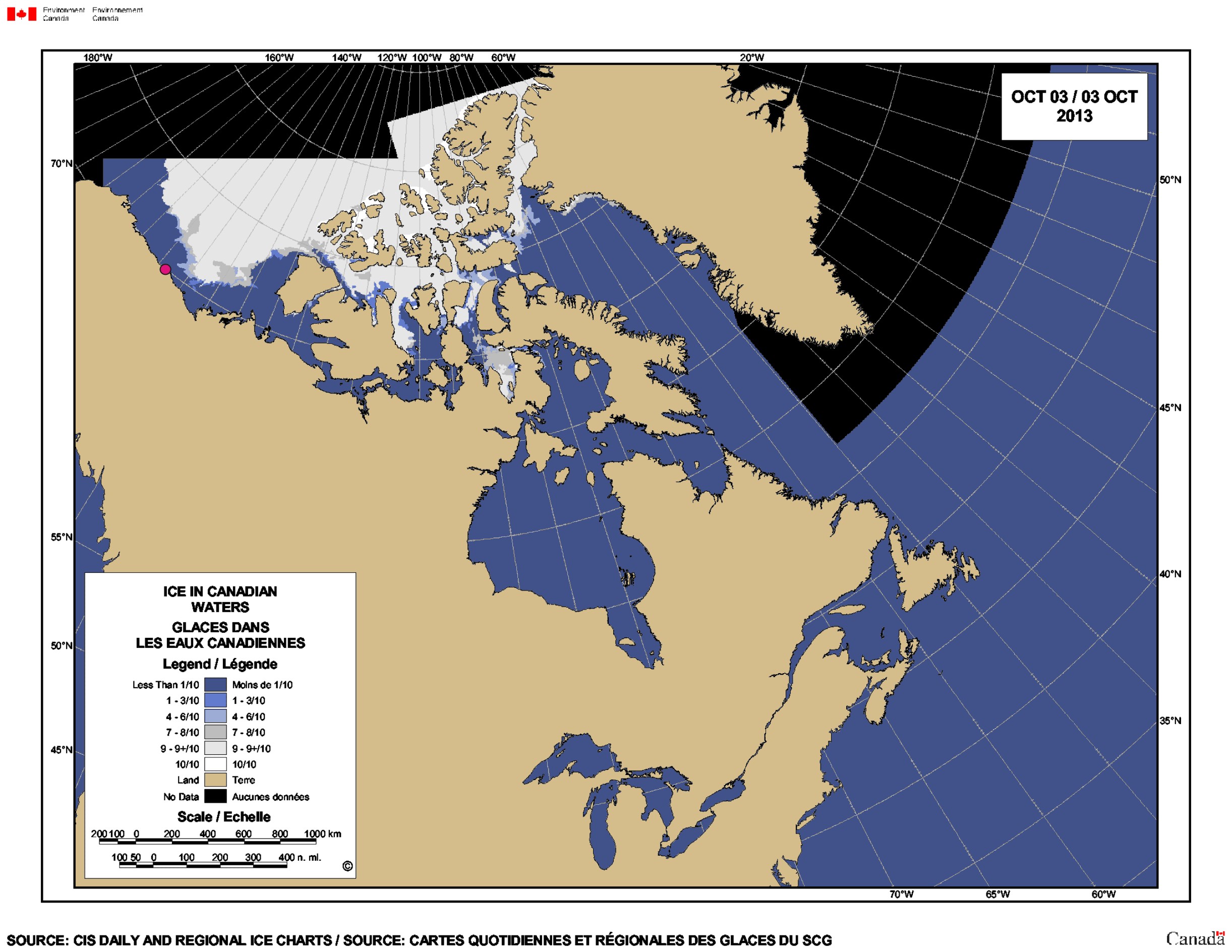
Kaktovik is the bright pink dot on the ice map below (October 3, 2013: click to enlarge), from the Canadian Ice Service – if the ice doesn’t get to the polar bears waiting on shore this weekend, it will be within swimming distance.

Note that this map doesn’t show the shorefast ice that is already forming along the beaches, bridging the gap between land and the offshore ice.

Shorefast ice provides the fall’s first ice platform for polar bears to hunt seals. It doesn’t need to be extensive for the bears to get out there — researchers working in Western Hudson Bay found that an ice concentration of only 10% marked the point when polar bears left the shore.

Kaktovik on CIS chart Oct 3 2013

Good news for polar bears: no early breakup of W. Hudson Bay sea ice this year

The sea ice chart provided by the Canadian Ice Service (Fig. 1 below) shows a lot of ice still present in Hudson Bay today, the last day of June, 2013.

Figure 1. Sea ice extent in Canada, June 30, 2013. From the Canadian Ice Service.

Figure 1. Sea ice extent in Canada, June 30, 2013. From the Canadian Ice Service.

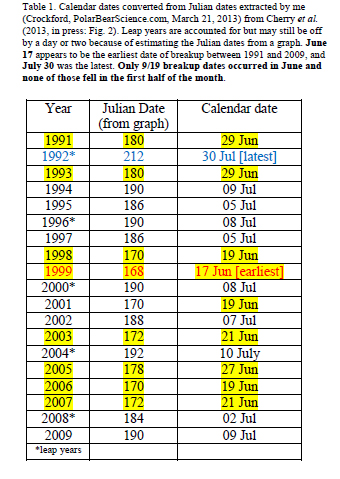
This means we have long passed the point when breakup of the sea ice in Western Hudson Bay (30% ice concentration) could be considered ‘early.’ See Table 1 below for previous breakup dates (1991-2009) and previous post here for more details.

 Table 1. Breakup dates calculated for Western Hudson Bay, 1991-2009, using a new method described by Cherry et al. (in press). More details in previous post here.


Table 1. Breakup dates calculated for Western Hudson Bay, 1991-2009, using the new method described by Cherry et al. (2013, in press). More details in previous post here.

Since most polar bears don’t leave the ice until almost a month after the official breakup date is declared, it means that even if breakup for Western Hudson Bay occurs within the next few days, most polar bears would not start their summer fast until the beginning of August.

Regardless of when polar bear biologists decide that breakup has occurred, one thing is now clear — this will not be an early breakup year for Western Hudson Bay. That’s good news for polar bears.

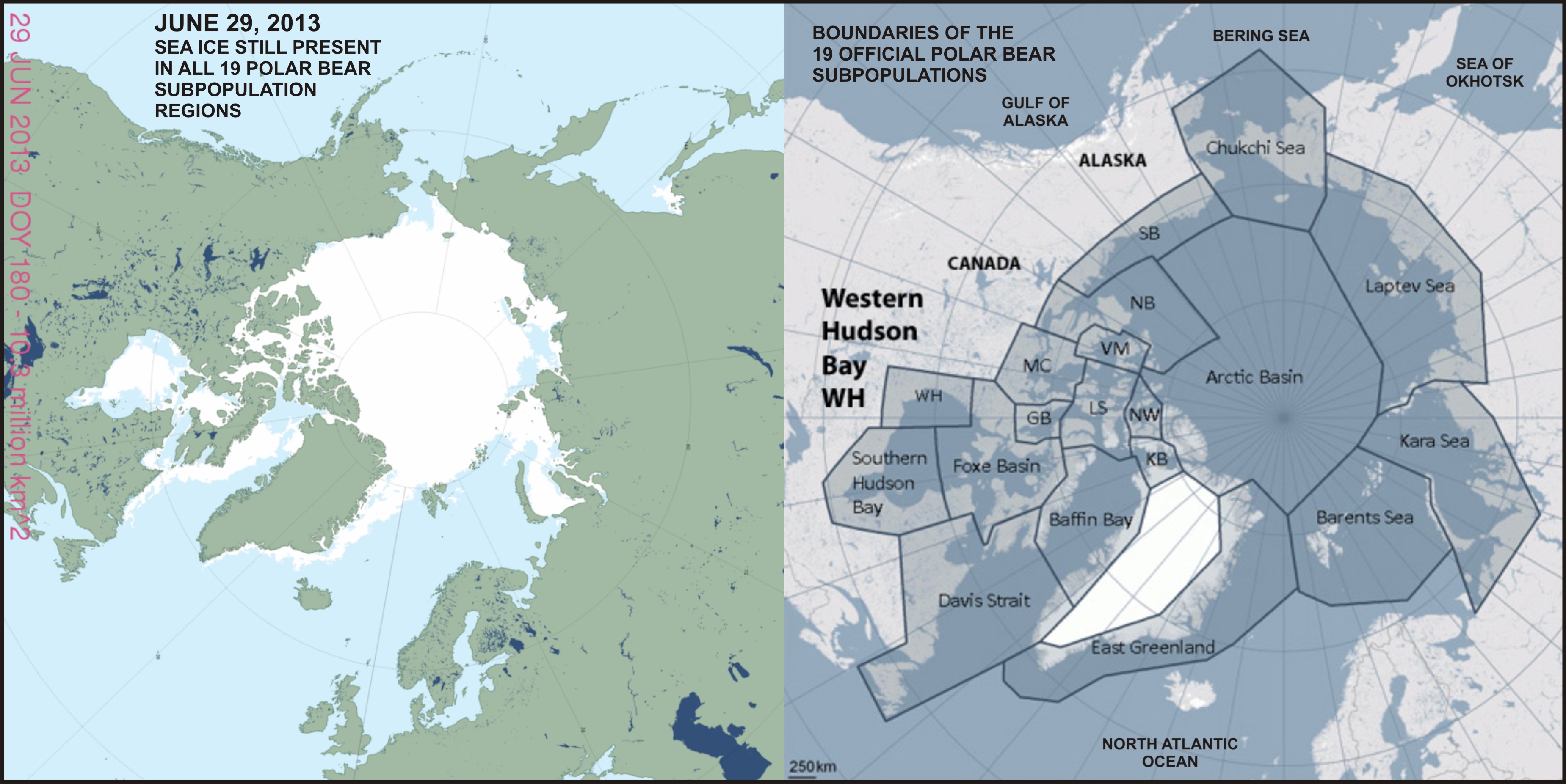
And what about the rest of the Arctic? You’ll see from Fig. 2 below that as of yesterday (June 29), there was still ice present in each of the 19 polar bear subpopulation regions — more good news for polar bears.

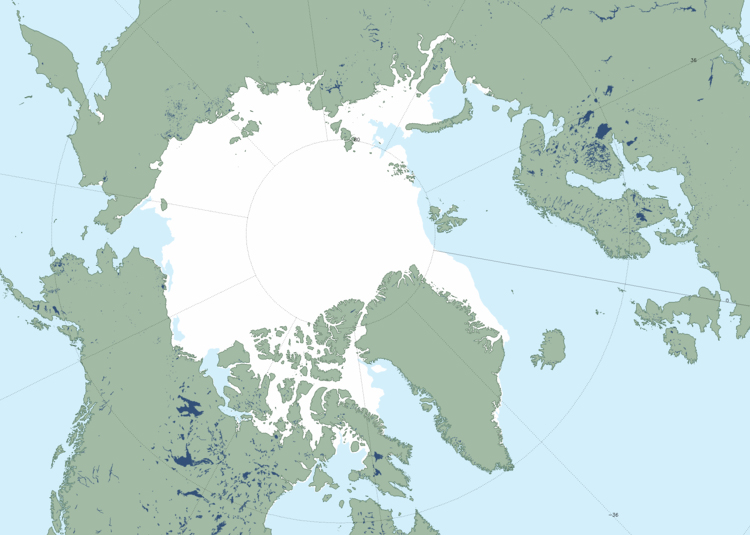
Figure 2. Sea ice extent worldwide vs. polar bear subpopulations at June 29, 2013. On this date, there was still sea ice present in every one of the 19 subpopulation regions. Map on the left from US National Snow and Ice Data Center (NSIDC “MASIE”) here; map on the right from the Polar Bear Specialist Group, with labels added. Click to enlarge

Figure 2. Sea ice extent worldwide vs. polar bear subpopulations at June 29, 2013. On this date, there was still sea ice present in every one of the 19 subpopulation regions. Map on the left from US National Snow and Ice Data Center (NSIDC “MASIE”) here; map on the right from the Polar Bear Specialist Group, with labels added. Click to enlarge

References
Cherry, S.G., Derocher, A.E., Thiemann, G.W., Lunn, N.J. 2013. Migration phenology and seasonal fidelity of an Arctic marine predator in relation to sea ice dynamics. Journal of Animal Ecology 82(4):912-921.
http://onlinelibrary.wiley.com/doi/10.1111/1365-2656.12050/abstract

Hudson Bay sea ice and trapped killer whales

Last night, I was alerted by a reader (h/t MM) to an NBC news report with this headline: “Killer whales’ plight in ice an example of climate change impact, researcher says.” Here’s part of what it says:

The plight of a pod of killer whales that got trapped by ice in a mostly frozen Canadian bay this week was a “good example of what climate change can do” in the Arctic, a researcher said Friday.

The 11 killer whales apparently escaped the ice in Hudson Bay late Wednesday or early Thursday morning, when shifting currents helped break open a path to the sea, according to Petah Inukpuk, mayor of Inukjuak, a remote Inuit village in Quebec where locals had crafted a plan to help the animals, also known as orcas. Other reports said there were 12 orcas in the pod.

The killer whales were hundreds of miles from where they should be at this time of year, such as in the Hudson Strait or the North Atlantic, said Lyne Morissette, a mariner researcher with the Quebec-based St. Lawrence Global Observatory.

The bay, which normally freezes over in late November or early December only froze over earlier this week. 

“It’s definitely a direct effect, a good example of what climate change can do,” she told NBC News on Friday of the orcas’ plight. “All the dynamics of how the ice is going to move and where the ice is going to be — it’s not only about ice melting in the Arctic, you know — it’s the whole dynamics and currents that could change because of climate changes. [my bold]

I take issue, first, with this statement from Morissette (SLGO):
The bay, which normally freezes over in late November or early December only froze over earlier this week.”

Not true, according to the Canadian Ice Service. Continue reading