Posted onOctober 4, 2017|Comments Off on Breaking: Pacific walrus is not threatened with extinction says US Fish & Wildlife
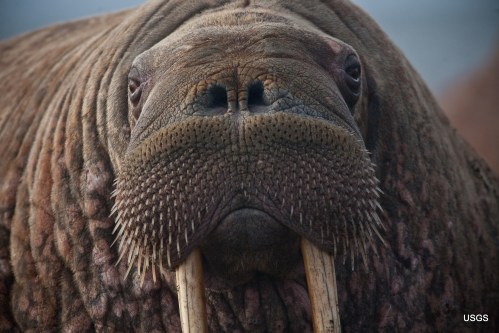
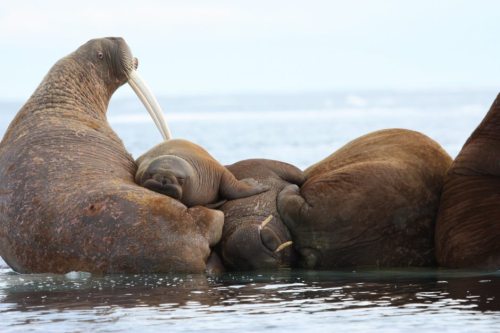
“U.S. Fish and Wildlife Service officials said they cannot determine with certainty that walruses are likely to become endangered “in the foreseeable future,” which the agency defines as the year 2060.”
“The agency said in 2011 that walruses deserve the additional protection of being declared threatened, but delayed a listing because other species were a higher priority.
The agency revised the decision based on new information, said Patrick Lemons, the agency’s marine mammals management chief.
“Walrus demonstrated much more ability to change their behaviours than previously thought,” Lemons said. Their ability to rest on shorelines before swimming to foraging areas makes the threat of less sea ice uncertain, he added.”
Posted onOctober 1, 2017|Comments Off on Fat healthy polar bear update: hundreds of not-starving bears attracted to dead whale
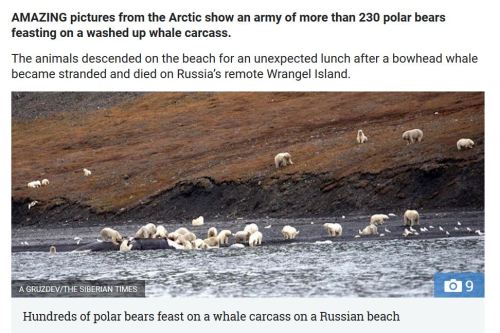
Are the hundreds of polar bears spending the summer on Wrangel Island in the Chukchi Sea starving and desperate for any scrap of food? Hardly! Photos taken by Russian tourists on a cruise ship (19 September 2017) show a huge number of already-fat, healthy bears converging on a dead bowhead whale washed up on a beach. Most of these bears would have been without food since at least early August, when the last sea ice disappeared around the island, and will return to the ice by November.
The extraordinary sight was witnessed by tourists on an Arctic cruise aboard the Finnish-built MV Akademik Shokalskiy.
A source at Wrangel Island Nature Reserve said: “There were at least 230 polar bears, including single males, single females, mothers with cubs and even two mothers with four cubs each.”
Experts called the sight of so many polar bears together “unique”.
The huge number could in fact amount to as much one per cent of the entire world’s population of the creatures.
Tourists initially thought the bears were a flock of sheep after viewing them from a distance, The Siberian Times reports.
But as the boat drew closer, the lucky holidaymakers realised what they were witnessing.
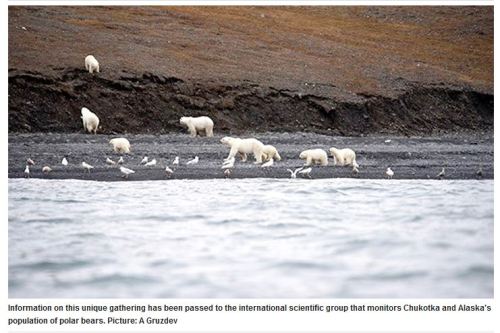
Fat cubs of the year are seen in the photo below, from the Siberian Timesstory:
A self-proclaimed science-based news site (LiveScience,29 September) that picked up the story of this unique event had the temerity to suggest the bears might have been “hungrier than usual” due to global warming.
It deliberately conflates predictions of future starving bears due to low sea ice levels with this observation of many obviously not-starving bears checking out an attractive food source (my bold):
“It’s unclear, however, whether climate change had made these particular bears hungrier than usual. The frequency of starving polar bears is expected to increase as the climate warms and sea ice declines — not just because of climate change directly, but because ice loss is taking away seals, their main food source, Steven Amstrup, chief scientist at Polar Bears International, a nonprofit research organization dedicated to studying polar bears, told Live Science in 2015.”
Except that there is no evidence that ice loss is “taking seals away” — certainly not in the Chukchi Sea. Chukchi Sea seals have been found to be doing better with less ice than they were when there was more ice in the 1980s.
More below, including the location of Wrangel Island and sea ice maps.
UPDATE 2 October 2017: Sea ice in the Chukchi Sea has been lower this summer than over the last few years but the polar bears spending the ice-free season on Wrangel Island are still in good to excellent condition:
Posted onAugust 24, 2017|Comments Off on Pacific walrus haulout two weeks early, US gov’t agency blames “earliest” ice loss
This year’s baseless media frenzy over walrus survival and loss of summer sea ice blamed on human-caused global warming was initiated by a press release from US Fish and Wildlife last week (16 August 2017, pdf here: “Pacific walruses haul out near Point Lay earlier than in previous years“). Quote below, my bold:
In the first week of August, several hundred Pacific walruses were observed on a barrier island near the Native Village of Point Lay, a small, Iñupiaq community on the northwest coast of Alaska. This is the earliest date yet for the haulout to form…This year, sea ice has retreated beyond the continental shelf earlier than in previous years
But is this all true? In a word, no — and it didn’t take much research to uncover the truth.
UPDATE 24 August 2017:A few minutes after this post was published, I became aware that just yesterday, 20 conservation activist organizations, lead bythe Center for Biological Diversity (who led the polar bear listing charge) issued a press release regarding a letter (pdf here) pressuring the US Fish and Wildlife Service to list Pacific walrus as threatened or endangered under the Endangered Species Act. Apparently, a decision must be made by the end of September on whether to actively list walrus or not. The text below has been amended to reflect this development. Continue reading
Comments Off on Pacific walrus haulout two weeks early, US gov’t agency blames “earliest” ice loss
Posted onMay 1, 2017|Comments Off on IUCN Specialist Group now rejects polar bear numbers it used for 2015 IUCN Red List review
Is there a mutiny in the works between the IUCN Red List and the IUCN Polar Bear Specialist Group (PBSG) over polar bear population estimates or has there simply been a breach of ethics? What else explains the fact that some of the subpopulation estimates used by the PBSG to support the status of ‘vulnerable’ for the IUCN Red List in 2015 are unacceptable to them in 2017? And why are the PBSG refusing to embrace the Red List global estimate of 22,000-31,000?
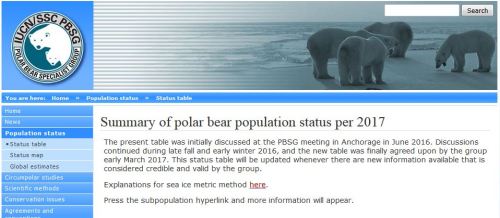
The latest version of the IUCN PBSG status table was posted online 30 March 2017 without fanfare or even a note on their home page. It seems the result came from much discussion at their official meeting last summer (June 2016) that they say continued into early March 2017.
PBGS members voted to reject four subpopulation estimates used in the 2015 Red List polar bear status review — even though the inclusion of those numbers was required in order for the Red List status of ‘vulnerable’ to be upheld. The group has also chosen not to update their global population page with the Red List estimate of 22,000-31,000.
And surprise, surprise — now that only one subpopulation out of nineteen worldwide has shown a recent decline, the PBSG have removed the “trend” columns from their summary table for subpopulations.
Posted onOctober 21, 2016|Comments Off on Fall Arctic ice growth often differs regionally: 2016 compared to other years
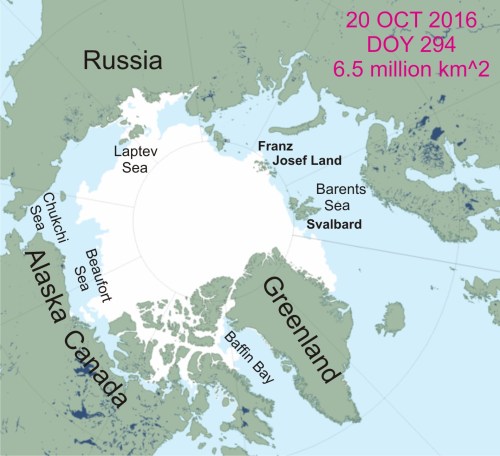
Arctic sea ice is spreading out quickly from its central basin summer refuge – according to this NSIDC Masie ice chart, it has already grown more than 2 mkm2 beyond the annual minimum reached in early September. Ice is already pushing south into the eastern Beaufort and the archipelago of Franz Josef Land in the Barents Sea.
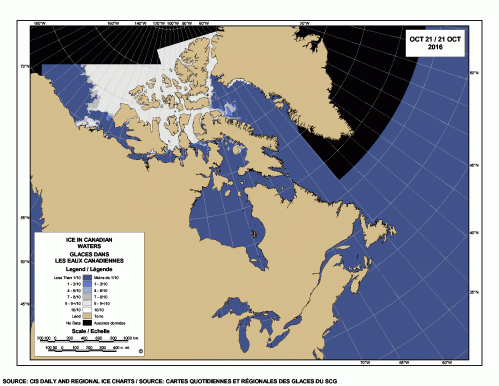
Over the next couple of weeks, shorefast ice will start forming along the coasts of North America and Eurasia (see the first bits off Alaska in the 21 October CIS map below), which will eventually meet the expanding Arctic Basin pack to fill the Basin and Canadian Arctic Archipelago with ice – as it has done for eons.
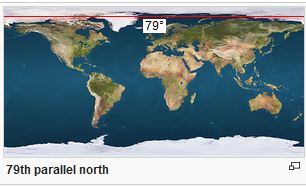
The evidence from the last decade or so suggests that by the end of October, most of the Arctic north of the 79th parallel (see map below) will be filled with ice – although the Chukchi Sea (north of the Bering Strait) may not fill until sometime in November:
Polar bears usually resume hunting as soon as sea ice conditions permit in the fall, since it’s their last chance to top up their fat reserves before the dark and cold of winter when hunting may become next to impossible.
I’ve copied ice charts from the Masie archives for some previous years at 31 October below.
Posted onSeptember 29, 2016|Comments Off on Polar bear habitat this fall shaping up fast – more like 2010 than 2007
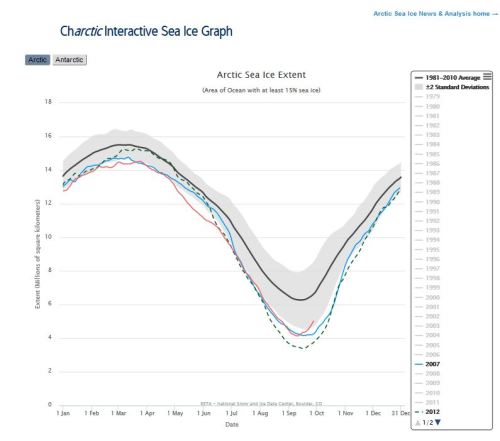
Arctic sea ice tied 2007 for extent at the September minimum less than 3 weeks ago but with the refreeze proceeding much faster than 2007, seals will soon be returning to the ice edge and polar bears will be back to feeding like they did in 2010.
Sea ice extent less than 5.0 mkm2 lasted less than 6 weeks (23 August – 28 September), according to NSIDC.
Posted onSeptember 13, 2016|Comments Off on Recent studies show Sept ice of 3-5 mkm2 did not kill polar bears off as predicted
The annual Arctic sea ice minimum for 2016 is imminent and the hand-wringing about polar bear survival has already begun. While this year is shaping up to be another very low sea ice minimum in the Arctic – not as low as 2012 but lower thanas low as 2007 (previously the 2nd lowest since 1979) – contrary to predictions, several recent studies show that such low sea ice coverage in summer has had no (or very limited) negative effects on polar bear health and survival. In fact, for polar bears in some areas low summer sea ice has been quite beneficial (although these are not the populations that polar bear specialists predicted would do better).
Since low summer extents of recent magnitude (3.0 – 5.0 mkm2) are clearly not any sort of threat to polar bears, it seems improbable that even an ice-free (≤ 1.0 mkm2) summer (e.g. Wang and Overland 2015) would be devastating to the species [don’t forget Cronin and Cronin 2016: they’ve survived such conditions before] – as long as conditions in spring allow for the necessary concentrated feeding on young seals.
Above: Top, minimum at 2012 (16 Sept, 3.41 mkm2, lowest since 1979); Center, 2007 (18 Sept, 4.17 mkm2); Bottom, 2015 (9 Sept, 4.50 mkm2), from NSIDC. Below: sea ice at 10 Sept 2016, 4.137 mkm2 – minimum not yet called).
Recall that in 2006, the IUCN Polar Bear Specialist Group based their conservation status of ‘vulnerable’ (likely to become threatened within the next 45 years due to reduced habitat) on the predictions of sea ice specialists (see 2008 update here).
Sea ice experts in 2005 predicted such low summer sea ice extents as polar bears have endured since 2007 (3.0 – 5.0 mkm2) would not happen until 2040-2070, at which time PBSG biologists said that >30% of the world’s bears would be gone.
Evidence to the contrary comes from polar bear specialists working in the Chukchi, Beaufort, and Barents Seas – and in Southern Hudson Bay – since 2007. Overall, the latest IUCN Red Book assessment (2015) put the global population size at 22,000-31,000 (or about 26,500).
All of this means that those polar bear experts were wrong: polar bears are more resilient to low summer sea ice conditions than they assumed.
UPDATE 2 January 2017:I’ve added some quotes from the original USGS reports that explicitly state their dire predictions for 2050 that differ from the predictions made by the IUCN Polar Bear Specialist Group. Continue reading
Comments Off on Recent studies show Sept ice of 3-5 mkm2 did not kill polar bears off as predicted
Posted onAugust 2, 2016|Comments Off on USGS report on history of walrus haulouts leaves out correlation with population size
Walrus researchers from the US Geological Survey have a new report on the history of walrus haulouts in the Chukchi and Bering Seas – yet their media efforts (via press releaseand interviews) fail to mention the relationship between fluctuating size of walrus haulouts and fluctuating walrus population size that is evident in that history. In fact, overall population size is not mentioned at all.
But neither articles nor the new USGS paper they are touting (Fischback et al. 2016) mention the huge summer/fall haulouts of females, calves, and juveniles that were documented in the 1970s that coincided with the huge population size at that time, which crashed in the 1980s.
Only now has the population grown (to at least 200,000) to the point that huge haulouts are again being reported – conservation has done it’s job. But when walrus numbers get too high the animals out-strip their food source and numbers plummet, as they did in the 1980s (Fay et al. 1989; Garlich-Miller et al. 2011). See my fully referenced summary paper, Crockford 2014 (On The Beach: Walrus Haulouts are Nothing New).
Here’s the concern: When (not if) a population crash happens again, will it be blamed on global warming rather than natural causes? According to the PBS article:
“The database is supposed to help federal officials with conservation, especially as more ships start sailing through the newly open waters. The U.S. Fish and Wildlife Service is determining whether walrus should be listed as a threatened species.” [my bold]
My GWPF video on the issue (The Walrus Fuss) below:
See excerpts from the USGS database below, with a map:
Posted onJune 11, 2016|Comments Off on Ice maps vs. observations in the W. Arctic – polar bear habitat reality check
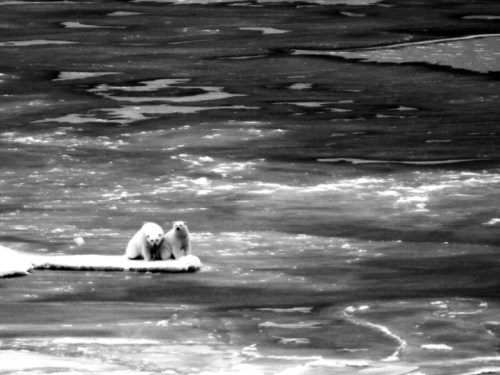
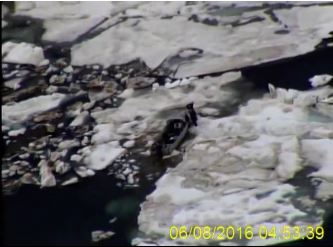
Last Wednesday (8 June 2016), the US Coast Guard rescued walrus hunters from Shishmaref in the Bering Strait who got stuck in sea ice that is barely visible on sea ice maps. It’s a rare glimpse of what sea ice really looks like up close compared to what you see on the ice maps.
[Unfortunately, the screencaps from the video, like the one below, are less impressive than the film. In the video, you can see the hunters walking on the ice around their trapped boat – the ice does not visibly move]
Have a look at the sea ice maps below for the day the incident took place. They show what appears to be hardly any ice in the area.
This is a good lesson for assessing what’s been going on in the Beaufort Sea a bit further east, where winds and currents have opened up a rather large patch of open water surrounded by considerable expanses of sea ice – at issue is the possible impact on polar bear spring feeding for April and May. Continue reading
Comments Off on Ice maps vs. observations in the W. Arctic – polar bear habitat reality check
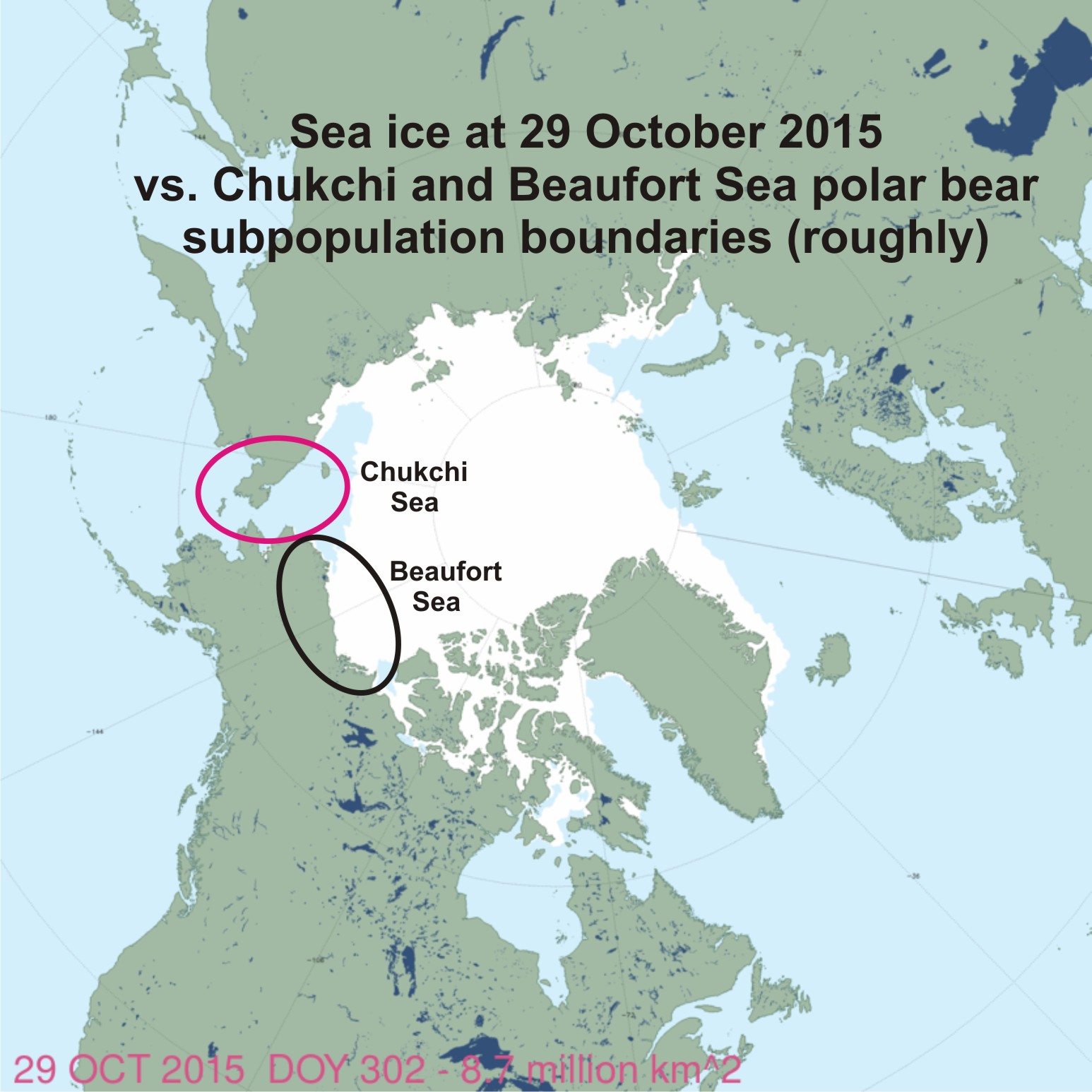
Posted onNovember 9, 2015|Comments Off on Specialists mum on low Chukchi Sea polar bear habitat this summer and fall
You may or may not have noticed that even though Chukchi Sea ice coverage has been way below average this melt season, there has been no hue-and-cry about poor suffering Chukchi polar bears. That’s because polar bear biologist’s own research has shown that the health and survival of these bears has not been negatively impacted by low summer sea ice. There may be threats from poaching in Russia, but not lack of summer sea ice.
As of this date, developing sea ice is only just approaching Wrangel Island, a major polar bear denning region in the Chukchi Sea, see maps below (Ovsyanikov 2006).
Yet, polar bear specialists insist that neighbouring Beaufort Sea bears – who endure a much shorter open-water season – are in peril of extinction because of scarce summer sea ice. Continue reading
Comments Off on Specialists mum on low Chukchi Sea polar bear habitat this summer and fall
Watch polar bear habitat reform in the Canadian Arctic: “last 10 days” Canadian Ice Service animation (works anytime) HERE.
See Quote archive for details.

 A self-proclaimed science-based news site (LiveScience,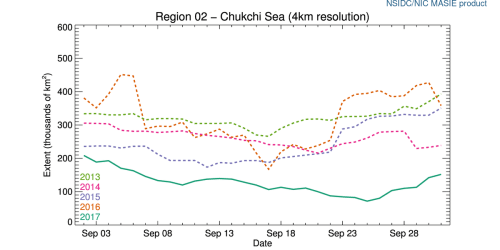
 This year’s baseless media frenzy over walrus survival and loss of summer sea ice blamed on human-caused global warming was initiated by a press release from US Fish and Wildlife last week (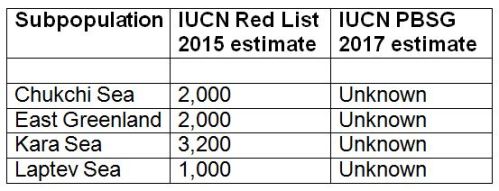
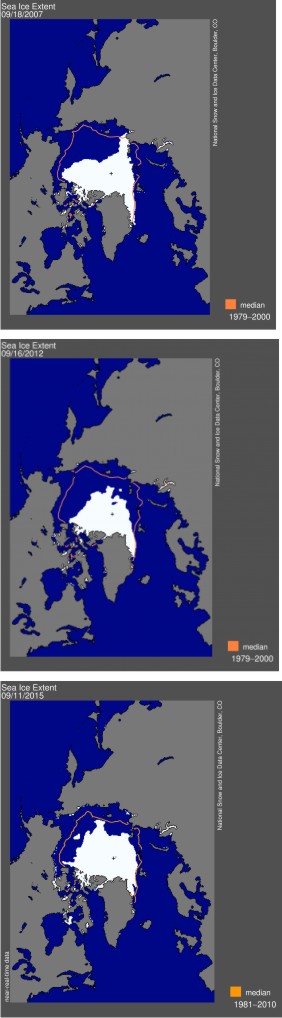 Above: Top, minimum at 2012 (16 Sept, 3.41 mkm2, lowest since 1979); Center, 2007 (18 Sept, 4.17 mkm2); Bottom, 2015 (9 Sept, 4.50 mkm2), from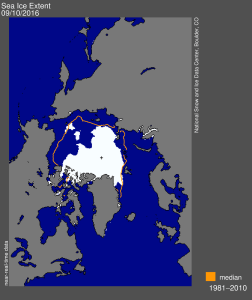




 polarbearscience
You must be logged in to post a comment.