Tag Archives: ringed seals

Chukchi/Bering Sea ringed seals doing better despite declines in ice and snow: new study

Ringed seal pup in snow cave

Previously, I highlighted new research results that showed, contrary to expectations, polar bears in the Chukchi Sea subpopulation are doing better – despite declines in extent of September sea ice – since the 1970s. So it might not come as much of a surprise to find that the same is true for the primary prey of polar bears in the Chukchi and Bering Seas, Arctic ringed seals (Phoca hispida hispida).

Surprisingly, less than 6 months after Arctic ringed seals were placed on the American list of “threatened” species (under the ESA, see previous post here), actual research in Alaska has shown that declines in sea ice have proven better for ringed seals, not worse.

At a presentation given at the Lowell Wakefield Fisheries Symposium in March (Anchorage, Alaska) [program and links to pdfs here] Justin Crawford, a biologist with the Alaska Department of Fish and Game (ADF&G) presented the results of ringed seal research conducted by himself and fellow ADF&G biologist Lori Quakenbush in the Chukchi and Bering Seas (posted online by the event organizers, see references below).

As for polar bears, the Crawford and Quakenbush presentation provides some very interesting details on the status of Chukchi and Bering Sea ringed seals over the last 40 years, and contains some mighty “inconvenient” conclusions that should raise some eyebrows.

I’ve summarized these details and conclusions below in point form, with a map.
Continue reading
Great polar bear red herring in the Southern Beaufort

Red herring iconWe know that thick-ice springs occurred in 1974, 1975, 1986, 1992, 2004, and 2005 in the former ‘Eastern Beaufort’ – now the southern portion of the ‘Northern Beaufort’ and the eastern portion of the ‘Southern Beaufort.’ We know that these severe spring ice conditions negatively impacted both polar bears and ringed seals in this region every decade since the 1960s because the effects have been documented by numerous studies conducted in April through May for polar bears (Amstrup et al. 2006; Cherry et al. 2009; Pilfold et al. 2012; Stirling 2002; Stirling and Lunn 1997; Stirling et al. 1980; Stirling et al. 1993; Stirling et al. 2008) and in June and July for ringed seals (Harwood et al. 2012; Smith 1987), see previous posts here, here, and here.

For example, even though Ian Stirling and colleagues argued in their 2008 paper that the thick spring ice conditions in 2004, 2005 and 2006 (but not those in previous decades) were caused by storms initiated or intensified by greater amounts of open water in previous summers, they did not deny that the thick-ice springs occurred. They stated quite clearly that:

The 1960s, 1970s, and 1980s each experienced a two- to three-year decline in seal productivity in the eastern Beaufort Sea and Amundsen Gulf, associated with heavy ice conditions, around mid-decade. Each was followed by a decline in polar bear reproduction and condition, after which both seal and bear populations recovered (Smith, 1987; Harwood et al., 2000; Stirling, 2002). The beginning of each of those three periods was associated with heavy ice conditions through the winter before the reproductive decline of the seals, followed by a late spring breakup.” [my bold]

So, I have to say, I was shocked but not surprised to find that in the more recent scientific literature, the phenomenon of thick-ice springs every decade in Southern and Northern Beaufort has been deliberately ‘disappeared.’ 

Not surprised because I suspected it had happened — this issue was a feature of the Stirling and Derocher (2012) paper from late last year which was the topic of my very first blog post, “Cooling the polar bear spin.

However, I think it is important to document how the transmogrification of sea ice effects on polar bears was managed in the scientific literature so that everyone can see exactly what has been done. In a truly astonishing move for what is supposed to be a field of science, thick-ice springs have been effectively replaced by an open-water red herring as the scourge of Southern Beaufort polar bears.

Continue reading

Why is it that every decade, Eastern Beaufort sea ice gets really thick?

I’ve written before about the incidents of starving polar bears in the eastern portion of the Southern Beaufort Sea (here, here, and here). For two or three years every decade since the 1960s, shorefast ice in the Eastern Beaufort (Fig. 1) has become too thick and compressed in the spring for ringed seals to maintain their breathing holes, so most or all of them presumably go elsewhere — as seals did in Greenland when ice got too thick there (Vibe 1965). With few or no seal pups born during March and April in thick ice years, some bears had a hard time finding enough food: starving bears and dying cubs were the result.

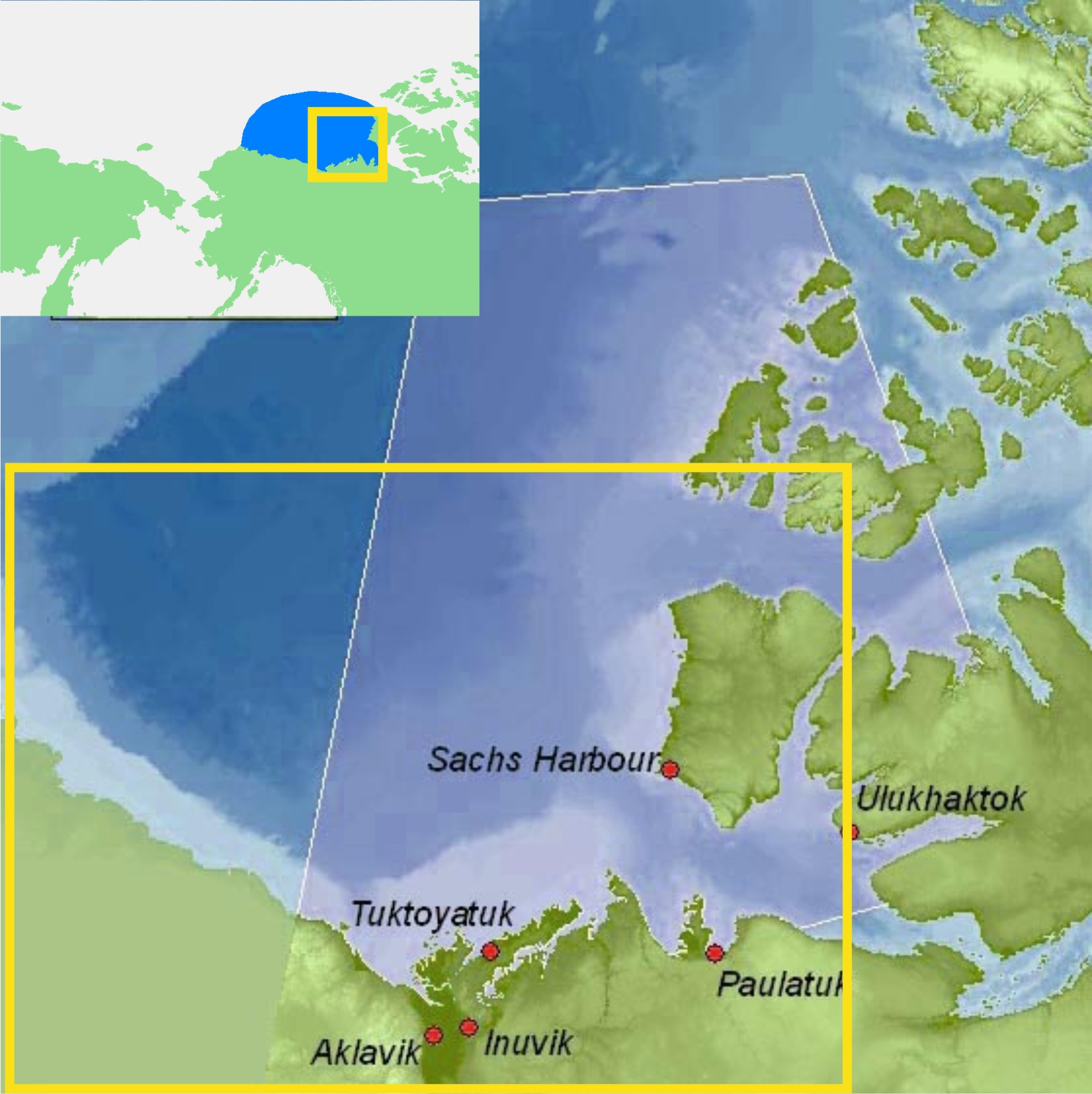
Figure 1. Eastern portion of the southern Beaufort Sea.  The communities of Tuktoyatuk (locally known as ‘Tuk’), and Sachs Harbour on southern Banks Island, have been useful starting points for polar bear research because they are accessible by plane via the larger community of Inuvik The light blue portions, e.g. along western Banks Island and the Eastern Beaufort/Yukon mainland coast, indicate shallow continental shelf areas (20 km wide in places) where extensive shorefast ice develops every winter. Main map from Beaufort Sea Partnership, inset map from Wikipedia.

Figure 1. ‘Eastern Beaufort’ (yellow square) polar bear study region.
The communities of Tuktoyatuk (locally known as ‘Tuk’), and Sachs Harbour on southern Banks Island have been used as base camps for polar bear research because they are accessible by plane via the larger community of Inuvik.
The light blue portions along western Banks Island and the Eastern Beaufort/Yukon mainland coast indicate shallow continental shelf areas (20 km wide in places) where extensive shorefast ice develops every winter.
Main map from Beaufort Sea Partnership, inset map from Wikipedia.

I’ve been trying to get my head around why this would happen in the Eastern Beaufort. Once or twice – maybe – but several times every decade? What on earth drives such a process?

So, I did some reading (actually, quite a lot of reading) and have what appears to be at least a partial answer.

All indications are that the occasional development of exceptionally thick spring ice in the Eastern Beaufort is the result of an entirely natural, cyclical phenomenon. However, some polar bear biologists are attempting to blame the latest episode (but not earlier ones) on increased amounts of open water in the Chukchi Sea during fall of the early 2000s. That doesn’t seem a plausible explanation to me, given the history of the sea ice in this region. Have a look.

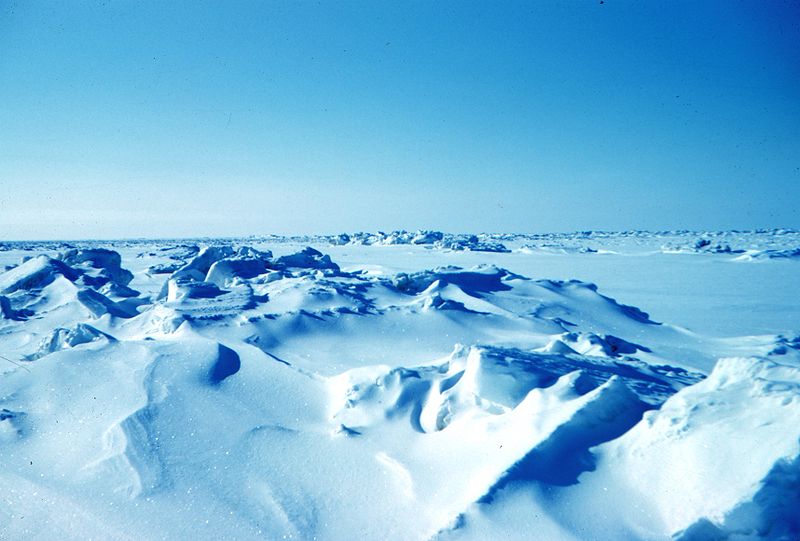
Figure 2. Beaufort sea pressure ridges, spring 1949. Courtesy Wikipedia (from NOAA “At the ends of the Earth” image collection #corp1014).

Figure 2. Beaufort sea pressure ridges, spring 1949. Courtesy Wikipedia (from NOAA’s “At the ends of the Earth” image collection #corp1014).

Continue reading

Buffet time for polar bears – spring/early summer is for eating baby seals

Spring is the busiest and most important season for polar bears: it is the most important feeding period and it is also when mating occurs. The fat that polar bears put on during the spring and early summer is critical for their survival over the rest of the year and for females, determines whether they can successfully produce cubs the following year.

Mothers and new cubs emerge from their winter dens in late March to early April and those who have chosen to den on land soon head towards the sea ice. For a fabulous photo of a polar bear female and her two young cubs, just out of their winter den, feeding on a bearded seal pup, pop over here. All other bears, including females with older cubs, will already be on the ice, feeding on the first newborn ice seals of the season and any other seals they can catch.

It’s buffet time for polar bears but the most dangerous time for cute baby seals. Continue reading

Polar bears cavorting with ABC brown bears not supported by geological and fossil evidence

The authors of a new paper out in PLoS Genetics (Cahill et al. 2013, entitled “Genomic Evidence for Island Population Conversion Resolves Conflicting Theories of Polar Bear Evolution”) propose to explain how and why the brown bears (aka grizzlies) of the ABC islands of southeast Alaska (Admiralty, Baranof, and Chicagof – see previous post here), got to be so genetically distinct from brown bears on the Alaska mainland and so surprisingly similar (genetically) to polar bears. The authors determined (using a model) that this genetic pattern could be explained by an ancient hybridization event resulting from female polar bears cavorting with male brown bears in SE Alaska.

I had some issues with the way the paper was promoted by some of the co-authors, which I dealt with separately here. More importantly, I found the scenario these geneticists offered to explain how hybridization might have occurred to be patently implausible. Geological and fossil evidence from SE Alaska largely refutes their scenario, although another explanation may be more tenable. It is not impossible, in my opinion, that hybridization occurred in SE Alaska during the last Ice Age, but if it did, it almost certainly did not happen the way Cahill and colleagues suggest.

Continue reading

Sea ice maximum reached March 15: what it means for polar bears

On Monday, March 25, the National Snow and Ice Data Center (NSIDC) announced that March 15 2013 was likely the maximum extent reached this winter. Note that just a few days ago, I discussed the relationship between maximum extent of sea ice and the global distribution of polar bears around the Arctic (see March 20th post here).

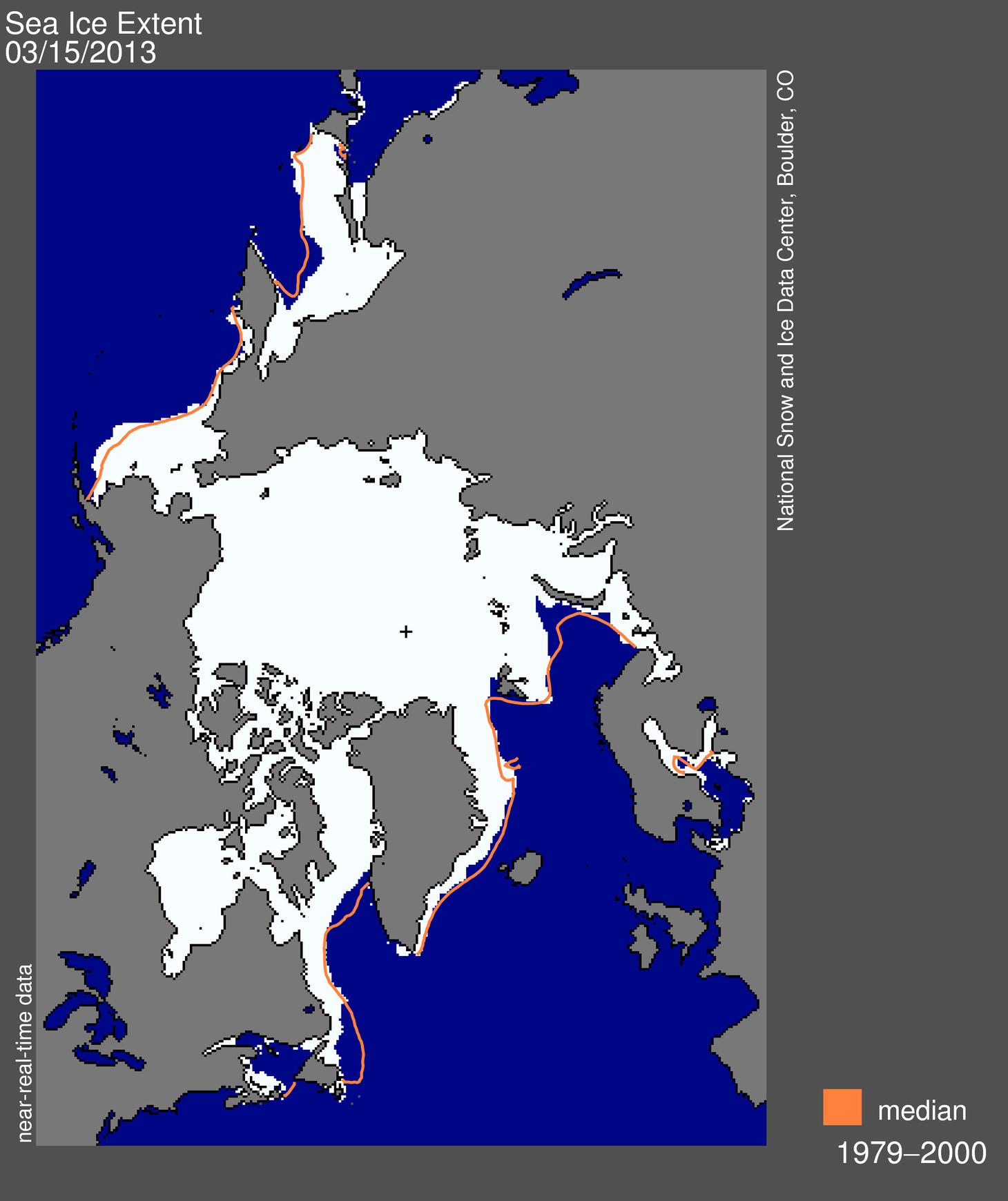
NSIDC says: “Arctic sea ice extent on March 15 was 15.13 million square kilometers (5.84 million square miles). The orange line shows the 1979 to 2000 median extent for that day. The black cross indicates the geographic North Pole.”

NSIDC says: “Arctic sea ice extent on March 15 was 15.13 million square kilometers (5.84 million square miles). The orange line shows the 1979 to 2000 median extent for that day. The black cross indicates the geographic North Pole.” Click to enlarge.

Continue reading

Ten good reasons not to worry about polar bears

IMPORTANT UPDATE March 13, 2013 Benny Peiser over at the Global Warming Policy Foundation has just posted an essay by well-known author Matt Ridley, entitled “We should be listening to Susan Crockford” which is included as a foreword to a pdf of this very post (“Ten good reasons not to worry about polar bears”), suitable for sharing. I encourage you to have a look.

[Update September 28, 2013: See also this follow-up post “Polar bears have not been harmed by sea ice declines in summer — the evidence.”]

Polar Bear-Cubs-Canada_Wallpaper

PB  logo colouredThis year marks the 40th anniversary of the signing of an international agreement to protect polar bears from commercial and unregulated sport hunting. The devastating decades of uncontrolled slaughter across the Arctic, including the Bering Sea, finally came to an end. And so in honor of International Polar Bear Day (Wed. February 27) – and because some activists are calling 2013 The Year of the Polar Bear – I’ve made a summary of reasons not to worry about polar bears, with links to supporting data. I hope you find it a useful resource for tuning out the cries of doom and gloom about the future of polar bears and celebrating their current success.

Continue reading

Where were the appeals to feed starving polar bears in 1974?

The so-called “policy paper” that polar bear biologist Andrew Derocher has been promoting over the last few weeks, which I commented on briefly when the press release came out, is still grabbing headlines. Online news outlets continue to run stories on this bizarre discussion of what officials might decide to do 40 years from now if global warming causes Western Hudson Bay polar bears to spend 6 months on land (Molnar et al. 2010), causing some of those polar bears to starve (see here, here, and here) – as if this is something likely to happen within the next couple of years.

But forget imagined future starvation: where was the media attention on the plight of starving polar bears back in 1974  and 1975 when polar bears were actually starving in large numbers in the eastern Beaufort Sea?

At least two of the co-authors of the paper getting all the attention – Drs. Ian Stirling and Nick Lunn – witnessed polar bears starving in the Beaufort in 1974 because of an especially cold winter and said nothing even though polar bear populations worldwide at the time were already low due to the wanton slaughter of previous decades. Did Stirling and Lunn humanely euthanize the bears they saw starving? Contact the media? [If they did, I’d like to know.] Appeal to governments to make a plan in case it happened again? Apparently not, because it did happen again, at least twice in the following two decades – with no attendant hue and cry then either. No, those Beaufort Sea bears starved to death, time and time again, without a word to the media from Ian Stirling and Nick Lunn.
Continue reading

Bearded and ringed seals join the polar bear as “threatened” by a computer-modeled future

As I pointed out in Featured Quote #22 (posted on Dec. 23, 2012), bearded and ringed seals have recently joined the polar bear on the American ESA’s list of animals that are “threatened” by computer-modeled predictions of Arctic sea ice declines projected 50-100 years into the future (USFWS 2008, 2012a, 2012b).

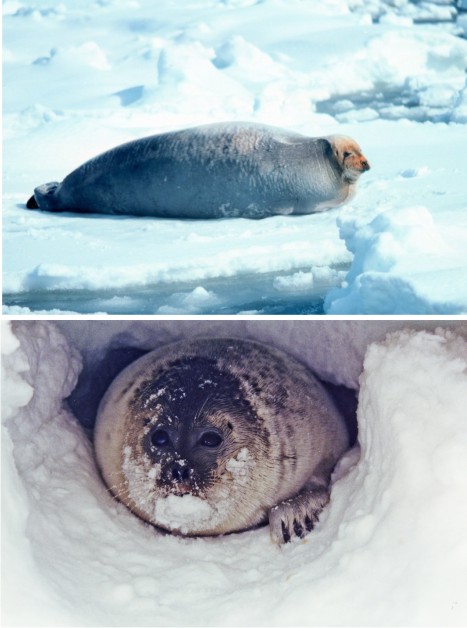
NOAA photos of bearded seal (top) and ringed seal (bottom)

NOAA photos of bearded seal (top) and ringed seal (bottom). The bearded seal is one of the largest Arctic ice seal while the ringed seal is the smallest. Both are eaten by polar bears, although ringed seals are consumed most often.

The decision by NOAA (National Oceanographic and Atmospheric Administration) affects the Arctic subspecies of ringed seal (Phoca hispida hispida) as well as the Okhotsk subspecies (Phoca hispida ochotensis) (in addition to several others) and thus includes all ringed seals off Alaska’s coast in the Beaufort, Chukchi and Bering Seas. The decision also affects two particular subpopulations of bearded seal (Erignatha barbatus): the “Beringia” [Bering Sea/Chukchi] subpopulation (about half of which reside in Alaskan waters), and the subpopulation that lives in the Sea of Okhotsk. (Alaska Fisheries (NOAA) Final Decision). Continue reading

The conundrum of cold winter effects in Hudson Bay

[Deleted April 20 2015 – this post needed revision, and I decided it was easier to re-do it completely. Which I haven’t done yet. I’ll insert a link here when the new post is done]