Tag Archives: Alaska

Polar bear habitat looking good for early summer – last days before the fast

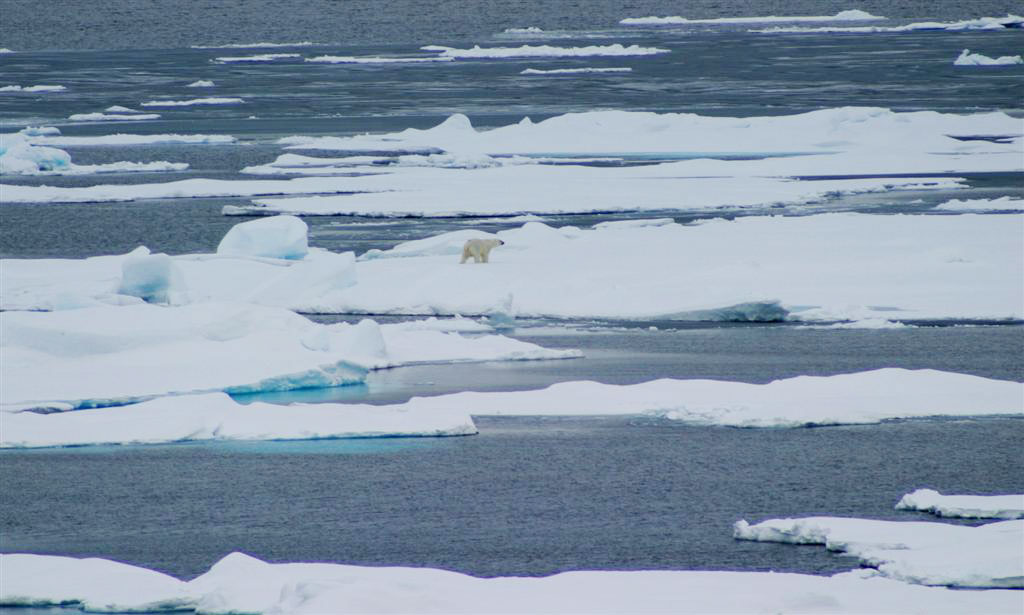
Some polar bears may already be living mostly off the fat put on over the spring but others may catch a seal or two on the sea ice before the summer fast begins – since the ice hasn’t left the coast in most regions quite yet. Polar bears eat little in summer, whether they spend their time on land or on the sea ice.

PolarBearCV1LG_USGS

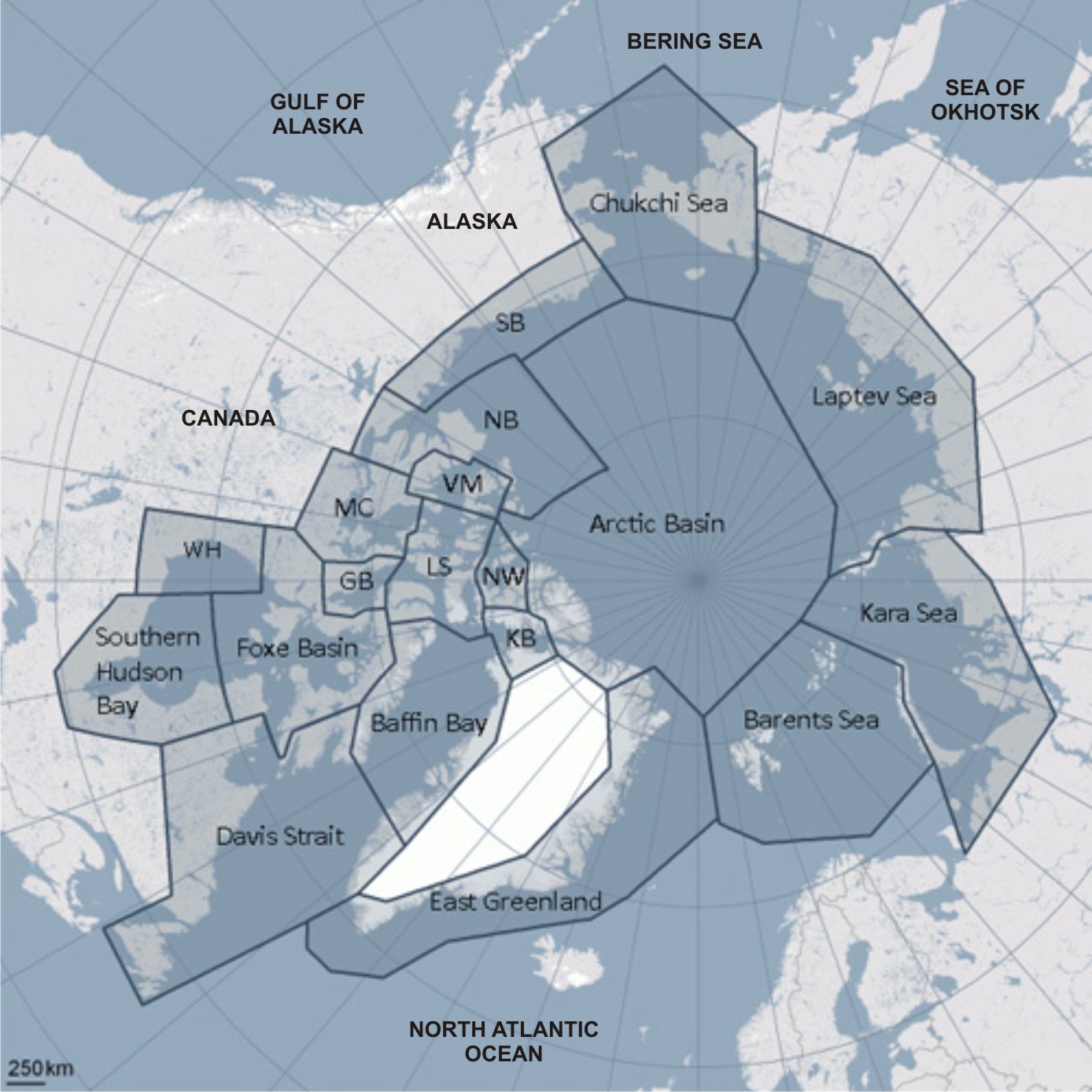
Sea ice is still high over Hudson Bay – for this time of year, it hasn’t had this much polar bear habitat since 2009. Davis Strait and Foxe Basin are also above average – Davis Strait hasn’t had this much ice since 1992 (the Mt. Pinatubo cold year). Polar bear subpopulation refresher map below.

PB map-all-populations PBSG original plus Okhotsk
Continue reading

Polar bears fine now but give us more money: US Fish & Wildlife Management Plan subtext

Between-the-lines message of the recently released (and hyped to death) Conservation Management Plan for polar bears by the US Fish & Wildlife Service is that the bears really have nothing to worry about except human-caused global warming but it will cost tens of millions of dollars over the next five years to study and manage them.

polar_bear_usfws_no date_sm

So filled with double-speak, misinformation, and obfuscation [including the newly-invented term, “quasi-extinction floor”] that it’s no wonder some news outlets got it wrong (nowhere in this document does it say that polar bears might go extinct within ten years“). The document does, however, lay out the FWS budget for polar bears over the next five years – and it’s a real eye-opener.

Continue reading

Tracking polar bears in the Southern Beaufort June 2015 – all 17 bears out on the sea ice

Sixteen females with satellite collars plus one with a glue-on transmitter – down from 17 with collars and 6 with tags last month – all out on the ice during the month of June 2015.

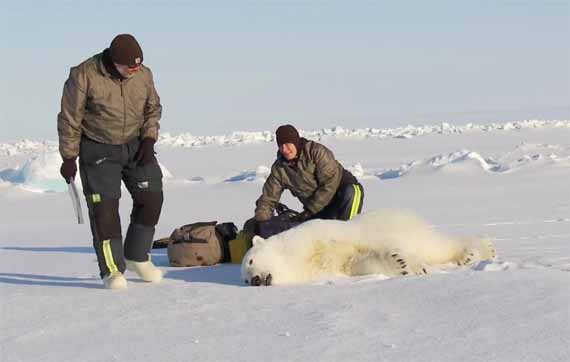
Tranquilized_pb570_S Beaufort March 2014_USGS

Polar bears were captured by USGS biologists in 2014 and 2015 on the spring-time sea ice of the southern Beaufort Sea. The glue-on tags don’t seem to be holding up very well, with only one remaining out of the original eight deployed this spring.
Continue reading

Beaufort Sea polynyas open two weeks before 1975 – open water is good news for polar bears

With masses of very thick, multiyear ice off Alaska this spring, the developing polynyas (open water) at either end of the Beaufort Sea are providing essential polar bear hunting habitat.
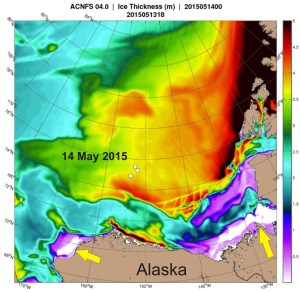
SB polynyas on ice thickness map 14 May 2015_PolarBearScience

Patches of open water in the Beaufort Sea are naturally recurring phenomena. This year we have two excellent examples, shown by the yellow arrows in the sea ice thickness map above (from the Naval Research Laboratory).

The eastern-most polynya forms in the Canadian portion of the Beaufort most years in the spring. This open water feature is so common it has a name – the Cape Bathurst polynya. Last year, there wasn’t an obvious polynya there until sometime in June, but in 1975, a patch of open water almost as large (or larger) as this year’s had developed by the end of May (Fig. 1).
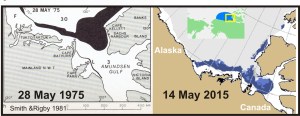
Figure 1. Cape Bathurst polynya at 28 May 1975 (Smith and Rigby 1981: Fig. 14h), with the extent probably underestimated, and the polynya this year at 14 May (Canadian Ice Service). Click to enlarge.

Figure 1. Cape Bathurst polynya at 28 May 1975 (Smith and Rigby 1981:Fig. 14h) and the polynya this year at 14 May (Canadian Ice Service). See discussion in the text below about the relative sizes. Click to enlarge.

According to the experts that study them, the timing and extent of the polynya formation depends on wind (Dunbar 1981:29), not temperature. This means that this spring’s polynya formation in the eastern Beaufort isn’t a symptom of global warming, it isn’t missing polar bear habitat,” and it isn’t a sign of early sea ice breakup.

In fact, the Cape Bathurst polynya is a critical place for ringed seals and bearded seals to congregate in spring. Therefore, this is where many Southern Beaufort polar bears go to hunt. The presence of the polynya is especially crucial in years like this one, when very thick sea ice covers most of the Beaufort Sea.  Continue reading

Designated critical habitat for Alaskan polar bears offers no protection from thick spring ice deaths

The Obama administration is apparently attempting to overturn a previous ruling that rejected proposed Alaskan “critical habitat” for polar bears in 2013 – as if “critical habitat” would protect the bears from the repeated episodes of thick spring ice that develop in this region every 10 years or so.

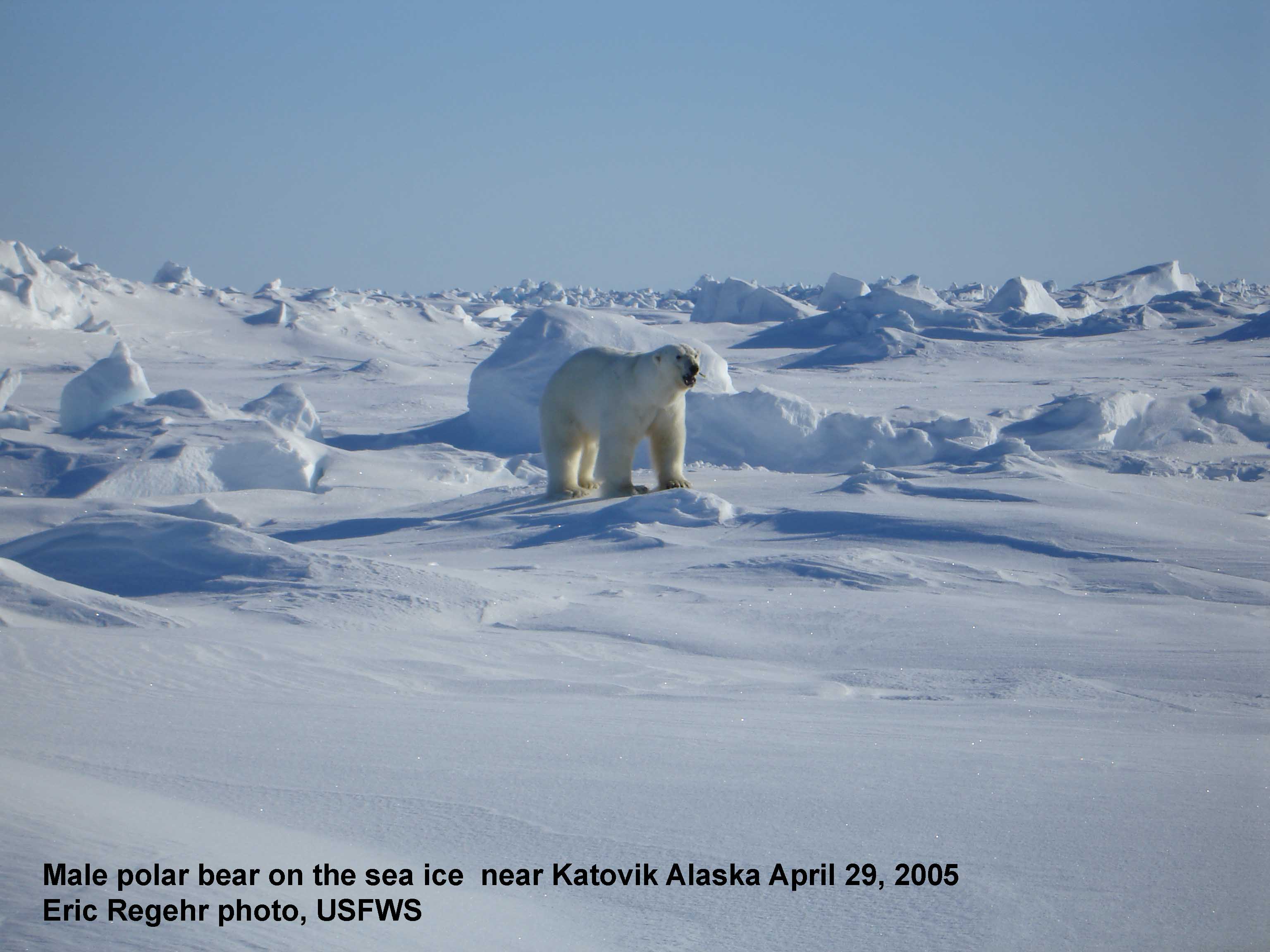
Polar_Bear_male on sea ice_Alaska Katovik Regehr photo_April 29, 2005_sm labeled

According to a Reuters report today (5 May 2015):

Seeking to reverse a ruling throwing out its designation of critical habitat for polar bears, the Obama administration has defended its decision to list large swathes of the Arctic as necessary for the conservation of the threatened species.

A coalition of oil industry groups and Alaska Natives, represented by Stoel Rives and Holland & Hart, successfully persuaded the U.S. District Court for Alaska to vacate the government’s polar bear habitat designation in 2013.” [my bold]

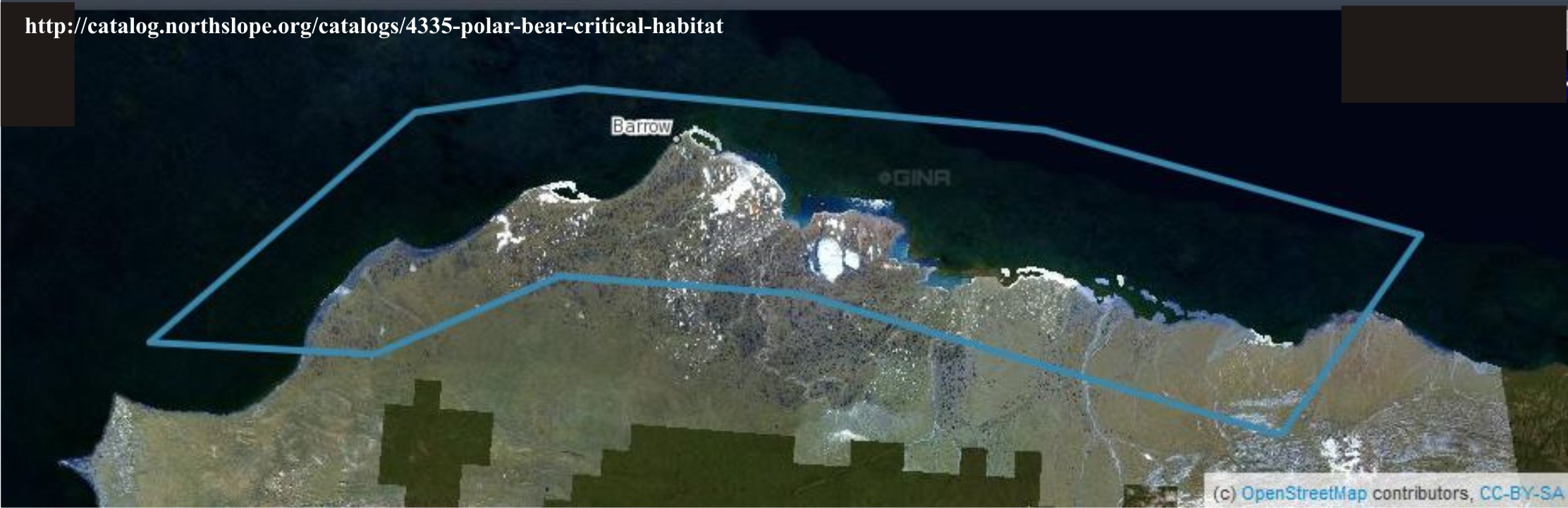
If they succeed, it would put most of the north coast of Alaska under special ESA rules, as the map below shows (click to enlarge).

Critical habitat Polar Bears US_NorthSlopeOrg map_labeled_PolarBearScience

As I commented previously, regarding the Obama administration’s recommendation to congress that they approve a proposed Arctic wildlife refuge area on Alaska’s North Slope, this move (if implemented) would not protect polar bears from the starvation deaths due to thick spring ice conditions that have occurred in this region for 2-3 years out of every 10 since 1960 at least.

The other issue is how much additional, biologically meaningful protection a critical habitat designation would provide for Southern Beaufort and Chukchi Sea polar bears – over and above that already provided by the Marine Mammal Protection Act.
Continue reading

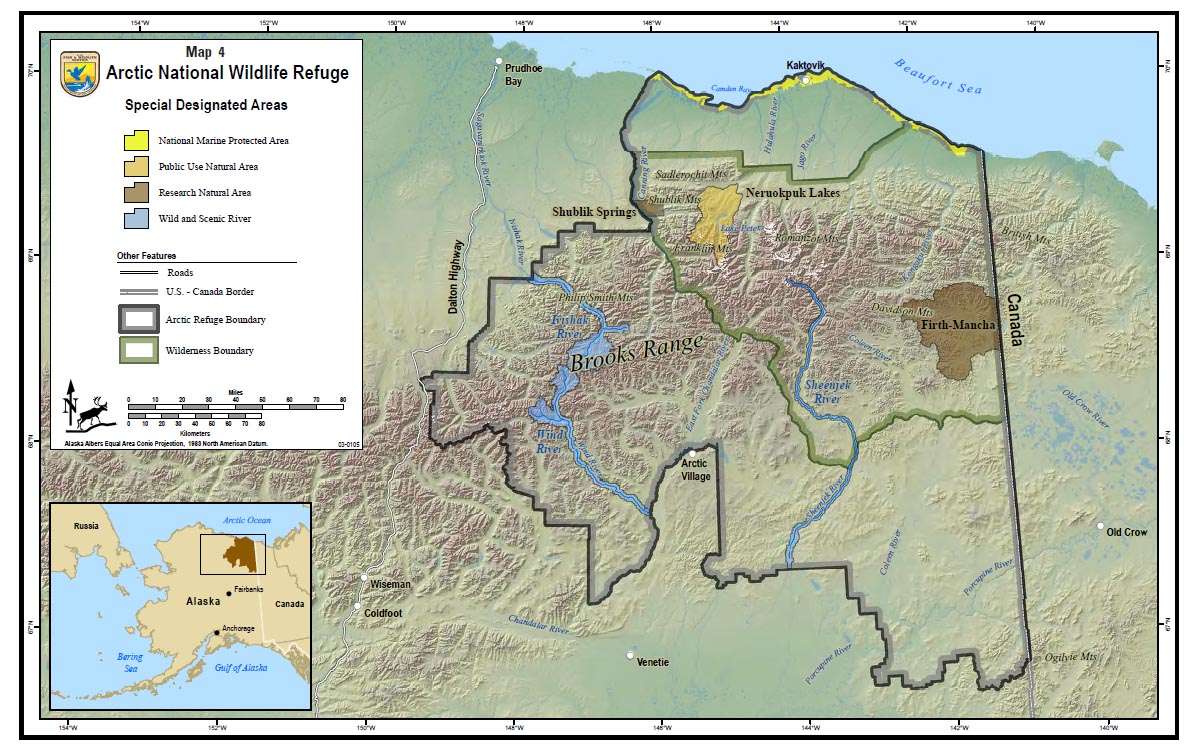
Arctic National Wildlife Refuge in Alaska won’t protect polar bears from thick spring ice

And the proposed coastal refuge won’t protect the denning areas of the majority of Southern Beaufort Sea polar bears, because most females den out on the sea ice, not on land.

Arctic Nat Wildlife Refuge proposed_USFWS_map 4 designated areas

The folks at Polar Bears International (PBI) are crowing with delight at the announcement today that US President Obama has recommended that congress approve plans to implement a proposed an Arctic wildlife refuge area that would include the Arctic coastal plain [see links below, including Obama video].

And in doing so, they mislead the public about how many polar bears use this region of coastal Alaska — as do the US Fish and Wildlife Service on their Refuge website.
Continue reading

Tracking polar bears in the Beaufort Sea – November 2014 map

Here is the November 2014 follow-up to my post on the July 2013 track map for female polar bears being followed by satellite in the Beaufort Sea by the US Geological Survey (USGS) – “Ten out of ten polar bears being tracked this summer in the Beaufort Sea are on the ice.”

See that post for methods and other background on this topic, and some track maps from 2012 (also available at the USGS website here). The USGS track map for November 2014 is copied below.

 Figure 1. Original caption: "Movements of 12 satellite-tagged polar bears for the month of November, 2014. Polar bears were tagged in 2014 on the spring-time sea ice of the southern Beaufort Sea. All twelve of these bears have satellite collar transmitters. Polar bear satellite telemetry data are shown with AMSR2 remotely-sensed ice coverage for 30 November, 2014." Click to enlarge, original here.


Original caption: “Movements of 12 satellite-tagged polar bears for the month of November, 2014. Polar bears were tagged in 2014 on the spring-time sea ice of the southern Beaufort Sea. All twelve of these bears have satellite collar transmitters. Polar bear satellite telemetry data are shown with AMSR2 remotely-sensed ice coverage for 30 November, 2014.” Click to enlarge, original here.

All twelve bears (all females) are finally visible on this map, confirming my suspicion that two were so close together they overlapped. Three out of the twelve “Southern Beaufort” bears were in the Chukchi Sea at the end of November (west of Point Lay, see discussion here). If you missed it, my October 2014 post on the progress of these bears has some maps from previous years that are worth reviewing.

Tracking polar bears in the Beaufort Sea – October 2014 map shows most ice since 2010

Here is the October 2014 follow-up to my post on the July 2013 track map for female polar bears being followed by satellite in the Beaufort Sea by the US Geological Survey (USGS) – “Ten out of ten polar bears being tracked this summer in the Beaufort Sea are on the ice.”

See that post for methods and other background on this topic, and some track maps from 2012 (also available at the USGS website here). The USGS track map for October 2014 is copied below (Fig. 1).

For the end of October, there was more ice in the Southern Beaufort this year than there has been since 2010.

Eight bears (all females) were on the ice and four were onshore. Only six of the eight on-ice bears were actually in the Southern Beaufort – the other two were in the Chukchi Sea (west of Point Lay, see discussion here).

Note that the recent boundary change between the Southern and Northern Beaufort subpopulations (the US/Canada boundary of the Southern Beaufort), reported here, has not addressed the fact that many western “Southern Beaufort” bears move into the Chukchi Sea. Continue reading

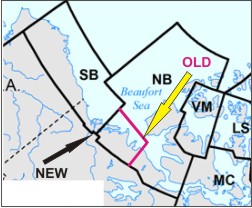
Beaufort Sea polar bear subpopulation boundary has been changed

Environment Canada recently posted a set of maps on its website that show it has moved the boundary between the polar bear subpopulation it shares with the USA — without a word to the media or a note anywhere.

EC S_N Beaufort boundary change Sept 8 2014_cropped PolarBearScience

Continue reading

Walrus mass haulout hype refuted, the video

Produced by the Global Warming Policy Foundation, there is now a short video summary of my recently-released GWPF briefing paper, which I wrote and narrated.

Walrus fuss_GWPF video Crockford

Watch it below:

Available also at GWPF TV“The Walrus Fuss – Walrus haulouts are nothing new.”

The briefing paper is here.

Save