Posted onJuly 8, 2015|Comments Off on Polar bear doom and gloom from USGS vs. biologist Mitch Taylor’s reasoned thoughts
A few days ago polar bear biologist Mitch Taylor and Nunavut’s Gabriel Niryungaluk talked to Toronto radio host Roy Green about the recent USGS dire model predictionsfor the future of polar bears.
There’s an audio podcast and, courtesy of the valuable efforts of fellow blogger Alex Cull, a transcript. Links below, plus some excerpts of Mitch Taylor’s commentary. Continue reading →
Comments Off on Polar bear doom and gloom from USGS vs. biologist Mitch Taylor’s reasoned thoughts
Posted onJuly 7, 2015|Comments Off on Polar bears fine now but give us more money: US Fish & Wildlife Management Plan subtext
Between-the-lines message of the recently released (and hyped to death) Conservation Management Plan for polar bears by the US Fish & Wildlife Service is that the bears really have nothing to worry about except human-caused global warming but it will cost tens of millions of dollars over the next five years to study and manage them.
So filled with double-speak, misinformation, and obfuscation [including the newly-invented term, “quasi-extinction floor”] that it’s no wonder some news outlets got it wrong (nowhere in this document does it say that “polar bears might go extinct within ten years“). The document does, however, lay out the FWS budget for polar bears over the next five years – and it’s a real eye-opener.
Posted onJuly 5, 2015|Comments Off on Tracking polar bears in the Southern Beaufort June 2015 – all 17 bears out on the sea ice
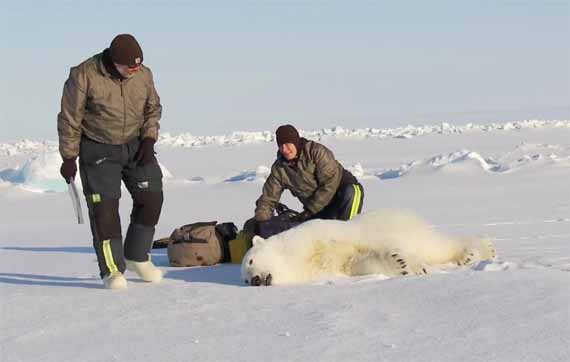
Sixteen females with satellite collars plus one with a glue-on transmitter – down from 17 with collars and 6 with tags last month – all out on the ice during the month of June 2015.
Polar bears were captured by USGS biologists in 2014 and 2015 on the spring-time sea ice of the southern Beaufort Sea. The glue-on tags don’t seem to be holding up very well, with only one remaining out of the original eight deployed this spring. Continue reading
Comments Off on Tracking polar bears in the Southern Beaufort June 2015 – all 17 bears out on the sea ice
Posted onJuly 1, 2015|Comments Off on Hudson Bay breakup later than average, longer hunting season for polar bears
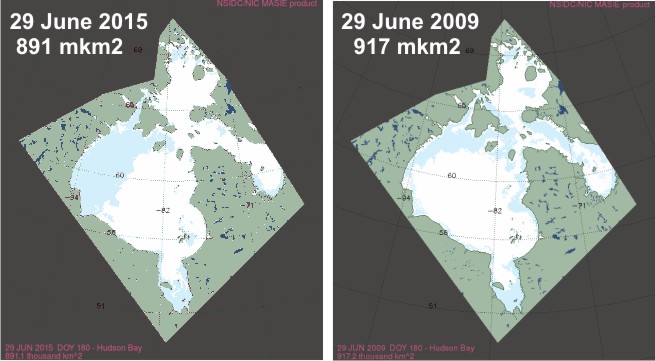
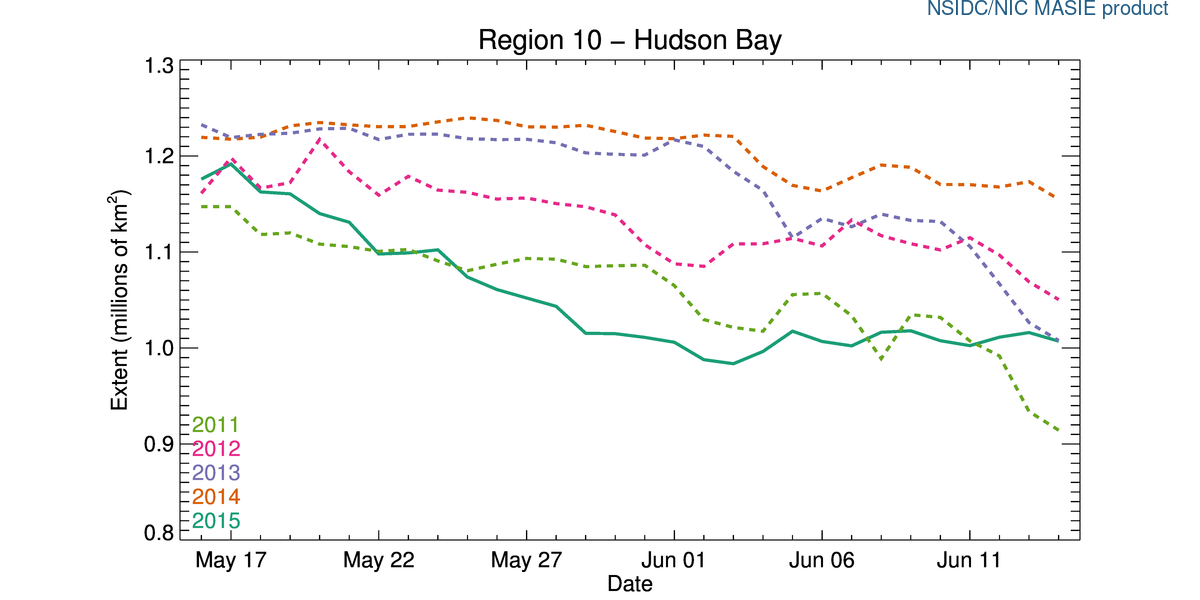
Due to the atypical pattern of sea ice melt on Hudson Bay this year, 2015 will definitely be a later than average breakup year – perhaps not as late as 1992 but maybe almost as late as 2009. Easing into the first days of Arctic summer, there is still a lot of polar bear habitat left on Hudson Bay, especially in the east.
Although official breakup in 2009 was only a little later than usual (9 July), bears came ashore about the same time (after mid-August) as they did in 1992, when breakup was very late (30 July). With the pattern this year being so unusual (and the melt so slow over the last few weeks), who knows how late it could be before the last bears leave the ice in 2015?
There is definitely more sea ice this year on the bay than there was last year, when breakup was about average for the last 24 years.
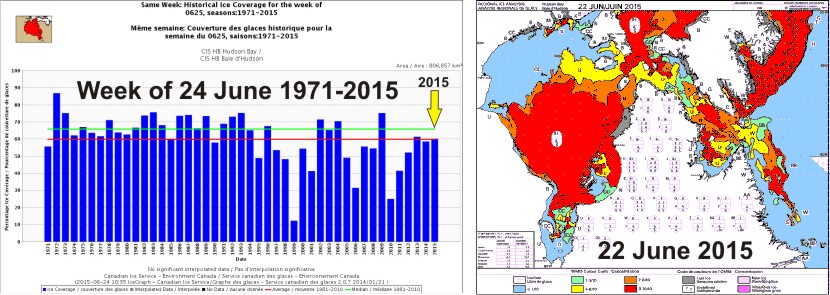
UPDATE 2 July 2015: CIS weekly ice coverage graphs added to the end of this post. Hudson Bay ice highest since 2009 and Davis Strait highest since 1994! Have a look. Continue reading
Comments Off on Hudson Bay breakup later than average, longer hunting season for polar bears
Posted onJune 30, 2015|Comments Off on USGS promotes another flawed polar bear model: GHG emissions still “primary threat”
It’s still based on the same flawed ecological premise as all previous models – it assumes that sea ice was a naturally stable habitat until human-caused global warming came along. It also uses slight-of-hand maneuvers to correlate declining summer sea ice and declining polar bear population numbers.
Just because they keep repeating the same hype doesn’t make it true. Continue reading
Comments Off on USGS promotes another flawed polar bear model: GHG emissions still “primary threat”
Posted onJune 25, 2015|Comments Off on Polar bear habitat update: many bears on the ice in Hudson Bay, lots of sea ice globally
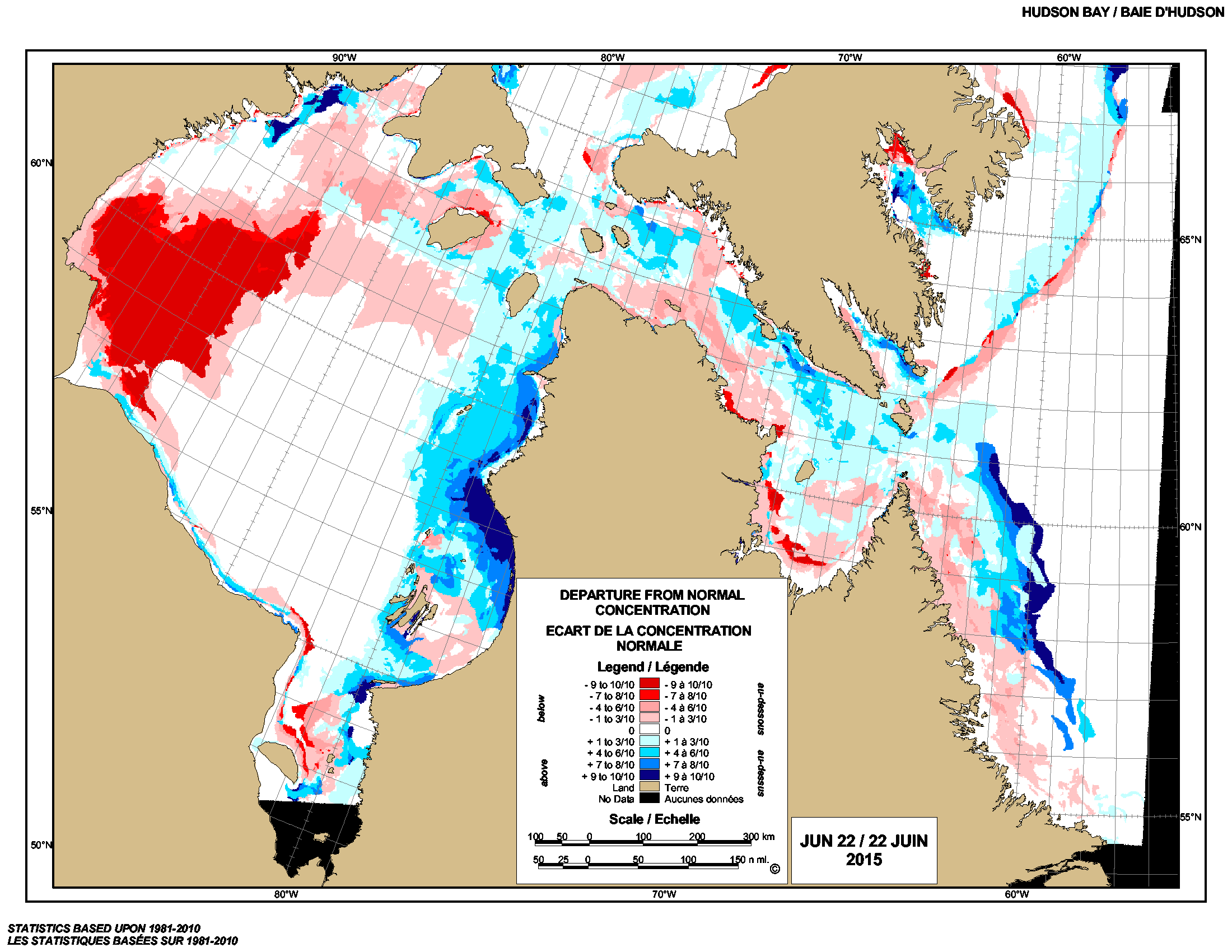
Polar bear habitat over Hudson Bay was average this week (at 60% coverage), despite the odd pattern of breakup – but the end of spring in the Arctic is only 5 days away and there is still plenty of polar bear habitat in all regions.
According to the Canadian Ice Service (CIS), there is still more ice in the eastern portion of the bay than usual and much less in the northwest (Fig. 1 below). There is far more ice than average ice in Hudson Strait, the approach to southern Davis Strait.
Figure 1. Hudson Bay sea ice, difference from average at 22 June 2015. Blue is less than average, red is more than average. CIS. Click to enlarge.
Posted onJune 24, 2015|Comments Off on Many polar bears cubs seen in Svalbard this year, says Norwegian biologist
Good news from Norway: polar bears around Svalbard are in excellent condition this spring and many females with new cubs have been spotted. This is a marked turn around from conditions just last year.
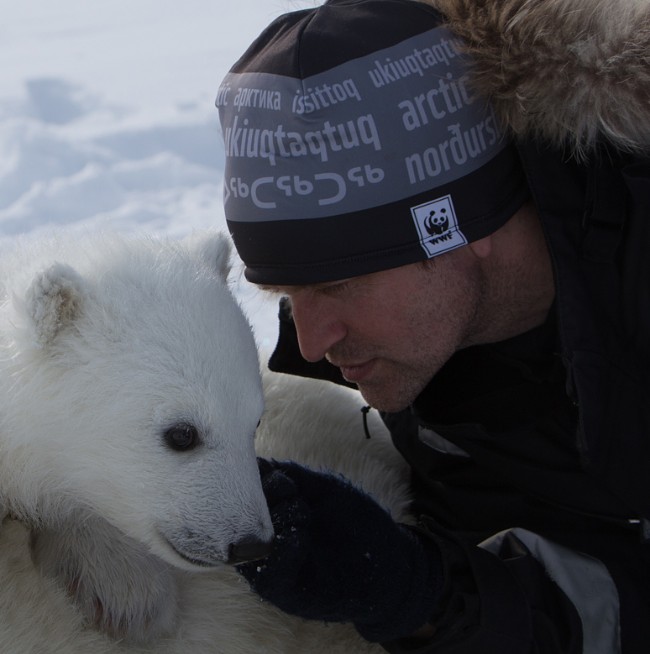
According to a Norwegian news outlet yesterday, Jon Aars (Fig. 1, below), from the Norwegian Polar Institute, confirms that this has been an excellent year for polar bear cubs around Svalbard because there has been abundant sea ice near denning areas on the east coast.
Posted onJune 21, 2015|Comments Off on Polar bear news: 1st fat bear ashore in WHB, trouble in S. Greenland, and more hybrid hype
Last week, among other events, the first fat polar bear of the season was photographed on shore in Western Hudson Bay, a fat bear was run out of town in South Greenland, and media outlets spread misinformation – apparently preferring global warming hype to rational facts.
1) First polar bears have been seen onshore in Western Hudson Bay in Wapusk National Park near Cape Churchill (map below) on 18 June this year, apparently fat and well prepared for the summer fast. My informants tell me a few bears usually come ashore in June near Churchill before ice conditions make this necessary; the bulk of the population will probably continue seal hunting for a few more weeks. Those bears will come ashore along the southwest coast (near Polar Bear Provincial Park, in Ontario, see Fig. 2 below). They’ll make their way north to the Churchill area in time for freeze-up in the fall. Watch one fat bear caught on camera on 18 June, below :
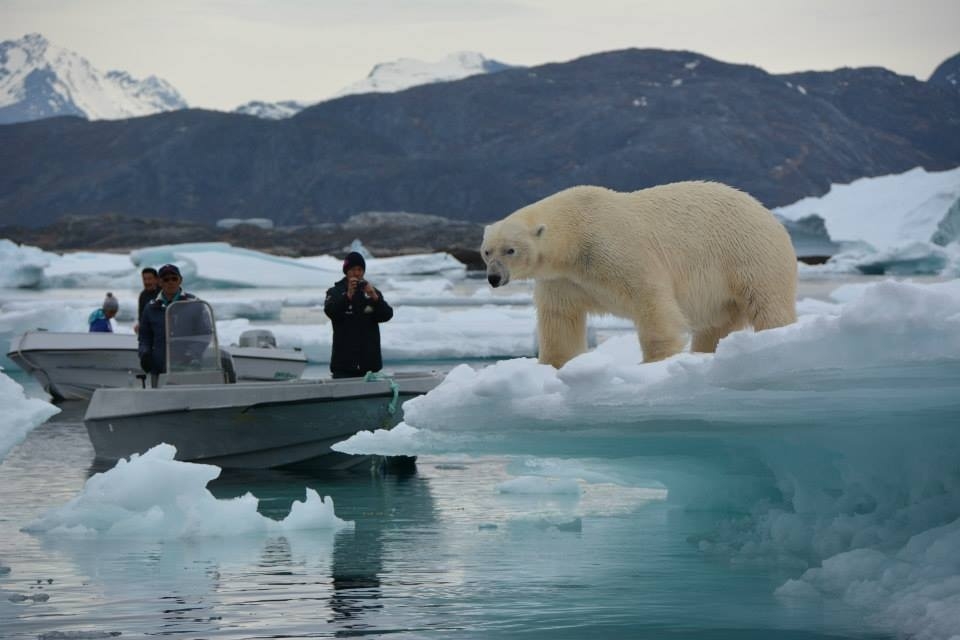
2) Fat polar bear spotted in Nanortalik, Southern Greenland 18 June 2015, a bit further south than usual. People from the community drove it away, but not before taking lots of pictures.
Some very cool photos, including the one above (taken by Henrik Hansen), worth a look. This bear was in excellent condition, well prepared for the summer fast ahead, whether he ends up spending it on shore somewhere (but not near this community!) or on the sea ice further north in SE Greenland (Fig. 1 below). The ice in that areas is probably broken up (~15-30% concentration) but this is enough for the bear to swim from flow to flow to make it’s way up the northeast coast where most East Greenland bears spend the summer. Continue reading
Comments Off on Polar bear news: 1st fat bear ashore in WHB, trouble in S. Greenland, and more hybrid hype
There is also more ice over Hudson Bay than there was in 2011, which was an early breakup year (charts for other Arctic regionshere, originals here).
Andrew Derocher notes (via twitter) that rather than heading to shore, most of the Hudson Bay bears with satellite tracking collars (7/10) are out on the ice (Fig. 1 below). They appear to be hunting along the ice edge, where they are most likely to find seals.
Update 17 June 2015:Sea ice images for the week 18 June 2015 compared to other years added below, for Hudson Bay and the Beaufort Sea.
Posted onJune 12, 2015|Comments Off on Polar bear behaviour gets the animal tragedy porn treatment – two new papers
Recently, several polar bear biologists have teamed up with photographers to get pictures of starving bears into the scientific literature – and picked up by the media, with mixed results.
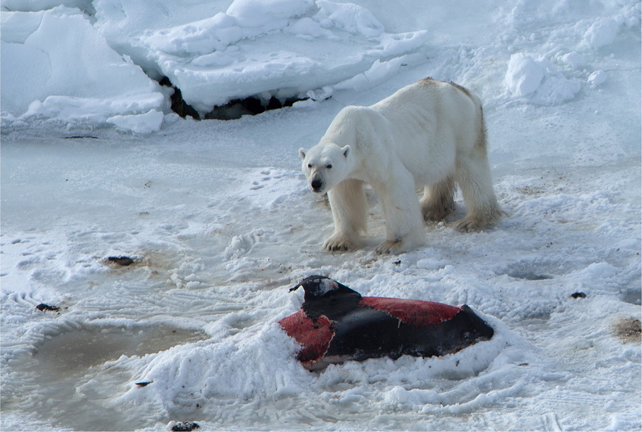
For the second time in five years, polar bear biologist Ian Stirling has teamed up with a photographer to give unwarranted scientific credence to an anecdotal account of polar bear behaviour. It included a picture of a pitifully thin animal (classic animal tragedy porn)and was framed to increase alarm over predicted effects of global warming. It got little media attention.
His Norwegian colleagues Jon Aars and Magnus Andersen have just done the same with a bear caught eating a white-beaked dolphin (photo above) – but this time the media took the bait.
Update 13 June 2015 – Information added on white-beaked dolphin distribution, sea ice conditions in 2014 and a correction. See below. Continue reading
Comments Off on Polar bear behaviour gets the animal tragedy porn treatment – two new papers
Watch polar bear habitat reform in the Canadian Arctic: “last 10 days” Canadian Ice Service animation (works anytime) HERE.
See Quote archive for details.







 polarbearscience
You must be logged in to post a comment.