Tag Archives: western hudson bay

Hudson Bay sea ice above average for this date – more good news for polar bears

It’s only the 4th of December and Hudson Bay ice formation is way up over late 2000s coverage for this date — and higher than 2012, which had the lowest overall September ice extent for the Arctic since 1978.
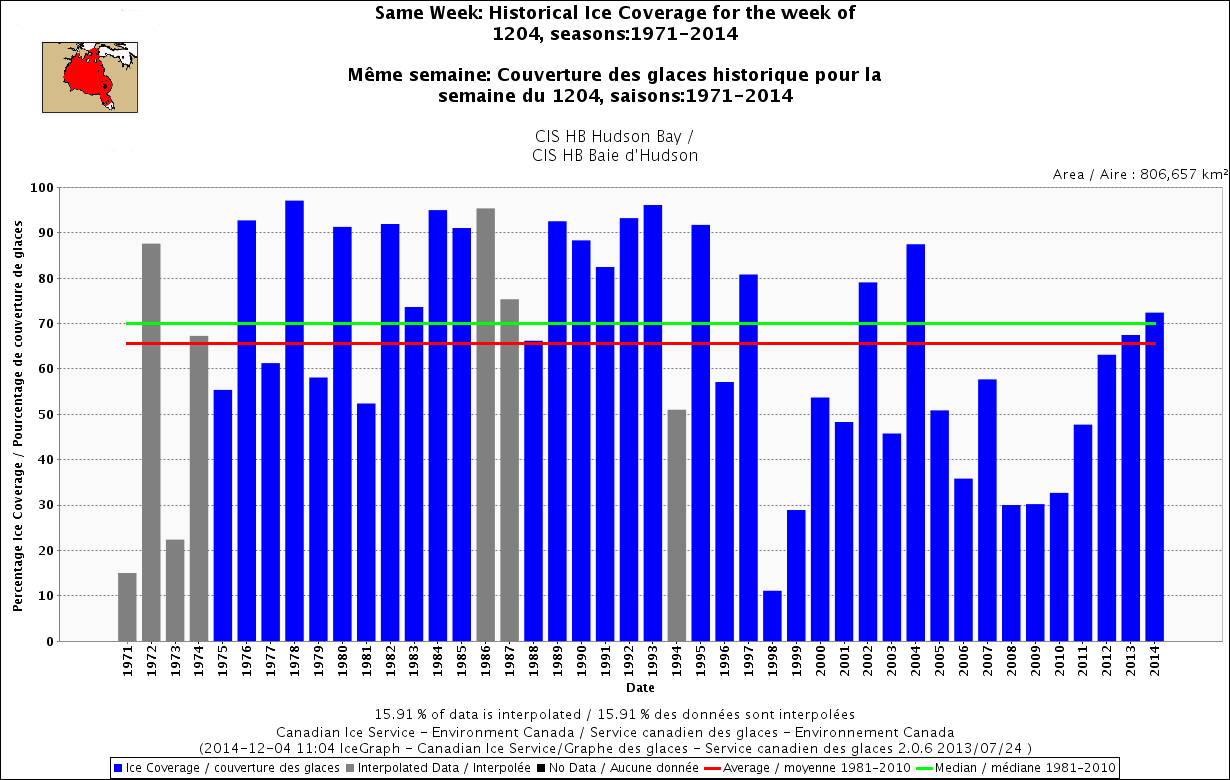
Hudson Bay freeze-up same week_Dec 4 1971_2014 w average

This means boom times for Western and Southern Hudson Bay polar bears as sea ice formation is several days to a week ahead of last year. And as I mentioned in my last post, average November ice coverage across the Arctic this year was higher than 2003. Don’t forget that 2/3’s of the world’s polar bears live in Canada (see recent status update here; map below).
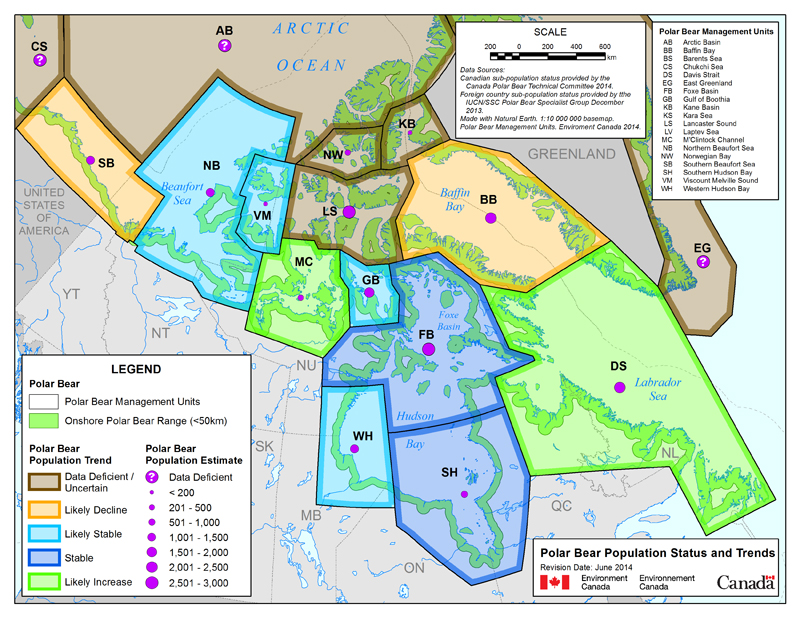
Figure 4. The Davis Strait (DS) subpopulation region runs from just below the Arctic Circle at the north end to at least 470N in the south. About half of DS lays at the same latitude as Western Hudson Bay (WH). Courtesy Environment Canada.

Polar bear population status in Canada. Courtesy Environment Canada.

More maps and charts below.
Continue reading
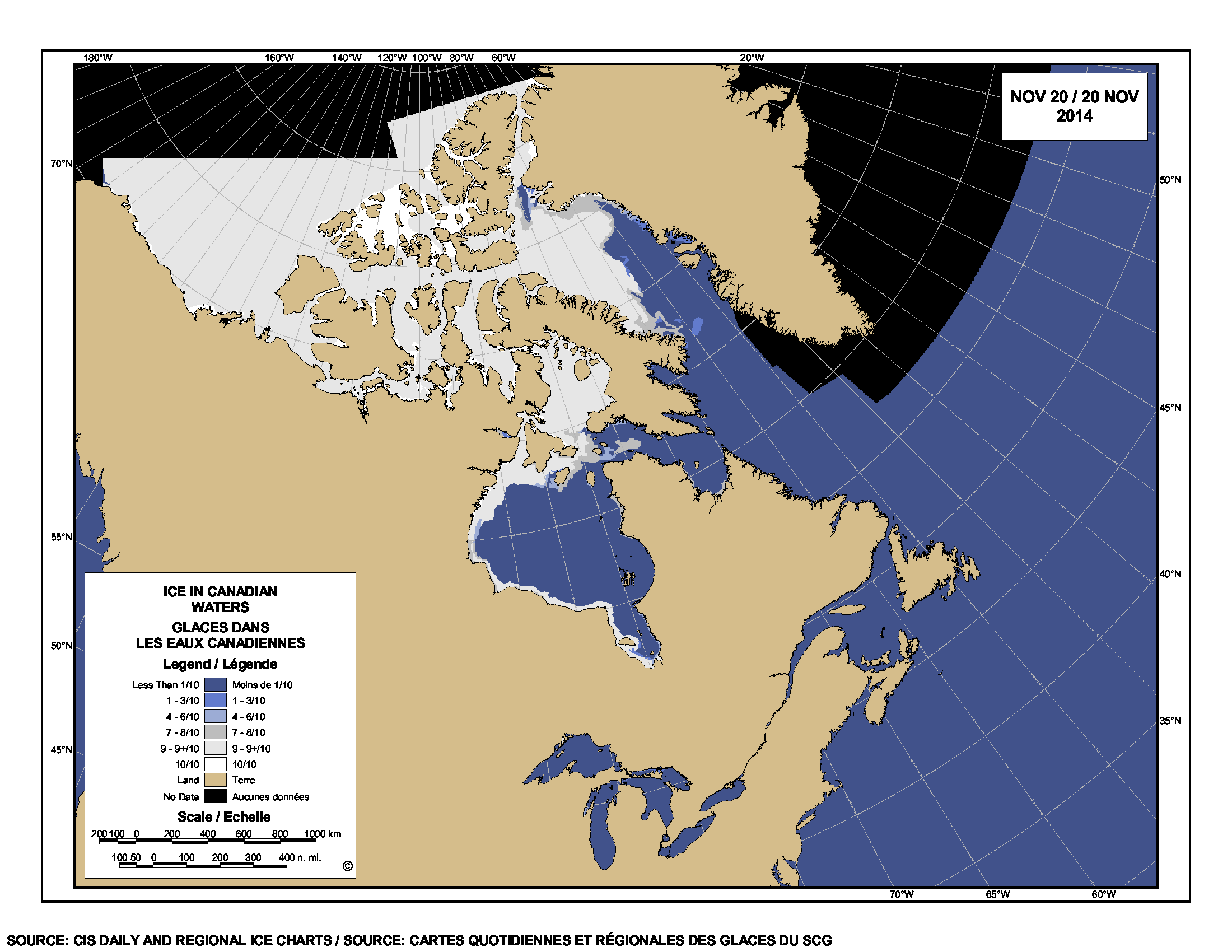
Hudson Bay freeze-up: way more ice for this day than in 2013

On this day (20 November 2014), there is way more sea ice over Hudson Bay and Foxe Basin than 2013, with ice starting to form in Hudson Strait.

The polar bears of Hudson Bay are on the ice (except pregnant females, who will be in their dens); Churchill polar bear season is over (see previous discussions here and here).

Ice maps and graph courtesy Canadian Ice Service.

Sea ice extent Canada 2014 Nov 20 CIS
Continue reading

Hudson Bay freeze-up update – most polar bears on the ice

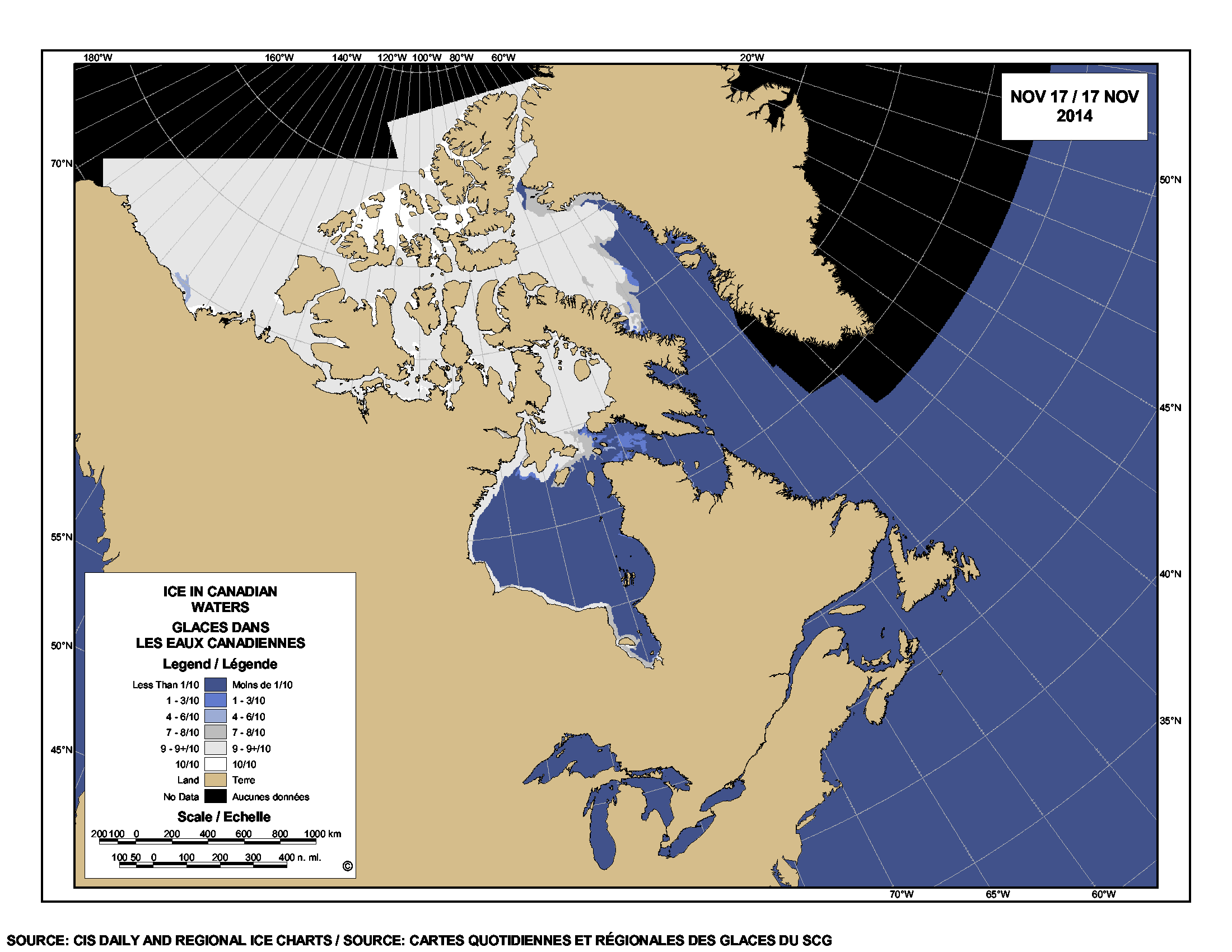
Latest sea ice maps and charts from the Canadian Ice Service show significant ice building quickly along the west coast of Hudson Bay, enough to allow polar bears out to hunt.

Kelsey Eliasson reported from Churchill earlier today that most of the polar bears have moved onto the ice.

Sea ice extent Canada 2014 Nov 17 CIS

Continue reading

A more optimistic view of Churchill polar bears and Hudson Bay freeze-up

Finally, an unbiased first-hand report about Churchill polar bears and freeze-up on Hudson Bay.

Over the last few weeks, biologists Andrew Derocher and Steve Amstrup have been repeating their tired old tales of doom and gloom about the polar bears around Churchill and I’ve done my best to refute the worst of their nonsense.

Figure 1. Polar bear female with cub, 2009, Churchill, Western Hudson Bay. Wikipedia.

Figure 1. Polar bear female with cub, 2009, Churchill, Western Hudson Bay. Wikipedia.

To that effort we can now add this report from PolarBearAlley, where Kelsey Eliasson has posted a good-news story about the bears of Cape Churchill and the progress of freeze-up, including sightings of a number of mothers with cubs.
Continue reading

Polar bear specialist says there are 800 polar bears in W Hudson Bay, gov’t says ~1,000-1,500

Activist polar bear biologist Andrew Derocher (University of Alberta) may have gone too far this time. In an interview with Yahoo News, Derocher is quoted as saying:

“When I first started here about 30 years ago the population was about 1,200 bears and now we’re down to about 800,” team member Andrew Derocher, a biology professor at the University of Alberta, said in a phone interview from the tundra outside Churchill.”  [my bold]

Figure 4. Environment Canada's "Map 3: 2014 Canadian Polar Bear Subpopulation and Status Map," original here.

Environment Canada’s “Map 3: 2014 Canadian Polar Bear Subpopulation and Status Map,” original here. Click to enlarge.

However, the Polar Bear Technical Committee of Environment Canada says differently: it estimates there are ~1000-1,500 bears in Western Hudson Bay (WH) and that the population is probably stable, as their new status map (dated June 2014, copied above) shows. A recent (2014) peer-reviewed paper by Stapleton and colleagues (discussed here) provides the data for that estimate.
Continue reading

Polar bear biologists doing mark-recapture work in Hudson Bay may have misled the world

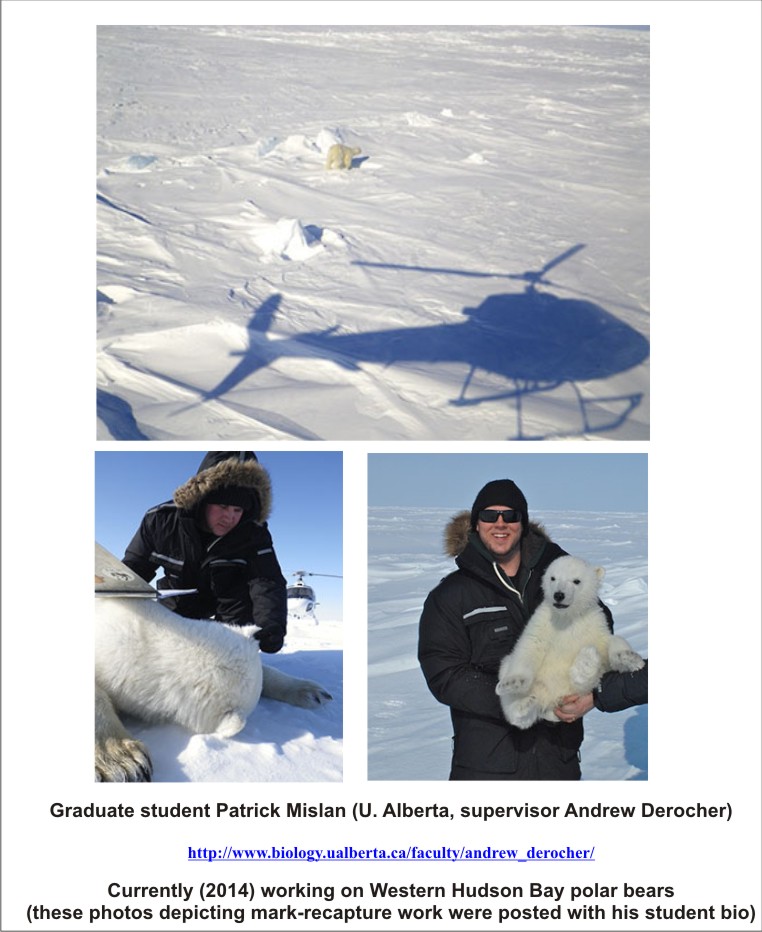
What exactly are Western Hudson Bay (WHB) polar bear researchers hiding? Since 2004, research on the body condition and cub production of Western Hudson Bay (WHB) polar bears has been carried out but none of the results of these mark-recapture studies have been made public.

U Alberta student Mislan bio photos_PolarBearScience

The researchers all claim that WHB polar bears are struggling to survive because of recent sea ice changes but won’t release the 10 years worth of updated information they possess on the bears or the sea ice.

Continue reading

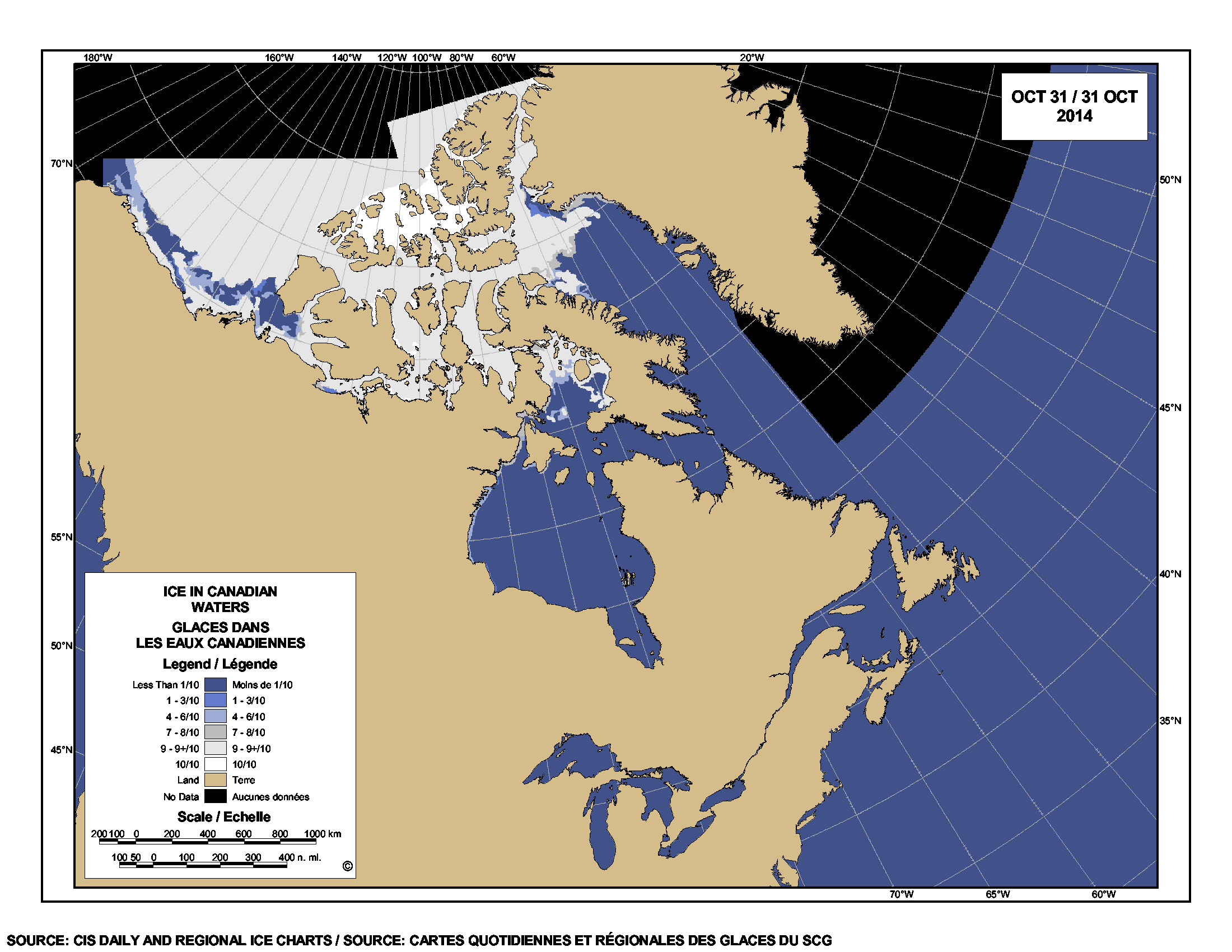
Polar bear habitat update – Sea ice starting to form on Hudson Bay

Is that ice I see forming along the shore of Hudson Bay, just in time for Hallowe’en? Not enough to resume hunting but a sign that freeze-up can’t be too far off. See the ice map below and this photo posted at PolarBearAlley confirming the presence of slushy ice on the shore near Churchill.

Sea ice extent Canada 2014 Oct 31 CIS

[Map above from Canadian Ice Service updated daily, click to enlarge]

Continue reading

W Hudson Bay polar bear population no longer “declining” – where are the headlines?

Why are the #saveourseaice folks at Polar Bears International, who have being working in Western Hudson Bay for decades, not dancing in the streets of Churchill? Environment Canada’s Polar Bear Technical Committee upgraded the status of Western Hudson Bay polar bears from “declining” to “likely stable” four months ago (details here). Why has this fabulous news not made major headlines around the world?

Figure 4. Environment Canada's "Map 3: 2014 Canadian Polar Bear Subpopulation and Status Map," original here.

Figure 1. Environment Canada’s “Map 3: 2014 Canadian Polar Bear Subpopulation and Status Map,” original here. Western Hudson Bay is “WH.”

After years of being told by polar bear specialists and activists organizations like Polar Bears International and the World Wildlife Fund that the Western Hudson Bay (WHB) population is already suffering mightily because of global warming, it now appears that is far from the truth.

Continue reading

Status of Canadian polar bear populations has been changed – more good news

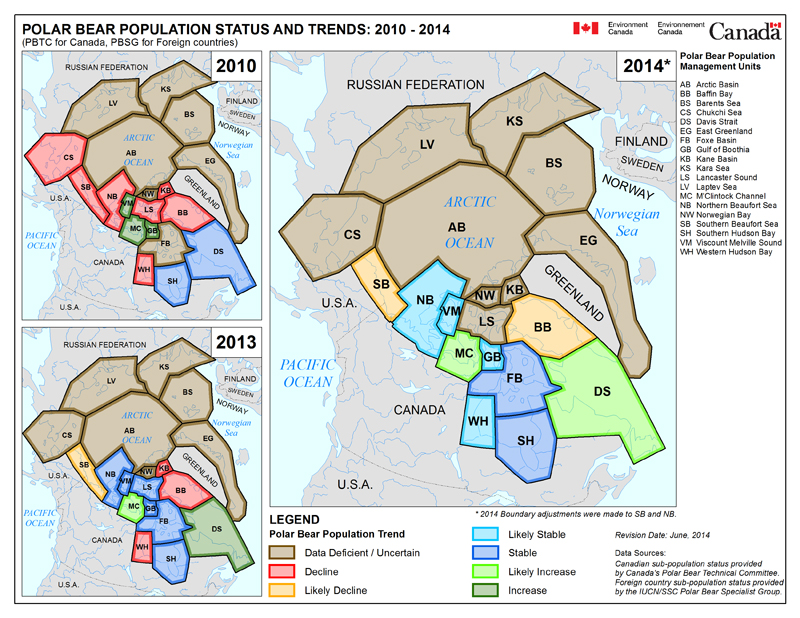
According to maps dated June 2014, Environment Canada (EC) has changed the trend status of several Canadian subpopulations — without any announcement or publicly-available documents explaining the basis of the changes.

Figure 3. "Series of Circumpolar Polar Bear Subpopulation and Status Trend Maps 2010, 2013 & 2014" Note the asterisk below the 2014 map, which is dated "June 2014" and is different in its status assessment from the one released in February 2013 by the PBSG. Original here.

Figure 1. Environment Canada’s “Map 4: Series of Circumpolar Polar Bear Subpopulation and Status Trend Maps 2010, 2013 & 2014.” Original here.

And would it surprise you to learn that virtually all of these status changes reveal more good news about polar bears?
Continue reading

Churchill problem bears and early breakup dates in WHB: The 1983 & 2004 anomalies

In this part of my critique of Stirling and Parkinson (2006), regarding breakup dates in Western Hudson Bay (see Part I here), I will show that these authors also left out critical data.

Figure 1. A bear is transported to Churchill’s polar bear holding facility, from a 2011 Huffington Post article “Polar Bear Prison.”

Figure 1. A bear is transported to Churchill’s polar bear holding facility, from a 2011 Huffington Post article “Polar Bear Prison.”

Their correlation between number of problem bears in Churchill and breakup dates for WHB worked because some very inconvenient data were simply left out: problem bear data for 1983 and 2004.

Inclusion of that information would have shown 1983 and 2004 were two of the worst years for polar bear problems in recent history despite being late breakup years (1983 also had the last human fatality from a polar bear attack). They could have explained why they did not use the data but they did not — they simply left it out.

Amazingly, this work is being touted as “evidence” that global warming is harming Western Hudson Bay polar bears.
Continue reading