Tag Archives: freeze-up

Well-fed polar bears onshore at height of summer easily deterred by noise, CBC reports

From the CBC this morning, we have the report of a female polar bear and her cub paying a visit to an Nunavut campsite near Chesterfield Inlet in northwestern Hudson Bay, which is technically within the boundary of the Foxe Basin polar bear subpopulation.

Maggie Putulik photo, 29 July 2015 Chesterfield Inlet, Nunavut.

Maggie Putulik photo, 29 July 2015 Chesterfield Inlet, Nunavut.

These are not the desperate bear victims of global warming we have been warned about by polar bear specialists but well-fed curious ursids not averse to an easy meal if there’s one to be had. Such bears are easily deterred by a loud noise. Note this was the second visit by polar bears this Nunavut family had experienced at this location within a three-week period – two other bears had stopped by earlier. Note that ice in this region of Hudson Bay broke up earlier than usual this year yet these bears seem to be in fine condition and can expect the first fall ice of the season (freeze-up) to appear in their neighbourhood, see maps below.
Continue reading
Keeping track of problem bears in Churchill

The City of Churchill has recently taken to posting its problem bear reports on its Facebook page. This is something to keep an eye on, so let’s catch up so that future reports can be put into context.

Figure 1. A bear is transported to Churchill’s polar bear holding facility, from a 2011 Huffington Post article “Polar Bear Prison.”

Photo above:  A bear is transported to Churchill’s polar bear holding facility (from a 2011 Huffington Post article, “Polar Bear Prison”).

Continue reading

Challenging NOAA’s “Arctic Report Card 2014” on polar bears

NOAA’s list of purported evidence for harm being caused to polar bears by Arctic warming is short and weak. It puts the gloomiest spin possible on the current well-being of an animal with all the earmarks of a healthy, well-distributed species.

Arctic report card 2014 screencap_Dec 18 2014

This year, polar bears are virtually the only species that NOAA mentions in their Arctic Report Card – they’ve put all their icon-eggs in one leaky basket [what happened to walrus??]. But polar bears are doing so well that to make an alarming case for polar bears as victims of Arctic warming, many important caveats had to be left out or misrepresented. Some details given are simply wrong.

This year’s polar bear chapter was penned by IUCN Polar Bear Specialist Group chairman Dag Vongraven (you might recall his email to me earlier this year) and a polar bear conservation activist from Polar Bears International (whose battle cry for donations is Save Our Sea Ice!”), Geoff York.

I challenge their four weak talking points one by one below.

Continue reading

Hudson Bay sea ice above average for this date – more good news for polar bears

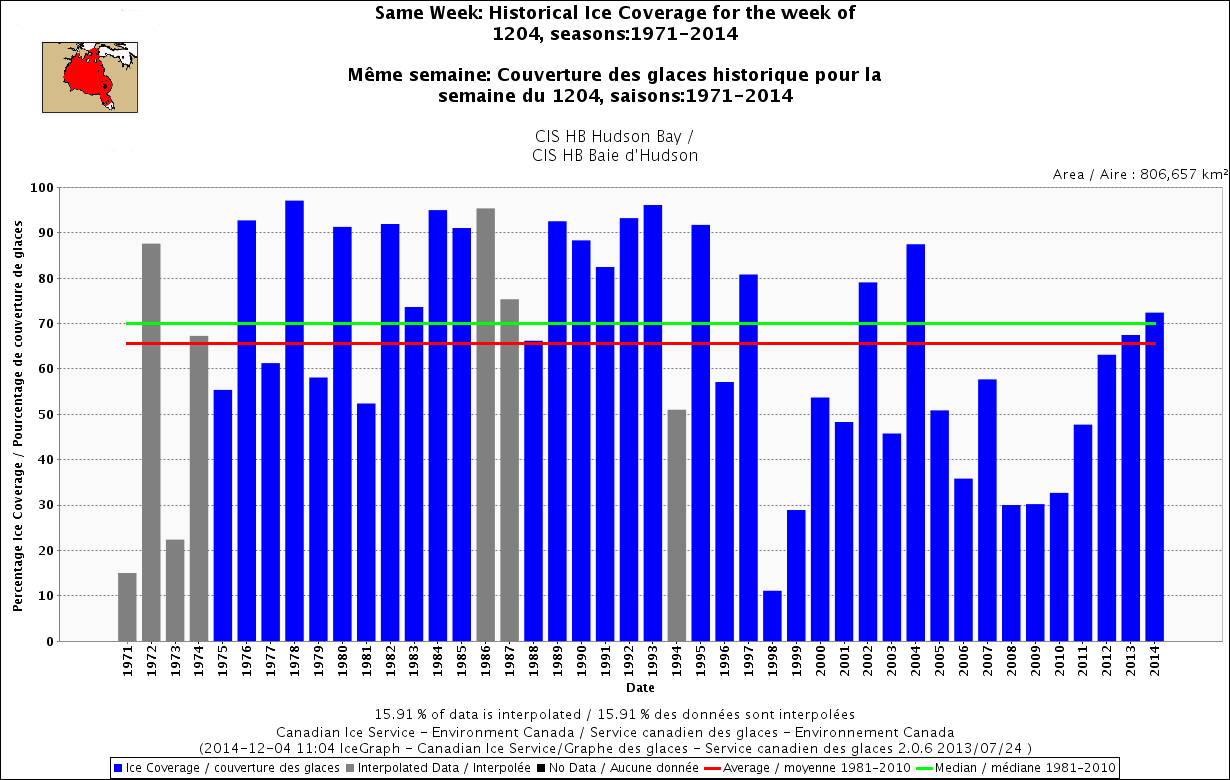
It’s only the 4th of December and Hudson Bay ice formation is way up over late 2000s coverage for this date — and higher than 2012, which had the lowest overall September ice extent for the Arctic since 1978.

Hudson Bay freeze-up same week_Dec 4 1971_2014 w average

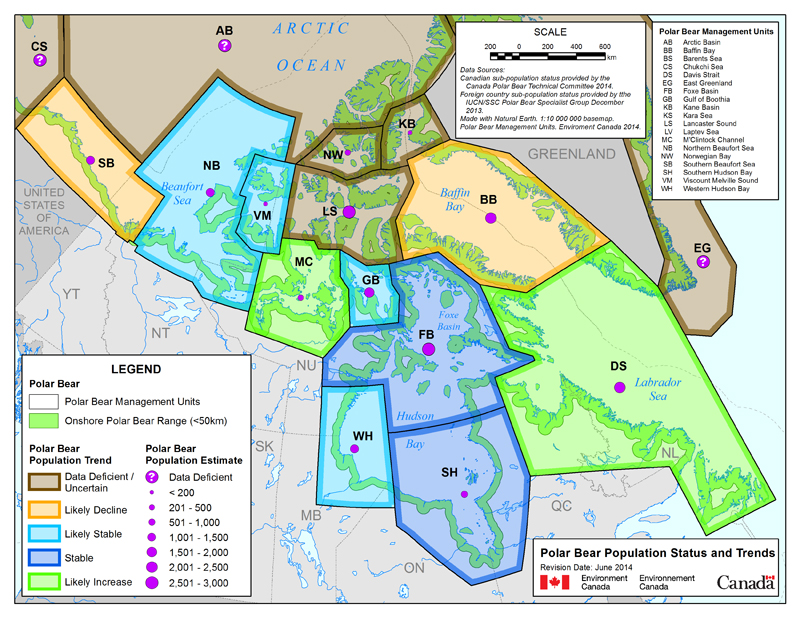
This means boom times for Western and Southern Hudson Bay polar bears as sea ice formation is several days to a week ahead of last year. And as I mentioned in my last post, average November ice coverage across the Arctic this year was higher than 2003. Don’t forget that 2/3’s of the world’s polar bears live in Canada (see recent status update here; map below).

Figure 4. The Davis Strait (DS) subpopulation region runs from just below the Arctic Circle at the north end to at least 470N in the south. About half of DS lays at the same latitude as Western Hudson Bay (WH). Courtesy Environment Canada.

Polar bear population status in Canada. Courtesy Environment Canada.

More maps and charts below.
Continue reading

Davis Strait polar bear habitat – the sea ice is forming, but it’s late!

Since 1971, there have been only two years with as little sea ice in Davis Strait as there was this year at this time – 2003 and 2010. But the ice is forming rapidly and history shows it will likely catch up enough by next week to allow most Davis Strait polar bears to start hunting seals except along the Labrador coast.

Courtesy IUCN PBSG

Courtesy IUCN PBSG

Have a look at the ice maps and charts below from the Canadian Ice Service for the status of freeze-up in Davis Strait.

UPDATE 30 November 2014: Sea ice extent map from NSIDC added.

Continue reading

Hudson Bay freeze-up: way more ice for this day than in 2013

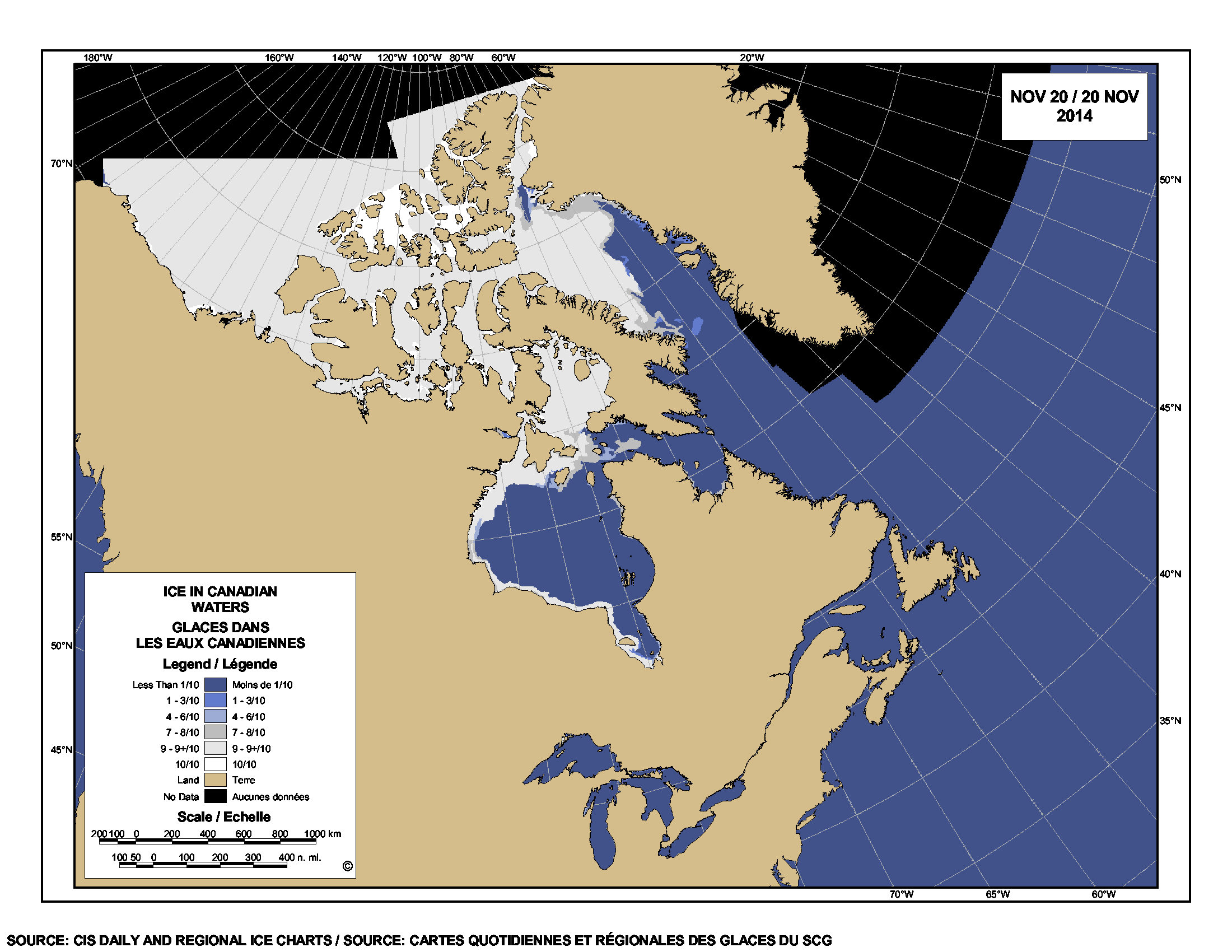
On this day (20 November 2014), there is way more sea ice over Hudson Bay and Foxe Basin than 2013, with ice starting to form in Hudson Strait.

The polar bears of Hudson Bay are on the ice (except pregnant females, who will be in their dens); Churchill polar bear season is over (see previous discussions here and here).

Ice maps and graph courtesy Canadian Ice Service.

Sea ice extent Canada 2014 Nov 20 CIS
Continue reading

Hudson Bay freeze-up update – most polar bears on the ice

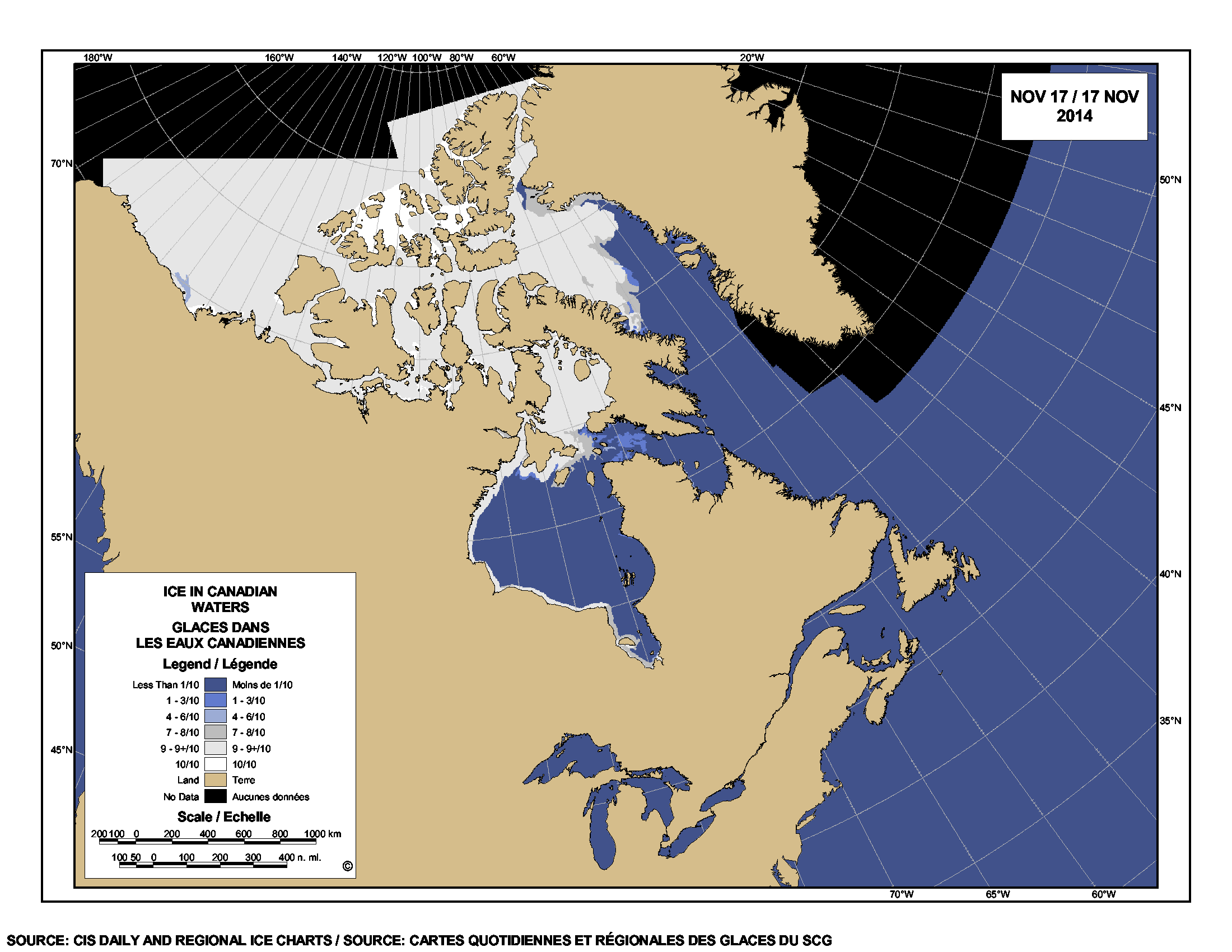
Latest sea ice maps and charts from the Canadian Ice Service show significant ice building quickly along the west coast of Hudson Bay, enough to allow polar bears out to hunt.

Kelsey Eliasson reported from Churchill earlier today that most of the polar bears have moved onto the ice.

Sea ice extent Canada 2014 Nov 17 CIS

Continue reading

Hudson Bay freeze-up 2014 – average again this year, not late

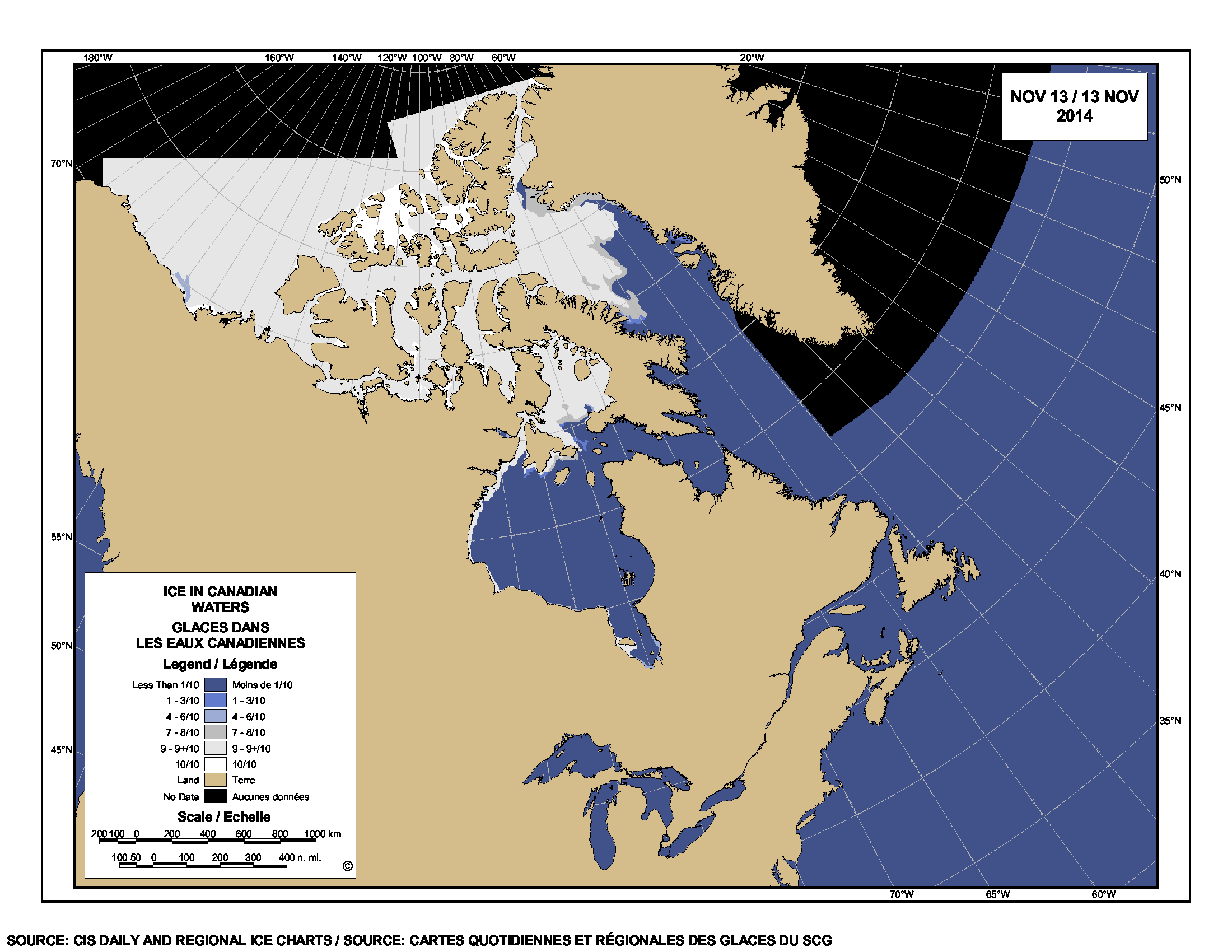
Freeze-up of Hudson Bay sea ice is well underway now, virtually the same time as it was the last three years, and in 2008. Bears in the north will be able to move out, while near Churchill and in Southern Hudson Bay, some bears will be able to successfully hunt for seals on the newly-formed ice close to shore.

Over the next week or so, all the bears onshore will gradually move out onto the ice as freeze-up progresses. By the time there is ~10% ice coverage on the bay, most bears will have moved onto the ice (except pregnant females that have made dens onshore).

The Arctic outbreak underway in over North America may hasten this process along (see 7-day and 14-day weather forecasts for Churchill). Ice maps below courtesy Canadian Ice Service.

Sea ice extent Canada 2014 Nov 13 CIS

It seems pretty clear now that time of freeze-up on Hudson Bay is not correlated with the extent of sea ice at the September minimum. Have a look at the maps and graphs below.  UPDATE: more recent maps added below (ice concentration 15 November; ice development 14 November).
Continue reading

A more optimistic view of Churchill polar bears and Hudson Bay freeze-up

Finally, an unbiased first-hand report about Churchill polar bears and freeze-up on Hudson Bay.

Over the last few weeks, biologists Andrew Derocher and Steve Amstrup have been repeating their tired old tales of doom and gloom about the polar bears around Churchill and I’ve done my best to refute the worst of their nonsense.

Figure 1. Polar bear female with cub, 2009, Churchill, Western Hudson Bay. Wikipedia.

Figure 1. Polar bear female with cub, 2009, Churchill, Western Hudson Bay. Wikipedia.

To that effort we can now add this report from PolarBearAlley, where Kelsey Eliasson has posted a good-news story about the bears of Cape Churchill and the progress of freeze-up, including sightings of a number of mothers with cubs.
Continue reading

Polar bear habitat update – Sea ice starting to form on Hudson Bay

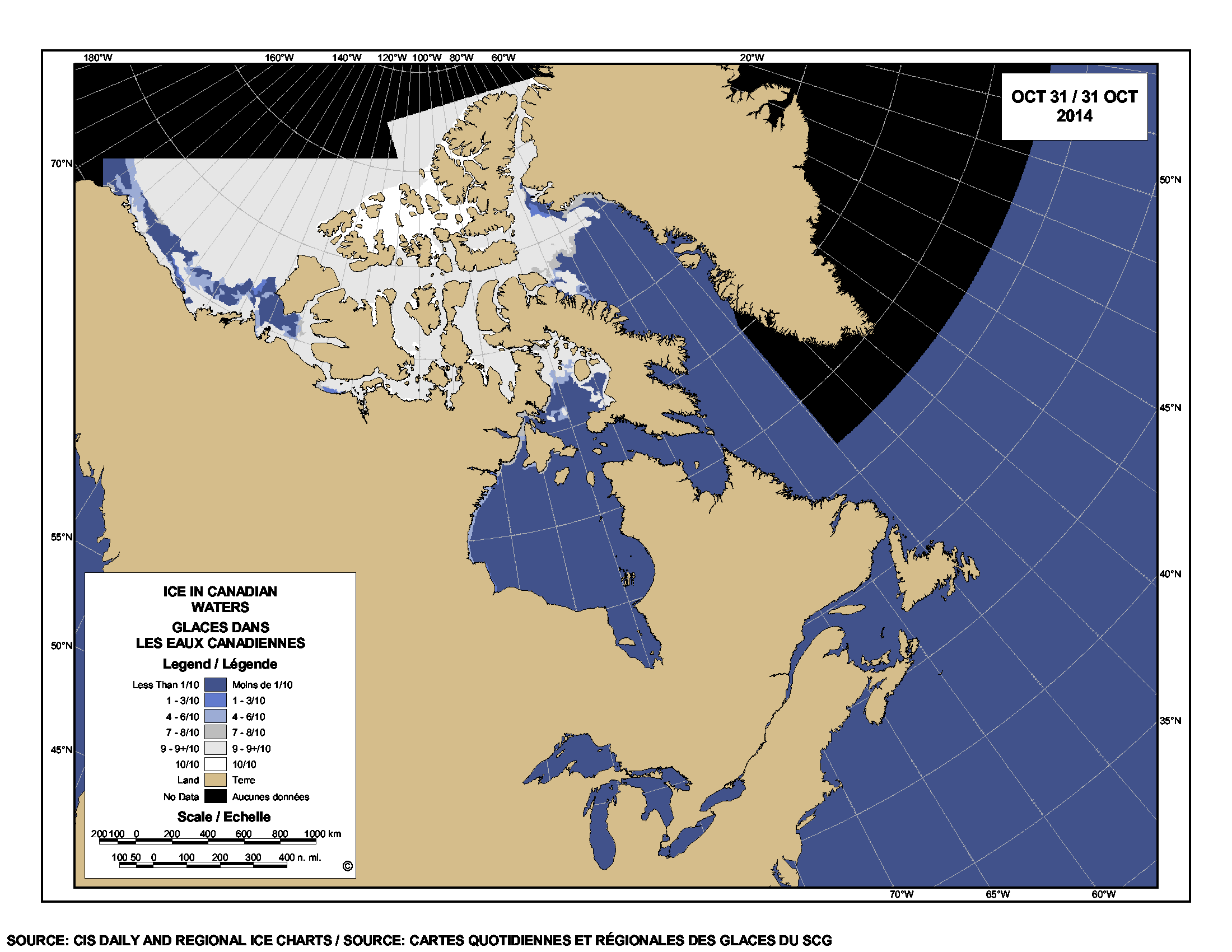
Is that ice I see forming along the shore of Hudson Bay, just in time for Hallowe’en? Not enough to resume hunting but a sign that freeze-up can’t be too far off. See the ice map below and this photo posted at PolarBearAlley confirming the presence of slushy ice on the shore near Churchill.

Sea ice extent Canada 2014 Oct 31 CIS

[Map above from Canadian Ice Service updated daily, click to enlarge]

Continue reading