Tag Archives: Arctic

Same amount of sea ice for Hudson Bay polar bears as 2013, bears still on the ice

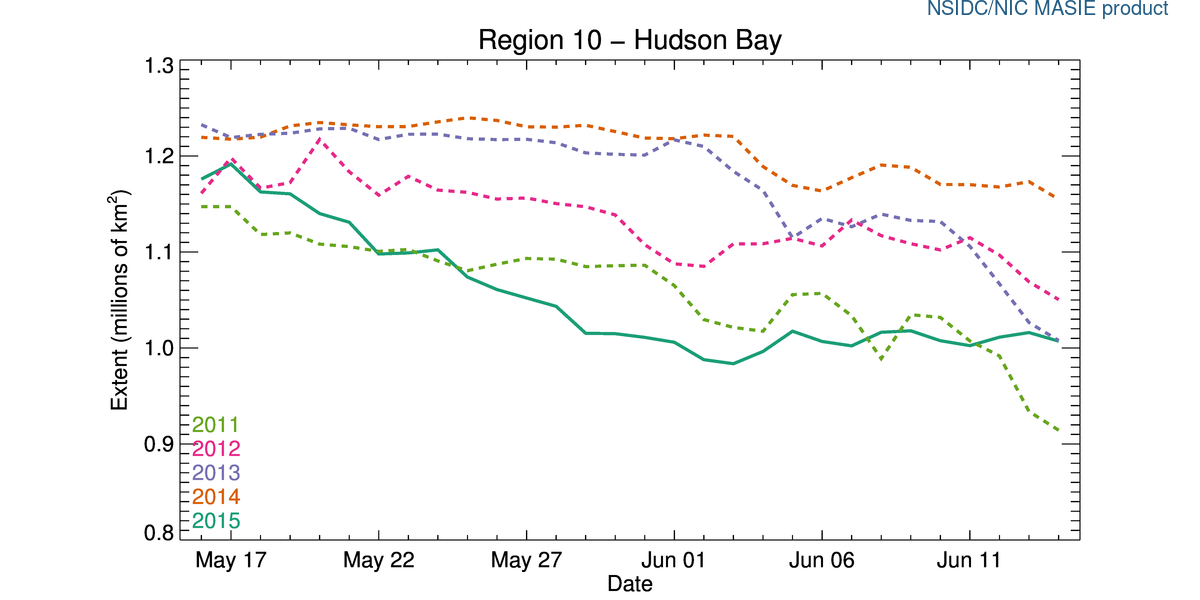
Sea ice coverage for Hudson Bay on 14 June converged on levels recorded in 2013, when breakup was slightly later than the average of the last two decades.

r10_Hudson_Bay_ts

There is also more ice over Hudson Bay than there was in 2011, which was an early breakup year (charts for other Arctic regions here, originals here).

Andrew Derocher notes (via twitter) that rather than heading to shore, most of the Hudson Bay bears with satellite tracking collars (7/10) are out on the ice (Fig. 1 below). They appear to be hunting along the ice edge, where they are most likely to find seals.

Update 17 June 2015: Sea ice images for the week 18 June 2015 compared to other years added below, for Hudson Bay and the Beaufort Sea.

Continue reading

Polar bear behaviour gets the animal tragedy porn treatment – two new papers

Recently, several polar bear biologists have teamed up with photographers to get pictures of starving bears into the scientific literature – and picked up by the media, with mixed results.

doi:10.3402/polar.v34.26612
For the second time in five years, polar bear biologist Ian Stirling has teamed up with a photographer to give unwarranted scientific credence to an anecdotal account of polar bear behaviour. It included a picture of a pitifully thin animal  (classic animal tragedy porn) and was framed to increase alarm over predicted effects of global warming. It got little media attention.

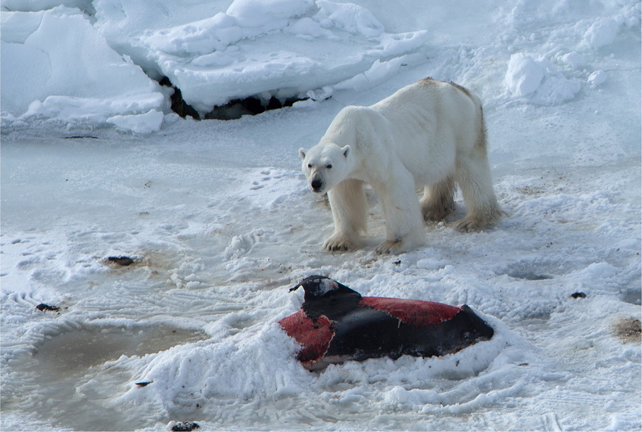
His Norwegian colleagues Jon Aars and Magnus Andersen have just done the same with a bear caught eating a white-beaked dolphin (photo above) – but this time the media took the bait.

Update 13 June 2015 – Information added on white-beaked dolphin distribution, sea ice conditions in 2014 and a correction. See below.
Continue reading

Beaufort Sea polynyas open two weeks before 1975 – open water is good news for polar bears

With masses of very thick, multiyear ice off Alaska this spring, the developing polynyas (open water) at either end of the Beaufort Sea are providing essential polar bear hunting habitat.
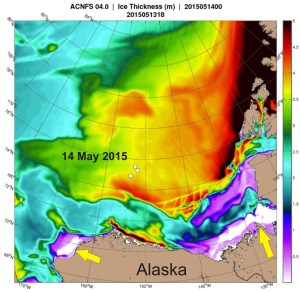
SB polynyas on ice thickness map 14 May 2015_PolarBearScience

Patches of open water in the Beaufort Sea are naturally recurring phenomena. This year we have two excellent examples, shown by the yellow arrows in the sea ice thickness map above (from the Naval Research Laboratory).

The eastern-most polynya forms in the Canadian portion of the Beaufort most years in the spring. This open water feature is so common it has a name – the Cape Bathurst polynya. Last year, there wasn’t an obvious polynya there until sometime in June, but in 1975, a patch of open water almost as large (or larger) as this year’s had developed by the end of May (Fig. 1).
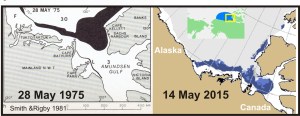
Figure 1. Cape Bathurst polynya at 28 May 1975 (Smith and Rigby 1981: Fig. 14h), with the extent probably underestimated, and the polynya this year at 14 May (Canadian Ice Service). Click to enlarge.

Figure 1. Cape Bathurst polynya at 28 May 1975 (Smith and Rigby 1981:Fig. 14h) and the polynya this year at 14 May (Canadian Ice Service). See discussion in the text below about the relative sizes. Click to enlarge.

According to the experts that study them, the timing and extent of the polynya formation depends on wind (Dunbar 1981:29), not temperature. This means that this spring’s polynya formation in the eastern Beaufort isn’t a symptom of global warming, it isn’t missing polar bear habitat,” and it isn’t a sign of early sea ice breakup.

In fact, the Cape Bathurst polynya is a critical place for ringed seals and bearded seals to congregate in spring. Therefore, this is where many Southern Beaufort polar bears go to hunt. The presence of the polynya is especially crucial in years like this one, when very thick sea ice covers most of the Beaufort Sea.  Continue reading

Polar bear encounter in the Canadian High Arctic reminiscent of recent attacks

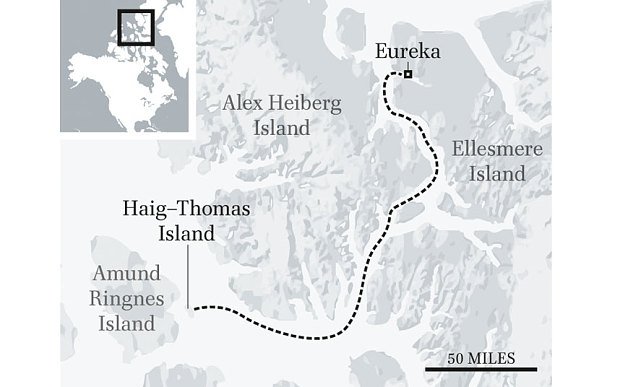
Men recreating the 1938 expedition of explorer David Haig-Thomas have a mid-April 2015 polar bear encounter reminiscent of two recent polar bear attacks (Labrador, 2013, Svalbard, 2011) but with a happier ending.

Haig-Thomas expedition map_Telegraph_April 18 2015

Continue reading

Arctic sea ice extent total for March does not equal global polar bear habitat

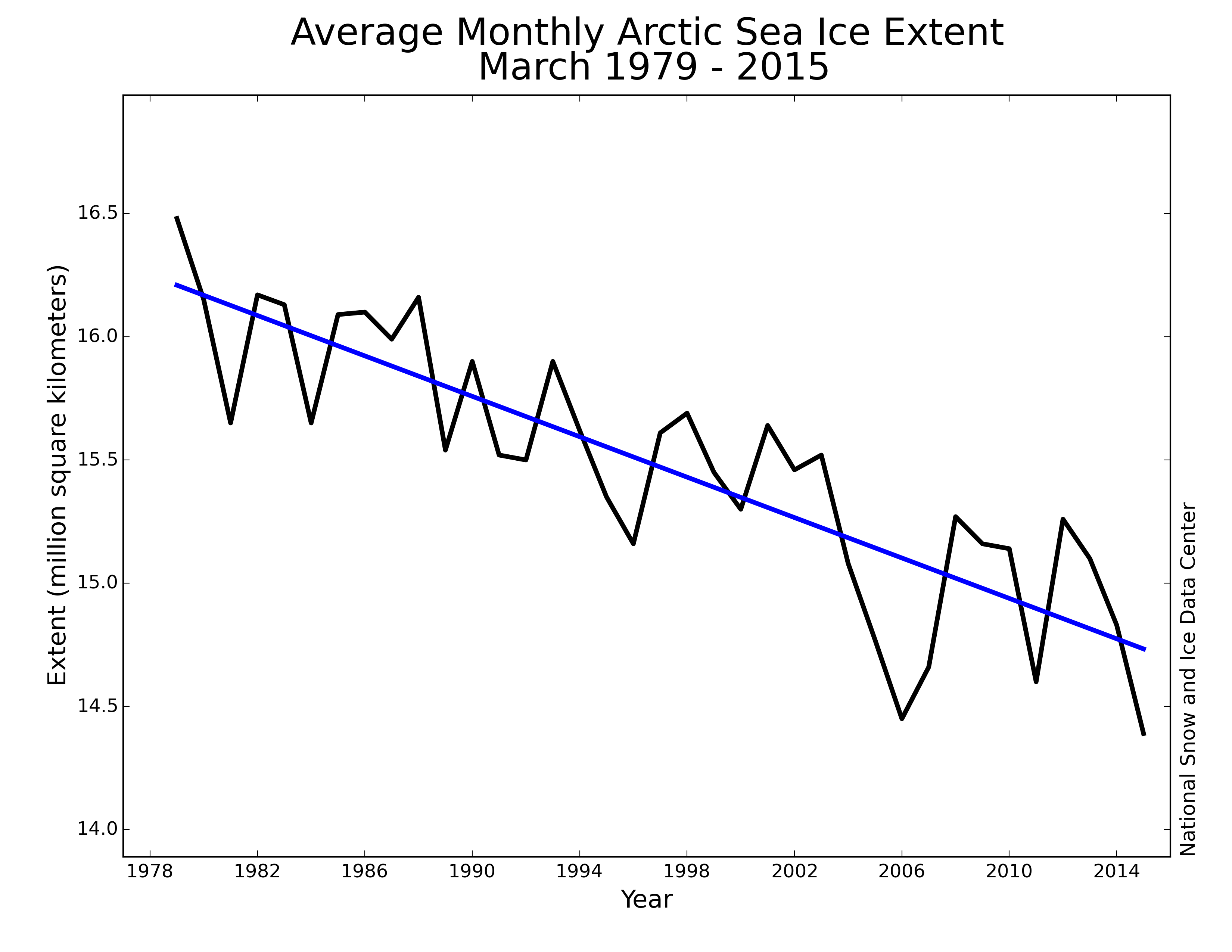
Only half or less of the estimated 2.6% loss per decade of March sea ice extent since 1979 (Fig. 1, below) represents a decline in polar habitat. That’s because several regions with sea ice that are not home to polar bears, like the Sea of Okhotsk, are included in Arctic sea ice totals.

Figure 1. Average monthly Arctic sea ice extent for March 1979-2015, which includes ice in the Sea of Okhotsk and the Sea of Japan, a decline of 2.6% per decade. NSIDC, March summary 2015.

Figure 1. Average monthly Arctic sea ice extent for March 1979-2015 (which includes ice in the Sea of Okhotsk, the Sea of Japan, and the Baltic, where polar bears do not live), shows a decline of 2.6% per decade. NSIDC, March summary 2015.

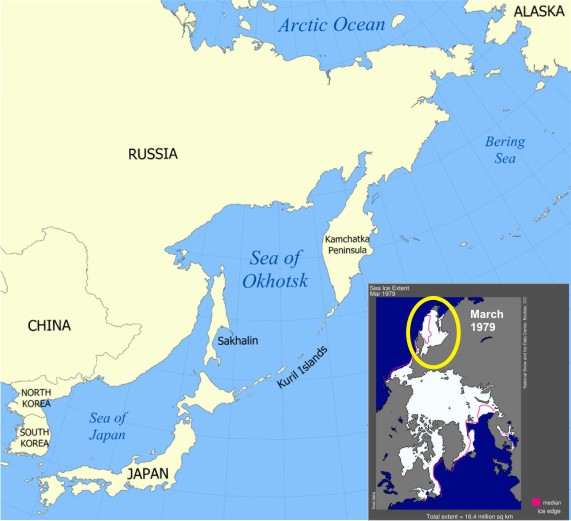
Both the Sea of Okhotsk and northern Sea of Japan (Fig. 2) have sea ice in winter (which is included in total Arctic sea ice records) but they are not truly “Arctic” – neither is connected to the Arctic by continuous ice, even when the ice is at its maximum extent (nor is the Baltic Sea — in contrast to Hudson Bay and the east coast of North America, which are connected to the Arctic by continuous ice).

Sea of Okhotsk_1979 March marked_PolarBearScience

Figure 2. Location of the Sea of Okhotsk and Sea of Japan. Insert ice map for March 1979 from NSIDC shows it’s position relative to the Arctic proper.

That lack of connection to Arctic pack ice is probably the main reason that polar bears never colonized the Sea of Okhotsk, even though western Arctic seal species (ringed, bearded, spotted, and ribbon) and Arctic whales  (bowhead and beluga) live there. Polar bears don’t currently live in the Sea of Okhotsk and all evidence suggests they never have.

Sea ice maps show that about half of the total ice extent difference between March 1979 and March 2015 was due to a relatively large decline in sea ice cover for Sea of Okhotsk and northern Sea of Japan — regions without polar bears. Surely no reputable scientist or journalist would suggest that the “record low” maximum ice extent for 2015 has any relevance for polar bear health and survival? [or for Northwest Passage travel, for that matter] Sadly, they would.

Continue reading

Polar bear consumption of terrestrial foods – new paper misses the point

A new paper by polar bear biologists (Rode et al. 2015) argues that terrestrial (land-based) foods are not important to polar bears now and will not be in the future – a conclusion I totally agree with – but they miss the point entirely regarding the importance of this issue.

Fat bears on land in the Southern Beaufort, Sue Miller photo, well-prepared for a brief summer fast.

Whatever food polar bears consume in the summer – whether they are on land or on the ice – doesn’t really matter. What matters is how many fat-rich seals they can consume between March and June each year. The fat put on in late winter/spring from gorging on baby seals carries polar bears over the summer, no matter where they spend it.

USGS polar bear biologist Karyn Rode and colleagues (press release here) have tried to frame this issue as one about future survival of polar bears in the face of declining sea ice. However, the fact that polar bears in the Chukchi Sea and Southern Davis Strait are thriving despite dramatic declines in summer sea ice (aka an extended open-water season), proves my point and disproves their premise. Bears in these regions are doing extremely well – contrary to all predictions – because they have had abundant baby seals to eat during the spring (see here and here).

Continue reading

Polar bears out on the sea ice eat few seals in summer and early fall

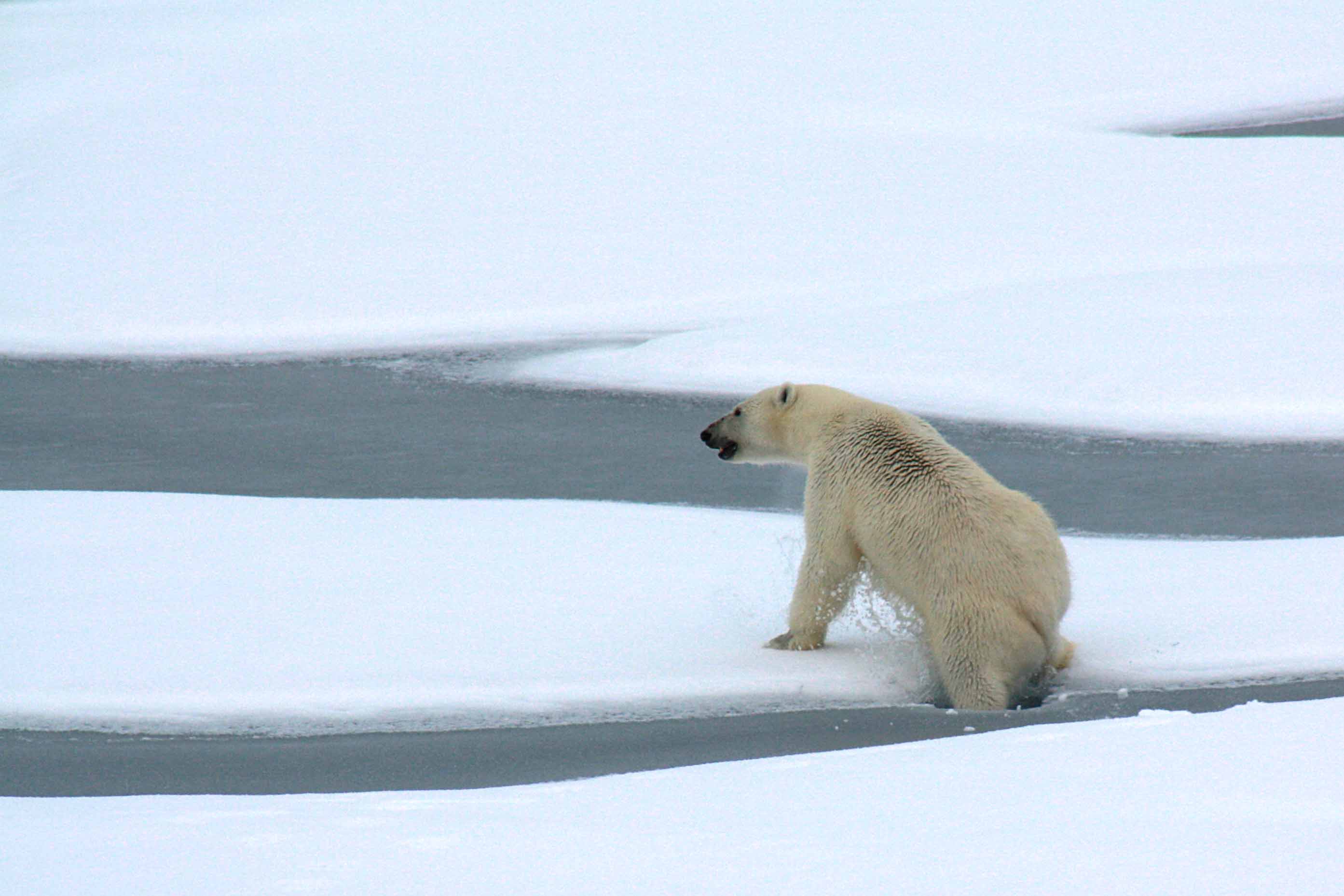
We hear endlessly about the polar bears ‘forced’ to go without food for months because of receding summer sea ice — what about all the bears that stay out on the ice over the summer? Presumably, those bears keep hunting for seals – but how many do they actually catch?

Polar Bear Breaks Ice

[Update 9 February 2015: Just to be clear, this post is based on the facts available in the peer reviewed literature — if you think I have missed something, let me know via the “Contact us” page above]
Continue reading

Challenging NOAA’s “Arctic Report Card 2014” on polar bears

NOAA’s list of purported evidence for harm being caused to polar bears by Arctic warming is short and weak. It puts the gloomiest spin possible on the current well-being of an animal with all the earmarks of a healthy, well-distributed species.

Arctic report card 2014 screencap_Dec 18 2014

This year, polar bears are virtually the only species that NOAA mentions in their Arctic Report Card – they’ve put all their icon-eggs in one leaky basket [what happened to walrus??]. But polar bears are doing so well that to make an alarming case for polar bears as victims of Arctic warming, many important caveats had to be left out or misrepresented. Some details given are simply wrong.

This year’s polar bear chapter was penned by IUCN Polar Bear Specialist Group chairman Dag Vongraven (you might recall his email to me earlier this year) and a polar bear conservation activist from Polar Bears International (whose battle cry for donations is Save Our Sea Ice!”), Geoff York.

I challenge their four weak talking points one by one below.

Continue reading

Polar bear habitat update: regional differences, melting vs. freezing

The freeze is on: from an annual low of ~5.1 m sq km at 15 September 2014, the sea ice that provides a hunting platform for polar bears is rapidly reforming.

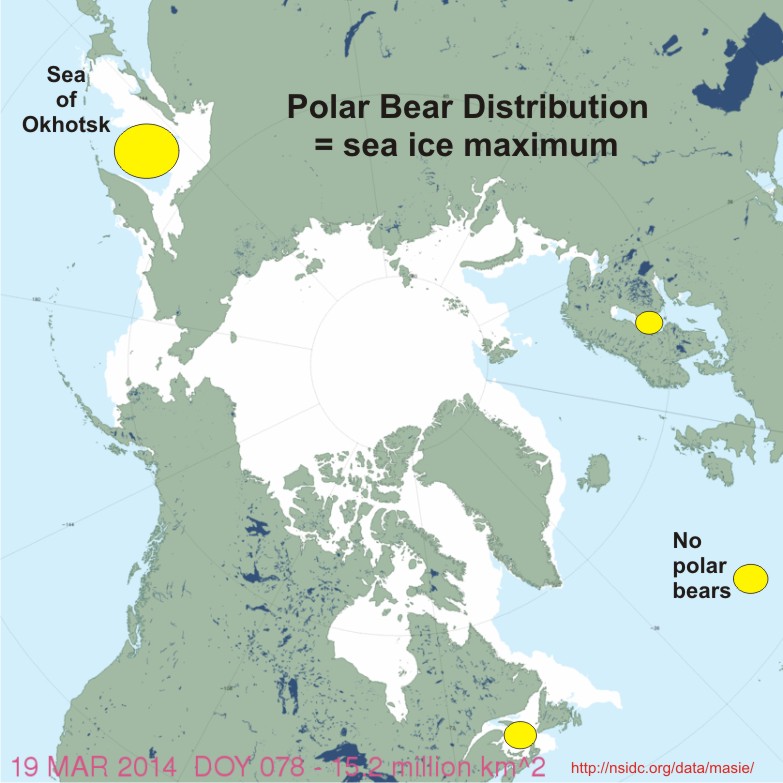
Note that polar bear habitat world-wide is pretty well defined by the extent of sea ice in spring, with three notable exceptions. There are no polar bears (or fossil evidence of polar bears), in the Sea of Okhotsk, the Gulf of St. Lawrence, or the Baltic Sea.

Bears in some areas spend time on land in late summer/early fall but the amount of time varies widely.

Polar bear distribution and ice extent_PolarBearScience
Have a look at the maps below: the difference in regional coverage between the sea ice at 4 August and 16 October (73 days apart, both covering 7.3 mkm2) might surprise you.
Continue reading

Up to 20% of collared polar bears located on ice that officially does not exist, says the PBSG

Here are two more priceless quotes from the minutes of the last meeting of the IUCN Polar Bear Specialist Group (PBSG) – on issues with sea ice percentages used to define “ice-free” and the problem of bears with collars showing up on sea ice that, according to ice data, does not exist. These quotes are in addition to the ones I posted earlier this week (here and here).

Polar bear with collar and tag_USGS_labeled

See the original document for the context here.
Continue reading