Tag Archives: thick spring ice

Arctic National Wildlife Refuge in Alaska won’t protect polar bears from thick spring ice

And the proposed coastal refuge won’t protect the denning areas of the majority of Southern Beaufort Sea polar bears, because most females den out on the sea ice, not on land.

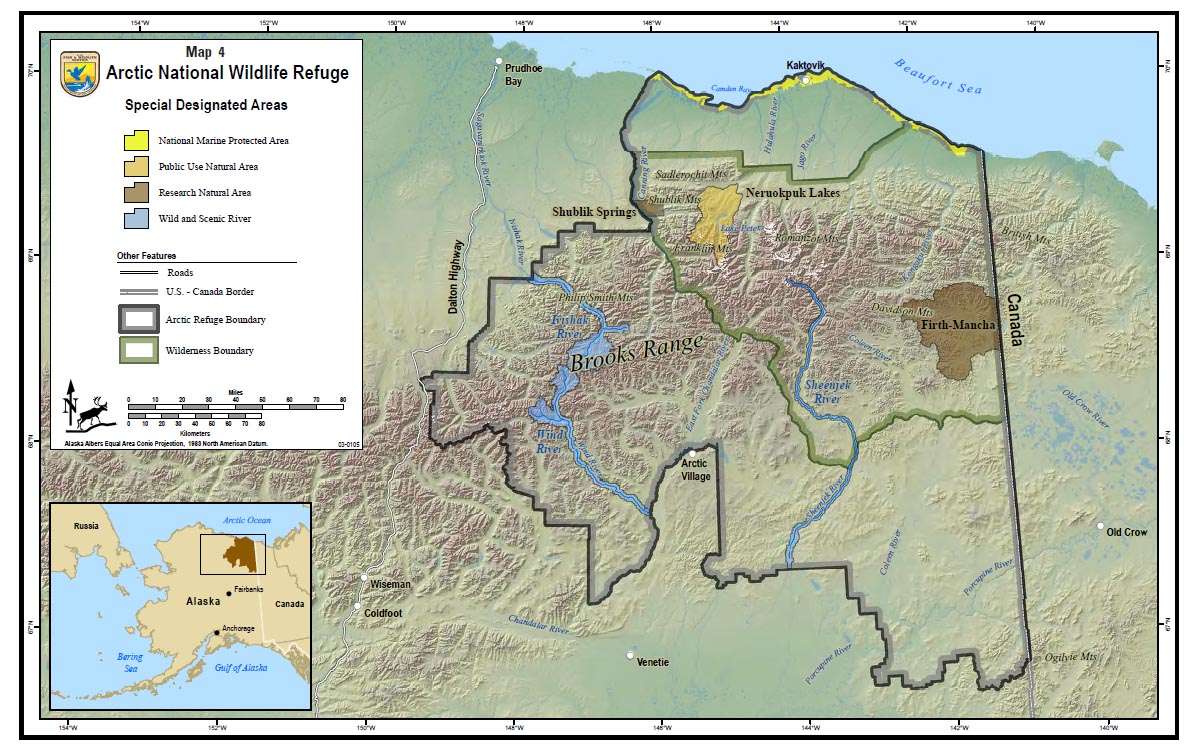
Arctic Nat Wildlife Refuge proposed_USFWS_map 4 designated areas

The folks at Polar Bears International (PBI) are crowing with delight at the announcement today that US President Obama has recommended that congress approve plans to implement a proposed an Arctic wildlife refuge area that would include the Arctic coastal plain [see links below, including Obama video].

And in doing so, they mislead the public about how many polar bears use this region of coastal Alaska — as do the US Fish and Wildlife Service on their Refuge website.
Continue reading

Challenging NOAA’s “Arctic Report Card 2014” on polar bears

NOAA’s list of purported evidence for harm being caused to polar bears by Arctic warming is short and weak. It puts the gloomiest spin possible on the current well-being of an animal with all the earmarks of a healthy, well-distributed species.

Arctic report card 2014 screencap_Dec 18 2014

This year, polar bears are virtually the only species that NOAA mentions in their Arctic Report Card – they’ve put all their icon-eggs in one leaky basket [what happened to walrus??]. But polar bears are doing so well that to make an alarming case for polar bears as victims of Arctic warming, many important caveats had to be left out or misrepresented. Some details given are simply wrong.

This year’s polar bear chapter was penned by IUCN Polar Bear Specialist Group chairman Dag Vongraven (you might recall his email to me earlier this year) and a polar bear conservation activist from Polar Bears International (whose battle cry for donations is Save Our Sea Ice!”), Geoff York.

I challenge their four weak talking points one by one below.

Continue reading

Polar bear researchers knew S Beaufort population continued to increase up to 2012

Why did the Southern Beaufort polar bear population survey stop in 2010? It’s clear that the recently-published and widely-hyped new study stopped before the population rebound from a known decline was complete.

USFWS 2013-2014 PB News_cover_PolarBearScience

The researchers of the recently-published paper knew before starting their mark-recapture study in 2007 that the population decline had taken place. They also knew why the numbers dropped and that previous declines, caused by similar conditions, had been followed by a full recovery.

Did they really think a full recovery in population numbers was possible in only three four years, when cubs born in 2007 would not yet have been old enough to reproduce?

In fact, a US Fish and Wildlife Service (USFWS) fall survey of Southern Beaufort polar bears in 2012 found numbers were higher than they had been in a decade.
Continue reading

S Beaufort polar bears largely recovered from known 2004-2006 decline, says new study

A bit more good news about polar bear populations, this time from an abundance study in the Southern Beaufort Sea. A paper released yesterday showed a 25-50% decline in population size took place between 2004 and 2006 (larger than previously calculated). However, by 2010 the population had rebounded substantially (although not to previous levels).

All the media headlines (e.g. The Guardian) have followed the press release lead and focused on the extent of the decline. However, it’s the recovery portion of the study that’s the real news, as it’s based on new data. Such a recovery is similar to one documented in the late 1970s after a significant decline occurred in 1974-1976 that was caused by thick spring ice conditions.
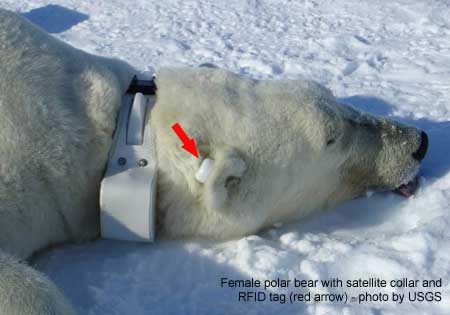
Polar bear with collar and tag_USGS_labeled

The title of the new paper by Jeffery Bromaghin and a string of polar bear biologists and modeling specialists (including all the big guns: Stirling, Derocher, Regehr, and Amstrup) is “Polar bear population dynamics in the southern Beaufort Sea during a period of sea ice decline.” However, the study did not find any correlation of population decline with ice conditions. They did not find any correlation with ice conditions because they did not include spring ice thickness in their models – they only considered summer ice conditions.

I find this very odd, since previous instances of this phenomenon, which have occurred every 10 years or so since the 1960s, have all been associated with thick spring ice conditions (the 1974-76 and 2004-2006 events were the worst). [Another incident may have occurred this spring (April 2014) but has not been confirmed].

Whoever wrote the press release for this paper tried hard to suggest the cause of the 2004-2006 event might have been “thin” winter ice caused by global warming that was later deformed into thick spring ice, an absurd excuse that has been tried before (discussed here). If so, what caused the 1974-1976 event?

It seems rather unscientific as well as implausible to even try to blame this recent phenomenon on global warming. However, neither the authors of the paper or the press release writers seemed to want to admit that 2-3 years of thick ice development in the Southern Beaufort could have been the cause of the population decline in 2004 (as for all of the previous events). No, that wouldn’t do, not in the age of global warming.

So, we are left with this equally absurd conclusion from the author:

The low survival may have been caused by a combination of factors that could be difficult to unravel,” said Bromaghin, “and why survival improved at the end of the study is unknown.

I’ve summarized the paper to the best of my understanding (there was a lot of model-speak to wade through), leaving out the prophesies of extinction, which in my opinion don’t add anything.

UPDATE November 19, 2014: Don’t miss my follow-up post, with some startling new information, Polar bear researchers knew S. Beaufort population continued to increase up to 2012
Continue reading

My interview with CNS News: “Alaskan Polar Bears Threatened…By Too Much Spring Ice”

Not bad, as these things go, but the reporter made one error that needs correcting – so I’m doing it here to set the record straight, just in case it does not get taken care of in the original story.

CNS News reporter Barbara Hollingsworth had seen my post last week, “Current ice conditions don’t bode well for Beaufort Sea polar bears” and wanted to talk to me about it. It was a little rushed, but I agreed.

This is how it turned out, with the error corrected and an updated ice thickness map.
Continue reading

Current ice conditions don’t bode well for Beaufort Sea polar bears

Thick spring ice along the shore of the Eastern and Southern Beaufort is bad news for polar bears, especially females emerging from their dens with new cubs. Are those conditions developing now?

Beaufort Sea pressure ridges_Spring 1949 wikipedia sm

Every 10 years or so, since at least the 1960s, nearshore ice gets too thick for ringed seals to maintain their breathing holes and many breeding seals depart the area. This leaves a lot of polar bears without the baby seals they need to consume to get them through the rest of the year (that’s if they don’t (or can’t) leave themselves).

I’ve discussed various aspects of this phenomenon before, with references – see the list at the end of this post.

Sadly, we are on schedule for such conditions to recur – could be this year, could be next. The last time of heavy spring ice was 2004 and previous heavy ice conditions occurred the springs of 1964, 1974 (the worst), 1984, 1992 and 2004. The 2004-2006 event was reportedly almost as bad as the 1974-1976 event.

So, prompted by reports of the heaviest sea ice conditions on the East Coast “in decades” and news that ice on the Great Lakes is, for mid-April, the worst it’s been since records began, I took a close look at ice thickness charts for the Arctic. I’m not suggesting these conditions are necessarily related to Beaufort ice, just that they got me thinking.

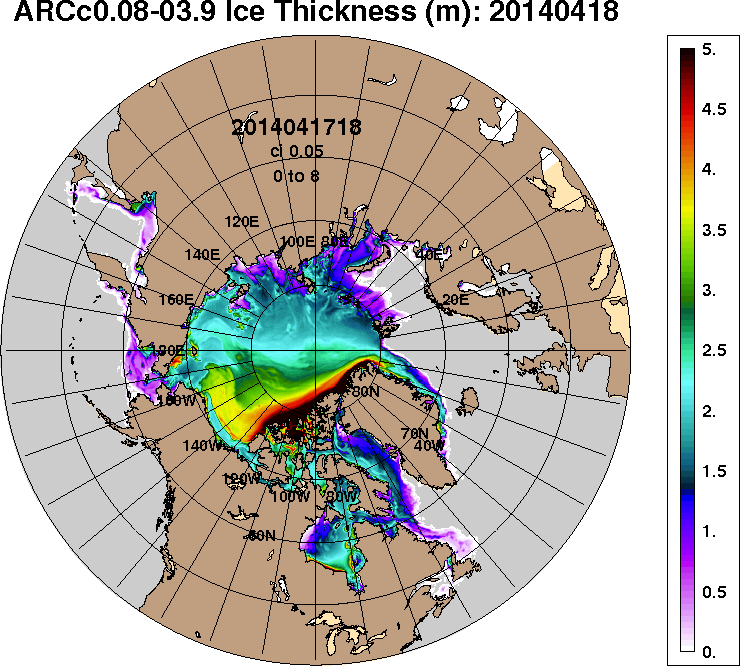
Here’s a screencap of the US Navy ice thickness animation chart for yesterday [from WUWT Sea Ice Page]

Figure 1. Arctic Sea Ice Thickness (NRL), for April 18, 2014. Look at thick ice (yellow, 3.5-4.0 meters thick) spreading along the north coast of Alaska. See the 30 day animation here.

Figure 1. Arctic Sea Ice Thickness (NRL), for April 18, 2014. Look at thick ice (yellow, 3.5-4.0 meters thick) spreading along the north coast of Alaska. See the 30 day animation here.

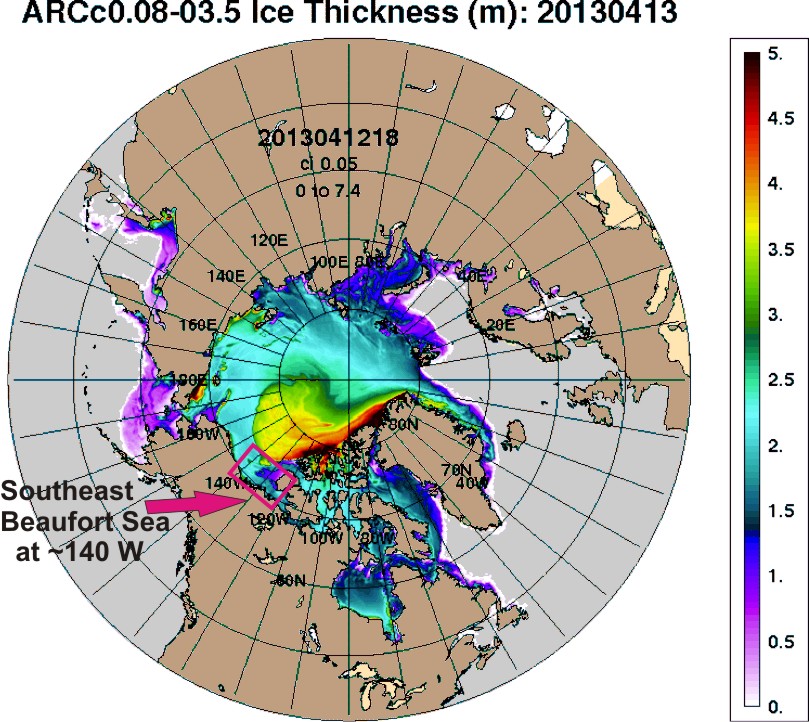
Below is a similar image from about the same time last year, with the Southeast Beaufort Sea marked.

Figure 2. Arctic Sea Ice Thickness (NRL), for April 13, 2013. Southeastern Beaufort marked.

Figure 2. Arctic Sea Ice Thickness (NRL), for April 13, 2013. Southeastern Beaufort marked.

I don’t think this bodes well for Beaufort bears but we’ll have to wait and see if there are any reports of starving bears bit later this spring and summer. Sea ice charts aren’t a guarantee that this heavy spring ice phenomenon is developing in the Beaufort, but they could be a warning.

Below are archived ice age charts from the US National Snow and Ice Data Center (NSIDC) for some previous years when Beaufort bears had trouble, especially 2004-2006, with which I compare this year’s conditions. [h/t Steve Goddard for alerting me to this resource]

Continue reading

Record sea ice loss in 2007 had no effect on polar bears, Chukchi study confirms

One aspect of the recently published study on Chukchi Sea polar bears (Rode et al.2014 [now in print] 2013; see here and here) has not been stressed enough: their finding that the differences in overall condition between bears in the Chukchi and Southern Beaufort Seas came down to disparities in spring feeding opportunities and therefore, the condition of spring sea ice.

The fact that spring — not summer — is the most critical period for polar bears is something I’ve pointed out before (see here and here, for example) but it’s worth repeating at this time of year, when all eyes are on the annual ice minimum. It is often treated as a given that the decline in extent of summer sea ice in the Arctic since 1979 has been detrimental to polar bears. However, this is an assumption that we can now say is not supported by scientific evidence (see summary of that evidence here).

The results published by Rode et al. (2014 2013) not only add further support to the conclusion that declines in summer sea ice have not harmed polar bears, but should put the matter to rest – unless new evidence to the contrary is produced.

Chukchi bears, the report tells us, had more food available in the spring than Southern Beaufort bears (see map below) and this was the primary reason that bears were doing very well in the Chukchi and not quite as well in the Southern Beaufort. And because the polar bears for this study were captured and measured in mid-March to early May, from 2008 to 2011, they reflect spring-time conditions for 2008-2011 as well as year-round conditions from 2007 through 2010.

This means that the annual low ice extent for 2007 (record-breaking at the time), in the fall before this study began, had no discernible negative effect on either Chukchi or Southern Beaufort polar bears – and neither did similarly low annual minimums in two of the three remaining years of the study (Fig 1).

Figure 1. Sea ice extent at August 27, 2007 – the lowest extent that year (downloaded September 15, 2013 from IARC-JAXA, Arctic Sea-ice Monitor). At the time, it was the lowest extent recorded since 1979 (2012 broke that record). This (2007) was the fall before the Rode & Regehr study on Chukchi/Southern Beaufort polar bears began (2008-2011). The ice was almost as low in September 2008 and 2010, while 2009 was more like 2013.

Figure 1. Sea ice extent at August 27, 2007 – the lowest extent that year (downloaded September 15, 2013 from IARC-JAXA, Arctic Sea-ice Monitor). At the time, it was the lowest extent recorded since 1979 (2012 broke that record). This (2007) was the fall before the Rode & Regehr study on Chukchi/Southern Beaufort polar bears began (2008-2011). The ice was almost as low in 2008 and 2010, while 2009 was more like 2013.

Continue reading

Chukchi polar bear status contradicts the “message” – new details

Previously, I summarized preliminary results of polar bear research in the Chukchi Sea undertaken between 2008 and 2011 by US Fish & Wildlife biologist Eric Regehr and US Geological Survey researcher Karyn Rode. At the time, a peer-reviewed paper on this study was promised shortly.

It now appears this paper is indeed on the way. I’m sure of that because a few weeks ago, I came across a conference presentation given by Karyn Rode that is a summary of the upcoming Chukchi research paper. The title of both presentation and ‘in review’ paper is:

“Variation in the response of an Arctic top predator experiencing habitat loss: feeding and reproductive ecology of two polar bear populations.

Rode’s slide presentation (given at the annual Lowell Wakefield Fisheries Symposium at the end of March, in Anchorage, Alaska) was posted online by the symposium organizers. It provides some very interesting details on the status of Chukchi Sea bears compared to bears in the Southern Beaufort, and contains some mighty “inconvenient” conclusions that should raise some eyebrows.

I’ve summarized these details and conclusions below in point form, below the maps.

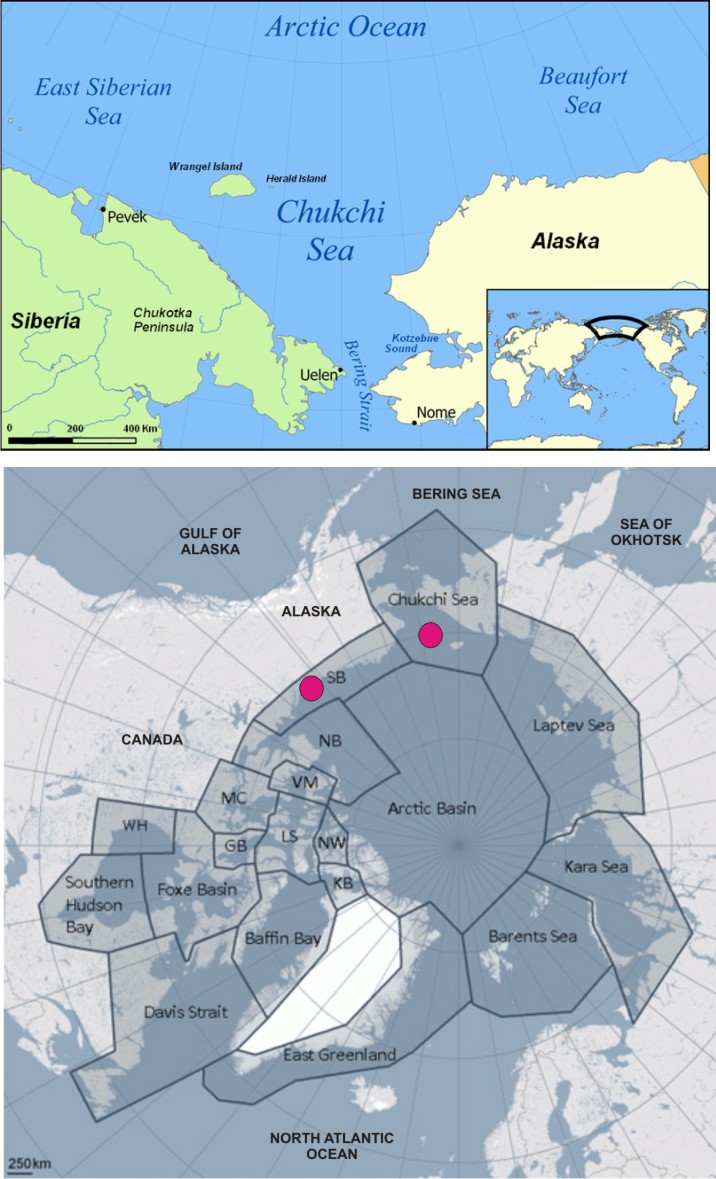
Figure 1. Chukchi and Beaufort Seas (from Wikipedia), upper. ‘Chukchi Sea’ polar bears are shared between the USA and Russia; ‘Southern Beaufort’ bears are shared between the US and Canada, lower (from PBSG, with labels added). Pink dots are the subpopulations featured in the Rode et al. presentation and upcoming paper.

Figure 1. Chukchi and Beaufort Seas (from Wikipedia), upper. ‘Chukchi Sea’ polar bears are shared between the USA and Russia; ‘Southern Beaufort’ bears are shared between the US and Canada, lower (from PBSG, with labels added). Pink dots are the subpopulations featured in the Rode et al. presentation and upcoming paper.

Continue reading

Great polar bear red herring in the Southern Beaufort

Red herring iconWe know that thick-ice springs occurred in 1974, 1975, 1986, 1992, 2004, and 2005 in the former ‘Eastern Beaufort’ – now the southern portion of the ‘Northern Beaufort’ and the eastern portion of the ‘Southern Beaufort.’ We know that these severe spring ice conditions negatively impacted both polar bears and ringed seals in this region every decade since the 1960s because the effects have been documented by numerous studies conducted in April through May for polar bears (Amstrup et al. 2006; Cherry et al. 2009; Pilfold et al. 2012; Stirling 2002; Stirling and Lunn 1997; Stirling et al. 1980; Stirling et al. 1993; Stirling et al. 2008) and in June and July for ringed seals (Harwood et al. 2012; Smith 1987), see previous posts here, here, and here.

For example, even though Ian Stirling and colleagues argued in their 2008 paper that the thick spring ice conditions in 2004, 2005 and 2006 (but not those in previous decades) were caused by storms initiated or intensified by greater amounts of open water in previous summers, they did not deny that the thick-ice springs occurred. They stated quite clearly that:

The 1960s, 1970s, and 1980s each experienced a two- to three-year decline in seal productivity in the eastern Beaufort Sea and Amundsen Gulf, associated with heavy ice conditions, around mid-decade. Each was followed by a decline in polar bear reproduction and condition, after which both seal and bear populations recovered (Smith, 1987; Harwood et al., 2000; Stirling, 2002). The beginning of each of those three periods was associated with heavy ice conditions through the winter before the reproductive decline of the seals, followed by a late spring breakup.” [my bold]

So, I have to say, I was shocked but not surprised to find that in the more recent scientific literature, the phenomenon of thick-ice springs every decade in Southern and Northern Beaufort has been deliberately ‘disappeared.’ 

Not surprised because I suspected it had happened — this issue was a feature of the Stirling and Derocher (2012) paper from late last year which was the topic of my very first blog post, “Cooling the polar bear spin.

However, I think it is important to document how the transmogrification of sea ice effects on polar bears was managed in the scientific literature so that everyone can see exactly what has been done. In a truly astonishing move for what is supposed to be a field of science, thick-ice springs have been effectively replaced by an open-water red herring as the scourge of Southern Beaufort polar bears.

Continue reading

Did polar bear numbers in E. Beaufort fluctuate each decade due to thick ice years?

Now that we have a plausible explanation (previous post here) for why shorefast ice in the Eastern Beaufort got too thick for ringed seals every ten years or so, it’s time to talk about the effect that this recurring sea ice phenomenon might have had on polar bear population numbers.

We know from the reports of polar bear biologists that without fat young seals to eat in the spring, some bears in those thick-ice springs came close to starving and many mothers lost all or most of their cubs (Amstrup et al. 2006; Stirling 2002; Stirling and Lunn 1997; Stirling et al. 1980; Stirling et al. 2008). This presumably had some impact on population numbers – the question is: how bad was it?

None of the reports on the effects of the thick ice have given us any indication of how many polar bears might have died or lost their cubs. However, Ian Stirling and colleagues (Stirling et al. 2011) recently published a paper on the Northern Beaufort subpopulation that looked, at first glance, to have done just that.

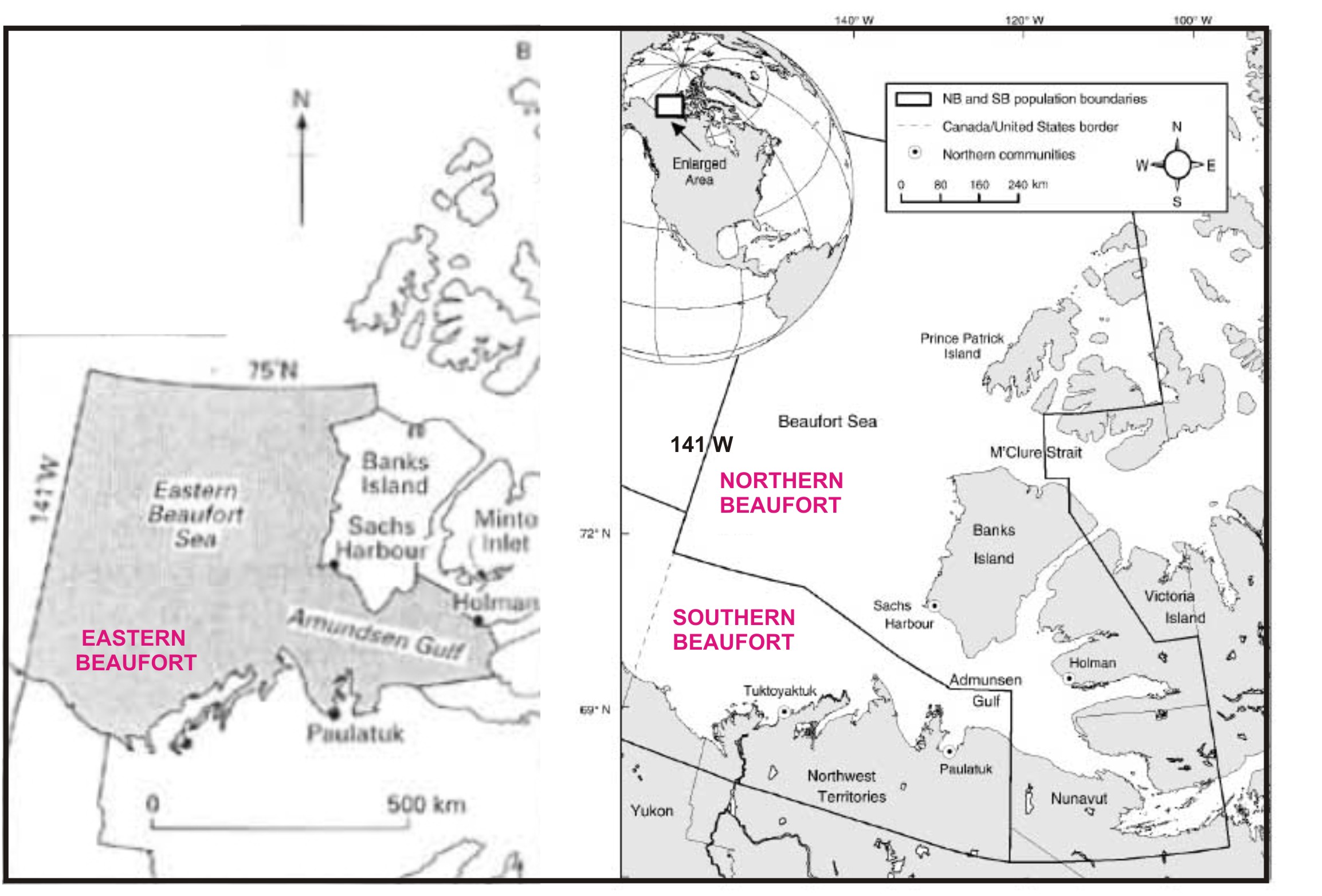
You have to keep in mind that the geographic area in question – the Eastern Beaufort – is not an official polar bear subpopulation region – at least, not any more. As Fig. 1 below shows, the Eastern Beaufort was once its own, strictly Canadian region (or at least, a strictly Canadian research region) see previous post here), but management is now shared between two subpopulations and managed by two governments (Canada and the USA). About half of the bears of the “Eastern Beaufort” reside in the ‘Northern Beaufort’ subpopulation and the other half live in the ‘Southern Beaufort’ subpopulation.

Figure 1. Re-jigging of polar bear subpopulations now splits what used to be an entirely Canadian segment, called the “Eastern Beaufort” (map on the left, from Stirling and Lunn 1997), into “Southern Beaufort” (shared with the USA) and “Northern Beaufort,” with the Canada-USA border at 141 W (map on the right, from Stirling et al. 2011). Labels added for clarity. Most of the polar bears sampled for the Stirling et al. paper were captured along the west and south coasts of Banks Island, although a few were captured north of Banks Island in M’Clure Strait and in Amundsen Gulf to the southeast.

Figure 1. Re-jigging of polar bear subpopulations now splits what used to be an entirely a Canadian research segment, called the “Eastern Beaufort” (map on the left, from Stirling and Lunn 1997), into management regions called “Southern Beaufort” (shared with the USA) and “Northern Beaufort,” with the Canada-USA border at 141 W (map on the right, from Stirling et al. 2011, Fig. 1). Labels added. Most of the polar bears sampled for the Stirling et al. paper were captured along the west and south coasts of Banks Island, although a few were captured in M’Clure Strait and in Amundsen Gulf.

Despite the changing boundaries, ringed seals and polar bears in the Eastern Beaufort have been the focus of research since the early 1970s. In part, this is because the region has been targeted for oil exploration and studies on both species have been part of the associated ecological impact assessments (Stirling et al. 1993).

Getting back to the point, did Stirling et al. 2011 find fluctuations in polar bear numbers in the Northern Beaufort that might reflect the periodic bouts of thick spring ice in the Eastern Beaufort? Unfortunately, no — the data lack necessary precision. You’ll see why, I think, from the summary below.  Continue reading